

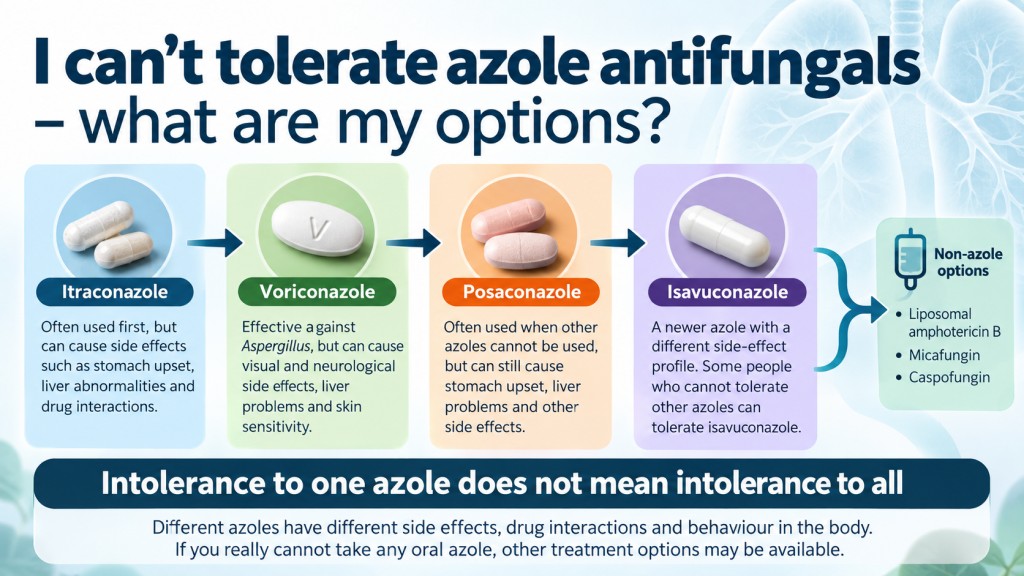
I can’t tolerate azole antifungals – what are my options?
Azole antifungal medicines are among the most important treatments for aspergillosis. They include itraconazole, voriconazole, posaconazole and isavuconazole.
Some people, however, experience significant side effects and eventually say, “I can’t take azoles.”
For a small number of patients this may indeed be the case. But having problems with one azole does not necessarily mean that you will be unable to take another. The different azoles have different side-effect profiles, drug interactions and behaviour in the body.
What does “azole intolerance” mean?
People use the term in several different ways.
It may mean that a medicine caused unpleasant but potentially manageable side effects, such as nausea, headache or fatigue. In other cases there may be a significant medical problem such as liver toxicity, a severe skin reaction, neurological symptoms, heart-related effects or a serious drug interaction.
Occasionally a person has tried several different azoles and developed significant problems with each. These patients can be genuinely difficult to treat and need specialist assessment.
The important question is therefore not simply “Are you intolerant to azoles?”, but:
Which azoles have you taken, what happened with each one, and were drug levels and other possible causes investigated?
The azoles are not identical
The main mould-active oral azoles used in aspergillosis are:
Itraconazole – commonly used as a first treatment, particularly for chronic pulmonary aspergillosis (CPA) and allergic bronchopulmonary aspergillosis (ABPA). Gastrointestinal problems, liver abnormalities, drug interactions and cardiac effects can occur.
Voriconazole – effective against Aspergillus, but can cause visual disturbances, neurological symptoms, liver abnormalities and significant photosensitivity and skin problems, particularly during prolonged treatment.
Posaconazole – often used when itraconazole or voriconazole cannot be used or have failed. It can still cause adverse effects, including gastrointestinal and liver problems.
Isavuconazole – a newer azole with a somewhat different side-effect and drug-interaction profile. Some people who have been unable to tolerate other azoles can tolerate isavuconazole.
For example, research from the National Aspergillosis Centre (NAC) found that some people with CPA who had previously been intolerant of other triazoles were able to tolerate standard-dose isavuconazole.
So a previous bad experience with itraconazole or voriconazole should not automatically be interpreted as meaning that every azole will produce the same reaction.
What does the evidence show?
Azole side effects are common enough to be an important part of long-term aspergillosis care.
- A systematic review of treatments for chronic pulmonary aspergillosis found adverse effects in approximately 25% of itraconazole-treated patients and 36% of voriconazole-treated patients. Treatment discontinuation because of adverse effects was also common in the studies included in the review.
- In a National Aspergillosis Centre comparison, adverse events were reported in 60% of patients taking isavuconazole compared with 86% taking voriconazole.
- Importantly, 25% of patients receiving isavuconazole who had previously been intolerant of other triazoles were able to tolerate standard-dose isavuconazole.
- NAC research has also shown that some patients receiving long-term isavuconazole can maintain satisfactory drug concentrations at a reduced dose, which may help some people continue treatment.
The key point: intolerance of one azole does not reliably predict intolerance of another.
Could the dose be part of the problem?
Sometimes.
People absorb and metabolise azole medicines very differently. Two people taking exactly the same dose can have very different concentrations of the drug in their blood.
This is particularly important with medicines such as itraconazole and voriconazole.
Therapeutic drug monitoring (TDM) measures the amount of antifungal medicine in the blood. It can help establish whether the concentration is:
- too low to be effective;
- within the intended range; or
- high enough to increase the risk of toxicity.
This means that apparent “intolerance” can sometimes be related to excessive drug exposure rather than an absolute inability to take the medicine.
Dose adjustment can occasionally make treatment tolerable.
Research from the National Aspergillosis Centre has also shown that some people receiving long-term isavuconazole maintained satisfactory drug concentrations on a reduced dose and were able to continue treatment.
Dose changes should only be made by the clinical team supervising antifungal treatment.
Drug interactions matter too
Azole antifungals interact with many other medicines because of the way they affect enzymes involved in drug metabolism.
Sometimes symptoms attributed to the antifungal may actually be caused or worsened by an interaction that increases the concentration of the azole or another medicine.
This is particularly important for people taking several medicines.
Before deciding that an azole is intolerable, the clinical team may therefore review:
- other prescription medicines;
- inhaled medicines;
- over-the-counter medicines;
- supplements;
- antifungal blood levels;
- liver function;
- kidney function where relevant; and
- ECG or other monitoring where appropriate.
What if I really cannot tolerate any oral azole?
This does happen.
For people with CPA who cannot take oral triazoles, other antifungal treatments may sometimes be considered. These include intravenous medicines such as liposomal amphotericin B and the echinocandins micafungin or caspofungin.
These treatments are not simple substitutes for an oral azole. They usually require intravenous administration and have their own limitations and potential toxicities. Amphotericin B, for example, requires careful monitoring because of potential effects including kidney toxicity.
The appropriate alternative also depends greatly on which form of aspergillosis is being treated. Treatment decisions for CPA, ABPA and invasive aspergillosis are not interchangeable.
“Allergic to azoles” is not necessarily the same as “intolerant”
It is useful to distinguish a true drug allergy or hypersensitivity reaction from other adverse effects.
Someone who experienced nausea on itraconazole, for example, has a very different clinical problem from someone who experienced a serious hypersensitivity reaction.
If you have previously been told that you are “allergic to azoles”, your specialist team may want to establish exactly which medicine caused the reaction and what happened before deciding whether another azole can safely be considered.
Questions worth asking your specialist team
If azole treatment has been difficult, useful questions include:
- Which azoles have I actually tried?
- What side effects did each one cause?
- Were my antifungal blood levels measured?
- Could the dose have been too high?
- Could another medicine have interacted with the antifungal?
- Have my liver tests or ECG shown evidence of toxicity?
- Would another azole have a sufficiently different side-effect profile to consider?
- Is isavuconazole appropriate in my situation?
- If I genuinely cannot take oral azoles, what non-azole treatments are available for my particular type of aspergillosis?
The important message
Do not stop an antifungal medicine or alter the dose without discussing it with your clinical team.
But equally, persistent or serious side effects should not simply be endured.
Some patients genuinely cannot tolerate long-term azole treatment. However, intolerance to one azole does not automatically mean intolerance to all azoles. Careful review of the reaction, antifungal blood levels, other medicines and alternative azoles can sometimes identify a treatment that is both effective and tolerable.
For patients who truly cannot take any oral azole, specialist antifungal services can consider other approaches depending on the type and severity of aspergillosis.
Further reading and evidence
- Systematic review of antifungal treatment for chronic pulmonary aspergillosis
- National Aspergillosis Centre: isavuconazole compared with voriconazole in chronic pulmonary aspergillosis
- National Aspergillosis Centre: therapeutic drug monitoring during long-term isavuconazole treatment
- Chronic pulmonary aspergillosis – treatment approaches and management
- IDSA Clinical Practice Guideline for the Diagnosis and Management of Aspergillosis
This information is intended to help people understand treatment options and should not replace individual advice from an aspergillosis specialist or other healthcare professional.

Weekly Aspergillosis Research Update – 5 October 2026
This week’s research includes a large real-world study of treatments for ABPA in people with cystic fibrosis, early research into why some people with ABPA may respond differently to biologic treatments, and the start of an important Cochrane review examining antifungal treatment in asthma associated with fungal sensitisation.
Steroids or antifungals for ABPA in cystic fibrosis?
A large real-world study published in CHEST examined treatment of allergic bronchopulmonary aspergillosis (ABPA) in 3,096 people with cystic fibrosis who had received their first ABPA diagnosis between 2006 and 2022.
Researchers compared people initially treated with oral corticosteroids, antifungal drugs, or a combination of the two.
Oral corticosteroid treatment was associated with an improvement in the rate of change in lung function after treatment began. However, adding an antifungal was not associated with significantly better lung function, fewer pulmonary exacerbations or a longer time before ABPA relapse compared with corticosteroids alone.
Why does this matter?
Antifungal drugs such as itraconazole and voriconazole are frequently used in ABPA because reducing Aspergillus in the airways may reduce the stimulus driving inflammation. They can also sometimes reduce the amount of corticosteroid treatment required.
This study suggests that, at a population level in people with cystic fibrosis-associated ABPA, routinely adding an antifungal to corticosteroid treatment may not improve the major respiratory outcomes measured.
However, this was an observational study rather than a randomised clinical trial. Treatment was chosen by clinicians, and people receiving antifungals may have differed from those receiving corticosteroids alone. The results also apply specifically to people with cystic fibrosis and should not automatically be extrapolated to ABPA associated with asthma.
Current international ABPA guidelines recognise both systemic corticosteroids and azole antifungals as treatments for acute ABPA, with treatment tailored to the individual patient.
Read the paper:
Walsh J, Hsu JY, Tully E, Hong G. Comparing the real-world effectiveness of oral corticosteroids and antifungals for the treatment of allergic bronchopulmonary aspergillosis in cystic fibrosis. CHEST. 2026.
https://doi.org/10.1016/j.chest.2026.09.085
Can we predict which people with ABPA will respond to biologic treatment?
Biologic medicines are increasingly being used for people with difficult-to-control or treatment-dependent ABPA.
A new retrospective study investigated people with ABPA receiving omalizumab, a biologic that targets IgE. The researchers looked for clinical characteristics and blood biomarkers associated with failure to respond to omalizumab and explored whether these might help identify people who could benefit from switching to mepolizumab, which targets IL-5 and therefore a different part of the allergic inflammatory pathway.
Why does this matter?
ABPA does not appear to be driven by exactly the same inflammatory mechanisms in every patient.
Omalizumab has the greatest accumulated experience among biologics used for ABPA, but some patients do not respond adequately. Mepolizumab, benralizumab, dupilumab and tezepelumab have also been used, particularly in treatment-dependent disease.
If biomarkers can eventually identify which inflammatory pathway is dominant in an individual patient, they could help clinicians choose the most appropriate biologic rather than relying largely on trial and response.
This study therefore points towards a more personalised approach to biologic treatment of ABPA.
There is an important limitation: this is a retrospective study currently published as a preprint, so its findings have not yet undergone full peer review and should be regarded as preliminary.
Read the preprint:
Wang H, Chen Y, Jing X, Zhang Y, Huang K. Predictors of Omalizumab non-response in ABPA and exploratory biomarkers for switching to mepolizumab: A retrospective cohort study. Research Square. 2026.
https://doi.org/10.21203/rs.3.rs-10727692/v1
Cochrane begins major review of antifungal treatment for fungal-associated asthma
A new Cochrane publication will examine an important and long-running question: do systemic azole antifungals improve outcomes when added to standard treatment for people with asthma and evidence of fungal sensitisation?
The planned review will include people with conditions such as severe asthma with fungal sensitisation (SAFS) and allergic bronchopulmonary aspergillosis/allergic bronchopulmonary mycosis (ABPA/ABPM).
Previous studies have produced mixed results. Some studies of itraconazole have reported improvements in people with severe asthma and fungal sensitisation, while trials of other azoles have not consistently demonstrated benefit.
Why does this matter?
Fungal sensitisation is relatively common in difficult asthma, but sensitisation does not necessarily mean that fungal growth in the airways is contributing sufficiently to disease to make antifungal treatment worthwhile.
Azoles can also cause side effects and have important interactions with other medicines, so identifying the patients most likely to benefit is important.
Cochrane reviews systematically assess all eligible clinical trials using predefined methods and are influential in evidence-based medicine and clinical guidelines.
Importantly, the publication this week is the protocol for the review, not the completed review. It therefore contains no new conclusion about whether azoles are effective. Instead, it shows that this question is now being subjected to a formal systematic assessment.
We will watch for the completed review.
Read the Cochrane protocol:
Fukuda Y, Homma T, Miyamoto Y, Watanabe N. Systemic azoles for asthma with fungal sensitisation. Cochrane Database of Systematic Reviews. 2026;9:CD016394.
https://doi.org/10.1002/14651858.CD016394
Research to watch: understanding azole resistance
Laboratory research continues to reveal that the way azole antifungals affect Aspergillus fumigatus is more complicated than simply blocking production of ergosterol, an essential component of the fungal cell membrane.
Particular attention is being paid to Hmg1, an enzyme involved in the pathway used by the fungus to manufacture ergosterol. Mutations affecting the sterol-sensing region of Hmg1 have previously been identified in azole-resistant clinical isolates of A. fumigatus.
Previous research has shown that azole exposure triggers a feedback system involving Hmg1 and another regulatory protein, InsA. Disruption of this system can reduce susceptibility to azole antifungals.
New preprint research published this week investigates Hmg1 regulation under triazole stress further.
This is basic laboratory research rather than something that changes treatment today, but understanding these additional resistance mechanisms may eventually help researchers develop better antifungal drugs and improve detection of azole resistance.
Because the new work is currently available only as a preprint, its findings should be regarded as preliminary.
Background research:
Rybak JM, Xie J, Martín-Vicente A, et al. A secondary mechanism of action for triazole antifungals in Aspergillus fumigatus mediated by hmg1. Nature Communications. 2024;15.
https://doi.org/10.1038/s41467-024-48029-2
What have we learned this week?
The strongest clinical evidence this week comes from the large cystic-fibrosis study. It provides useful real-world evidence that adding antifungal treatment to corticosteroids does not necessarily produce better outcomes for every person with ABPA.
At the same time, emerging work on biologics illustrates how ABPA treatment may increasingly move in the opposite direction to a “one treatment fits all” approach — towards identifying the particular inflammatory mechanisms operating in an individual patient.
Finally, the new Cochrane protocol highlights an important unresolved question: exactly which patients with fungal-associated asthma benefit from antifungal treatment?
Together, these studies reinforce a recurring theme in aspergillosis research: the presence of Aspergillus, fungal sensitisation and allergic inflammation are related, but they are not interchangeable — and treatment increasingly needs to reflect those differences.
```

Thursday Sessions: Brain Fog, Fatigue, Anxiety and the Value of Health Diaries
Our Thursday patient discussion on 1 October 2026 covered several subjects raised by people attending the session, including brain fog and fatigue, food intolerance, heart palpitations and anxiety.
One subject generated particularly strong discussion: keeping a health diary. Four of the five people taking part described keeping quite detailed records of their health, using methods including calendars, colour coding and notebooks.
As always, these Thursday Sessions are informal discussions between people living with aspergillosis. They give patients an opportunity to compare experiences and raise subjects that matter to them. The comments below should not be interpreted as medical advice, but we have added some background information where it may be helpful.
Brain fog and fatigue
Brain fog and fatigue were among the symptoms discussed during the session, including the experience of these symptoms while taking systemic corticosteroids such as methylprednisolone.
People living with aspergillosis can find fatigue particularly difficult because there may be several possible contributors. The underlying lung condition, infection, poor sleep, medicines, corticosteroid treatment and recovery from an exacerbation can all potentially play a part.
One of the difficulties is therefore working out whether a change represents the illness itself, treatment, or something unrelated.
People also discussed how long recovery can take following a flare. Even when the most obvious symptoms have improved, energy levels and the ability to work or carry out normal activities may take considerably longer to return.
Food intolerance
Food intolerance and the possibility that particular foods might make symptoms worse also came up during the discussion.
When symptoms naturally fluctuate from day to day, it can be difficult to know whether a particular food really caused a change or whether the two things simply happened at the same time.
Looking for a repeated pattern can be more useful than drawing conclusions from a single episode. This is one situation where keeping a record may help.
However, repeatedly removing foods from the diet without good evidence can result in an unnecessarily restricted diet. Significant or persistent suspected food intolerance is worth discussing with an appropriate healthcare professional.
Heart palpitations
Heart palpitations were another symptom mentioned during the session.
There are many possible causes of palpitations, including medicines, infection, dehydration, anxiety and heart rhythm problems. They should therefore not automatically be attributed to aspergillosis.
New, persistent or concerning palpitations should be discussed with a healthcare professional, particularly if they occur with symptoms such as chest pain, fainting or significant breathlessness.
Anxiety and calming techniques
Anxiety was another important part of the conversation.
Living with a fluctuating chronic illness can create considerable uncertainty. A new symptom, a change in breathing or waiting to see whether treatment is working can understandably cause anxiety.
People attending the session were interested in simple calming and relaxation techniques that might help when anxiety becomes overwhelming. We will return to this subject in a future session and provide some practical resources.
Relaxation techniques can help reduce the physical response to anxiety, but they should not be used to dismiss or ignore a new symptom that needs medical assessment.
Health diaries – strong support from the group
One of the most interesting parts of the 1 October discussion was how many people were already keeping detailed records of their health.
Four of the five people taking part described using some form of detailed health diary.
These were not necessarily simple lists of symptoms. People described using daily records, calendars, colour coding and an A5 notebook to keep track of what had happened and when.
Several participants clearly regarded these records as an important way of understanding their health over time.
Are health diaries actually worth the effort?
The discussion prompted us to look at what research tells us about health diaries.
There is good reason to record important changes when they happen. Human memory is not particularly good at reconstructing fluctuating symptoms over several weeks or months, and contemporary recording can make patterns easier to identify.
Research in respiratory diseases such as asthma and COPD has shown that symptom diaries can detect changes over time and may show deterioration around an exacerbation.
However, the evidence does not show that everyone with a chronic respiratory condition benefits from completing a detailed diary every day.
Daily recording can also become burdensome, and adherence tends to fall when people are asked to record large amounts of information for long periods.
The experience of our Thursday group therefore suggests a useful middle ground:
A health diary may be most valuable when it helps answer a question – what changed, when did it change, what else happened at the same time, and did it get better again?
Why might this be particularly useful in aspergillosis?
Aspergillosis can involve several things changing at once.
Someone might experience increased breathlessness or fatigue, develop different sputum, start antibiotics, change a steroid dose, alter an antifungal treatment and then gradually recover.
Several weeks later, remembering the exact sequence can be difficult.
A simple record might show:
Sputum changed on Monday → breathlessness increased Tuesday → antibiotics started Wednesday → temperature settled Friday → fatigue took another ten days to improve.
Similarly, a diary might help establish whether a new symptom repeatedly appears following a change in medication, or whether good and bad periods follow a recognisable pattern.
You don't have to record everything
The discussion showed that some patients find quite detailed recording extremely useful. That does not mean everyone needs to do the same.
For someone wanting to try a simpler approach, it may be enough to record:
- whether it was a good, average or bad day;
- anything important that changed;
- significant changes in cough, sputum, breathlessness, fatigue or other symptoms;
- starting, stopping or changing a medicine;
- an infection, exacerbation or hospital visit; and
- anything else that may help explain the change.
Before a clinic appointment, the diary can then be used to identify the important patterns rather than presenting months of individual daily entries.
Don't let monitoring become another burden
There is also a potential downside to tracking health too closely.
For some people, repeatedly checking every symptom can increase anxiety or make illness occupy even more of everyday life.
If keeping a diary becomes stressful, takes substantial time or produces information that is never useful, simplifying it – or stopping – may be entirely reasonable.
A health diary should work for you; you should not feel that you have to work for the diary.
What we took from this week's discussion
The 1 October Thursday Session ranged across brain fog, fatigue, food intolerance, palpitations and anxiety. But one of the clearest messages came from the patients themselves.
Four out of five people taking part had developed their own detailed way of recording changes in their health.
The research does not tell us that everybody with aspergillosis should keep a daily diary. What the discussion highlighted, however, is how valuable some people with a complicated, fluctuating illness find having a record that helps them make sense of what has happened between appointments.
Further reading
- NICE evidence review: monitoring asthma control
- Daily symptom diaries and exacerbations in COPD
- Self-monitoring and self-management in chronic disease
Thursday Sessions are informal patient discussions organised by the National Aspergillosis Centre CARES team. Experiences shared during the meetings are personal experiences and should not be taken as medical advice. New or worsening symptoms should be discussed with an appropriate healthcare professional.
Developments in Biologic and Inhaled Antifungal medications for ABPA
Updated October 2026
Treatment for allergic bronchopulmonary aspergillosis (ABPA) is changing. Oral corticosteroids and oral antifungal drugs remain important treatments, but newer approaches aim to control the allergic inflammation caused by Aspergillus while reducing the problems associated with repeated or long-term steroid and antifungal treatment.
Two areas are attracting particular interest: biologic medicines, which target specific parts of the immune response, and inhaled antifungal treatments, which aim to deliver antifungal drugs directly to the lungs.
Neither has replaced conventional ABPA treatment, but the evidence supporting these approaches has developed considerably in recent years.
Key points
- Oral corticosteroids and itraconazole remain established treatments for acute ABPA.
- Biologics are increasingly used in selected people with recurrent or treatment-dependent ABPA, particularly where reducing exposure to oral corticosteroids is important.
- Omalizumab, mepolizumab and benralizumab currently have the largest body of clinical experience in ABPA, with emerging evidence for dupilumab and other biologics.
- There is not yet enough evidence to identify one biologic as the best treatment for ABPA or to establish an optimal sequence.
- Inhaled antifungals aim to achieve high antifungal concentrations in the lungs while reducing systemic exposure.
- A 2026 phase 2 trial of inhaled itraconazole (PUR1900) produced encouraging results, but larger phase 3 trials are needed.
- Opelconazole is another investigational inhaled antifungal of interest.
Where does treatment for ABPA stand now?
The 2024 international ISHAM guidelines for ABPA recommend oral prednisolone or itraconazole alone for treating acute ABPA, whether newly diagnosed or an exacerbation. Combination treatment with prednisolone and itraconazole is generally reserved for recurrent exacerbations rather than being used routinely as initial treatment.
The guidelines do not recommend biologics as routine first-line treatment for acute ABPA. However, biologics have an increasingly important potential role in people with treatment-dependent or recurrent disease, particularly when repeated courses or long-term use of corticosteroids are causing problems.
This distinction is important. Biologics are not simply newer replacements for steroids or antifungal drugs: they target a different part of the disease process.
Why might biologics help in ABPA?
ABPA involves an exaggerated immune response to Aspergillus in the airways. This commonly involves type 2 inflammation, including IgE, eosinophils and signalling pathways involving cytokines such as IL-4, IL-5 and IL-13.
Biologic medicines can selectively interfere with these pathways. Several biologics originally developed for severe asthma have therefore been used in people with ABPA.
Omalizumab
Omalizumab targets IgE and has the longest history of biologic use in ABPA.
Clinical experience and observational studies suggest that some people experience fewer exacerbations, improved asthma control and reduced dependence on oral corticosteroids.
ABPA can, however, produce extremely high IgE concentrations, sometimes outside conventional dosing ranges used for severe allergic asthma.
Mepolizumab and benralizumab
Mepolizumab targets IL-5, while benralizumab targets the IL-5 receptor and produces marked depletion of eosinophils. Both have been used in ABPA, particularly when eosinophilic inflammation and severe asthma are prominent features.
A 2025 real-world study of 74 people with ABPA receiving biologic therapy found that 65% were considered to have responded successfully at 12 months, with improvements in asthma control and exacerbation frequency and reduced maintenance oral corticosteroid use.
However, 35% stopped or changed biologic during follow-up, principally because of an inadequate clinical response. This illustrates an important point: biologics can work very well for some people with ABPA, but not everyone responds.
Dupilumab
Dupilumab blocks signalling through the IL-4 receptor alpha pathway, affecting both IL-4 and IL-13 signalling.
Case reports and observational experience have described successful treatment of difficult ABPA, including in some people who have not responded adequately to other biologics. However, ABPA-specific evidence remains much less extensive than we would ideally want when deciding which biologic should be used for an individual patient.
Tezepelumab
Tezepelumab targets thymic stromal lymphopoietin (TSLP), an upstream signalling molecule involved in airway inflammation.
It is an established treatment for some people with severe asthma, and there are reports of its use in ABPA, but evidence specifically for ABPA remains limited. Its effectiveness in severe asthma should therefore not be interpreted as proof that it is an established ABPA treatment.
Can patients switch biologics?
Yes. Switching between biologics is increasingly reported when the first treatment produces an inadequate response or causes problems.
A 2026 scoping review of biologic switching in ABPA identified 73 published patients and 108 switching events.
Omalizumab was the most frequently reported initial biologic. Switching from omalizumab to an IL-5 or IL-5-receptor treatment was common, while subsequent switching to dupilumab was also reported.
Many published cases reported improvement after switching. However, most of the evidence consisted of case reports, case series and retrospective observational studies. We therefore cannot yet reliably identify the best biologic for ABPA or establish the best sequence in which biologics should be tried.
Why are inhaled antifungals interesting?
Oral azole antifungals such as itraconazole can reduce the burden of Aspergillus in the airways, but the drug circulates throughout the body.
This can create several difficulties, including:
- drug interactions;
- variable absorption and blood concentrations;
- liver toxicity and other adverse effects;
- the need for therapeutic drug monitoring in many circumstances.
An inhaled antifungal offers an attractive alternative in principle: deliver a high concentration of antifungal directly to the airways while reducing exposure elsewhere in the body.
Achieving this successfully is technically difficult. A formulation must reach the appropriate parts of the lungs, remain active, be tolerated by sensitive or inflamed airways and be delivered consistently by an inhalation device.
Nevertheless, there is now considerably more clinical evidence than when this article was originally written in 2023.
Inhaled itraconazole: PUR1900
One of the most important recent developments is PUR1900, an inhaled formulation of itraconazole designed to produce high concentrations of the drug in the airways with relatively low systemic exposure.
Results from a phase 2 randomised controlled trial of PUR1900 in adults with asthma and ABPA were published in 2026.
The study included 43 participants who received PUR1900 20 mg, PUR1900 40 mg or placebo once daily for 16 weeks.
At 16 weeks, the 40 mg dose was associated with improvements compared with placebo in several exploratory measures, including lung function (FEV1), asthma control and total IgE. No comparable placebo-adjusted effect was seen with the 20 mg dose. Adverse events were not more frequent with the 40 mg dose than with placebo in this small study.
There is an important limitation: this was a small exploratory phase 2 trial without a prespecified primary endpoint. It therefore does not establish inhaled itraconazole as a standard treatment for ABPA.
However, the findings were sufficiently encouraging to support further phase 3 evaluation. This represents an important advance from the situation in 2023, when we were largely waiting to discover whether this approach could work clinically.
Opelconazole
Another investigational inhaled antifungal is opelconazole, previously known as PC945.
Opelconazole is a triazole designed specifically for inhaled delivery, with the aim of achieving high concentrations in the lungs while limiting systemic exposure.
A 2025 case report described successful treatment of a patient with ABPA using inhaled opelconazole. This is interesting but, as a single case report, cannot establish how effective the treatment will be across the wider ABPA population.
Pharmacology studies are also encouraging. A 2025 study examining the drug-interaction potential of inhaled opelconazole found negligible CYP-mediated interaction potential at the systemic concentrations produced by inhaled treatment.
This illustrates one of the potential advantages of inhaled antifungal treatment: reducing some of the systemic drug-interaction problems associated with oral azoles.
Opelconazole remains investigational and is not routine treatment for ABPA.
What does this mean for patients now?
For most people experiencing a new or acute episode of ABPA, established treatments remain the starting point.
The important change is that clinicians now have a growing range of options to consider when ABPA repeatedly returns, becomes dependent on corticosteroids, conventional treatments cannot be tolerated, or severe asthma and type 2 inflammation are also important components of the person's disease.
Biologics may allow some patients to reduce their exposure to systemic corticosteroids. The largest recent real-world ABPA study provides encouraging evidence for this approach, while also showing that a substantial minority do not respond adequately.
Inhaled antifungals offer a different strategy: targeting Aspergillus in the lungs while attempting to minimise systemic antifungal exposure. The positive phase 2 PUR1900 findings are encouraging, but this approach remains investigational.
Looking ahead
The major unanswered question is no longer simply whether these newer treatments can work. We increasingly need to understand which treatment is most appropriate for which patient.
ABPA is unlikely to behave identically in everyone. Some people may have particularly prominent eosinophilic or IgE-driven inflammation; others may have substantial fungal burden, mucus plugging, bronchiectasis or difficult asthma.
Future studies should help determine whether these characteristics can guide treatment selection between antifungal therapy, biologics and combinations of treatments.
For people with difficult or treatment-dependent ABPA, these developments provide additional treatment possibilities. However, they also reinforce the importance of specialist assessment: the newest treatment is not necessarily the most appropriate treatment for every patient.
Further reading and references
- Agarwal R, et al. (2024). Revised ISHAM-ABPA working group clinical practice guidelines for diagnosing, classifying and treating allergic bronchopulmonary aspergillosis/mycoses.
- Real-World Effectiveness of Biologic Therapy in Allergic Bronchopulmonary Aspergillosis (2025). Study of 74 patients receiving biologic treatment for ABPA.
- Hu Q, et al. (2026). Biologic switching in allergic bronchopulmonary aspergillosis: a scoping review of published clinical experience.
- Agarwal R, et al. (2026). Safety and efficacy of inhaled itraconazole in adults with asthma and ABPA (PUR1900-ABPA): phase 2 randomised controlled trial.
- Nwankwo L, et al. (2025). Successful treatment of an allergic bronchopulmonary aspergillosis patient with inhaled antifungal opelconazole.
- Cass LMR, et al. (2025). In vitro and clinical data demonstrate negligible risk of drug-drug interactions with opelconazole, a novel inhaled antifungal agent.
This information is intended to explain current and emerging treatment approaches and is not a substitute for individual medical advice. Treatment decisions for ABPA should be made with the clinical team responsible for the patient's care.

Join our online community for people affected by aspergillosis

Living with aspergillosis can bring questions and challenges that are hard to explain to people who have not experienced them. Our online community gives people affected by aspergillosis a place to share experiences, ask questions and support one another.
Why have we created this community?
People use different ways to keep in touch, and no single platform suits everyone. Some people prefer not to use Facebook, while others find it difficult to keep up with posts in a large social media network. What you see in a Facebook feed is shaped by algorithms, and useful conversations can quickly move out of view.
Our Telegram group is useful for brief, informal conversations. Discourse serves a different purpose: it organises discussions into topics, so conversations are easier to follow and find again. Posts do not simply disappear beneath newer updates after a few days. A question answered today may also help someone who finds it weeks or months later.
The community is private and separate from Facebook and Telegram. You do not need an account on either platform to take part.
Who can apply?
The community is for people with aspergillosis and their family members or carers. When you apply, please tell us which form of aspergillosis you have, or whether you are applying as a family member or carer. We review applications before approving access.
How to become a member
Visit the community and apply to join. Create an account and complete the application questions, including your connection to aspergillosis. An administrator will review your application. If it is approved, you can sign in and join the discussions.
How to use the community
New to Discourse? This short video introduces the platform and shows how to get around. You can then explore the categories and topics, read existing discussions, or start a conversation of your own.
Watch the Discourse help video on YouTube
Categories and topics
Discourse organises the community into categories for different subjects, such as ABPA, CPA, aspergilloma, Aspergillus sinusitis and Aspergillus bronchitis, as well as general support. Within a category, each conversation is a topic with its own title and replies. You can browse topics, read existing conversations, or start a new topic by asking a question or sharing an experience.
You are welcome to look around before joining a conversation.
What can I expect?
Members have different diagnoses, treatments and experiences. Information shared in the community reflects personal experience and is not a substitute for advice from your doctor or specialist team. Please speak to your healthcare team before making changes to your treatment.
Aspergillosis research: this week’s update
This week’s papers look at how ABPA and CPA can overlap, whether changes in an antibody test might help monitor CPA, and why airway damage can persist in ABPA. The findings are interesting, but the monitoring study is small and the proposed explanation for airway remodelling needs more research.
ABPA and CPA can overlap
In a study of 166 people with chronic pulmonary aspergillosis (CPA), 45 (27%) also met the study’s criteria for allergic bronchopulmonary aspergillosis (ABPA). The overlap group had a distinct clinical pattern, including more asthma and evidence of antifungal resistance.
The study was retrospective and from one specialist centre, so the findings need confirmation in other groups. They don’t change the criteria for diagnosing either condition. Read the study.
Why this matters to you: Some people with CPA may also have features of ABPA. If you have both diagnoses, your clinical team may consider how the two conditions interact when reviewing your symptoms and treatment.
Could changes in Aspergillus IgG help monitor CPA?
A small study explored whether changes in Aspergillus IgG over time might track CPA worsening. It included 22 people, with 57 pairs of follow-up visits. IgG changes tended to be greater when CPA was worsening, but the results were uncertain after accounting for repeated visits from the same people.
The authors suggest a marked rise might prompt earlier clinical reassessment, alongside symptoms and imaging. This is an exploratory finding: the proposed thresholds need external validation, and a smaller rise cannot rule out progression. Read the abstract.
Why this matters to you: In future, changes in IgG might help clinicians decide when to reassess CPA. This small study does not establish a test or threshold for patients to use now.
A review explores airway remodelling in ABPA
A new review proposes that fibroblasts—cells involved in maintaining and repairing tissue—may help link ongoing inflammation with structural airway changes in ABPA. The authors suggest this could help explain why some airway damage persists, but they also stress that direct evidence in people with ABPA is limited.
This is a research framework, not a proven mechanism or a new treatment. Read the review.
Why this matters to you: The review explores why airway changes may persist even when inflammation is better controlled. It may guide future research, but it does not yet offer a new treatment or change current care.
In summary
This week’s research adds to our understanding of overlapping disease features, possible ways to monitor CPA, and the processes that may contribute to airway damage in ABPA. None of these findings changes current diagnosis or treatment. The IgG results need testing in larger groups, and the proposed role of fibroblasts in ABPA needs direct study in patients.
These studies add to research understanding; they do not provide individual treatment advice. Discuss changes in symptoms or test results with your clinical team.
Mick: living with CPA and adapting to change
Mick shares his experience of living with chronic pulmonary aspergillosis (CPA). After a serious lung bleed and hospital admission, his care and daily life changed significantly. In this video, he talks about treatment, ambulatory oxygen, pulmonary rehabilitation and the adjustments he has made over time.
A serious bleed and changes to care
Mick describes being taken to hospital after a serious bleed. A CT scan showed changes that had not been apparent on his X-rays. His team made a treatment plan that included antifungal treatment and embolisation. After discharge, an oxygen assessment led to him using ambulatory oxygen.
Mick describes a serious bleed in his own experience. This is not something everyone with CPA will experience. If you cough up blood, follow your healthcare team’s advice about what to do.
Pulmonary rehabilitation and social connection
Mick valued the education sessions that were part of pulmonary rehabilitation, alongside the exercise. He describes learning techniques from respiratory physiotherapists and how rehabilitation helped him understand more about living with a progressive lung condition.
He also reflects on how breathlessness and difficulty walking can make it harder to go out and stay socially connected. Support from his partner, friends and patient groups has been important to him. He describes joining creative and social activities where people can spend time together without needing to focus on illness.
Finding new ways to enjoy familiar interests
As his mobility changed, Mick began using aids such as a mobility scooter and adapted how he managed everyday tasks. He has also found new activities at home, including model making, crafts and jigsaws. Online walking and travel videos let him revisit places he would like to see.
Mick’s story is about adjusting to change, keeping in touch with other people and looking for ways to continue doing things that matter to him.
This is Mick’s personal experience, not medical advice. Speak with your healthcare team about pulmonary rehabilitation, oxygen, breathing techniques or mobility support.
Alison: living with ABPA and adrenal insufficiency
Alison lives in New Zealand and has allergic bronchopulmonary aspergillosis (ABPA), bronchiectasis and other complex health conditions. In this video, she shares her experience of developing adrenal insufficiency after long-term steroid treatment and the challenges of managing several conditions at once.
Recognising that something had changed
Alison was diagnosed with ABPA in 2019. In 2022, after coming off long-term steroid treatment, she began experiencing severe fatigue, nausea and difficulty getting herself moving. She wondered whether adrenal insufficiency might explain what was happening and contacted her GP. Tests and a hospital assessment led to a diagnosis of steroid-induced adrenal insufficiency.
Managing complex conditions and care
Alison describes the difficulty of balancing treatment for ABPA with the effects of long-term steroid use and adrenal insufficiency. Her care became more complicated when appointments were repeatedly postponed during the pandemic and it was difficult to access specialist advice. She also discusses living with other health problems and the uncertainty of working out which condition may be contributing to a change in how she feels.
Practical ways Alison manages day to day
Alison talks about keeping records of symptoms and medication, carrying medical information and emergency supplies, and learning to explain her needs to healthcare professionals. She stresses the value of patient support groups, where people can share experience and feel understood.
She also describes adapting her activities and finding projects that bring purpose and enjoyment while recognising that her energy and capacity can change. Support from other patients has helped her feel less alone and better able to advocate for herself.
This page shares Alison’s personal experience. It is not medical advice. Her discussion of steroid treatment, medication timing and emergency plans should not be used as instructions. Anyone with adrenal insufficiency should follow the individual plan agreed with their healthcare team.
Marcela: A 2026 follow-up: everyday life with ABPA
In this later conversation, Marcela talks about the practical and emotional parts of living with ABPA. She describes adapting her work and social plans when her energy or symptoms change, recognising when she needs to rest, and finding hobbies and activities that remain manageable and enjoyable.
Marcela also discusses explaining her needs to other people, the frustration of having to change plans, and the value of learning from others who understand the condition. She says that the National Aspergillosis Centre’s patient support group has helped her feel less alone.
Read Marcela’s earlier story: Marcela’s experience of ABPA: diagnosis, treatment and finding support
Marcela also shares personal experiences relating to treatment, exercise, breathing practices, food and environmental triggers. These are her own experiences and should not be taken as medical advice or recommendations for others.
Marcela: living with ABPA in Portugal (2024)
Marcela lives in southern Portugal. In this video, she describes her experience of allergic bronchopulmonary aspergillosis (ABPA), from the changes in her health that led to a diagnosis to the effects the condition and its treatment have had on her everyday life.
Marcela shared a follow-up in 2026: Read about her everyday life with ABPA, pacing and finding support
From asthma to an ABPA diagnosis
Marcela had lived with asthma for many years and felt it was generally under control. She describes a change in her health in 2020, with a persistent cough, tiredness and other symptoms that were difficult to explain. During the COVID-19 pandemic, she found it difficult to get the investigations she felt she needed.
After seeking another medical opinion, Marcela had further tests, including a CT scan and bronchoscopy. She was diagnosed with ABPA in 2022. Until then, she had not heard of the condition and was surprised by how much it changed her life.
The challenges of treatment and everyday life
Marcela speaks openly about the difficulty of managing a complex condition alongside the effects she has experienced during treatment. She describes changes to her voice, concentration, energy and mood, and the impact these have had on her work as a lawyer, her family life and her ability to make plans.
She also reflects on how hard it can be when other people assume that someone is well because they look well. For Marcela, connecting with people who understand the experience has been an important source of support.
Finding support and adapting
Marcela says that the National Aspergillosis Centre’s patient support group helped her learn about aspergillosis and feel less alone. She values being able to ask questions and hear from people with similar experiences, especially on difficult days.
She has also found ways to adapt activities to how she is feeling, including photography, spending time with friends, listening to music and practising gentle activities when she can. She describes learning to prioritise and take each day as it comes.
Marcela’s message to other patients
Marcela encourages people to learn about their condition, prepare questions for their healthcare team, talk with family and seek support from others. She recognises that everyone’s experience is different and that finding a balance between treatment and quality of life can take time.
This is Marcela’s personal experience, shared in her own words. It is not medical advice. Treatment decisions should be discussed with your own healthcare team.