Damp, mould and aspergillosis in rented homes (UK)
Home › Knowledge Hub › Damp, mould and aspergillosis (UK rented homes)
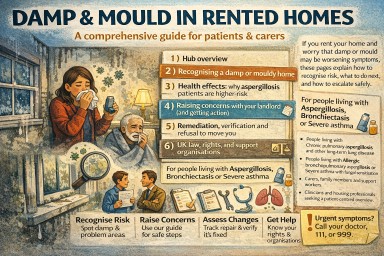
A comprehensive guide for patients and carers. If you rent your home and worry that damp or mould may be worsening symptoms, these pages explain how to recognise risk, what to do next, and how to escalate safely.
Who this guide is for
- People living with Chronic pulmonary aspergillosis and other long-term lung disease.
- People living with Allergic bronchopulmonary aspergillosis or Severe asthma with fungal sensitisation.
- Carers, family members, and support workers.
- Clinicians and housing professionals seeking a patient-centred overview.
The key message
A damp home does not automatically cause aspergillosis. However, damp and mould can:
- worsen airway inflammation and symptoms
- trigger exacerbations in asthma/bronchiectasis
- increase allergic-type reactions in sensitised people
- make it harder to stabilise symptoms even with optimal treatment
This hub focuses on practical steps: recognising risk early, communicating effectively, understanding remediation quality, and using UK escalation routes.
How to use this hub
- Start with Recognising a damp home to build an evidence base.
- Read Health effects to understand patterns that support an environmental contribution.
- Use Landlord communications to push for a safe plan, not cosmetic fixes.
- Check Remediation & refusal to move if you’re being pressured to return.
- Use Law & support for UK rights and escalation routes.
Important safety note
If you have severe breathlessness, chest tightness, wheeze, or features of anaphylaxis (for example lip/tongue swelling, throat tightness, collapse), seek urgent medical help. If you are repeatedly attending A&E with symptoms that seem worse at home, tell clinicians you are concerned about damp/mould exposure.
How to raise damp and mould with your landlord (and get action)
Home › Knowledge Hub › Damp, mould and aspergillosis › Raising with your landlord
Your aim is to secure a safe, evidence-based plan: fix the cause, dry properly, remediate safely, and confirm the home is safe to occupy.
Principles that prevent “cosmetic fixes”
- Source control: stop the leak/ingress/defect.
- Drying: dry building fabric, not just the air.
- Safe remediation: remove/clean contaminated materials appropriately.
- Verification: show the home is safe to occupy.
How to report effectively
- Report in writing (email/portal) and keep everything.
- Attach dated photos and a brief symptom timeline.
- Use health-focused language: “damp and mould hazard”, “medical vulnerability”, “safe to occupy”.
- Ask for timescales, named contact, and written findings.
Template email (copy/paste)
Subject: Damp and mould hazard – urgent investigation and repair plan (health impact) Hello [Landlord/Housing Officer/Letting Agent], I am reporting ongoing damp and/or mould at [address], affecting [rooms/locations]. This has been present since [date] and appears linked to [water ingress/leak/condensation/ventilation failure]. We have clinically vulnerable occupants in the household, including [brief: chronic lung disease / aspergillosis / severe asthma / bronchiectasis], and symptoms are worsening. Please confirm in writing: 1) the inspection date and who will attend, 2) the findings (including likely cause), 3) the repair and drying plan (including timeframes), 4) what remediation will be undertaken (not just surface cleaning/painting), 5) how you will confirm the property is safe to occupy once works are completed. Thank you, [Name] [Phone]
If you are told it is “lifestyle” or “just condensation”
You can reply calmly:
Thank you. We are doing reasonable ventilation and heating measures. However, the pattern and location suggest a building/ventilation defect that requires investigation and repair. Given medical vulnerability in the household, we need a written plan that addresses the underlying cause and confirms the home is safe to occupy.
When to escalate early
- Repeated failed repairs, or mould returns quickly
- Visible mould plus long-term damp patches
- Health deterioration, repeated GP/A&E attendances
- Pressure to accept repainting/bleach-only cleaning
See Page 6 for UK escalation routes and support organisations.