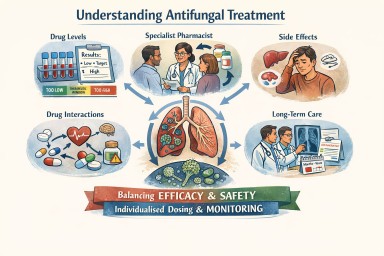
Antifungal Medicines: Dosing, Monitoring, and the Role of Specialist Care

A detailed reference for patients and non-specialist clinicians


1. Why antifungal treatment is different from most medicines

Oral antifungal medicines—especially azole antifungals—are essential for treating long-term fungal diseases such as chronic pulmonary aspergillosis and allergic bronchopulmonary aspergillosis.

They differ from many common medicines because they:

  • Have a narrow margin between effectiveness and toxicity

  • Behave very differently between individuals

  • Are often taken for months or years, not days

  • Interact with many commonly prescribed drugs

For these reasons, antifungal treatment requires individualised dosing, monitoring, and specialist input, rather than a standard fixed dose.


2. What “pharmacokinetics” means (plain language)

Pharmacokinetics describes what the body does to a drug:

  1. Absorption – how well the drug enters the bloodstream from the gut

  2. Distribution – how effectively it reaches tissues such as the lungs

  3. Metabolism – how quickly the liver breaks it down

  4. Elimination – how the drug leaves the body

Differences at any of these stages explain why the same dose can be ineffective for one person and toxic for another.


3. Different generations of azole antifungals behave differently

Each generation of azole antifungal was designed to improve effectiveness, but chemical changes also altered how the body handles the drug.

First-generation azoles (older drugs)

Examples

  • Ketoconazole

  • Fluconazole (limited activity against Aspergillus)

Key features

  • Variable absorption

  • Shorter half-life

  • Less reliable lung penetration

Clinical relevance

  • Rarely used now for chronic aspergillosis


Second-generation azoles (mainstay treatment)

Examples

  • Itraconazole

  • Voriconazole

  • Posaconazole

Key features

  • Excellent lung and tissue penetration

  • Highly variable metabolism between people

  • Strong interaction with liver enzymes

Clinical relevance

  • Very effective

  • Blood levels vary widely

  • Dose adjustment and monitoring are often essential


Newer azoles

Example

  • Isavuconazole

Key features

  • More predictable absorption

  • Long, stable half-life

  • Fewer extreme peaks and troughs

Clinical relevance

  • Often better tolerated long-term

  • Monitoring still important, but dosing may be more stable


4. Why the “right dose” matters so much

Too little antifungal

  • Infection not adequately controlled

  • Symptoms persist or worsen

  • Risk of antifungal resistance

  • Fewer future treatment options

Too much antifungal

  • Liver irritation or damage

  • Nausea, appetite loss

  • Neurological or visual side effects

  • Drug accumulation, especially with long-term use

The aim is always the lowest dose that effectively controls the fungus.

https://ars.els-cdn.com/content/image/3-s2.0-B9780123868824000189-f18-07-9780123868824.jpg

5. How clinicians know whether the dose is right

No single test determines this. The correct dose is identified when three elements align:

1️⃣ Blood level testing (therapeutic drug monitoring)

  • Measures how much drug is actually in the bloodstream

  • Helps identify:

    • Under-dosing

    • Target-range dosing

    • Toxic levels

2️⃣ Clinical response

  • Symptoms stabilise or improve

  • Fewer flare-ups or complications

  • Better day-to-day function

3️⃣ Safety monitoring

  • Liver and kidney blood tests

  • Review of side effects

  • Ongoing assessment of drug interactions

Only when effectiveness and safety are both acceptable is the dose considered “right”.


6. Why the right dose can change over time

A dose that was correct initially may later need adjustment because of:

  • Weight or body-composition changes

  • Age-related metabolic changes

  • New medications (including antibiotics or steroids)

  • Changes in liver or kidney function

  • Gradual drug accumulation during long-term therapy

Regular review is therefore expected and appropriate.


7. Is it sometimes impossible to find a stable dose?

Yes. For a minority of patients, a perfectly balanced dose cannot be found.

Reasons include:

  • Extremely fast or slow drug metabolism

  • A very narrow safety window

  • Long-term toxicity despite “acceptable” blood levels

  • Unavoidable interacting medications

  • Liver, kidney, or neurological vulnerability

  • Partial or full antifungal resistance

In these cases, the dose that controls the fungus and the dose that causes side effects may overlap.

This reflects biological limits, not treatment failure.


8. What clinicians do when a stable dose cannot be achieved

Options may include:

  • Switching to a different azole with different pharmacokinetics

  • Using modified dosing schedules (split dosing, slower titration)

  • Accepting a lower suppressive dose rather than full eradication

  • Considering non-azole antifungals where appropriate

  • Prioritising symptom control and quality of life

All are intentional, safety-focused decisions.


9. The central role of the specialist pharmacist

Specialist pharmacists are key to safe antifungal care, particularly for long-term azole therapy.

They play a critical role in:

Interpreting drug levels

  • Assessing whether a level is truly low or high

  • Accounting for dose timing and formulation

  • Preventing unnecessary or unsafe dose changes

Managing drug–drug interactions

Azoles interact with many common medicines, including:

  • Steroids and inhalers

  • Heart rhythm drugs

  • Blood thinners

  • Anti-epileptics

  • Pain medications

The specialist pharmacist:

  • Reviews the full medication list

  • Anticipates interactions before harm occurs

  • Advises on adjusting both interacting drugs

Individualising dosing

When standard doses do not work, they help design:

  • Non-standard doses

  • Split dosing schedules

  • Slow titration plans

  • Alternative azoles with different pharmacokinetics

Protecting patients during long-term treatment

They monitor:

  • Trends in liver and kidney tests

  • Signs of cumulative toxicity

  • Whether symptoms may be drug-related rather than disease-related

Coordinating care

They act as a bridge between:

  • Laboratory results

  • Clinical decision-making

  • Patient experience

https://www.omnicare.com/wp-content/uploads/omnicare-services-overview-02-expert-consultant.jpg

Their involvement often changes management, not just fine-tunes it.


10. Where antifungal drug level testing is done in the UK

In the UK, antifungal drug level testing is centralised.

  • Blood samples are taken locally

  • Samples are sent to specialist reference laboratories, most commonly the
    Mycology Reference Centre Manchester

  • Results are returned to the local clinical team for interpretation

Patients managed through specialist services such as the
National Aspergillosis Centre
benefit from integrated expertise in antifungal pharmacology, imaging, and long-term monitoring.

This process is routine and standard for antifungal care.


11. Key reassurance for patients

  • Dose changes are normal and expected

  • Side effects are often biology-driven, not your fault

  • Blood tests make treatment safer, not riskier

  • Switching drugs is a planned strategy, not giving up


12. One-paragraph summary

Antifungal medicines—particularly azole antifungals—have complex and highly variable behaviour in the body, with a narrow balance between effectiveness and toxicity. Safe use requires individualised dosing, therapeutic drug monitoring, symptom review, and long-term safety checks. Specialist pharmacists play a central role in interpreting drug levels, managing interactions, and tailoring treatment. For some patients, a perfectly balanced dose cannot be achieved, and alternative strategies are required. This reflects biological complexity, not failure, and the overarching aim is always effective fungal control with the best possible long-term safety and quality of life.


When treatment itself causes harm: an important message for people with aspergillosis

For most people, following medical advice is the safest and most appropriate course of action. However, for some people living with aspergillosis or other long-term lung conditions, treatment itself can occasionally cause harm — particularly when adverse drug reactions are not recognised early.

Aspergillosis often requires long-term or repeated courses of medication, sometimes alongside treatment for co-existing infections or other conditions. Because symptoms of aspergillosis can overlap with medication side effects, new or worsening problems may be assumed to be part of the illness rather than a reaction to treatment.

Why this can be difficult to recognise

People with aspergillosis may:

  • already experience fatigue, breathlessness, pain, or neurological symptoms

  • take multiple medicines at the same time

  • have fluctuating symptoms due to infection, inflammation, or treatment response

This makes it harder to distinguish disease activity from drug-related effects.

The importance of recognising adverse drug reactions

Some medicines commonly used in people with lung disease can, in a small number of individuals, cause serious or long-lasting side effects. These reactions may develop gradually or worsen with continued use.

Examples (not exhaustive) include:

  • Antibiotics – tendon, nerve, gastrointestinal, cardiac or immune-related effects

  • Antifungal medicines – liver toxicity, neurological symptoms, skin reactions, drug interactions

  • Steroids – bone loss, adrenal suppression, mood changes, infection risk

  • Immunosuppressive or biologic therapies – infection risk, immune dysregulation, inflammatory reactions

Not everyone experiences these effects, and many people take these medicines safely. However, when significant new symptoms appear after starting or changing treatment, they should be actively reassessed.

Why knowledge of medication side effects matters

Patients are not expected to diagnose themselves. However, having a basic awareness of known serious side effects can help patients recognise when something may not be right.

In the UK, trusted sources such as the British National Formulary (BNF) list both common and rare but serious adverse effects for prescribed medicines, and drug:drug interactions which are particularly significant for antifungal medications. Reviewing this information can support informed discussions with healthcare professionals, particularly if symptoms worsen rather than improve.

Checking authoritative sources is not about challenging clinical expertise or stopping treatment independently. It is about ensuring that potential drug reactions are considered alongside disease progression.

A balanced message for patients and clinicians

Safe care depends on partnership. This means:

  • patients feeling able to report side effects clearly and repeatedly if needed

  • clinicians remaining alert to drug reactions, especially when symptoms are atypical or progressive

  • being willing to pause, review, and reconsider treatment when outcomes are not as expected

Early recognition of adverse drug reactions can reduce the risk of long-term or permanent harm.

Take-home message

If treatment is making you feel significantly worse, and the symptoms do not feel right for you, it is reasonable to ask for reassessment — even if the treatment is commonly used or usually well tolerated.

Being informed, listened to, and reviewed promptly helps ensure safer care for people living with aspergillosis.