
**Adrenal Insufficiency & Steroid Tapering:
A Complete Patient Guide**
People taking long-term steroids (prednisolone, methylprednisolone, hydrocortisone, dexamethasone) can develop adrenal insufficiency because their adrenal glands “go to sleep” and stop making cortisol.
During tapering, the body must slowly “wake up” again — and this needs careful monitoring.
This guide explains the symptoms, tests, warning signs, and emergency precautions to keep you safe.
⭐ 1. Why adrenal insufficiency happens
Long-term steroid use suppresses the HPA axis (hypothalamus–pituitary–adrenal system).
When daily steroid doses are reduced, your body must produce more of its own cortisol. This takes time.
If the steroid reduction is too quick, or the body is under stress, low cortisol symptoms appear.
⭐ 2. Symptoms to watch for during steroid tapering
These are early signs that your body may not be keeping up with the reduction.
✔ Early, mild symptoms
-
Fatigue / sudden exhaustion
-
Muscle weakness
-
Dizziness when standing
-
Nausea or reduced appetite
-
Flu-like aching
-
Low mood, anxiety, irritability
-
Brain fog
-
Feeling unusually cold
-
Worsening joint or muscle pain
These often improve if the taper is slowed or paused.
⭐ 3. More serious symptoms of low cortisol
These symptoms suggest steroid levels are too low and the taper needs urgent review:
-
Vomiting
-
Persistent dizziness
-
Very low blood pressure
-
Severe fatigue (unable to function normally)
-
Salt cravings
-
Ongoing nausea preventing eating
-
Faintness or near-collapse
These require medical advice (same day).
⭐ 4. Emergency symptoms — possible adrenal crisis
Call 999 or go to A&E immediately if you develop:
-
Severe vomiting or diarrhoea
-
Collapse or inability to stand
-
Severe dehydration
-
Confusion
-
Sudden severe abdominal or back pain
-
Pale, clammy skin
-
Rapid breathing
-
Loss of consciousness
This is a medical emergency.
Patients normally receive 100 mg hydrocortisone IM/IV, but patients allergic to hydrocortisone require a pre-agreed emergency alternative — your endocrinologist must document this clearly.
⭐ 5. Symptoms that mean you may need a temporary “stress dose” of steroids
Your cortisol requirement increases during physical stress.
If you have adrenal suppression, your body cannot produce this extra cortisol.
You may need a temporary increase in dose if you have:
✔ Illness
-
Fever
-
Chest infection
-
Flu-like illness
-
COVID
-
Urinary infection
-
Gastroenteritis
-
Diarrhoea
-
Persistent nausea
✔ Physical stress
-
Injury
-
Significant fall
-
Severe pain
-
Dental surgery
-
Medical or surgical procedures
✔ Emotional stress
-
Bereavement
-
Panic attacks
-
Trauma
If vomiting prevents taking steroids → seek emergency help immediately.
⭐ 6. Tests used to monitor adrenal function during tapering
Doctors rely on a combination of symptoms and laboratory tests.
✔ Morning cortisol (8–9 am)
A key test to assess recovery.
Typical interpretation:
-
> 400–500 nmol/L → likely normal function
-
150–350 nmol/L → recovering / borderline
-
< 100 nmol/L → adrenal insufficiency
(Exact thresholds vary.)
✔ ACTH level
Shows whether the pituitary is trying to stimulate the adrenals.
-
Low ACTH → still suppressed
-
High ACTH → trying to wake adrenals
-
Normal ACTH + low cortisol → gland slow to respond
✔ Short Synacthen Test (SST)
Gold standard.
A small ACTH injection tests whether your adrenal glands can produce cortisol.
Used when:
-
taper reaches low doses
-
symptoms appear
-
deciding if steroids can be stopped
✔ Electrolytes (U&Es)
Low cortisol may cause:
-
Low sodium
-
High potassium (less common in steroid-induced insufficiency)
✔ Blood pressure monitoring
Low cortisol → low BP, dizziness, faintness.
✔ Glucose levels
Low-normal glucose and shakiness may occur during withdrawal.
✔ Clinical symptom review
Symptoms are sometimes more sensitive than tests.
Doctors track:
-
fatigue
-
appetite
-
dizziness
-
illness triggers
-
salt cravings
-
mental state
-
recovery after small dose increases
⭐ 7. How tapering decisions are made
Tapering depends on:
-
how long steroids have been taken
-
current dose
-
symptoms
-
test results
-
presence of illness
-
rate at which symptoms develop
-
allergy restrictions (pred/hydrocortisone allergy requires specialist handling)
General principles (not schedules):
-
Higher doses can reduce more quickly.
-
Taper slows dramatically near physiological levels
(~4–6 mg pred-equivalent). -
If symptoms appear → pause, slightly increase, or slow taper.
-
SST is used near the end to confirm recovery.
⭐ 8. When to contact your medical team
Same day advice needed
-
worsening dizziness
-
persistent nausea
-
new vomiting
-
symptoms appear with each taper step
-
fainting
-
new severe fatigue
-
any infection (urinary, chest, flu)
Urgent / A&E
-
collapse
-
severe vomiting/diarrhoea
-
confusion
-
severe abdominal pain
-
unable to take oral steroids
-
suspected adrenal crisis
⭐ 9. What patients should do to stay safe
-
Carry a Steroid Emergency Card at all times
-
Keep emergency instructions from your endocrinologist
-
Know your Sick Day Rules
-
Ensure A&E or ambulance crews know about corticosteroid allergy
-
Keep a written record of tapering plan
-
Never stop steroids suddenly
-
Be cautious during illness
-
Know your emergency steroid plan (alternative if allergic to hydrocortisone)
⭐ Final reassurance
Adrenal insufficiency during tapering is common, manageable, and often reversible.
By monitoring symptoms, using regular blood tests, and following specialist guidance, tapering can be done safely.
You are not alone — your endocrine team will guide every step, especially if allergies (to prednisolone or hydrocortisone) make your case more complex.
With careful observation and a clear emergency plan, serious complications are rare and preventable.
❤️ Thinking About Donating Blood After Aspergillosis or Lung Treatment?
A supportive message for people living with ABPA, CPA, SAFS, and related lung conditions
When you live with aspergillosis or a long-term lung condition, you know what it means to go through difficult treatments, long recoveries, and moments of uncertainty.
So when someone says, “Once I’m well, I’d like to donate blood to help others,” it is an incredibly generous and hopeful act.
Many people in our community wonder whether blood donation is possible after lung surgery, long-term inhalers, antifungals, or biologics. The reassuring answer is:
👉 Yes — some aspergillosis patients can donate blood once fully recovered, but it depends on individual treatments and health status.
And even if you can’t donate, the spirit behind the idea is powerful and meaningful.
🌱 1. Recovery comes first — your health is the priority
Whether you’ve had:
-
ABPA flare-ups
-
CPA treatment
-
bronchoscopy
-
long-term antifungals
-
biologics
-
a lobectomy or wedge resection
…the NHS will want you to be:
-
fully healed
-
breathing comfortably
-
stable in your lung condition
-
free from infection
-
strong enough to safely donate
For major surgery like a lobectomy, this often means several months of recovery before you can even be reviewed for donation.
This protects your health, not just the receiver’s.
💊 2. Medications commonly used for aspergillosis can affect eligibility
NHS Blood and Transplant will look closely at what you’re taking.
Here’s a simple guide:
Often NOT permitted
-
Biologics (e.g., mepolizumab, benralizumab, dupilumab)
-
Long-term immunosuppressants
-
Regular systemic steroids
May require a delay after stopping
-
Itraconazole / voriconazole / posaconazole
-
Recent antibiotic courses
-
Short steroid bursts
Usually fine
-
Inhalers
-
Nebulised saline
-
Montelukast
-
Airway clearance treatments
-
Most pain medicines
Every case is assessed individually — there is no automatic “yes” or “no” for all aspergillosis patients.
🫁 3. Your lung condition does not automatically exclude you
Having ABPA, CPA, bronchiectasis, or SAFS does not automatically prevent blood donation.
What matters is:
-
your condition is stable
-
your oxygen levels are good
-
you are not prone to sudden flare-ups
-
you feel well and strong
Many people with asthma or mild-to-moderate bronchiectasis still donate safely.
🩸 4. Your blood type is always valuable
Whether you’re a universal donor type (O-negative) or any other type, your blood can help save lives.
Even wanting to donate is something to be proud of — especially after everything you’ve been through.
🌟 5. The intention to donate speaks volumes about your strength
People living with aspergillosis know:
-
what it means to struggle for breath
-
how it feels to wait for test results
-
the exhaustion of flare-ups
-
the courage needed for surgery
-
the patience required for long-term treatment
So when someone in this community says:
“If I recover well, I want to donate blood to help someone else.”
…it’s a truly inspiring message of recovery and generosity.
🌈 6. Even if you can’t donate — your kindness still matters
Because of medications or long-term conditions, some people with aspergillosis will be told they can’t donate blood. This is completely normal.
You can still help others by:
-
encouraging friends or family to donate
-
sharing your story to raise awareness
-
supporting patient groups, campaigns, and research
-
simply being there for someone newly diagnosed
Your contribution to the world is not measured by a needle — it’s measured by your compassion.
❤️ Takeaway message
If you want to donate blood after aspergillosis treatment or lung surgery, that’s a beautiful intention. When you’re fully recovered, the NHS can review your health and medications. Whether you can donate or not, the willingness to help others already makes a real difference.
⭐ How to Avoid Being Fooled by Misleading Products, Private Tests and Health Claims
A practical, evidence-based guide for people living with aspergillosis, asthma, bronchiectasis and COPD
People with long-term lung conditions are often targeted by persuasive marketing, “health influencers”, alternative practitioners, and private test companies.
These services frequently exploit fear, frustration, and the very understandable desire for answers.
This expanded guide explains why certain products look scientific, why most are biologically impossible, and how you can protect yourself from being misled or spending money on things that cannot help your condition.
This is about empowerment — never about blaming patients.
🧩 1. Why misleading products look convincing
Companies deliberately use wording and imagery that trigger trust:
-
lab coats
-
microscopes
-
graphs and biological diagrams
-
words like “antifungal”, “immune”, “toxins”, “wellness”, “clinical strength”
These features make a product appear evidence-based — but appearance is not evidence.
Many claims contain a grain of truth, e.g.:
-
“Tea tree oil kills fungus in the lab”
-
“Silver has antimicrobial properties”
-
“This herbal extract reduces inflammation in laboratory tests”
But the missing information is the critical part:
⭐ The lab conditions have nothing to do with the human body.
To “kill fungus in a dish”, companies use concentrations that:
-
would be toxic in humans
-
cannot reach the lung tissue
-
would be broken down in the gut or bloodstream
-
do not survive into the airways
Companies rely on the fact that most customers don’t know this.
🧬 2. “Plausibility comes before testing” — the rule companies hope you don’t know
Scientists follow a simple chain:
1️⃣ Is it plausible?
Can the substance reach the lung?
Does the pathway make sense?
2️⃣ If yes — test it.
If not — don’t.
Products sold online almost always fail at Step 1.
Examples:
Turmeric supplements
Even at huge oral doses, only a tiny amount enters the bloodstream — nowhere near the lung in meaningful levels.
Oregano oil
Kills fungi on metal plates in labs — but the amount needed inside the lung would be toxic.
Silver products
Irritate the lungs and accumulate in tissues — highly implausible as therapy.
Essential oils
Break down long before reaching the airways in meaningful amounts.
Herbal antifungals
Often metabolised by the gut and liver — never reach airways at therapeutic levels.
This is why clinical trials don’t happen —
not because no one has tried,
but because there’s no scientific reason to bother.
🛍️ 3. How companies use “allowed” claims to sound medical
Because these products are not classed as medicines, they must not claim to “treat disease”.
So companies use vague, legally safe wording:
-
“Supports immunity”
-
“Maintains wellness”
-
“Promotes respiratory health”
-
“Contains antifungal botanicals”
-
“Helps with mould exposure”
-
“Advanced detox science”
All of these sound medical but say nothing measurable.
Example:
A supplement cannot say:
-
“Improves aspergillosis symptoms”
But it can say:
-
“Supports healthy immune response”
This tricks the viewer into mentally connecting the dots without the company making any illegal claims.
🧊 4. Air filters — the rare partial exception
Air purifiers can help some people, because they reduce:
-
dust
-
pollen
-
irritants
-
pet dander
-
airborne particulate matter
These changes may ease coughing or wheezing in sensitive people.
BUT…
most devices sold online are far too weak.
A purifier needs:
-
True HEPA H13 filter (not “HEPA-type”)
-
CADR 250–350+ for most rooms
-
Strong fan to turn over room air 4–5 times per hour
Without these, a purifier is just an expensive fan.
What they cannot do:
-
cure aspergillosis
-
remove Aspergillus from the lungs
-
prevent exposure
-
substitute for ventilation
-
fix damp or mould in walls
They improve comfort, not disease.
👩⚕️ 5. Why alternative practitioners are so persuasive
Alternative practitioners often:
-
speak with confidence
-
promise personalised care
-
provide long consultations
-
listen sympathetically
-
use scientific-sounding language
-
offer simple explanations for complex symptoms
Their tests and treatments look legitimate, but the problems include:
❌ No training in lung disease
❌ Misunderstanding of immunology
❌ Misuse of lab dish studies
❌ Incorrect interpretation of “toxins”
❌ Selling supplements with no evidence
❌ Recommending dangerous inhaled substances (e.g., oils, peroxide)
❌ Relying on anecdotes, not data
Even well-meaning practitioners can unintentionally cause:
-
lung irritation
-
drug interactions
-
adrenal effects
-
delays in proper NHS treatment
-
unnecessary fear
🧪 6. Private test companies — why their results look real but mean nothing
Common private tests include:
-
mycotoxin urine tests
-
“mould illness panels”
-
detox pathway testing
-
food IgG tests
-
fungal metabolite tests
-
heavy metal hair analysis
-
“immune balance” panels
-
testosterone finger-prick kits
These results are presented with:
-
charts
-
colour-coded ranges
-
expert-sounding commentary
But the key issue is:
⭐ The reference ranges are invented by the company.
Often “high” simply means:
-
“higher than the average of people who bought this test”
Not:
-
higher than healthy people
-
higher than unwell people
-
linked to disease
GPs and consultants cannot act on these results because they are not medically interpretable.
👨⚕️ 7. Testosterone tests — a perfect illustration of misleading health screening
Companies advertise:
-
“Tired? Low mood? Low motivation?”
-
“Check your testosterone at home”
-
“Feel younger again”
They use US-style messaging that implies easy treatment.
But in the UK, testosterone treatment requires:
-
symptoms consistent with hypogonadism
-
two morning venous blood tests
-
validated hospital labs
-
endocrine specialist interpretation
-
ruling out multiple other causes
- testosterone levels fall slowly as part of ageing - it is normal
Finger-prick tests do not meet NHS criteria,
so patients end up:
-
anxious
-
misinformed
-
sold supplements
-
not eligible for NHS treatment
This perfectly mirrors the broader pattern of private testing.
🔍 8. The “curiosity gap”: why people buy tests that GPs won’t order
Patients understandably feel:
-
frustrated
-
curious
-
confused
-
not listened to
-
desperate for answers
When a GP says “That test won’t help,” it can feel like:
-
rejection
-
dismissal
-
obstruction
But the reality is:
⭐ GPs are following evidence-based pathways to protect you.
Most private tests:
-
do not answer a clinical question
-
have false positives
-
trigger unnecessary follow-up scans
-
cause anxiety
-
cannot be interpreted
-
do not influence treatment
Private companies exploit:
-
curiosity
-
frustration
-
the desire for answers
-
the emotional gap left by long waits or unexplained symptoms
But a meaningless test result is worse than no test at all.
🧾 9. Real-world examples: 15 common traps to avoid
1. Mould settle plates
All rooms grow mould on plates — totally meaningless for health.
2. IgG food sensitivity tests
Measure normal immune exposure, not allergies.
3. Finger-prick vitamin tests
Often inaccurate and label normal levels as “borderline”.
4. Lung detox drinks
Nothing you drink detoxes the lungs.
5. Hydrogen peroxide / silver nebulisers
Dangerous. Irritate lungs. Risk chemical burns and pneumonitis.
6. Essential oil diffusers marketed as “antifungal”
Irritate airways; no delivery to lung tissue.
7. Mycotoxin detox programmes
Based on non-diagnoses; push expensive supplements.
8. Immune-boosting products
No supplement boosts immunity in a useful way for aspergillosis.
9. “Black mould blood tests”
No such test exists; ranges are invented.
10. Ozone machines and air ionisers
Harmful to lungs; zero evidence.
11. Anti-mould paint additives
Mask damp; do not impact indoor fungal counts long term.
12. Red-light therapy devices
Cannot penetrate tissue; no lung benefit.
13. Detox foot patches
Turn brown from sweat; total scam.
14. Anti-mould laundry boosters
Irrelevant to aspergillus exposure.
15. Humidifiers sold for “lung support”
Raise humidity → increase mould risk.
🛡️ 10. The Anti-Fooling Checklist
Before you buy anything, ask:
✔ Has this been tested in people with aspergillosis?
✔ Can it physically reach the lungs?
✔ Does NHS medicine recognise or use it?
✔ Are the claims vague? (“supports immunity”)
✔ Are the reference ranges medically valid?
✔ Would my consultant recommend this?
✔ Is this a simple answer to a complex condition?
If any answer is no, it’s a red flag.
⭐ 11. Golden rule
If a treatment or test genuinely helped aspergillosis, your consultant would already be using it —
not influencers, Amazon sellers, or unregulated US labs.
🌟 12. Final message: It’s not foolishness — it’s human
You are not being “tricked” because you’re naïve.
These products are engineered to be emotionally irresistible.
People with chronic illness are targeted because they are thoughtful, curious, and trying hard to get better.
If you are ever unsure about a product or test:
-
ask NAC/CARES
-
ask your specialist
-
or bring it to your next appointment
You deserve real answers — not false hope.
Why Exposure to Young Children Can Increase Illness in Aspergillosis, ABPA, and Bronchiectasis — and How to Track Viral Outbreaks
Many patients with Allergic Bronchopulmonary Aspergillosis (ABPA), aspergillus-related asthma, or bronchiectasis notice that they become ill far more often when spending time around younger children. This applies whether you work with them, live with them, or spend time with grandchildren or family groups. Here’s why it happens, what other patients experience, and how to monitor viral outbreaks so you can protect yourself.
Why Young Children Increase Illness Risk
1. Young children spread far more respiratory infections
Children under 11:
-
Carry more colds, viruses, and respiratory bugs
-
Shed viruses for longer periods
-
Have high viral loads
-
Are still learning hygiene habits
-
Spend a lot of time in close physical contact with adults
Even small viral infections can cause major lung flares in ABPA and bronchiectasis.
2. Viral infections trigger flare-ups, exacerbations, and pneumonia
With:
-
Bronchiectasis → mucus doesn’t clear properly, so infections “stick”
-
ABPA → airways are inflamed, reactive, and mucus-filled
-
Asthma → viruses are the most common exacerbation trigger
A simple cold in a child can turn into:
-
Fever
-
Chest infection
-
Need for antibiotics
-
Pneumonia
-
Weeks of recovery
This pattern is extremely common.
3. Children spread viruses even when only mildly ill
Some viruses (RSV, adenovirus, flu) spread before symptoms, or for many days after a child appears well.
Adults with lung conditions may experience far more severe symptoms from these same infections.
4. Any indoor, close-contact time increases risk
This includes:
-
Teaching music or classroom work
-
Caring for grandchildren
-
Sitting in cars together
-
Birthday parties, playgroups, soft play
-
Family gatherings
-
Living in the same household
Even short exposures can be enough in winter months.
What Other Aspergillosis Patients Report
Across support groups and clinics:
-
Many patients stay well until grandchildren reach nursery/school age.
-
Switching from high school to primary/elementary teaching often leads to repeated infections.
-
People frequently report more pneumonias in winter when around young children.
This is very common and not your fault.
How to Reduce Risk (Realistically)
1. Improve ventilation
-
Open windows/doors during visits or lessons
-
Use a HEPA air purifier at home or work
-
Avoid long stays in small rooms
2. Control exposure without avoiding children
Shorter visits with good ventilation are safer than long indoor contact.
3. Keep up with airway clearance routines
Vital for preventing infections from settling.
4. Mask during periods of high virus circulation
Especially when RSV, flu, COVID, or “winter bugs” are rising.
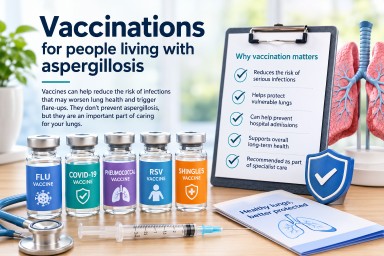
5. Stay vaccinated
Flu, pneumococcal, COVID (if eligible), and pertussis if around infants.
6. Get medical review if you're repeatedly unwell
Your team may consider:
-
Prophylactic antibiotics
-
Nebulised saline
-
Optimising inhalers/biologics
-
Checking ABPA control
7. Use Occupational Health if exposure is workplace-related
Ask for:
-
Teaching older groups
-
Ventilation improvements
-
Reduced winter exposure
Where to Get Reliable Information on Viral Outbreaks
Tracking viral activity can help you plan safer weeks and reduce the chance of flare-ups.
1. UK Health Security Agency (UKHSA)
Weekly reports on:
-
Flu
-
COVID
-
RSV
-
Measles and other outbreaks
-
Regional activity levels
Best official national overview. Link
2. GOV.UK Infectious Disease Reports
Lists:
-
Confirmed outbreaks
-
Public health warnings
-
School/nursery clusters
-
Localised alerts
3. Local NHS Trust or ICB Websites
Many publish:
-
Weekly respiratory dashboards
-
Local flu/RSV alerts
-
Outbreak notices for schools and care settings
(Example: Greater Manchester ICB has regular respiratory activity updates.)
4. GP Surgeries & NHS App Alerts
GPs can push:
-
Local viral alerts
-
Flu surges
-
Measles/strep notifications
Often one of the earliest local signals.
5. School/Nursery Letters and Newsletters
Schools must notify families about:
-
Flu/strep outbreaks
-
High absence levels
-
Confirmed clusters
Very useful if you work with or spend time around children.
6. Zoe Health Study App
Crowd-sourced, real-time data on:
-
Colds
-
Flu-like illness
-
COVID
-
Regional spikes
Good for early warning.
7. Local Council Public Health
Check:
[Your council] + “Public Health”
They often post:
-
Local outbreak alerts
-
Enhanced infection-control notices
-
Community virus trends
8. NHS 111 Online Data
Shows real-time spikes in:
-
Cough
-
Fever
-
Chest infections
-
Sore throat or strep symptoms
A useful snapshot of local trends.
Key Message
Yes — any exposure to young children can raise infection risk when you have aspergillosis, ABPA, or bronchiectasis.
Tracking viral outbreaks helps you plan safer contact, adjust your activities, and reduce the chance of pneumonia or flare-ups.
Resources
Here are direct links to trusted resources you can use to monitor viral outbreaks and infection risk (especially helpful for those with ABPA, bronchiectasis, asthma, and other lung conditions):
-
UK Health Security Agency (UKHSA) “Influenza and Respiratory Viruses” dashboard — UK data on influenza, RSV, COVID-19, ICU/hospital admission rates.
https://ukhsa-dashboard.data.gov.uk/ -
UKHSA / GOV.UK “National flu and COVID-19 surveillance reports” — weekly/bi-weekly reports summarising community, primary care, hospital and mortality data.
https://www.gov.uk/government/statistics/national-flu-and-covid-19-surveillance-reports-2025-to-2026-season -
GOV.UK “Outbreaks under monitoring” — current outbreaks of various infectious diseases in the UK.
https://www.gov.uk/government/publications/outbreaks-under-monitoring-in-2025/outbreaks-under-monitoring-week-41-week-ending-12-october-2025 -
GOV.UK “Infectious diseases: detailed information” — data, guidance, and analysis for a wide range of infections (flu, RSV, scarlet-fever, etc.).
https://www.gov.uk/government/collections/infectious-diseases-detailed-information -
Public Health Wales “Weekly influenza and acute respiratory infection report” — regional data including GP consultations and infection trends.
https://www.phw.nhs.wales/topics/immunisation-and-vaccines/fluvaccine/weekly-influenza-and-acute-respiratory-infection-report/ -
GOV.UK “Prepare – infectious disease outbreaks” — advice for the public on how to stay prepared for outbreaks, with hygiene and vaccination guidance.
https://prepare.campaign.gov.uk/be-informed-about-hazards/health-infectious-disease-outbreaks/
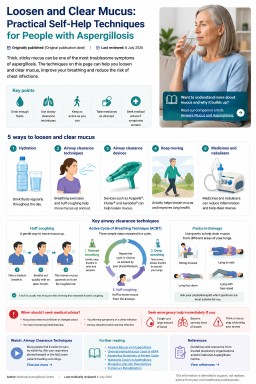
💨 Airway Clearance and Nebulised Saline
(for ABPA, severe allergic asthma, and bronchiectasis)
Why mucus clearance matters
If you have ABPA (allergic bronchopulmonary aspergillosis), severe allergic asthma, or bronchiectasis:
-
The airways can produce thick, sticky mucus.
-
Mucus may form plugs that block airflow.
-
Trapped mucus increases the risk of flare-ups and infections.
Nebulised saline loosens mucus, but it must be followed by airway clearance to move it out of your lungs.
Airway clearance methods
1. Active Cycle of Breathing Technique (ACBT)
-
A structured cycle of relaxed breathing, deep breaths, and “huffing” (forced breaths out).
-
Very effective when combined with nebulised saline.
2. Devices (Acapella, Flutter, Aerobika, etc.)
-
Use vibrations and back pressure to shake mucus loose.
-
Often recommended alongside ACBT.
3. Traditional physiotherapy techniques
-
Postural drainage – lying in certain positions to use gravity to drain mucus.
-
Chest percussion (clapping) – rhythmic tapping on the chest/back.
-
Assisted coughing – for those who can’t cough strongly.
All these techniques remain valid. The key is choosing the one that works for you.
The role of the respiratory physiotherapist
Your respiratory physiotherapist is central to airway clearance care:
-
They assess your condition (ABPA, asthma, bronchiectasis pattern).
-
They teach and supervise techniques so you can use them safely.
-
They tailor a plan – deciding whether ACBT, a device, drainage, or a mix is best.
-
They adjust your plan over time – for example:
-
During a flare-up with extra mucus
-
If new treatments (like biologics or antifungals) change your symptoms
-
If you develop new bronchiectasis or infections
-
👉 The physio is your partner in protecting your lungs.
How nebulised saline helps
-
Comes in sterile vials (normal 0.9% or stronger “hypertonic” 3–7%).
-
Hydrates and thins sticky mucus.
-
Prepares mucus for clearance with ACBT, devices, or drainage.
-
Sometimes used with a bronchodilator first to avoid wheeze or tightness.
Putting it together
-
Nebulised saline to loosen mucus
-
Airway clearance technique (ACBT, device, drainage) guided by your physio
-
Regular review with your physio to keep the plan up to date
✅ Key takeaway:
For ABPA, severe allergic asthma, and bronchiectasis, the combination of nebulised saline + airway clearance is one of the most effective ways to keep your lungs clearer and healthier. The respiratory physiotherapist will help you find the right method for your lungs and adjust it as your condition changes.
Why Medicines in the UK Come in Blister Packs – and What’s Being Done About the Waste
Many patients with aspergillosis (or other long-term conditions) notice something frustrating when they collect prescriptions: medicines often come in tiny blister packs, with only a few tablets per box. For example, azithromycin often arrives in boxes of just three tablets. When a longer course is needed, the pharmacy has to give you several boxes – leading to mountains of card and plastic waste.
So why does the UK stick with blister packs instead of using larger recyclable bottles? And is anything being done to cut down on the waste?
Why the UK prioritises blister packs
Blister packs are not just a packaging choice – they are built into how medicines are licensed and regulated in the UK and Europe. The main reasons are:
-
Safety and tamper protection
-
Each tablet is sealed in its own compartment, so it’s clear if a dose has been tampered with.
-
Bottles are harder to secure once opened.
-
-
Stability of the medicine
-
Some drugs break down if exposed to moisture, air, or light.
-
A blister pack protects each tablet until the moment it’s taken, which can extend shelf-life.
-
-
Dosing and adherence
-
Blisters help patients (and carers) see how many doses have been taken.
-
For short antibiotic courses, blister packs help doctors prescribe “one strip = one course.”
-
-
Child safety
-
Blisters are harder for small children to open compared with bottles, even those with child-resistant caps.
-
-
Regulatory approval
-
When a company licenses a medicine, the tests are carried out on that specific packaging.
-
To switch to bottles, companies would have to repeat expensive stability tests and resubmit to the MHRA.
-
These factors explain why UK pharmacies almost always supply the manufacturer’s blister pack, rather than re-dispensing tablets into bottles (as is common in the US).
The problem: waste and inefficiency
While blisters have advantages, they cause problems for patients and the NHS:
-
Waste of card and plastic: multiple boxes and layers of packaging for what could fit into one small bottle.
-
Cost and storage: pharmacies spend time opening and combining packs; patients are left with unnecessary clutter.
-
Recycling difficulties: blister packs are made of mixed plastic and foil, which are very hard to recycle in normal household systems.
What’s being done to reduce packaging waste
There is now a growing effort across the NHS, regulators, and industry to tackle this problem. Key developments include:
1. Greener NHS programme
-
The NHS has pledged to reach net zero by 2040.
-
Medicines are a big part of its carbon footprint, and packaging is specifically highlighted as an area for improvement.
-
Suppliers will increasingly be judged on how sustainable their packaging is when the NHS decides what to buy.
2. Original Pack Dispensing (OPD) reform (England, 2025)
-
From January 2025, pharmacists in England will be allowed to dispense up to 10% more or less than prescribed if it allows them to give patients the full original pack.
-
This reduces the need to cut up blister strips or re-package tablets, helping both safety and efficiency.
3. Extended Producer Responsibility (EPR) for packaging (2025)
-
All large companies must start reporting on the recyclability of their packaging.
-
Packs that are harder to recycle (like plastic-foil blisters) will face higher fees, pushing manufacturers to redesign them.
4. Industry innovation (CiPPPA)
-
A group called the Circularity in Primary Pharmaceutical Packaging Accelerator (CiPPPA) is working with the MHRA and industry to test new blister materials that are easier to recycle.
5. Pharmacy leadership
-
The Royal Pharmaceutical Society and local NHS teams are producing guides for “greener pharmacies,” encouraging steps to reduce medicine and packaging waste.
What this means for patients
Right now, the small packs are still the norm – especially for antibiotics and antifungals. But over the next few years we may start to see:
-
Larger, recyclable pack sizes becoming available.
-
Pharmacies having more flexibility to supply original packs instead of splitting them.
-
New materials being trialled to replace mixed-plastic blisters.
In the meantime, patients can:
-
Return unused medicines (and their packaging) to the pharmacy for safe disposal.
-
Ask their pharmacist if combining packs is possible (sometimes they can reduce excess boxes).
-
Support “greener pharmacy” initiatives by raising awareness of the waste problem.
✅ In short: The UK prioritises blister packs for safety, stability, and child protection, but the waste they generate is a real issue. Change is coming slowly, through NHS net zero commitments, new regulations, and industry projects – but for now, patients still see the frustration of multiple half-empty boxes.
🩺 Monitoring your health at home with aspergillosis
Many people with aspergillosis (ABPA, CPA, SAFS, aspergillus bronchitis) now use home devices such as pulse oximeters, blood pressure monitors, and thermometers. These are very useful tools — but only if you know how to take reliable measurements and when to act on them.
⚠️ Important: These devices are only guides. If you feel unwell, worsening, or unsafe — seek help, even if the numbers look “normal.” How you feel is always more important than a single reading.
This guide explains:
-
✅ How to measure correctly
-
🟢 When to relax, 🟠 when to monitor, 🔴 when to seek help
-
⚠️ What’s different if you have other health conditions
📏 How to take reliable measurements
🌡 Temperature
-
Use a digital thermometer (ear, mouth, or underarm).
-
Take your temperature at the same time each day when well, to learn your baseline.
-
Avoid measuring straight after a hot drink, bath, or exercise.
-
Always use the same device and method for consistency.
-
⚠️ Normal isn’t the same for everyone:
-
Typical range is 36.1–37.2 °C.
-
Some people naturally run a little “cooler” or “warmer.”
-
Temperature changes with time of day, age, hormones, and medicines (e.g. steroids, paracetamol).
-
Your personal baseline is most important.
-
💨 Oxygen saturation (SpO₂)
-
Sit quietly and rest for 5 minutes before checking.
-
Warm your hands — cold fingers reduce accuracy.
-
Remove nail polish, gel nails, or false nails.
-
Place the oximeter on your index or middle finger.
-
Keep your hand still, relaxed, and at heart level.
-
Wait 30–60 seconds until numbers settle, then record both SpO₂ and pulse.
❤️ Pulse rate
-
Normally shown on your oximeter.
-
Measure when sitting calmly.
-
If irregular, double-check manually by counting your pulse at the wrist or neck for 30 seconds ×2.
-
Record alongside oxygen reading.
🔹 Blood pressure (BP)
-
Rest for 5 minutes before measuring.
-
Use the same arm each time (usually left).
-
Keep your arm supported at heart level.
-
Sit with feet flat on the floor, legs uncrossed.
-
Avoid caffeine, smoking, or exercise for 30 minutes before.
-
Take two readings, 1–2 minutes apart, and record the average.
📝 Recording results
-
Note date, time, reading, and how you feel.
-
Keep a diary or use an app to spot trends over time.
-
Share with your GP or specialist, especially if you reach “amber” or “red” zones.
📊 When to seek help — traffic light system
⚠️ Don’t rely on numbers alone. If you feel unwell, dizzy, very breathless, confused, or unsafe, seek medical help — even if your readings are in the “green” zone.
🌡 Temperature
-
Green (OK): Within your baseline range.
-
Amber (monitor/GP): ≥37.5 °C repeatedly, or ≥1 °C above your baseline.
-
Red (urgent help): ≥38 °C once with feeling unwell; any fever with severe breathlessness, chest pain, or confusion.
💨 Oxygen saturation (SpO₂)
-
Green (OK): 93–100% (or your personal baseline).
-
Amber (monitor/GP): Drop of ≥3% from normal; persistent 89–92% at rest; dips after mild exertion that recover slowly.
-
Red (urgent help): ≤88% at rest, or sudden fall with confusion, blue lips/fingers, severe breathlessness.
❤️ Pulse rate
-
Green (OK): 60–100 bpm at rest, regular.
-
Amber (monitor/GP): >100 but <120 bpm; <50 bpm with fatigue/dizziness; irregular pulse.
-
Red (urgent help): >120 bpm at rest; chest pain, collapse, or fainting.
🔹 Blood pressure (BP)
-
Green (OK): 100/60 – 140/90 (unless advised otherwise).
-
Amber (monitor/GP): Systolic >150 or <95; diastolic >95 or <60 on repeated readings.
-
Red (urgent help): ≥180/110, or systolic <80 with dizziness, fainting, or collapse.
⚠️ Comorbidities: special considerations
If you have other health conditions, your safe ranges may be different:
-
COPD or severe chronic lung disease → Oxygen targets are usually 88–92% (not higher).
-
Heart disease or pulmonary hypertension → Leg swelling + falling oxygen may need urgent review.
-
Atrial fibrillation / irregular heart rhythm → Oximeters may give unreliable pulse readings. Confirm with your GP or specialist.
-
Diabetes or thyroid problems → Can affect pulse rate and blood pressure; your “green” zone may differ.
-
Kidney disease, diabetes, cardiovascular disease → Stricter BP targets may apply (often <130/80).
-
Older age or steroid/immune-suppressing treatment → You may not get a high fever with infection. Even a small rise above your baseline could be important.
👉 Always ask your clinician:
-
“What’s my personal safe oxygen range?”
-
“What blood pressure or pulse numbers should trigger a call for me?”
⚠️ Other warning signs to act on
-
Sudden increase in sputum (more volume, colour change, or blood-streaked)
-
Fever with worsening cough or breathlessness
-
Rapid swelling of legs, ankles, or abdomen
-
New confusion, drowsiness, or severe fatigue
🟢 AMBER RED system
-
Green: Stay calm, record readings.
-
Amber: If new or persisting >24–48 hours, contact your GP or specialist.
-
Red: Seek urgent medical help (999 / A&E).
✅ Key message:
Home monitors are helpful, but they don’t replace how you feel. Always act on symptoms first — numbers are just part of the picture. If in doubt, seek medical advice.
Medicine Leaflets, Side Effects, and Interactions: Where to Find Reliable Information
When you open a new box of medicine, you’ll usually find a folded sheet of paper inside — the Patient Information Leaflet (PIL). These leaflets are important, but they can be hard to read because of the tiny print and the amount of information squeezed onto the page.
Patients often ask: Where does this information come from? What if I can’t read it? And how do I check for drug interactions as well as side effects?
Here’s what you need to know.
1. Where do leaflets come from?
-
Written by the manufacturer – The drug company that makes the medicine is legally required to prepare the leaflet.
-
Checked by regulators – In the UK, the MHRA (Medicines and Healthcare products Regulatory Agency) reviews and approves the leaflet before the medicine is sold. In Europe, this role is carried out by the EMA.
-
Updated regularly – If new safety information comes to light (for example, through the Yellow Card reporting system), the leaflet must be revised and re-approved.
By law, leaflets must include:
-
What the medicine is for.
-
Who can and cannot take it.
-
How to take it.
-
Side effects and how common they are.
-
Possible drug interactions.
-
Storage instructions.
-
How to report suspected side effects.
2. Why the text is so small
Because there’s so much information to fit into a tiny folded sheet, the print is often very small and difficult to read. For many patients, the leaflet in the box just isn’t practical.
3. Where to find more readable versions
If the leaflet is hard to read, you have better options:
-
Electronic Medicines Compendium (eMC)
-
Up-to-date PILs and professional information for nearly all UK-licensed medicines.
-
Easy to zoom, search, and print in large text.
-
BNF (British National Formulary)
-
Trusted source for doctors and pharmacists, but also useful for patients.
-
Lists side effects, cautions, and drug interactions clearly.
-
NHS.uk
-
Easy-to-read summaries of common medicines.
-
Pharmacist
-
Can print a large-text version of the leaflet.
-
Can check for interactions with other medicines you take.
-
Some companies provide Braille, audio, or large-print versions on request.
-
4. Where to check drug interactions
Drug interactions are just as important as side effects, because they can make medicines stronger, weaker, or more dangerous.
-
BNF online (bnf.nice.org.uk) – the best source in the UK, used by clinicians, with a clear section on interactions.
-
eMC (SmPC section) – each drug’s Summary of Product Characteristics includes detailed interaction data.
-
Pharmacist or GP – the safest and most personal check, since they know your full medication list.
-
Hospital specialists – especially important if you are on antifungals, as these interact with many other medicines.
5. The bottom line
Medicine leaflets are carefully written, regulated documents — but the folded sheet in your box isn’t the only option, and it’s often not the easiest to use.
👉 You don’t have to struggle with tiny print. Reliable, readable versions are available online (eMC, BNF, NHS.uk), and your pharmacist can explain and print large-text copies.
👉 For drug interactions, never rely on random internet sources — use the BNF, eMC, or your healthcare team.
And if you’re ever unsure, ask your doctor or pharmacist before starting anything new, including over-the-counter medicines or supplements.
Side Effects, New Medicines, and Safety Reporting: What Every Patient Should Know
Modern medicines, including antifungals used for aspergillosis, can be life-saving. But they can also have powerful side effects. One patient recently described developing nerve damage (neuropathy) while on treatment, but never mentioned it to their doctor, because they didn’t know it could be a side effect. Sadly, by the time it was recognised, the damage was permanent.
This story shows why patients and doctors need to work together in partnership to spot and report side effects early — especially when medicines are new and real-world safety data is still limited.
1. From passive role to partnership
In the past, healthcare was one-way: the doctor gave instructions, the patient followed. Today the NHS encourages shared responsibility:
-
Doctors bring their expertise about the illness and treatments.
-
Patients bring their daily experience of living with the condition.
-
Together they can make safer, better-informed decisions.
This partnership is essential for powerful drugs like antifungals, where side effect monitoring depends on both sides working together.
2. Why side effect statistics can be misleading
Leaflets list side effects as “common” or “rare,” often with percentages. But these figures don’t always reflect real life because:
-
Trials are limited – only a few thousand people take part, often younger and healthier than typical NHS patients.
-
Under-reporting is common – doctors and patients often fail to report side effects, especially mild ones.
-
Bias exists – severe or unusual reactions are reported more often than everyday ones.
👉 Bottom line: leaflets tell us what can happen, not always how often it happens.
3. The Yellow Card system
The UK’s main tool for detecting safety issues is the Yellow Card Scheme, run by the MHRA.
-
Anyone can report: doctors, nurses, pharmacists, patients, or carers.
-
Reports are vital: patterns in these reports may reveal risks not seen in trials.
-
Action is taken: if needed, leaflets are updated, warnings issued, or drugs restricted/withdrawn.
You can report suspected side effects at yellowcard.mhra.gov.uk.
4. Why reporting matters
Poor reporting leads to harm:
-
Delayed warnings – e.g. photosensitivity with voriconazole took years to be recognised.
-
Biased safety data – drugs may seem safer than they are.
-
Preventable harm – patients may suffer permanent injury before action is taken.
For new medicines (marked with a ▼ black triangle in the BNF and leaflets), the MHRA asks for all side effects to be reported, no matter how small.
5. Extra protections for new medicines
When a drug is new, safety systems are stronger than usual:
-
Black triangle (▼) – signals “additional monitoring” so all suspected ADRs should be reported.
-
Specialist prescribing – new antifungals are usually limited to centres like NAC.
-
Closer monitoring – frequent blood tests, drug levels, eye or skin checks depending on risk.
-
Risk Management Plans – agreed with regulators, spelling out what to watch for.
-
Post-marketing studies – Phase 4 trials track safety in real-world patients.
These safeguards are extensive, but not fool-proof. Rare or long-term effects may still emerge only after years of wider use.
6. The NHS challenge
Despite the systems:
-
Only a small percentage of doctors file Yellow Card reports each year.
-
Most GPs never prescribe brand-new drugs — so reporting falls heavily on specialist centres like NAC.
-
Under-reporting risks harm, increases NHS costs, and erodes trust.
7. Who sets the rules?
Several organisations provide guidance on reporting and safety:
-
MHRA (UK regulator): runs Yellow Card, monitors new and established drugs, and issues safety updates.
-
BNF (British National Formulary): highlights side effects, black triangle drugs, and links to reporting tools.
-
GMC (General Medical Council): obliges doctors to report serious ADRs and all reactions to ▼ drugs.
-
EMA (European Medicines Agency): operates EudraVigilance, pooling reports from across Europe.
-
Global standards: the UK follows international rules (ICH E2B) so data is shared worldwide.
8. What patients can do
You are central to this safety net:
-
Be observant – notice anything new or unusual.
-
Keep a record – note when it started, how often, and any changes with medication.
-
Report promptly – tell your team and consider submitting a Yellow Card yourself.
-
Ask questions – “What side effects should I look out for? Which are urgent? How will we monitor this drug?”
-
Use trusted sources – NHS.uk, bnf.nice.org.uk, NAC, or your pharmacist.
9. The reality of side effects
For many, side effects are not “minor inconveniences.” They can mean:
-
Permanent disability (e.g. nerve or vision damage).
-
Loss of independence or mobility.
-
Social isolation and depression.
That’s why side effect monitoring is not just bureaucracy — it’s about protecting real lives.
Key message
The systems around new medicines are extensive but not fool-proof. That’s why patients and doctors must work as partners.
👉 If you notice something new, strange, or worrying while on antifungal medication — however small — tell your healthcare team and consider reporting it. Your report may be the missing piece that protects you and others.
Working With Your Medical Team: What Every Patient With Aspergillosis Needs to Know
Modern antifungal treatments, and many of the medicines used alongside them, can be life-saving. They help control infections that would otherwise cause severe damage to the lungs and other organs. But these medicines are also powerful, and like all strong treatments, they sometimes carry risks.
One patient recently shared that they developed nerve damage (neuropathy) while taking antifungal medication, but did not mention it to their doctor because they did not know it could be a side effect. Sadly, problems like this can sometimes become permanent if not spotted early.
This raises an important question: what do patients need to know about their responsibilities when taking medicines like antifungals, and more broadly, when living with aspergillosis?
From passive role to partnership
In the past, healthcare often worked in one direction: the doctor gave instructions, and the patient was expected to follow them. Patients were mostly passive, with little chance to ask questions or take part in decisions.
The NHS is now moving towards a very different way of working: partnership.
This means:
-
Doctors and nurses share their medical knowledge.
-
Patients share their experiences of living with their condition.
-
Together, both sides decide what treatment and care will work best.
Why doctors sometimes hesitate about side effects
Some patients are surprised to learn that not all doctors automatically tell patients about possible side effects. Why is this?
-
Some worry about causing anxiety or putting patients off treatment.
-
Others fear the nocebo effect — where simply knowing about a side effect can make someone more likely to notice it.
-
They may also feel that handing over a long list of possible effects is overwhelming.
But when it comes to antifungals and other long-term, powerful medicines, not knowing can be dangerous. If patients do not know what to look for, they may ignore early signs of serious problems until it is too late.
The best approach is balance:
-
Patients don’t need to memorise an endless list.
-
They do need a clear, short list of the most important and urgent symptoms to look out for — and to know what to do if they appear.
Medicines: what patients should do
-
Take medicines as prescribed – antifungals, inhalers, steroids, or biologics must be taken on schedule. Missing doses can reduce effectiveness or drive resistance.
-
Do not stop suddenly – especially steroids. Always follow tapering advice.
-
Check for interactions – antifungals can clash with common medicines such as statins, blood pressure tablets, and painkillers. Always tell your team about new prescriptions, over-the-counter drugs, or supplements.
-
Use the same pharmacy if possible – so interactions are checked consistently.
Monitoring your health
-
Attend all scheduled tests – blood work, lung function, CT scans. These can reveal hidden changes before you feel them.
-
Know your “normal” – keep track of oxygen levels (if you use a pulse oximeter), peak flow, sputum colour, cough, and breathlessness.
-
Spot infections early – worsening cough, fever, or new sputum colour may mean infection or flare-up. Report these quickly.
Communication with your team
-
Bring notes to clinic – write down questions and symptoms so nothing is forgotten.
-
Be open and honest – if you’ve missed doses, struggled with side effects, or found treatment difficult, let your team know.
-
Keep contact details handy – know who to call if problems arise (specialist nurse, hospital helpline, GP).
Lifestyle and prevention
-
Reduce exposure to moulds – avoid compost heaps, rotting leaves, damp basements, and building dust. If you cannot avoid them, wear an FFP2/3 mask.
-
Protect your lungs – keep up with vaccinations (flu, COVID-19, pneumococcal).
-
Support your overall health – eat well, stay as active as you can, and rest when needed.
-
Look after your mental health – chronic illness is stressful. Patient groups, counselling, or peer support can make a big difference.
Self-management skills
-
Recognise flare-ups – learn the difference between ABPA flare, CPA progression, and bacterial infection symptoms.
-
Know your rescue plan – what to do if you suddenly worsen (extra inhalers, antibiotics, or emergency help).
-
Keep records – note symptoms, hospital visits, and medication changes. This helps spot long-term patterns.
-
Be part of decisions – ask about benefits, risks, and alternatives of treatments. Care should fit your life as well as your lungs.
Where to find reliable information on medicines
Many patients say the leaflet in the medicine box is written in tiny print or feels overwhelming. You do have other options:
-
Ask your clinical team or pharmacist — they can give you a short list of the most important side effects to watch for and explain what’s urgent.
-
Check the BNF (British National Formulary) online — the NHS makes this trusted reference free to the public at bnf.nice.org.uk. It lists side effects, drug:drug interactions, and safety notes.
-
Use NHS.uk — clear pages on most medicines, written in plain English.
-
Patient support organisations — such as the National Aspergillosis Centre or relevant charities, which often provide tailored advice.
If you’re unsure, it’s always safer to ask rather than guess.
The bigger picture: partnership
In the past, doctors made decisions and patients followed instructions. Today, with complex conditions like aspergillosis, patients are central members of the care team.
-
You notice problems first.
-
You take daily responsibility for medication.
-
You decide when to seek help.
This isn’t about shifting the whole burden onto patients — it’s about recognising that care works best when it is a true partnership.
Key message
👉 If you notice something new, strange, or worrying while on antifungal medication — however small — tell your healthcare team. Don’t assume it’s not important.
And remember: safe, effective treatment is a two-way street. Your role as a patient is not just to take medicines, but to observe, record, communicate, and partner with your team. That partnership is what keeps you safe and makes your treatment work.