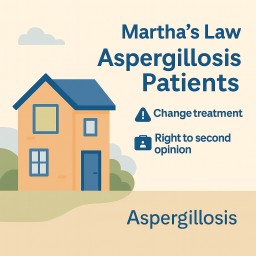
👩‍⚕️ Martha’s Law – What It Means for Aspergillosis Patients

Why the law was introduced

  • Martha Mills was a 13-year-old girl who died in 2021 after developing sepsis in hospital.

  • Her parents felt their concerns were not acted on quickly enough and that they were not given access to a second opinion.

  • In response, the government announced Martha’s Law, to ensure patients and families can easily get a second clinical opinion if they feel their concerns are not being taken seriously.


What the law requires

  • Hospitals must provide a clear and simple process for patients and families to request a second opinion from a senior doctor.

  • This right applies when someone feels that:

    • Their symptoms are worsening or not being managed properly.

    • They are not being listened to by the care team.

    • They need reassurance that their treatment plan is the right one.

  • Staff must also inform patients and carers about this right so people know it is available.


Why this matters for people with Aspergillosis

  • Aspergillosis is a rare and complex condition, and not all hospitals or clinicians have specialist knowledge.

  • Symptoms (e.g. breathlessness, chest pain, fever, wheeze, coughing blood) can be misinterpreted as asthma, pneumonia, or something less serious.

  • Martha’s Law means that if you or your family feel your care isn’t right, you can:

    • Request a second opinion promptly.

    • Be assessed by another senior doctor, potentially with respiratory or infectious disease expertise.

    • Gain access to the National Aspergillosis Centre or another specialist service if appropriate.


What you can do if concerned

  • Speak up early: tell staff if you are worried about your symptoms getting worse.

  • Ask for a second opinion: mention “Martha’s Law” if you feel you’re not being heard.

  • Bring your information: if you’re an aspergillosis patient, carry your clinic letters or patient passport to help new doctors understand your condition.

  • Involve carers/family: they can raise concerns on your behalf if you are too unwell.


In summary: Martha’s Law ensures that patients and families have the right to be heard and to request a second medical opinion. For people with aspergillosis, this could be life-saving when symptoms are worsening and urgent, specialist input is needed.


🧑‍🤝‍🧑 Taking Part in Your Own Care: Shared Decision-Making, Self-Management & Advocacy in the NHS

Living with a long-term condition like aspergillosis can be complicated. You may see hospital specialists, your GP, nurses, pharmacists, and sometimes social services too. The NHS is working hard to make sure patients aren’t just “done to,” but are real partners in decisions about their own health.

This approach is called shared decision-making and supported self-management.


🌱 Where did this idea come from?

  • It’s a core part of the NHS Long Term Plan (2019, refreshed 2023/24).

  • The aim: give patients a stronger voice, improve care outside hospital, and reduce emergency admissions.

  • It grew out of earlier “shared care” models, where GPs and hospitals split prescribing or monitoring tasks. Now the focus is much wider: putting patients at the centre of their own care.


💡 What does it mean?

Shared decision-making

  • You and your clinicians decide together.

  • Doctors explain the evidence, options, risks, and benefits.

  • You share what matters most to you — daily life, family, work, fears, and preferences.

  • Example: deciding whether to start biologics, taper steroids, or continue antifungal therapy.

Self-management

  • You are supported to handle your condition day-to-day.

  • This includes recognising early warning signs, having an action plan, knowing when to call for help, and using tools like the NHS App or support groups.

  • Education, pulmonary rehab, peer groups, and digital health apps can all help.


🚧 Barriers patients may face

Even though the NHS wants all patients involved in their care, challenges exist:

  • Short appointments that leave little time for discussion.

  • Medical jargon that is hard to follow.

  • Confidence gaps, especially when you feel unwell.

  • Health inequalities (literacy, language, digital access).

  • Fragmented care, where GP and hospital don’t always join up.

  • Information overload — too much general advice, not enough personalised guidance.


🧑‍🤝‍🧑 Can you have an advocate?

Yes. You don’t have to face this alone. Advocacy can come from:

  • Specialist nurses at the National Aspergillosis Centre (NAC) or your local hospital.

  • Family or friends — you are always entitled to bring someone to appointments.

  • Peer groups like NAC CARES, where other patients share practical advice.

  • PALS (Patient Advice and Liaison Service) in every NHS trust.

  • Healthwatch (local branches) or independent advocacy charities.


🔎 Care Coordinators & Link Workers

These are newer NHS roles that help patients navigate complex care.

Care coordinators

  • Support people with complex, long-term conditions.

  • Help organise appointments, blood tests, and follow-up.

  • Make sure GPs, hospitals, and community services talk to each other.

  • Often based in Primary Care Networks (PCNs) or specialist hospital clinics.

Social prescribing link workers

  • Focus on the non-medical side of health.

  • Connect patients to local community support, peer groups, exercise schemes, benefits advice, or housing help.

  • Anyone struggling with isolation, anxiety, or lifestyle issues can be referred.


📋 Criteria for Accessing Care Coordinators & Link Workers

Care Coordinators – who qualifies?

  • Patients with two or more long-term conditions, or one condition requiring complex management (e.g. aspergillosis with antifungals, steroids, biologics, adrenal monitoring).

  • People on multiple medicines or with frequent hospital admissions.

  • Patients needing help to coordinate care between GP, hospital, pharmacy, and community services.

  • Prioritised for those at risk of “falling through the cracks” in the system.

Social Prescribing Link Workers – who qualifies?

  • Any patient whose social or practical situation affects their health.

  • Examples:

    • Feeling isolated or low in mood.

    • Struggling with benefits, housing, or finances.

    • Wanting help with lifestyle changes.

    • Needing connections to peer groups or local activities.

  • Usually no strict medical criteria — referral is based on need.

How referrals usually happen

  • GP or practice nurse refers after spotting a need.

  • Hospital team (e.g. NAC or respiratory clinic) may suggest referral back to the GP/PCN.

  • Some PCNs allow self-referral if the service is advertised locally.


📊 How many coordinators are there?

  • As of mid-2025, NHS England data shows:

    • Around 5,000–6,800 full-time equivalent care coordinators employed across Primary Care Networks.

    • Over 3,500 social prescribing link workers active across England.

  • Numbers vary by area, and coverage is still expanding as ICSs and PCNs grow their teams.


🧠 Why do people think care coordination is mostly mental health?

  • Historically, most care coordinators were employed in mental health services, where patients often need joined-up support from psychiatry, GPs, housing, benefits, and social care.

  • That’s why many people first hear the term “care coordinator” in relation to community mental health teams.

  • But the NHS is now expanding care coordination into physical long-term conditions, including respiratory diseases like COPD, bronchiectasis, and aspergillosis.

  • Access still varies by region — some areas prioritise cancer, frailty, or diabetes, while others are starting to include respiratory patients.


🧑‍⚕️ Care Coordination: Mental Health vs Physical Health

Aspect Mental Health (traditional focus) Physical Health (expanding role)
Where based Community Mental Health Teams Primary Care Networks (GP groups), hospital specialist clinics
Why developed To join up psychiatry, GPs, social care, housing, and benefits To support patients with multiple long-term conditions (e.g. COPD, diabetes, aspergillosis)
Patient needs Severe mental illness, complex social problems, frequent crisis episodes Complex care plans, multiple medicines, hospital visits, difficulty managing appointments
Tasks Coordinate mental health reviews, social support, community referrals Organise tests and follow-ups, link GP and hospital, ensure medication and monitoring plans are clear
Referrals Usually from psychiatrist or community mental health nurse Usually from GP practice, sometimes via hospital specialist or self-referral in PCN areas
Examples Patient with schizophrenia needing GP, psychiatrist, housing officer all linked Patient with aspergillosis on antifungals, steroids, and biologics needing joined-up GP + hospital care
Extra support Peer groups, advocacy, PALS, housing officers Social prescribing link workers, community health support, peer groups (e.g. NAC CARES)

✅ What this means for aspergillosis patients

  • If you have complex care needs (antifungal monitoring, biologics, steroid side-effects, adrenal insufficiency, other chronic conditions), you are likely to meet criteria for a care coordinator.

  • If you are struggling with the social and emotional impact of illness (fatigue, isolation, money worries, lifestyle changes), you may benefit from a link worker.

  • These roles are increasingly available in GP networks, though availability may differ locally.

  • Ask both your hospital team and your GP practice what is available in your area.


🔍 Questions to ask at your next appointment

  • Could I be referred to a care coordinator to help manage my appointments and medicines?

  • Is there a link worker who can support me with non-medical needs?

  • What local services are available through my Primary Care Network or ICS?

  • Who is responsible for updating my care plan?

  • What support is there for my carer or family?


💬 In summary:
Shared decision-making and self-management mean you are an active partner in your care. Aspergillosis is complex, but you don’t have to manage it alone. Between your hospital specialists, GP, advocates, and newer NHS roles like care coordinators and link workers, there is growing support available across the NHS to help you live better and feel more in control.


⚠️ Mistakes in NHS Care: Why They Happen & What You Can Do

🔎 Why mistakes happen

  • Heavy workload: Doctors and nurses handle huge numbers of patients and results every day.

  • Fragmented IT systems: GP, hospital, and lab systems don’t always link, so information can get lost.

  • Human error: Fatigue, multitasking, and assumptions all increase the risk of oversight.

  • Defensive culture: Trusts sometimes minimise problems to protect reputation or avoid litigation.

Most errors are not deliberate — but they can cause harm if they are not caught quickly.
Martha’s Rule was created after a young girl died when her family’s concerns were ignored — it’s designed to stop that happening again.


🛡 What safeguards are already in place?

Although mistakes still happen, the NHS has many systems to reduce risk and catch errors early:

  • Critical results alerts: Labs automatically flag dangerously abnormal results so they cannot be overlooked.

  • Early Warning Scores (NEWS2): Vital signs generate a score that prompts urgent review if the patient is deteriorating.

  • Sepsis protocols: Hospitals have rapid-response pathways for suspected sepsis.

  • Cross-checking: High-risk drugs often require two professionals to sign off.

  • Incident reporting: Staff can log “near misses” to help the system learn.

  • Duty of Candour: Trusts must inform patients if serious harm has been caused by an error.

  • Martha’s Rule: Gives patients/families the right to request an urgent independent review if they feel concerns are being ignored.


💻 Are new IT systems making care safer?

The NHS is moving to large electronic patient record (EPR) systems such as Epic, Cerner and Lorenzo. These bring real safety gains:

Safer features

  • Automatic alerts for critical blood results.

  • Built-in early warning score (NEWS2) calculations to detect deterioration.

  • Electronic prescribing with dose, allergy, and interaction checks.

  • Shared records across hospitals, GPs, and community services.

  • Digital audit trails showing who reviewed results and when.

But challenges remain

  • Too many alerts can cause “alert fatigue,” leading staff to dismiss warnings.

  • System crashes or downtime can force staff back to paper, which is less safe.

  • Complexity can slow clinicians down until they are confident with the system.

  • Hospital and GP systems still don’t fully integrate everywhere, so results can still be missed.

Bottom line: New IT has improved safety compared to the old paper-and-fax systems, but it isn’t foolproof. It works best alongside clinical vigilance and patient involvement.


✅ What you can do if you suspect a mistake

Step 1. Check directly with the clinical team

  • Ask: “Can you confirm this result/issue has been reviewed?”

  • Request a written explanation or clinic letter.

  • Keep notes of the conversation.

Step 2. Escalate to a senior doctor/clinical lead

  • Ask who the consultant in charge is.

  • Write your concern clearly and factually.

Step 3. If your loved one is deteriorating: use Martha’s Rule

  • You can request an urgent review by a critical care team, separate from the ward team.

  • Available 24/7 in hospitals where introduced.

  • Say: 👉 “We want a review under Martha’s Rule.”

  • If not yet in your hospital, ask for the critical care outreach team.

Step 4. Contact PALS (Patient Advice & Liaison Service)

  • They can chase answers and log concerns.

Step 5. Make a formal complaint to the Trust

  • Keep it factual (what happened, why it matters, what outcome you want).

  • The Trust must acknowledge within 3 working days.

Step 6. Escalate outside the Trust

  • If unsatisfied, go to the Parliamentary and Health Service Ombudsman (PHSO).


🧭 Tips to protect yourself & your family

  • Keep copies of all results and letters.

  • Track your results in a simple log.

  • Bring support (family, advocate, charity like AvMA).

  • Stay factual: stick to dates, facts, and impact.


🔑 Key message

Mistakes in healthcare happen for many reasons — but the NHS has safeguards and new IT systems to reduce risk, and Martha’s Rule adds an extra urgent safety net.

Patients and families still play a vital role by asking questions, checking results, and speaking up.

You are not being difficult — you are being safe.


Misinformation on Social Media: Health and Beyond

Social media helps us stay connected, share experiences, and find support. But it also spreads false or misleading stories — about health, politics, money, and world events. These stories can cause unnecessary fear, confusion, and sometimes real harm if people act on them.

Understanding why misinformation spreads, what’s being done about it, and how to spot it helps keep you and your loved ones safe.


🚩 Why do false stories spread?

  1. Algorithms reward attention
    Platforms are designed to keep you scrolling. Content that shocks (“miracle cure discovered!”), scares (“hidden danger you’re not being told about!”), or excites spreads the fastest — even if it isn’t true.

  2. Anyone can post anything
    Unlike newspapers, medical journals, or BBC/NHS websites, most social media posts aren’t checked by editors or experts before going live.

  3. Echo chambers
    Platforms show you more of what you already click on. If you read about miracle diets or political conspiracies, you’ll see more of them — true or not.

  4. Deliberate misinformation
    Some people spread falsehoods deliberately:

    • To sell fake health products

    • To make money from clicks

    • To influence politics or sow division

  5. Speed beats accuracy
    False stories can go viral in minutes. Corrections are slower and rarely reach as many people.


⚖️ What’s being done about it?

Legal approaches

  • UK: The Online Safety Act (2023) requires platforms to remove illegal or harmful misinformation, including dangerous health advice.

  • EU: The Digital Services Act (DSA) makes large platforms responsible for acting faster against harmful content.

  • Extreme cases: Fraud, scams, defamation, or incitement of violence are not protected speech and can be prosecuted.

Technical approaches

  • Algorithms: AI flags suspicious posts.

  • Labelling: Content can be marked as “false” or “missing context.”

  • Bot control: Platforms limit fake accounts that spread stories at scale.

  • Digital nudges: Some apps ask “Do you want to read before sharing?” or warn if a post is outdated.

The limits

  • Freedom of speech protects many misleading opinions unless they cause direct harm.

  • Global reach makes it hard to police.

  • Volume — billions of posts daily are impossible to check one by one.

  • Trust — some people ignore fact-check labels, believing platforms are biased.


🧐 How to know what’s real

Five quick checks:

  1. Who is posting it? NHS, WHO, BBC, or Reuters → reliable. Unknown influencer or “miracle cure” shop → beware.

  2. Is it reported elsewhere? Real news appears in multiple reputable outlets.

  3. Does it use scare tactics or hype? “Doctors don’t want you to know this secret cure!” → red flag.

  4. Can you fact-check it? Try NHS.uk, Full Fact (UK), Snopes, Reuters Fact Check or BBC Verify.

  5. Check dates and pictures — old or unrelated content is often recycled to look new.


🚦 The traffic-light test

  • 🟢 Green – from official sources, confirmed, calm tone → likely true.

  • 🟡 Amber – source unclear, dramatic style, no confirmation elsewhere → pause, check.

  • 🔴 Red – sensational, “miracle” claims, conspiracy, or urging you to share → almost certainly false.


💡 Should we avoid social media completely?

Not necessarily. Social media has real value for support, awareness, and connection. The key is using it wisely:

  • Follow trusted organisations for health and news.

  • Unfollow or mute accounts that regularly spread falsehoods.

  • Balance social media with direct trusted sources (NHS, GP, recognised news).

  • Step away if scrolling leaves you anxious, angry, or confused.


✨ Bottom line

False stories spread online because the system rewards attention, not accuracy. Laws and technology help, but they can’t stop misinformation entirely.

The best defence is awareness. Before acting on or sharing any post — whether about health, politics, or world events — pause, check, and if in doubt, don’t share.

👉 Protecting yourself from misinformation means protecting your community too.


Being Heard in Healthcare: Confidence, Communication, Gender Bias, and Your Rights

Living with aspergillosis or severe asthma often means frequent contact with healthcare professionals — GPs, hospital specialists, nurses, physiotherapists, pharmacists, and more. Most of these encounters are positive, but sometimes patients leave feeling they weren’t truly listened to. This can be frustrating, especially when symptoms are complex, variable, or invisible to others.

Why Some Patients Feel Unheard

Some patients report that their background, gender, education, or knowledge of their condition seems to affect how clinicians speak to them. If a clinician thinks you are “well informed,” they may change their approach — sometimes giving you more detail, but occasionally becoming defensive or dismissive.
This shouldn’t happen. Every patient deserves the same respect, attention, and clear explanations, regardless of their background or experience.

Occasionally, what feels like healthcare ego may actually come from other sources:

  • Time pressure in busy clinics

  • Stress or fatigue

  • Overconfidence in diagnostic skills

  • Unconscious bias about gender, age, or condition severity

The Role of Gender Bias

Research in the UK and internationally shows that gender can sometimes influence how symptoms are interpreted and how seriously they are taken. Women are, on average, more likely to have their symptoms attributed to stress or anxiety, while men may be assumed to under-report pain or discomfort.
In conditions like asthma and aspergillosis — where breathlessness, fatigue, and chest symptoms may not always show clearly on tests — this bias can delay diagnosis, affect treatment urgency, and shape how much explanation is given. Recognising that this bias exists can help you prepare to advocate for yourself more effectively, regardless of gender.

The Women’s Health Strategy for England — A Step Forward

The Women’s Health Strategy for England (gov.uk link) is a landmark initiative aiming to transform how healthcare listens to and serves women. It highlights priorities that matter for anyone with a long-term, complex condition:

  1. Women’s Voices Must Be Heard – 84% of women surveyed said they often felt ignored or dismissed by healthcare professionals.

  2. More Inclusive Policies and Training – Increased focus on women’s health education for healthcare staff and embedding shared decision-making into routine care.

  3. Closing the Research Gap – Improving female representation in clinical research and analysing data by sex and life stage.

  4. System-Level Change – Appointing a Women’s Health Ambassador, setting up women’s health hubs, and introducing women’s health leads for accountability.

For the aspergillosis community, this means a greater push for inclusive research, equal access to treatment, and recognition of symptoms that might otherwise be overlooked.

What to Do if You Feel You Weren’t Heard

If you leave an appointment feeling your concerns weren’t addressed:

  • Restate your main concern politely but firmly, explaining why it matters.

  • Ask the clinician to repeat back what they understood, so you can correct any misunderstandings.

  • Request that your concerns be recorded in your medical notes.

  • Follow up in writing via a patient portal, email, or letter.

  • Bring a trusted supporter (trusted friend, family member, or advocate) to future appointments to help make your case.

Building Confidence in Healthcare Conversations

Confidence in speaking up grows with preparation:

  • Prepare your top two or three key points before the appointment.

  • Practise saying them aloud so they feel natural.

  • Use clear phrases like “I am concerned about…” or “I need to understand…”

  • Remember — you have a right to clear information about your diagnosis, treatment, and risks.

  • If you can’t speak up in the moment, follow up in writing afterwards.

Why This Works — The Evidence

Research shows prepared, assertive patients get clearer, more thorough answers:

  • The Ask Me 3 approach improves understanding and engagement.

  • Shared decision-making studies show prepared patients are more likely to have concerns addressed and remember what was discussed.

  • BMJ and Patient Education & Counseling studies find that specific, assertive language leads to better explanations and consideration of alternatives.

  • Having an advocate present improves follow-up and adherence to care plans.

Final Thought

In aspergillosis care, where symptoms can be complex and treatments long-term, good communication is as important as good medicine. Speaking up respectfully but confidently helps you get the care you need and supports a culture where every patient — regardless of gender or background — is listened to from the first moment. The Women’s Health Strategy shows there is now national recognition of these issues, and your voice is a vital part of making change happen.


💭 Why Some People with Aspergillosis Delay Going to A&E

And Why That Could Be Dangerous

If you live with chronic aspergillosis — whether CPA, ABPA, SAFS, or aspergillus bronchitis — you’ve probably had moments where your symptoms suddenly worsened and you didn’t know what to do. Maybe you’ve thought about going to A&E, or even dialling 999, but something stopped you.

You're not alone. Many people in our community feel reluctant to seek emergency care, even when they’re very unwell.

Here’s why — and why it matters.


🏥 “I’ve Been to A&E Before — and It Wasn’t a Good Experience”

Many patients have told us:

  • “I waited for hours just to be told it’s probably my usual symptoms.”

  • “The staff didn’t seem to know what aspergillosis is.”

  • “They didn’t know how to manage my antifungal treatment or asthma.”

  • “I felt dismissed — like I was being dramatic.”

Experiences like this can leave people feeling humiliated or unsafe, and understandably less likely to go back — even when things are serious.


🛏️ “I Don’t Want to Be Admitted — I’ll Be Stuck There”

A&E can be a gateway to hospital admission, and for someone managing a complex, fluctuating condition at home, this can feel like losing control. You may worry about:

  • Being put on the wrong ward

  • Catching infections

  • Not being given the right antifungal, steroid, or oxygen support

  • Losing time, independence, or confidence

So instead, you might choose to stay home — sometimes too long.


⌛ “I Don’t Want to Waste Anyone’s Time”

We hear this all the time:

“A&E is for people who are really ill — not for someone like me.”
“The NHS is already overwhelmed.”
“I’ll just give it a bit more time.”

But remember: you’re not wasting time by going to A&E if your health is deteriorating. Chronic illness doesn’t make your emergency less urgent — it just makes it harder to spot.


😔 “I’m Tired of Needing Help”

Living with chronic aspergillosis is exhausting. It’s easy to feel like:

  • “I should be able to manage this myself.”

  • “I don’t want to be a burden.”

  • “It’s probably just another bad flare.”

But when symptoms cross a line — from “bad day” to “dangerous” — it’s vital to act. Seeking urgent care isn’t failure. It’s strength.


🌫️ “I Didn’t Know It Was That Serious”

The truth is: even very experienced patients often aren’t sure when symptoms need emergency treatment. You might think:

  • “I’ve had breathlessness before — I’ll just rest.”

  • “The coughing is worse, but it’s happened before.”

  • “I’ll wait until the morning and see.”

But if you’re coughing blood, can’t speak a sentence, can’t stand up, or feel confused or faint, waiting is dangerous.


💬 “I Asked in a Group First”

Support groups are amazing — and a lifeline for many. But no group can diagnose an emergency. If you're:

  • Asking whether to go to A&E

  • Describing symptoms that sound like respiratory failure, sepsis, or adrenal crisis

  • Hoping someone tells you not to worry...

Then it’s already time to act, not wait for replies.


✅ Final Message

If you have severe symptoms, sudden changes, or feel frightened about your health:

Don’t wait. Don’t post. Don’t hope it passes.
Call 999 or go to A&E.

You are not a burden. You are not overreacting.
You are saving your own life.

When to go to A&E or call 999


Cyber Safety for Aspergillosis Patients: Supplement to UK NCSC Advice

This guide builds on the official UK Government cybersecurity advice for families and individuals (www.ncsc.gov.uk/section/advice-guidance/you-your-family) and adds patient-specific tips for people with aspergillosis.


Feeling overwhelmed?

You're not alone. The internet and phone landscape can feel like a minefield, especially when you're trying to manage your health too. No one expects you to become an expert in cybersecurity overnight. The aim of this guide isn’t to scare you — it’s to help you take small, realistic steps to protect yourself.

Just like with your health, doing the basics well goes a long way. You don’t need to memorise everything — focus on:

  • Using strong passwords (or a password manager)
  • Being cautious with texts, links, and phone calls
  • Asking for help when something doesn’t feel right
  • Always accept updates on your phone, browser, or computer when offered — these often fix known security problems and help keep you protected.

It's okay to stop and ask: “Does this sound right?” If in doubt, check with someone you trust.


Top Scam Red Flags

Watch out for these common signs that something could be a scam:

  • You’re told to act urgently or keep it secret
  • You’re offered money, discounts, prizes or help out of the blue
  • You’re asked to click a link or open an attachment in a message
  • A caller claims to be from the bank, NHS, government, or police, but something feels off
  • You’re told the second part of a message will come from a different number or address
  • You’re asked to confirm personal, financial or password information
  • You’re asked to download software or apps to “fix” your device
  • You’re pressured to stay on the phone or not call anyone else

If in doubt, hang up, delete, or double check with someone you trust.


1. Protecting Your NHS and Medical Accounts

  • Use strong, unique passwords for your NHS login, GP apps (e.g. Patient Access, myGP), or hospital portals.
  • Enable two-factor authentication (2FA) wherever it’s offered.
  • Never share your NHS login or codes with anyone.
  • Always go directly to the official app or website, not through links in emails or texts.

2. Beware of Scams

  • Scams can take many forms — phone calls, emails, texts, or fake websites.
  • Be especially wary of anyone offering money, discounts, prizes, or urgent deals.
  • Criminals may pose as trusted organisations like your bank, utility provider, government, or even the NHS.
  • As a general principle: if something seems too good to be true — such as offers of free money, major discounts, prizes, or miracle cures — it almost certainly isn't real. Be suspicious of anything that promises unusually high benefits for little or no effort.
  • If in doubt, forward suspicious messages to [email protected] (Link) or speak to someone you trust before taking action.

3. Using Online Support Groups Safely

  • Facebook groups and forums can be great for connection, but don’t post:
    • Your address, phone number, or full date of birth
    • Photos of prescriptions or test results
  • Don’t click links shared by strangers, even if they seem friendly.
  • Moderators or admins should never ask for sensitive personal details.

4. Shopping and Donations

  • Be cautious when buying medical supplies or donating online.
  • Stick to trusted UK pharmacies and charities.
  • Watch for copycat sites that look like legitimate health organisations.

5. Email, Phone & Text Safety

  • Don’t click on links or open attachments in messages claiming to be from the NHS, unless you were expecting them.
  • Never share passwords or bank details over email or text.
  • Never give out your account numbers or passwords, especially if someone is trying to rush or pressure you.
  • Scam texts can fake NHS or GOV.UK addresses — check official sites if unsure.
  • Even texts or emails that appear to come from your bank can be faked. A common red flag is a message saying that a second text or email will come from a different number or sender — ask yourself why a genuine organisation would do this. Real authorities go to great lengths to be verifiable.
  • If someone calls and tries to rush or scare you, hang up and call back using an official number from the NHS or your GP’s website.
  • If in doubt — or even as a general principle — hang up and call a number you can verify yourself, such as:
    • The number printed on the back of your bank card
    • The official website of a company or authority (searched independently)
  • Avoid using any contact information provided by the caller or in a suspicious message — treat it as untrustworthy until confirmed.
  • To check a suspicious link in a text, don’t click — instead, search for the organisation’s website directly or ask someone you trust.

6. If You're Shielding or Vulnerable

  • You may be more targeted by scams pretending to offer:
    • COVID-19 test kits, antifungal treatments, or priority delivery slots
    • Access to urgent medical appointments or services
  • Verify any offer with your NHS care team before taking action.

7. Keeping Your Devices Safe

  • Install antivirus and keep your phone/tablet/computer updated.
  • Always accept software updates — they patch security flaws that criminals may try to exploit.
  • Set devices to auto-lock and use a passcode or fingerprint.
  • Avoid using public Wi-Fi for medical logins or financial information.

Do You Still Need Antivirus?

  • Windows PCs: Yes — always install antivirus. Microsoft Defender (built-in) is good and free. You can also consider free versions of AVG, Avast, or Bitdefender.
  • Mac computers: Less targeted, but still recommended. Free options include Avira or Sophos Home.
  • Android phones: A good idea, especially if you install apps outside the Play Store. Try Bitdefender or AVG.
  • iPhones/iPads: Antivirus apps aren’t usually needed if you keep iOS updated and install apps only from the App Store.

Whichever device you use, updates and cautious browsing are just as important as antivirus software.


8. Best Ways to Use Strong Passwords

Cyber security can be time-consuming and even irritating — but as malicious activity becomes more sophisticated, it’s worth the effort. Consider using different levels of passwords for different kinds of accounts:

  • Low-level passwords for things like newsletters or forums
  • High-level, strong passwords for NHS, banking, or health-related logins

Make Passwords Long and Unique

  • Use at least 12 characters, mixing letters, numbers, and symbols
  • Avoid personal info like names or birthdates

Use a Password Manager

  • Tools like Bitwarden, 1Password, or Apple Keychain securely store passwords
  • You only need to remember one master password

Use Passphrases for Important Accounts

  • Combine random words to create a memorable but strong password, like:
    • Correct!Horse-Battery!Staple99

Turn On Two-Factor Authentication (2FA)

  • Adds a second layer of protection, such as a code from your phone
  • 2FA ties your account to a specific device (like your phone), meaning a criminal would need access to that device as well as your password to break in

Use a Unique Password for Every Account

  • Never reuse passwords

Avoid These Mistakes

Mistake Better Option
Reusing passwords Use a password manager
Writing them down Use encrypted storage
Adding "123" to a word Use unrelated, random words/symbols

When to Change Passwords

  • If your account may have been hacked
  • If the same password is used elsewhere

Is It Safe to Use Chrome or Other Browser Autofill?

Using Chrome, Firefox, Safari, or Edge to autofill logins can be safe with the right precautions:

  • Your device should be private and locked with a passcode or fingerprint
  • Your browser and operating system should be kept fully up to date
  • You should avoid storing logins for sensitive accounts (e.g. banking, NHS login)

Risks to consider:

  • Passwords stored in browsers can be accessed by malware or rogue extensions
  • If someone gets access to your device, they may access saved logins

Safer Alternative:

  • Use a dedicated password manager (like Bitwarden, 1Password, or Dashlane)
  • These offer stronger security and are harder for malware or hackers to access

If you do use browser autofill, protect your device and account with:

  • Two-factor authentication for your Google, Apple, or Microsoft account
  • A strong device password or biometric lock

9. Finding the Happy Medium

Cybersecurity doesn’t have to take over your life — the key is to find a realistic balance between staying safe and staying sane:

  • Focus on protecting your most important accounts first — especially NHS, email, banking, and anything medical
  • Don’t ignore warning signs, but don’t feel you have to be perfect with every app or device
  • Use automation where possible (e.g. password managers, browser autofill, device lock)
  • Ask for help if you’re unsure — carers, family members, or digital support charities can assist

Think of it like seatbelts — you hope you never need them, but they’re worth the hassle when something goes wrong.


Useful Links


Remember: Your health is private and valuable. Treat your medical and personal information like you would your bank details. Stay cautious, ask questions, and when in doubt, ask a trusted health professional or carer.


🫁 Is It an ABPA Flare or a Bronchiectasis Flare? How to Tell the Difference

If you have aspergillosis, especially ABPA (Allergic Bronchopulmonary Aspergillosis) and bronchiectasis, it can be hard to know which one is flaring up when your lungs feel worse. They often overlap — but there are some clues that can help.


🔍 How the Two Conditions Are Different

Feature ABPA Flare (Allergic Reaction to Aspergillus) Bronchiectasis Flare (Infection in Damaged Airways)
Main cause Your immune system reacting to Aspergillus Infection in widened, inflamed airways
Symptoms you may notice - Chest tightness or wheezing
- Thick, sticky mucus
- Feeling more tired
- Occasional low-grade fever
- Wet cough with more sputum
- Sputum changes colour (green/yellow)
- Fever, chills, or general unwell feeling
How it starts May come on gradually or after exposure to damp/mould Often starts after a cold or virus
What helps most Steroids (inhaled or oral), sometimes biologics Antibiotics and chest physiotherapy
What tests may show - Raised IgE or eosinophils
- CT may show mucus plugs
- Raised CRP or white cells
- Sputum may grow bacteria or fungus
What to ask your doctor “Is my IgE or eosinophil count up?” “Do I need a sputum test or antibiotics?”

🧭 What Can You Do as a Patient?

  • 📝 Keep a symptom diary – especially note changes in:

    • Sputum colour or amount

    • Wheezing or chest tightness

    • Tiredness or sleep quality

  • 🧪 Ask for the right tests:

    • Blood tests like IgE and eosinophils for ABPA

    • CRP, white blood count, and sputum tests for bronchiectasis

  • 🩺 Don’t guess or self-treat – steroids and antibiotics work in different ways, and using the wrong one can make things worse or mask important signs.


💬 Final Thought

It's very common for people with aspergillosis to feel confused by flare-ups — you're not alone. Learning to spot your own patterns, and getting support from your specialist team, can make a real difference.


🧾 Getting a Second Opinion for Aspergillosis: What If Your Hospital Refuses?

Many patients living with aspergillosis or allergic bronchopulmonary aspergillosis (ABPA) ask for a second opinion — often from a national centre like the National Aspergillosis Centre (NAC) in Manchester or from another specialist elsewhere in the UK. But sometimes, hospitals resist sending your case outside their own department.

Here’s what’s happening, why it might occur, and what you can do.


🤔 Why Would a Hospital Refuse an Outside Opinion?

It’s understandably frustrating when you’ve asked for expert help and your local hospital insists on keeping things “in-house.” Here are some reasons this might happen:

1. Internal Referral Rules

Hospitals sometimes have a policy to refer to another consultant within their own department first. They may consider this a “second opinion,” even if it’s not truly independent.

2. Cost and Complexity

Referrals to another NHS trust — especially across health boards or into England (e.g. to NAC) — can involve extra steps and costs. Some hospitals prefer to avoid that unless they feel there’s no choice.

3. Professional Sensitivities

Some doctors may feel a national second opinion implies criticism of their care, even if your request is made respectfully.

4. Lack of Awareness

Some clinicians aren’t fully aware of what the National Aspergillosis Centre offers — or may underestimate how complex aspergillosis, ABPA, or recurrent fungal infections can be.


🧑‍⚕️ But Isn’t a Specialist Opinion My Right as an NHS Patient?

Yes. If your GP or hospital team believes it’s clinically appropriate, you have the right to be referred to another NHS consultant — including one outside your local area.

The NAC is nationally commissioned by NHS England to provide care for people with chronic aspergillosis. They accept referrals from across the UK.


💷 Why Private Care Might Not Be an Option

Some patients consider going private when local NHS referrals are blocked — but private care often means:

  • Paying for new scans, blood tests, and sputum cultures

  • No direct access to previous NHS records

  • Higher costs than expected, especially for complex tests

If you can’t afford this, you are not alone, and there are still NHS options available.


🧭 What You Can Do Next

Here are practical steps if you're being blocked from getting a second opinion:

✅ 1. Restate Your Request Clearly

Ask your GP (or write yourself) to reply to the hospital and explain:

  • You are specifically asking for an opinion from a national expert service (e.g. NAC or Dr Iain Page in Edinburgh).

  • This is not a rejection of their care, but a request for specialist reassurance, diagnosis support, or treatment planning.

✅ 2. Ask for a Tertiary Centre Referral

Use the term “tertiary referral” — this means a referral to a national or highly specialised NHS service.

✅ 3. Raise It with PALS

If you're still being blocked, contact your local Patient Advice and Liaison Service (PALS) or NHS complaints team. Explain:

  • You have a rare/complex condition,

  • You’ve asked for a national review,

  • And you’ve been offered only an internal opinion.

✅ 4. Get support on NAC Support Facebook Group

  • https://www.facebook.com/groups/aspergillussupport/

💬 In Summary

  • You’re not being difficult — you’re advocating for your health.

  • It is reasonable and often necessary to seek input from specialists like those at the NAC.

  • If you’ve been told “no,” it may be due to policies or misunderstandings — not a reflection on your need for better care.

  • Keep asking, and if needed, involve your GP, or PALS.


🛡️ Staying Safe with Self-Treatment and Complementary Therapies: A Guide for Aspergillosis Patients

Living with a chronic condition like aspergillosis — whether chronic pulmonary aspergillosis (CPA), allergic bronchopulmonary aspergillosis (ABPA), severe asthma with fungal sensitisation (SAFS), or aspergillus bronchitis — can be exhausting. Many patients explore over-the-counter (OTC) products, natural remedies, or complementary therapies to gain a sense of control.

But how can you be sure a product or therapy is safe, effective, and not a waste of money?

This guide aims to help.


🔍 Why Do Patients Try Things on Their Own?

In many countries, it’s common to self-medicate or explore alternative treatments without consulting a healthcare professional. Reasons include:

  • Limited access to specialist care

  • Cultural norms that favour self-management

  • Easy access to remedies and supplements online or in shops

  • Feeling unheard or unsupported in mainstream medical care

Even in the UK, patients with aspergillosis may turn to:

  • Herbal products

  • Nutritional supplements

  • Creams or gels with capsaicin (chilli), turmeric, or menthol

  • Breathing techniques, steam inhalation

  • “Immune-boosting” diets or over-the-counter fungal cleanses

Some of these may be helpful — but not all are safe or worthwhile.


✅ Step 1: How to Check if a Product or Therapy Is Safe

Before trying anything new, ask:

1. Is it approved or regulated in the UK?

Medicines and certain creams should have a Product Licence (PL) number, issued by the Medicines and Healthcare products Regulatory Agency (MHRA).
You can check the licence on the MHRA product registry.

2. Could it interact with your prescribed medications?

  • Some herbal remedies affect azole antifungal drugs (like itraconazole or voriconazole) or oral steroids.

  • Ask your GP (General Practitioner), specialist, or pharmacist before combining treatments.

3. Is it safe to apply or inhale?

  • Never use essential oils, menthol, or herbal mixtures in a nebuliser unless clearly intended for lung use.

  • Avoid applying hot or irritating creams to broken or sensitive skin.

4. Is it mentioned in NHS guidance?

Stick to advice on:


⚠️ Watch Out for Red Flags

Be cautious of any product, practitioner, or website that:

🚩 Red Flag ⚠️ Why It’s a Concern
Claims to “cure” aspergillosis There is no cure — only long-term management
Says it’s “100% natural with no side effects” Natural products can still be harmful
Uses high-pressure sales tactics Legitimate care is never urgent or fear-based
Recommends stopping your prescribed treatment Stopping antifungals or steroids can be dangerous

🧪 Step 2: Look for Evidence, Not Just Testimonials

Some treatments are promising — but we need solid evidence to know they work.

✅ Good sources of trustworthy evidence:


💬 Can You Trust a Pharmacist?

Yes — in most cases, UK pharmacists are highly trained and regulated. However, there are two kinds to be aware of:

Type of Pharmacist What to Know
Retail Pharmacist May sell you products directly; still bound by safety standards
Clinical Pharmacist (in GP surgeries or hospitals) Focused entirely on clinical care and not sales-driven

Both are regulated by the General Pharmaceutical Council (GPhC) and must put patient safety first, regardless of sales.

🟢 Ask them:

  • “Will this interact with my medications?”

  • “Is this supported by NHS or NICE?”

  • “Would this be suitable for someone with CPA or ABPA?”


🧘 What About Complementary Therapies?

Some patients explore:

  • Acupuncture

  • Herbal medicine

  • Osteopathy or chiropractic

  • Reflexology or massage

  • Nutritional therapy

  • Mindfulness and yoga

These may help with:

  • Muscle or joint pain

  • Fatigue and sleep problems

  • Emotional stress or anxiety

They can complement your medical treatment — but should never replace it.

✅ Safe if:

  • Practitioner is registered with a reputable UK body

  • The therapy does not interfere with prescribed medications

  • It is used for symptom relief, not for “cleansing” or treating the infection

❌ Risky if:

  • It’s marketed as a cure for aspergillosis

  • It encourages you to stop medical treatment

  • It is expensive, secretive, or vague about its effects

Reputable UK Registers:

Practitioner Type Regulator / Body
Acupuncturists British Acupuncture Council (BAcC)
Herbalists National Institute of Medical Herbalists (NIMH)
Osteopaths General Osteopathic Council (GOsC)
Chiropractors General Chiropractic Council (GCC)
Nutritionists Association for Nutrition (AfN)

🧾 Summary: A Safer Way to Explore New Treatments

Do This Avoid This
Check the MHRA or NHS website Trusting social media or forums alone
Look for a PL number and regulated status Using unlicensed creams, drops, or nebuliser fluids
Ask your pharmacist or GP about interactions Assuming “natural” means harmless
Use one new treatment at a time Trying multiple new remedies together
Start with low doses or small trial sessions Buying expensive long-term “packages” up front

📘 Real Example: Using Capsaicin Cream for Pain

Some patients with back pain or joint discomfort have tried capsaicin cream (chilli-based), especially if they cannot tolerate non-steroidal anti-inflammatory drugs (NSAIDs) like ibuprofen.

✅ It’s safe for many people when:

  • Applied in small amounts to intact skin

  • Hands are washed after use

  • Used up to 4 times daily

  • Product is licensed (e.g. Zacin® 0.025%)

⚠️ It may cause a burning feeling for the first few days.
Avoid contact with eyes, mouth, or mucous membranes.

Ask a pharmacist before use — especially if you’re on steroids, have skin thinning, or are very sensitive to heat or irritation.


🗂️ Want to Learn More?