Key points
- People wear masks for different reasons: reducing fungal spore exposure, avoiding respiratory viruses, protecting others, reducing allergens, or limiting exposure to potentially azole-resistant spores.
- A well-fitting, certified FFP2, FFP3 or N95 respirator filters airborne particles more reliably than a loose surgical or cloth mask. It does not eliminate exposure.
- Evidence that respirators filter particles is much stronger than evidence that they prevent ABPA flare-ups, CPA progression or acquisition of azole-resistant Aspergillus.
- For major mould contamination, compost disturbance or heavy dust, avoiding the exposure is preferable to relying on a mask.
- Ordinary walking, sitting in the garden and most everyday outdoor activities do not generally require a respirator.
Why might someone with aspergillosis wear a mask?
A patient asking how to stop their glasses fogging while wearing a mask prompted a wider question: what are we trying to protect ourselves against? People with aspergillosis, ABPA, asthma or bronchiectasis may have very different reasons for wearing one. The best choice depends on the activity, the exposure, the person’s health and whether the aim is to protect the wearer or other people.
There are two main functions. Inward protection reduces particles breathed in by the wearer. Source control reduces respiratory particles released into shared air. A product that performs one function well does not necessarily perform the other equally well.
Five reasons for wearing a mask: what does the evidence say?
1. Reducing exposure to fungal spores
Aspergillus spores occur naturally in indoor and outdoor air. Activities such as opening compost bags, turning compost heaps, clearing rotting vegetation, disturbing dusty soil and some building work can generate much higher exposures. A correctly fitted particulate respirator can reduce the number of spores inhaled.
What is established: particulate respirators filter airborne particles, and environmental exposure is a recognised route for aspergillosis. What remains uncertain: exactly how much occasional respirator use reduces the chance of developing aspergillosis or worsening established disease. The US CDC recommends exposure-reduction precautions for vulnerable people while noting that they have not been proven to prevent aspergillosis.
For people with profound immune suppression, or those advised to avoid dusty work, not doing the task is usually a better first choice than relying on respiratory protection.
2. Reducing exposure to respiratory viruses
Some people with bronchiectasis or severe lung disease use a respirator on public transport, in crowded waiting rooms or other poorly ventilated indoor settings. Their aim is to reduce inhalation of infectious respiratory aerosols. Respiratory viruses can trigger asthma symptoms or bronchiectasis exacerbations.
What is established: a well-fitting respirator reduces inhaled airborne particles, including virus-containing aerosols. What remains uncertain: how many infections or exacerbations routine mask use prevents in people with aspergillosis specifically. Real-world protection depends on fit, consistency, ventilation, exposure and other precautions.
Vaccination where recommended, ventilation and avoiding close contact with people who are ill remain useful additional measures.
3. Reducing the spread of infection to other people
This is the familiar COVID-era use of a mask as a way to catch some of the particles released when a person breathes, talks or coughs. Surgical masks and well-fitting respirators can provide source control, although performance differs by design and fit.
Important distinction: aspergillosis itself is not ordinarily transmitted from one patient to another by coughing. Source control is relevant to respiratory viruses and other transmissible respiratory infections, not to preventing someone from catching aspergillosis directly from another patient.
An exhalation valve can improve comfort, but some designs allow more unfiltered exhaled air to escape. A non-valved respirator is generally the simpler choice when protecting others is an important aim.
4. Reducing allergic triggers in ABPA
Allergic bronchopulmonary aspergillosis (ABPA) involves an exaggerated immune response to Aspergillus, often in people with asthma or cystic fibrosis. It is reasonable to wonder whether filtering airborne fungal allergens might reduce symptoms.
What is established: a suitable respirator can reduce inhalation of airborne fungal particles during an exposure. What remains uncertain: whether routine mask use reduces ABPA exacerbations, steroid requirements or other long-term outcomes. ABPA also involves fungal persistence in the airways; a mask cannot remove organisms or allergens already present there.
People who consistently notice symptoms during particular dusty or mouldy activities may find exposure avoidance helpful, but a mask should not be presented as an established ABPA treatment.
5. Reducing exposure to azole-resistant Aspergillus spores
Some Aspergillus fumigatus strains are resistant to azole antifungal medicines. Resistance can arise in the environment, including through selection associated with agricultural azole fungicide use, and resistant spores can be inhaled by people who have never taken an antifungal.
What is established: environmental acquisition of azole-resistant strains occurs, and a respirator filters resistant and susceptible spores by the same physical mechanism. What remains uncertain: whether wearing a respirator during particular activities reduces the risk of acquiring a resistant infection or changes treatment outcomes. There is no special mask that selectively filters resistant spores.
Which situations justify extra precautions?
| Situation | Practical approach |
|---|---|
| Walking outside or sitting in the garden | Routine mask use is not generally needed; individual advice may differ. |
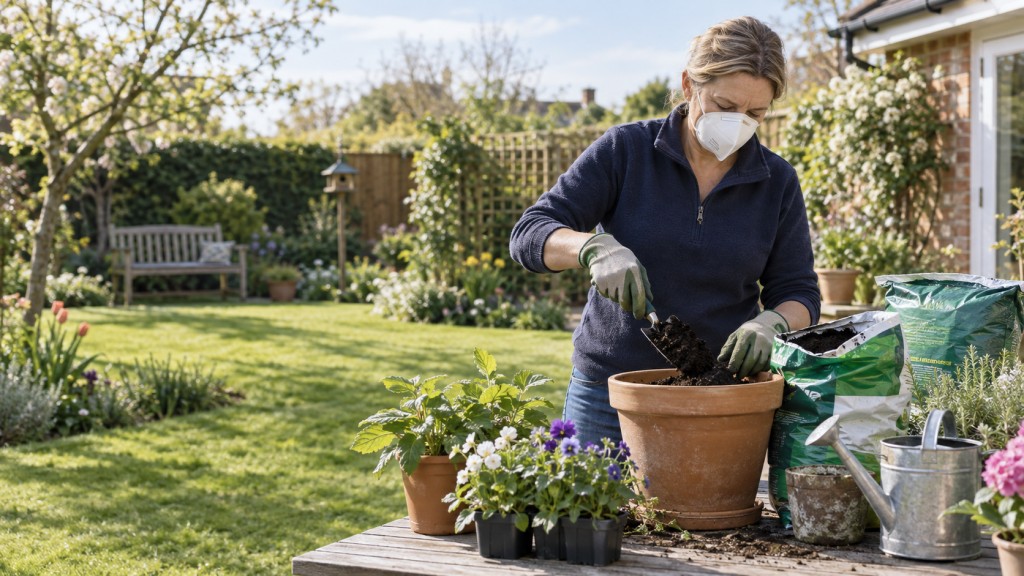
| Opening compost, turning heaps or disturbing rotting leaves | Avoid heavy exposure where possible; ask someone else to do the task, or consider a properly fitting respirator if the task cannot be avoided. |
| Dusty DIY, loft clearance, demolition or major mould removal | Prefer avoidance or appropriate professional help; do not assume a respirator makes major contamination safe. |
| Crowded indoor transport or healthcare waiting rooms | A well-fitting respirator is a reasonable optional extra precaution against respiratory viruses. |
| Bonfire smoke or wildfire smoke | A particulate respirator may reduce fine-particle exposure but does not remove harmful gases; moving away from smoke is better. |
Which type of mask?
Surgical masks are mainly designed for medical source control and splash protection; their loose fit limits dependable inward protection. FFP2 and FFP3 respirators are UK/European classes of filtering facepiece respirators, while N95 is a US classification. Certified models must meet defined filtration performance tests, but the protection actually achieved depends heavily on face seal and correct use.
Reusable elastomeric half-mask respirators with appropriate particulate filters can be an option for repeated exposure, but they require careful selection, cleaning, maintenance and correct fitting. A moulded mask is not automatically better than a foldable one. Brand names and advertising claims such as “five-layer” or “HEPA-style” do not replace recognised certification and good fit.
Why do my glasses fog up?
Warm, moist breath escaping upwards around the nose can condense on cooler spectacle lenses. This often indicates an imperfect seal, although fogging alone is not a formal fit test and its absence does not prove a perfect seal.
- Try a different size or shape of certified respirator; faces and mask designs vary.
- Shape the adjustable nose clip carefully and use the straps as instructed.
- A built-in foam nose seal may improve comfort and reduce upward leakage.
- Position spectacles so they do not push the respirator away from the face.
- Check the seal each time you put on a tight-fitting respirator, following the manufacturer’s instructions.
- Avoid improvised modifications that damage the mask or interfere with its seal.
Facial hair across the sealing surface can markedly reduce protection. Where respirators are required at work, formal fit testing and appropriate training are important. If several models leak or feel uncomfortable, seek advice from an occupational-health or respiratory-protection specialist.
What about exhalation valves?
Valves may reduce heat and moisture build-up and make exhaling feel easier. They do not guarantee a good seal at the nose, so they may not solve spectacle fogging. They can also reduce source-control performance compared with a similar non-valved respirator. If you are primarily trying to protect yourself from dust or spores, a certified valved respirator may be suitable; if you are also trying to protect other people from respiratory infection, a non-valved model is usually preferable.
What if a respirator makes breathing difficult?
People with asthma, bronchiectasis, CPA or other respiratory conditions may find tight-fitting respirators uncomfortable, particularly during exertion or hot weather. Do not force yourself to continue a task if you feel significantly breathless, dizzy or unwell. Move to cleaner air and remove the respirator safely. Seek medical advice if symptoms are severe or do not settle.
If a respirator is difficult to tolerate, avoiding or delegating the dusty task may be the safest solution. Discuss individual suitability with your respiratory team, particularly if you have severe breathlessness or need respiratory support.
What masks cannot do
- They cannot completely eliminate inhalation of spores or viruses.
- They cannot remove Aspergillus already present in the airways.
- They are not a proven treatment for ABPA or CPA.
- They cannot guarantee prevention of azole-resistant infection.
- They do not make major mould remediation or heavy dust exposure safe for a vulnerable person.
- Particulate respirators do not filter all gases and vapours in smoke.
Making a decision that fits your circumstances
Before choosing a mask, ask: What am I trying to avoid? How much exposure is likely? Can I avoid or reduce the exposure at its source? Can I wear this respirator comfortably and correctly? Someone opening compost bags, someone travelling on a crowded train and someone with ABPA walking in a garden are facing different questions. They do not all need the same answer.
We aim to provide the evidence and practical options, not prescribe an individual course of action. If your risk is unusually high or you are unsure whether a respirator is appropriate, discuss the activity with your respiratory or specialist team.
Can I Sit in My Garden or Go for a Walk Without a Mask?
For most people with ABPA, asthma or bronchiectasis, ordinary outdoor activities do not require a face mask. Sitting in the garden, walking along a street or enjoying a local park are generally reasonable activities. Having a respiratory condition does not mean you must avoid fresh air.
Aspergillus spores are naturally present outdoors and cannot be avoided completely. The more useful distinction is between ordinary background exposure and activities that disturb substantial amounts of potentially spore-containing material.
- Generally lower exposure: sitting outdoors, walking on pavements, enjoying a garden without disturbing soil or compost.
- Potentially higher exposure: turning compost, handling decaying vegetation, disturbing mouldy materials, demolition work and heavy dust-producing activities.
Weather alone is not a reliable guide to fungal exposure. Spore concentrations vary with fungal species, season, location and local activities. There is no simple rule that everyone with ABPA should wear a mask after rain or on windy days.
If an activity consistently aggravates your respiratory symptoms, consider modifying or avoiding it and discussing the pattern with your clinical team. New or worsening breathlessness, wheezing or chest symptoms should not simply be attributed to fungal spores.
The aim is to reduce avoidable high exposures while continuing to enjoy normal daily life. A respirator may be useful for selected activities, but routine masking outdoors is not generally necessary solely because someone has ABPA or bronchiectasis.
Practical Tips: Using and Looking After Your Respirator
Put your respirator on before exposure
If you decide to use a respirator for an activity that may expose you to large amounts of dust or fungal spores, put it on before entering the area or starting the activity. Waiting until you develop coughing, wheezing or irritation may mean exposure has already occurred.
For particularly high-risk activities, such as turning mouldy compost or removing extensive indoor mould, avoiding the activity or asking someone else to do it may be safer than relying on a respirator.
Keep a spare available
If you regularly use disposable respirators, keeping a clean spare in your bag, car or gardening equipment can be helpful. Store respirators somewhere clean and dry, protected from damage. Replace disposable respirators if they become damaged, wet, visibly dirty or difficult to breathe through, following the manufacturer’s instructions.
Look after reusable respirators
Reusable respirators need regular inspection, cleaning and appropriate filter replacement. Follow the manufacturer’s instructions for your particular model rather than relying on a fixed number of hours of use.
Check that straps, valves and seals remain in good condition. Replace damaged components, and make sure the respirator still fits properly each time you use it.
Remember: a respirator is one way of reducing exposure, not a guarantee of protection. The most effective precaution may be to avoid or reduce the exposure itself.
Further reading
- CDC: Reducing risk for aspergillosis
- 2024 ISHAM clinical practice guidelines for ABPA
- CDC: Clinical overview of aspergillosis
- Gardening and aspergillosis
- Reducing mould exposure
This article provides general information and does not replace advice from your own clinical team.

Did this page help you?
Tell us in one minute