

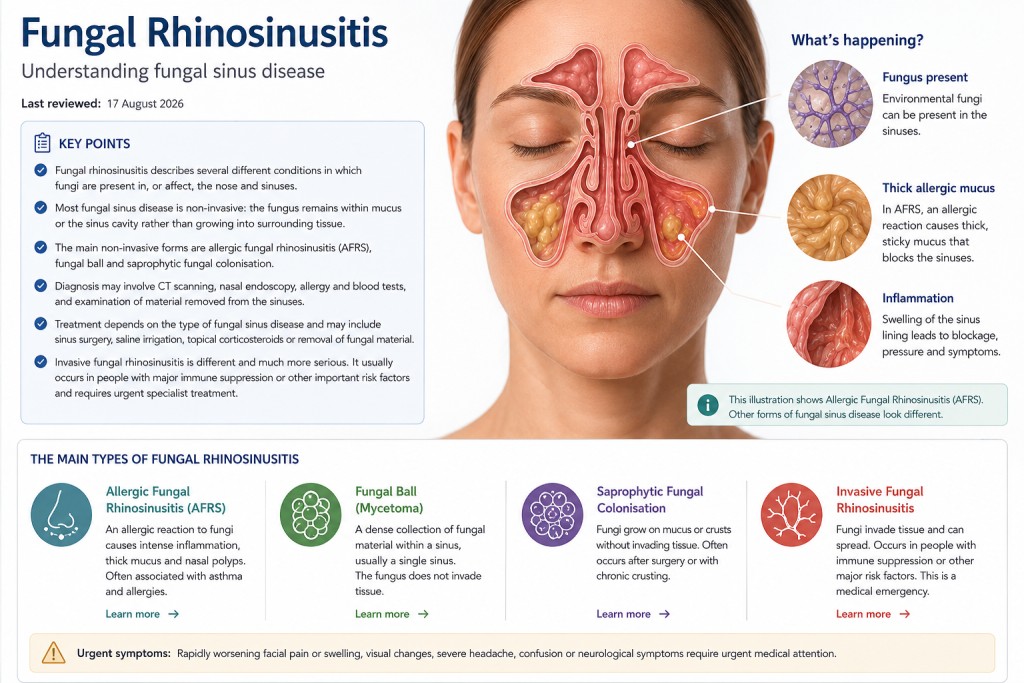
Last reviewed: 17 August 2026
Developed with patients
This information has been developed with patients and carers alongside clinical specialists. It is evidence based and regularly reviewed, and is intended to support—not replace—advice from your own healthcare team.
Key points
- Fungal rhinosinusitis describes several different conditions in which fungi are present in, or affect, the nose and sinuses.
- Most fungal sinus disease is non-invasive: the fungus remains within mucus or the sinus cavity rather than growing into surrounding tissue.
- The main non-invasive forms are allergic fungal rhinosinusitis (AFRS), fungal ball and saprophytic fungal colonisation.
- AFRS is an inflammatory and allergic condition associated with fungi and commonly occurs with nasal polyps, asthma and other allergic disease.
- Diagnosis may involve CT scanning, nasal endoscopy, allergy and blood tests, and examination of material removed from the sinuses.
- Treatment depends on the type of fungal sinus disease and may include sinus surgery, saline irrigation, topical corticosteroids or removal of fungal material.
- Invasive fungal rhinosinusitis is different and much more serious. It usually occurs in people with major immune suppression or other important risk factors and requires urgent specialist treatment.
Table of contents
- Overview
- Symptoms
- Diagnosis
- Types of fungal rhinosinusitis
- Allergic Fungal Rhinosinusitis (AFRS)
- Fungal Ball
- Saprophytic Fungal Colonisation
- Invasive Fungal Rhinosinusitis
- Outlook and recurrence
- Common questions
- When to seek medical advice
- Author and review information
- References and further reading
Overview
The sinuses are air-filled spaces in the skull around the nose, cheeks and forehead. They connect with the nasal passages and are lined with a thin layer of mucus-producing tissue.
Fungi are widespread in the environment, and everyone breathes in fungal spores. Usually this causes no problem. In some people, however, fungi can grow within mucus or debris in the sinuses, or contribute to an inflammatory or allergic response.
The term fungal rhinosinusitis describes a group of conditions rather than one single disease.
An important distinction is whether the fungus is non-invasive or invasive.
- Non-invasive fungal rhinosinusitis – fungi remain within mucus, crusts or the sinus cavity and do not invade healthy surrounding tissue.
- Invasive fungal rhinosinusitis – fungal hyphae grow into sinus tissue and may spread into surrounding structures. This is much less common but can be very serious.
The main non-invasive forms are:
- Allergic Fungal Rhinosinusitis (AFRS)
- Fungal ball
- Saprophytic fungal colonisation
These conditions behave differently and require different treatment, so identifying the type of fungal sinus disease is important.
Symptoms
Symptoms vary according to the type and severity of sinus disease. Non-invasive fungal rhinosinusitis can resemble ordinary chronic rhinosinusitis.
Symptoms may include:
- blocked or congested nose
- difficulty breathing through the nose
- thick nasal mucus
- post-nasal drip
- reduced or lost sense of smell
- facial pressure or discomfort
- headaches
- recurrent sinus problems
- fatigue or disturbed sleep
Some people with a fungal ball have surprisingly few symptoms, whereas AFRS can cause extensive sinus inflammation and nasal polyps.
Can I smell Aspergillus? Altered and phantom smells
Some people notice an unusual smell that seems to come from inside the nose—perhaps earthy, musty, herbal, smoky or like burning. It is understandable to wonder whether this means they can smell Aspergillus. Smell is not a reliable way to diagnose or monitor Aspergillus in the lungs.
Persistent sinus inflammation, blockage, mucus, crusting and nasal polyps can all affect the smell pathways. A person may have parosmia, where real smells seem different or unpleasant, or phantosmia, where they smell something that is not present. These changes can also occur after colds, flu or COVID-19, with allergies or sinusitis, and sometimes with medicines.
Fungal balls and other sinus conditions can be associated with altered smell, especially where a sinus is blocked or inflamed. If the fungal material is removed and normal drainage improves, the altered smell may improve too. We do not think the body is deliberately “compensating” by making a smell; rather, inflammation or disruption of the smell pathways can distort the signals reaching the brain.
Tell your GP or ENT team if a new smell persists, recurs, is mainly on one side, or occurs with nasal blockage, discharge, facial pressure or headaches. If someone close to you repeatedly notices a change in your breath around the time of a respiratory flare, it can be recorded as a personal early-warning sign, but should always be considered alongside your other symptoms and clinical tests.
Diagnosis
Persistent or complicated sinus disease is usually assessed by an ear, nose and throat (ENT) specialist.
Depending on the suspected condition, investigations may include:
- CT scanning – to identify blocked or expanded sinuses, accumulated mucus and characteristic dense material within the sinuses
- nasal endoscopy – allowing an ENT specialist to examine the nasal cavity and sinus openings
- blood tests – including total IgE, fungal-specific IgE and eosinophil levels where AFRS is suspected
- allergy testing – using blood tests or skin-prick testing to look for sensitisation to fungi and other allergens
- laboratory examination of sinus material or tissue – particularly when material is removed during surgery
There is no single blood test that can diagnose all forms of fungal rhinosinusitis. Results have to be interpreted alongside symptoms, endoscopic findings and imaging.
Types of fungal rhinosinusitis
Allergic Fungal Rhinosinusitis (AFRS)
What is AFRS?
Allergic fungal rhinosinusitis (AFRS) is a form of chronic rhinosinusitis with nasal polyps in which fungi are associated with a strong allergic and type 2 inflammatory response.
The sinuses may contain very thick, eosinophil-rich mucus containing fungal hyphae. Importantly, however, the fungi do not normally invade the surrounding healthy tissue.
Aspergillus species can be involved, but AFRS may also be associated with other environmental fungi.
AFRS commonly occurs in people who:
- have nasal polyps
- have asthma or other allergic disease
- show sensitisation to fungi
- have a functioning immune system rather than severe immune suppression
How is AFRS diagnosed?
There is currently no single test that confirms AFRS. Diagnosis is based on a combination of clinical findings, imaging, evidence of allergic inflammation and, where available, examination of sinus material.
Doctors may use:
- nasal endoscopy to identify polyps and thick allergic mucus
- CT imaging to identify characteristic changes within affected sinuses
- total IgE and fungal-specific IgE
- eosinophil measurements
- allergy testing
- microscopy, histology or other examination of material removed from the sinuses
Diagnostic criteria for AFRS have been used since the 1990s, but our understanding of the condition has changed substantially. Researchers are now reassessing these criteria and looking for more practical ways to recognise AFRS and distinguish it from other forms of chronic rhinosinusitis.
Read more in our update on how the diagnosis of allergic fungal rhinosinusitis is changing.
Treatment of AFRS
For many people with established AFRS, endoscopic sinus surgery followed by ongoing medical treatment remains the mainstay of management.
Surgery can:
- remove thick allergic mucus and fungal material
- remove obstructing nasal polyps
- open blocked sinus cavities
- allow saline irrigation and topical medicines to reach the affected sinuses more effectively
- provide material for laboratory and pathological examination
Long-term treatment after surgery commonly includes saline irrigation and topical corticosteroids to control inflammation and reduce recurrence.
Systemic corticosteroids, allergen immunotherapy, antifungal treatment and other therapies may be considered in selected patients, but their roles vary and treatment should be individualised.
Biologic treatments
There is growing interest in biologic medicines that target particular parts of type 2 inflammation. Medicines such as dupilumab, mepolizumab and omalizumab are already used in conditions including severe asthma and chronic rhinosinusitis with nasal polyps.
Studies in AFRS have so far been much smaller than those for chronic rhinosinusitis with nasal polyps more generally, but recent systematic reviews have found encouraging improvements in symptoms and measures of inflammation in people with difficult-to-treat AFRS.
Biologics may therefore become increasingly useful for selected people with recurrent or difficult-to-control disease, although more research is needed to establish exactly where they fit alongside surgery and other treatments.
AFRS and allergic bronchopulmonary aspergillosis (ABPA)
Some people with AFRS also have allergic bronchopulmonary aspergillosis (ABPA). Both conditions involve an exaggerated immune response to fungi and can occur in people with asthma or other allergic disease.
In AFRS, the inflammatory response mainly affects the nose and sinuses. In ABPA, it mainly affects the lungs and airways.
Having one condition does not mean that a person will develop the other. However, recognising the possible overlap is important, particularly when someone has both persistent sinus disease and respiratory symptoms.
If someone with AFRS also has asthma, bronchiectasis, recurrent chest symptoms or markedly raised IgE, clinicians may consider whether assessment for ABPA is appropriate.
For more information, visit our ABPA Knowledge Hub.
Fungal Ball
Overview
A fungal ball is a dense collection of fungal hyphae and debris that develops within a sinus. The older term mycetoma is sometimes used, although fungal ball is clearer because mycetoma also describes a different type of fungal disease affecting skin and deeper tissues.
The fungus remains within the sinus cavity and does not invade the surrounding tissue.
Fungal balls often affect a single sinus, particularly the maxillary sinus in the cheek or the sphenoid sinus deeper in the skull. Aspergillus species are frequently found.
Some people have few symptoms, while others experience nasal blockage, discharge, facial pressure, headaches or recurrent sinus problems.
Diagnosis
CT scanning may show characteristic dense or calcified material within the affected sinus. Diagnosis is usually confirmed when the fungal material is removed and examined.
Treatment
Treatment is usually surgical removal of the fungal material and opening of the affected sinus so that it can drain normally.
Antifungal medicines are not usually needed for an uncomplicated fungal ball because the fungus has not invaded the surrounding tissue.
Saprophytic Fungal Colonisation
Overview
Saprophytic fungal colonisation occurs when fungi grow on mucus or crusts within the nasal cavity or sinus openings without invading the underlying tissue.
It may occur after sinus surgery or where persistent crusting and retained mucus provide material on which fungi can grow.
This is generally a relatively minor form of fungal sinus disease.
Treatment
Treatment usually involves removing fungal crusts and debris and improving nasal hygiene with saline irrigation or other measures recommended by the ENT team.
Antifungal medicines are usually not required.
Invasive Fungal Rhinosinusitis
Invasive fungal rhinosinusitis is very different from AFRS, fungal ball and saprophytic colonisation. In invasive disease, fungal hyphae grow into the tissues of the nose and sinuses and can spread into surrounding structures.
Acute invasive fungal rhinosinusitis occurs mainly in people whose immune defences are severely impaired, for example because of some blood cancers, chemotherapy, transplantation, profound neutropenia or other significant immune suppression. Poorly controlled diabetes, particularly with ketoacidosis, is also an important risk factor for some invasive fungal infections.
Symptoms can progress rapidly and may include severe facial pain or swelling, fever, nasal or facial tissue changes, visual symptoms, severe headache or neurological symptoms.
Suspected invasive fungal rhinosinusitis is a medical emergency requiring urgent specialist assessment. Treatment may involve urgent surgery, systemic antifungal medication and treatment of the underlying condition that has increased susceptibility to infection.
Outlook and recurrence
The outlook varies considerably between the different types of fungal rhinosinusitis.
Fungal balls and saprophytic fungal colonisation can usually be treated successfully once the fungal material has been removed.
AFRS is different because the underlying inflammatory tendency remains. Recurrence after treatment is common, so long-term ENT follow-up, topical treatment and monitoring may be required even after successful surgery.
For many people, a combination of surgery and ongoing medical treatment substantially improves nasal obstruction, sinus drainage and other symptoms.
Common questions
Is fungal sinusitis contagious?
No. Fungal rhinosinusitis is not normally passed from one person to another. The fungi involved are generally organisms that are already widespread in the environment.
Does finding fungus mean I have a fungal infection?
Not necessarily. Fungi can be present in the nose and sinuses without invading tissue. In AFRS, much of the disease results from the immune and inflammatory response associated with fungi rather than invasive fungal growth.
Do antifungal medicines always treat fungal sinusitis?
No. Treatment depends on the type of fungal rhinosinusitis. Antifungal medication is generally not required for an uncomplicated fungal ball or saprophytic colonisation, while AFRS management primarily focuses on surgery where necessary and control of inflammation. Invasive fungal disease is different and requires systemic antifungal treatment.
Is fungal rhinosinusitis linked to asthma?
AFRS is strongly associated with allergic disease, and many people with AFRS also have asthma. A smaller number may also have ABPA, in which a related allergic response to fungi affects the lungs.
Can AFRS come back after surgery?
Yes. AFRS has a significant tendency to recur. Surgery removes accumulated material and opens the sinuses, but it does not remove the underlying tendency towards inflammation. Long-term topical treatment and follow-up are therefore important.
Are biologics replacing sinus surgery?
Not at present. Biologic medicines are promising for some people with severe or recurrent AFRS, particularly when there is associated type 2 inflammatory disease such as asthma or nasal polyposis. However, surgery remains an important part of treatment for many patients with established AFRS.
When to seek medical advice
Speak to a healthcare professional if you have:
- sinus symptoms persisting for more than 12 weeks
- persistent nasal blockage
- recurrent sinus problems despite treatment
- significant loss of smell
- persistent facial pressure or pain
- asthma that becomes more difficult to control alongside worsening sinus disease
Seek urgent medical assessment for rapidly worsening facial pain or swelling, visual disturbance, severe headache, neurological symptoms or rapidly progressive sinus symptoms, particularly if you are significantly immunocompromised.
Related information
Browse the Aspergillosis Knowledge Hub
Learn about ABPA
Visit the SAFS Hub
Learn about treatment for aspergillosis
Author and review information
Author: Aspergillosis Website Editorial Team
Audience: Patients, carers, GPs and non-specialists
Last reviewed: 17 August 2026
References and further reading
- Roland LT, Damask C, Luong AU, et al. Allergic Fungal Rhinosinusitis Diagnosis, Management, Associated Conditions, Pathophysiology, and Future Directions: Summary of a Multidisciplinary Workshop. International Forum of Allergy & Rhinology. 2025;15(6):626-641. PubMed PMID: 40310935.
- Allergic Fungal Rhinosinusitis: A Contemporary Update. 2025. PubMed PMID: 40491076.
- Im YH, Stybayeva G, Hwang SH. Short-Term Efficacy of Biologics in Recalcitrant Allergic Fungal Rhinosinusitis: A Systematic Review and Meta-analysis. Otolaryngology–Head and Neck Surgery. 2025;173(4):840-847. PubMed PMID: 40552669.
- Aljubran HJ, Bamalan OA, Alfayez AA, et al. The evaluation of therapeutic outcomes of biologics in allergic fungal rhinosinusitis: a systematic review and meta-analysis. Rhinology. 2025;63(1):118-120. PubMed PMID: 39484735.
- Fokkens WJ, Lund VJ, Hopkins C, et al. European Position Paper on Rhinosinusitis and Nasal Polyps 2020. Rhinology. 2020;58(Suppl S29):1-464. PubMed PMID: 32077450.
- deShazo RD, Swain RE. Diagnostic criteria for allergic fungal sinusitis. Journal of Allergy and Clinical Immunology. 1995;96(1):24-35. PubMed PMID: 7622760.
Did this page help you?
Tell us in one minute