Can overseas patients access specialist centres like NAC? A clear guide for patients and families

Last reviewed: April 2026

Key points

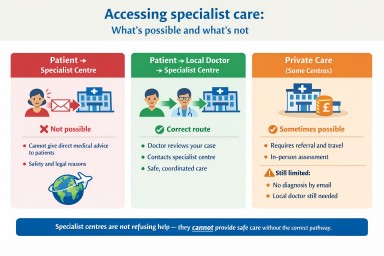
  • Specialist centres such as the National Aspergillosis Centre (NAC) cannot provide individual medical advice directly to patients, especially from overseas.
  • This is due to safety, legal, and clinical responsibility requirements.
  • The correct route is through a local doctor, using a formal referral process.
  • A referral does not guarantee that a patient will be seen.
  • Even when doctors contact specialist centres, there are limits to what can be offered.
  • NAC does not offer private care, although some other centres do.

Table of contents


Why can’t specialist centres respond directly to patients?

It is natural to want to contact a specialist centre directly, especially when dealing with a complex condition such as aspergillosis. However, centres like NAC cannot provide individual medical advice directly to patients.

This is not a matter of choice—it is because they cannot safely or legally do so.

Patient safety

  • Safe medical advice requires full access to medical records, test results, and examination findings
  • Doctors must be able to monitor progress and adjust treatment
  • This cannot be done through messages or emails alone

Legal and regulatory requirements

  • Doctors must follow strict rules set by regulators such as the General Medical Council (GMC) in the UK
  • They cannot take responsibility for a patient without a formal clinical relationship

Responsibility for care

  • Any doctor giving advice must be able to take responsibility for outcomes
  • This requires recognised clinical pathways and follow-up arrangements

In summary: Specialist centres are not refusing help—they cannot provide care outside safe and regulated systems.


The correct way to get help

The safest and most effective way to access specialist expertise is through your local doctor.

Step 1 – See a local specialist

  • Respiratory doctor
  • Infectious disease specialist
  • Internal medicine specialist

Step 2 – Assessment and initial care

  • Your doctor reviews your symptoms and history
  • Tests are arranged where needed
  • Treatment may be started

Step 3 – Referral or specialist advice

This approach ensures your care is coordinated, safe, and based on full clinical information.


What does a referral mean?

A referral is when your doctor formally asks another specialist or centre to review your case or consider seeing you.

This is not just a message—it is a structured clinical process.

What does a referral usually include?

  • Your medical history
  • Details of your symptoms
  • Results of tests (such as scans or laboratory results)
  • Treatments you have already received
  • A clear reason for referral

This allows the specialist centre to understand your situation safely and properly.

What happens next?

After reviewing the referral, the specialist centre may:

  • ✔️ Accept the referral and arrange an appointment
  • ✔️ Provide advice to your doctor without seeing you
  • ✔️ Suggest a more appropriate service
  • ❌ Decline the referral

A referral is like a formal handover between doctors—it does not guarantee an appointment.


Will a referral always be accepted?

Even when your doctor makes a referral, it is important to understand that the referral may not always be accepted.

Why might a referral not be accepted?

Eligibility criteria

  • Specialist centres often have strict criteria for the patients they can see
  • Some services are commissioned only for specific conditions

Geographic and funding rules

  • Access may depend on healthcare system or funding arrangements

Clinical suitability

  • The centre may decide your care can be managed locally
  • They may offer advice instead of accepting the referral

Capacity

  • Specialist centres often manage large numbers of complex patients

What happens if it is not accepted?

  • Your doctor may still receive expert advice
  • You may be directed to another service
  • Your care continues locally

This does not mean you are being refused help.


Why specialist centres may not be able to confirm anything to you

Patients and families sometimes ask a specialist centre whether a referral has been received, reviewed, or accepted.

It is important to understand that the centre may not be able to confirm or discuss this with you directly.

Why is this?

Confidentiality and data protection

  • Medical information is protected by strict confidentiality rules
  • In the UK, this includes laws such as data protection legislation and professional duties of confidentiality
  • Centres must be certain they are communicating with the correct person and through approved channels

Communication is usually between doctors

  • Referrals are handled as clinician-to-clinician communication
  • Responses are normally sent back to the referring doctor, not directly to the patient

No confirmation does not mean no action

  • If you do not receive a reply from the centre, it does not necessarily mean your referral has been ignored
  • Advice or decisions may already have been communicated to your doctor

What should you do?

  • Contact your own doctor for updates
  • Ask whether a referral has been sent and if a response has been received
  • Discuss next steps with your clinical team

Summary

Specialist centres usually communicate with your doctor, not directly with patients. This is to protect your privacy and ensure safe, appropriate communication.


Do personal requests from patients or families help?

Personal requests are completely understandable, but specialist centres cannot provide individual medical advice directly to patients, even in urgent situations.

This is because they cannot safely or legally do so without a doctor involved.

These requests may still help with general information and guidance, but they do not usually lead to diagnosis or treatment advice.


Limits even when doctors are involved

When your doctor contacts a specialist centre, this is the correct route—but there are still limits.

What specialist centres can offer

  • Expert opinion
  • Suggestions for diagnosis
  • Guidance on tests
  • Interpretation of results

What they cannot usually provide

  • Direct patient care
  • Full responsibility for treatment
  • Definitive diagnosis without full assessment

Your local doctor remains responsible for your care.


What about private care?

The National Aspergillosis Centre (NAC) does not offer private care.

  • You cannot arrange to be seen there privately
  • Access is through NHS referral pathways only

Some other specialist centres may offer private consultations. However:

  • A referral and medical records are usually required
  • An in-person assessment is typically needed
  • Private care does not bypass safety or legal requirements

Common myths

  • “I can contact a specialist centre directly for help”
    → Centres cannot provide individual advice directly to patients
  • “If it’s urgent, they will make an exception”
    → The same safety rules apply to all patients
  • “A referral guarantees I will be seen”
    → Referrals are reviewed and may not always be accepted
  • “Private care means I can be seen anywhere”
    → Not all centres offer private care (NAC does not)
  • “A detailed email is enough for diagnosis”
    → Diagnosis requires full clinical assessment

When to seek urgent medical help

If you or someone you care for has any of the following, seek urgent local medical care:

  • Severe breathlessness
  • Chest pain
  • Coughing up blood
  • Confusion or extreme drowsiness
  • High fever that is not improving

Do not delay seeking help while trying to contact overseas specialists.


Summary

Specialist centres such as NAC play an important role in supporting complex conditions like aspergillosis. However, they must work within systems designed to keep patients safe.

The most effective way to access their expertise is through your own doctor, using formal referral pathways and specialist advice where needed.


Author & review information

Prepared for patient education purposes.
Aligned with UK specialist centre practice and patient safety guidance.

References & further reading


Patient referrals in the NHS - how it works

Here’s why GPs in the NHS usually refer patients first to a local specialist (e.g. a local respiratory team) rather than directly to a national centre like the National Aspergillosis Centre (NAC):


🏥 1. The NHS Referral Pathway Is Tiered (Local → Regional → National)

  • The NHS is designed to escalate care through “levels”:

    • GP → Local Consultant → Tertiary/National Centre

  • This structure ensures efficient use of resources and prioritises local care where appropriate.

  • National centres are not intended to be the first point of contact, except in emergencies or highly specialised pre-agreed pathways.

🧠 Analogy: You don’t go straight to a brain surgeon for a headache — you start with your GP.


📝 2. Referral Criteria for NAC Require Specialist Input

  • The NAC (based in Manchester) is a nationally commissioned tertiary centre, which means:

    • It only accepts referrals from consultants (not GPs directly)

    • It expects that basic tests (CT scan, IgE, Aspergillus-specific IgE/IgG, eosinophils, spirometry) have been done

    • Local teams should attempt initial diagnosis and management, and refer on if the case is complex, resistant, or unusual

📄 The NAC’s referral form specifically asks for consultant details and supporting investigations.


⚖️ 3. Clinical Governance and Local Responsibility

  • Local respiratory consultants are responsible for:

    • Ruling out common conditions first

    • Starting standard ABPA or CPA treatment (e.g. steroids, itraconazole)

    • Monitoring early response

  • This ensures that patients who are referred to the NAC are those who really need advanced care, e.g.:

    • Antifungal resistance

    • Multiple relapses

    • Atypical radiology

    • Drug intolerance or failure

    • Need for biologics, surgery, or MDT input


🧭 4. NHS Resource Planning and Fairness

  • National centres are funded to manage only the most complex or rare cases across the UK.

  • If GPs referred patients directly, national centres would become overwhelmed — and many patients would bypass the local care they actually need.

💡 It's not about gatekeeping — it's about managing capacity and focusing expertise where it’s most needed.


🛠️ What Can Patients Do?

If you suspect ABPA or CPA and your GP doesn’t know about NAC:

  1. Ask to be referred to a local respiratory team — ideally one with fungal disease knowledge.

  2. Share NAC information NAC referral criteria & guidanceSupport for professionals

  3. If already under a consultant and you're not improving, ask:

    “Would you consider referring me to the National Aspergillosis Centre for specialist input?”

  4. If you're already diagnosed with ABPA or CPA and not improving, you can request your consultant refer you to NAC, citing lack of progress or drug intolerance.