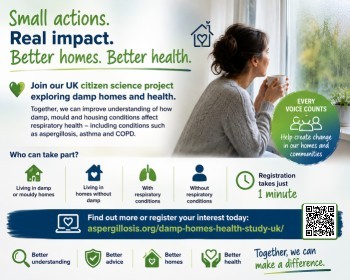
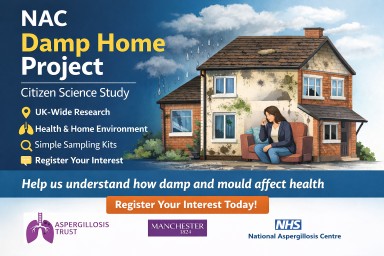
Join our UK Citizen Science Project on Damp Homes and Health

Many people living with aspergillosis, asthma and chronic lung disease tell us they are worried about damp, mould and housing conditions — but often struggle to know:
- whether their home really has a problem
- who to trust for advice
- whether mould testing is reliable
- and what effective remediation should involve.
There is currently considerable uncertainty around indoor mould assessment, air sampling and interpretation of results. Many patients report difficulty obtaining clear, independent advice or meaningful remediation.
At the same time, we still know surprisingly little about the real-life health impact of living in damp homes across the UK.
A UK Citizen Science Project
We are supporting a UK citizen science project exploring how damp homes may affect health, including respiratory health and conditions such as aspergillosis.
Citizen science projects involve members of the public helping researchers and healthcare communities better understand real-world problems by sharing experiences and observations.
You do not need to have diagnosed aspergillosis to take part.
We are interested in hearing from people:
- living in damp or mouldy homes
- living in homes without damp
- with respiratory conditions
- and without respiratory conditions.
The initial registration takes about 1 minute and simply records your interest in the project.
Why this matters
By taking part, you may help improve understanding of:
- damp homes and respiratory disease
- mould exposure
- indoor air quality
- housing conditions
- challenges with mould assessment and remediation
- and the wider health impact of dampness in UK homes.
We hope the project will help patients, clinicians, housing professionals and researchers better understand:
- how people experience damp homes in real life
- the difficulties many people face obtaining reliable advice
- the limitations of current mould assessment approaches
- and what practical interventions may genuinely improve health and quality of life.
Related information
You can also read our practical guide discussing damp homes, mould testing, remediation and tenant support:
Read our guide to damp, mould and aspergillosis
Find out more or register your interest
Damp Homes and Health Study UK
Please share this project with:
- patients and carers
- healthcare professionals
- housing professionals
- damp and mould specialists
- environmental health professionals
- researchers
- and anyone interested in improving understanding of damp homes and health.
Help us understand how damp homes affect health

We are supporting a UK research project looking at how damp homes may affect health, including respiratory health and conditions such as aspergillosis.
This study is being led by the National Aspergillosis Centre at Manchester University NHS Foundation Trust, and is being shared through aspergillosis.org to support research into damp homes and health.
We are currently inviting people across the UK to register their interest in taking part.
Registering your interest should take less than one minute and does not commit you to taking part.
Why this matters
Damp and mould are often linked to health problems, but there is still limited real-world evidence from people’s homes across the UK.
This project aims to help improve understanding of how home environments may affect health by gathering information from people living in a wide range of housing conditions.
Who can register interest?
We would like to hear from people living in the UK, including:
- people with lung or respiratory conditions
- people without any known lung or breathing condition
- people who have experienced damp or mould at home
- people who have not experienced damp or mould at home
- members of the general public who would like to contribute to the research
We are keen to hear from people with different health backgrounds and a wide range of home environments.
What is the study about?
This research is exploring how damp homes may affect health. The aim is to improve understanding of the relationship between home environments and health symptoms in real-world settings.
This project is for research purposes only and does not provide medical advice or diagnosis.
What might taking part involve later?
If the study opens, some people who register interest may later be invited to:
- complete a short questionnaire about their home and health symptoms
- receive a simple home sampling kit by post
- collect and return a small household sample, for example dust from the home, for research purposes
The home sampling part is intended to be simple and practical. Full instructions would be provided.
Registering your interest now does not commit you to taking part later.
Important information
- Registering interest is voluntary.
- You do not have to take part in the full study later.
- Your details will only be used to contact you about this project.
- Your data will be handled in line with UK data protection regulations.
- You can decide later whether or not to take part.
Frequently asked questions
Am I signing up to take part in the study now?
No. At this stage, you are only registering your interest in hearing more about the study.
Do I need to have a lung condition to register interest?
No. We would like to hear from people with and without lung conditions.
Do I need to have damp or mould in my home?
No. We are interested in hearing from people with a wide range of home environments and experiences.
Will I definitely receive a kit?
Not necessarily. Registering interest helps the research team understand the level of interest and contact people if the study opens.
Will I get personal results about my home or health?
At this stage, no individual results are being promised. More information would be provided if the study proceeds.
What happens after I register interest?
You do not need to do anything further straight away. If the study opens, you may be contacted with more information so you can decide whether you would like to take part.
Register your interest
Ready to help? Complete the form below.
This secure form should take less than one minute to complete.
If the form does not load, you can open it here:
Open the form in a new window