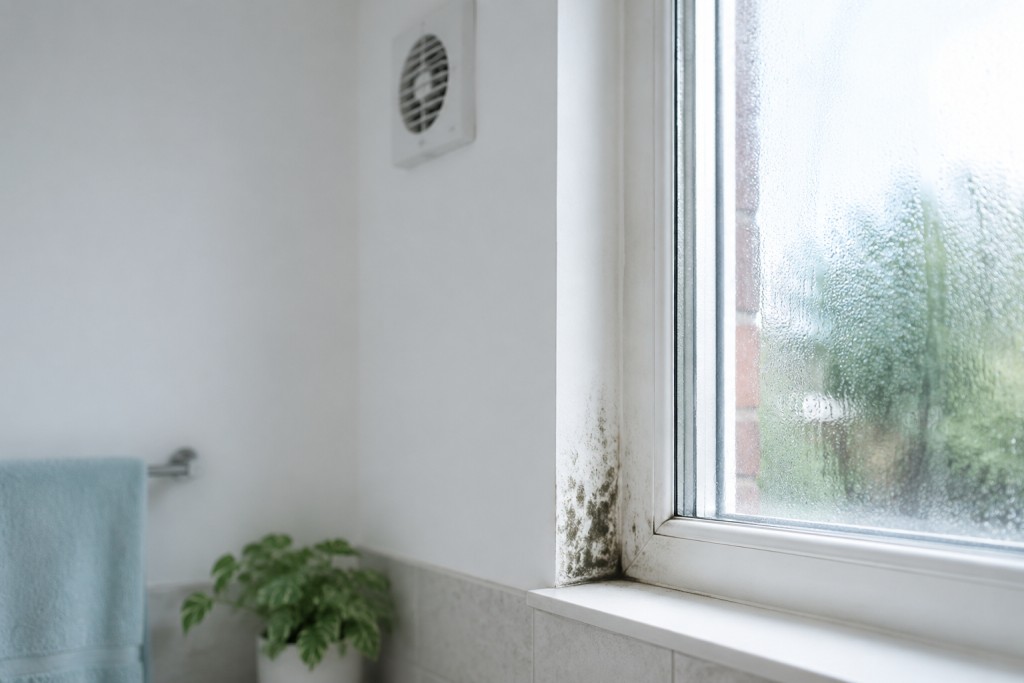
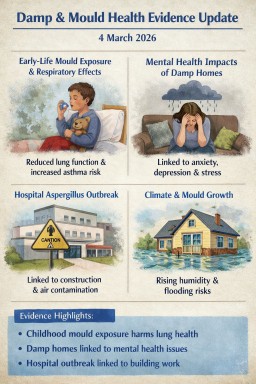
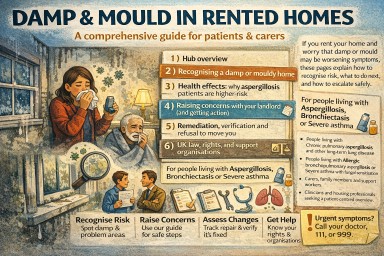
Government and peer-reviewed research on damp and mould in UK housing between 2020 and 2025 shows a marked policy shift toward public health integration, landlord accountability, and cross-sector action led by UKHSA, NHS partners, and local government.

UK Government and Local Authority Frameworks

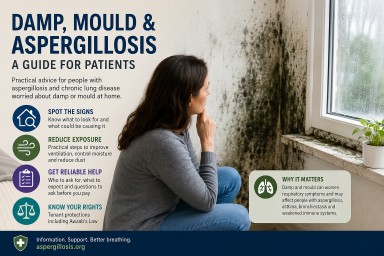
The UK Government’s 2024 guidance on Understanding and Addressing the Health Risks of Damp and Mould directs local authorities and landlords to treat all mould reports as potential health hazards, not lifestyle issues. It mandates inspection, remediation, and resident communication protocols consistent with the Housing Health and Safety Rating System (HHSRS) and the Decent Homes Standard.

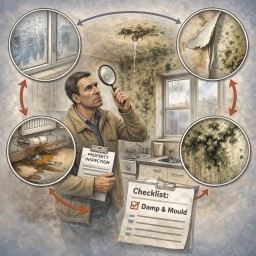
Local authorities such as Newham, Waverley, and Rotherham have implemented Damp and Mould Action Plans (2023–2025) integrating health, climate, and housing inspection frameworks. They require proactive identification using repair logs, thermal imaging, and joint inspection with environmental health officers.

The Royal Borough of Kensington and Chelsea’s 2025–2030 Housing Strategy further emphasizes reform under Awaab’s Law (2025), ensuring swift remediation within fixed timeframes and continuous monitoring aligned with learning from the Grenfell Inquiry.

NHS and UKHSA Public Health Findings

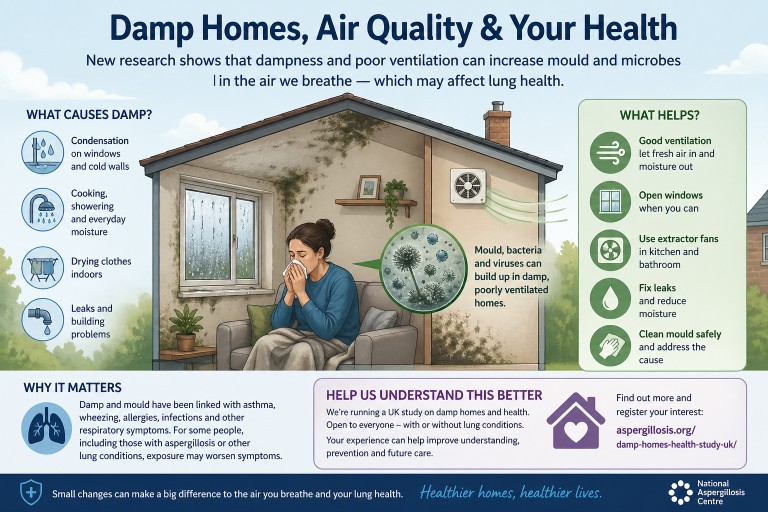
The UK Health Security Agency’s 2024 “Burden of Disease from Damp and Mould” report provides the first national quantification of health outcomes. It attributes 2,800 annual DALYs to damp-related respiratory illnesses (especially childhood asthma and chronic bronchitis) and shows strong socio-economic and ethnic disparities in exposure.

NHS partners, including Integrated Care Boards (ICBs), have incorporated damp and mould into local health inequality programmes. The NHS Cornwall and Isles of Scilly ICB (2023) reported collaborations with housing authorities to monitor respiratory admissions linked to poor housing conditions and prevent seasonal exacerbations.

These measures align with NHS England’s “Core20PLUS5” framework, recognizing housing quality as a determinant of population health outcomes.

Peer-Reviewed Research

Recent academic studies reinforce and contextualize government data:

  • LSE’s “Damp and mould—the big picture” (Frontiers in Environmental Health, 2024) concludes that UK social housing dampness has structural causes worsened by aging housing stock, underinvestment, cost-of-living pressures, and climate-related moisture extremes. It calls for cross-sectoral, health-led remediation strategies.
  • BMJ (2024): “Law Change for Tenants in Mouldy Social Housing” analyzed the legal and public health rationale for Awaab’s Law, emphasizing its role in reducing avoidable childhood morbidity and mortality.
  • A 2023 study in Housing Studies (Taylor & Francis) found significant psychological and respiratory effects from chronic exposure to mould in UK homes, emphasizing that remediation improved wellbeing and reduced GP visits.
  • The Environmental Health Perspectives 2024 review synthesized global evidence linking damp housing with immune and respiratory dysfunction, reinforcing the urgency of UK-specific regulation.

Integrated Summary

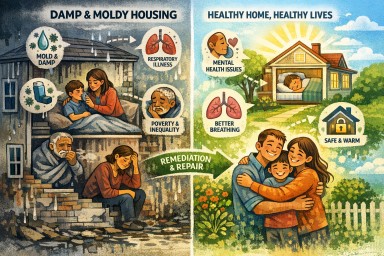
Between 2023 and 2025, the UK’s approach shifted from advisory to enforceable frameworks. National and local policy now aligns under Awaab’s Law, reinforced by detailed health surveillance through UKHSA and NHS systems. Peer-reviewed data confirm both physiological and psychological harm from damp housing, justifying the strategy’s integration within broader health inequality reduction policies.

  1. https://www.gov.uk/government/consultations/the-future-homes-and-buildings-standards-2023-consultation/the-future-homes-and-buildings-standards-2023-consultation
  2. https://www.gov.uk/government/publications/damp-and-mould-understanding-and-addressing-the-health-risks-for-rented-housing-providers/understanding-and-addressing-the-health-risks-of-damp-and-mould-in-the-home–2
  3. https://www.waverley.gov.uk/portals/0/documents/services/housing/private-housing/private sector housing damp and mould action plan.pdf
  4. https://moderngov.rotherham.gov.uk/documents/s154245/Healthy Homes Plan Appendix 1.pdf
  5. https://www.newham.gov.uk/downloads/file/6700/damp-and-mould-strategy-2023-25
  6. https://www.rbkc.gov.uk/sites/default/files/media/documents/AAA2026_HOU – Housing Strategy_v04.pdf
  7. https://research.ukhsa.gov.uk/our-research/damp-and-mould/
  8. https://docs.cios.icb.nhs.uk/DocumentsLibrary/NHSCornwallAndIslesOfScilly/Organisation/PublicMeetings/BoardMeetings/2224/202309/AGMICB2324101ICBAnnualReportAndAccounts.pdf
  9. https://www.frontiersin.org/journals/environmental-health/articles/10.3389/fenvh.2024.1340092/full
  10. https://www.bmj.com/content/390/bmj.r1419.full.pdf
  11. https://www.tandfonline.com/doi/full/10.1080/02673037.2023.2286360
  12. https://ehp.niehs.nih.gov/doi/full/10.1289/EHP14341
  13. https://www.nihe.gov.uk/getattachment/e682bf57-71a0-4d43-8110-fbb1f14e0684/Tenancy-Support-Sustainment-Strategy.pdf
  14. https://democracy.newforest.gov.uk/documents/s34021/Greener Housing Strategy Annual Review.pdf
  15. https://www.stockport.nhs.uk/documentstore/board meetings/Public Board meeting pack – 6 Apr 2023 – V2.pdf
  16. https://www.housing-ombudsman.org.uk/2025/02/25/latest-learning-from-complaints/
  17. https://www.ethnicity-facts-figures.service.gov.uk/housing/housing-conditions/housing-with-damp-problems/latest