🌿 Biologics when ABPA and CPA overlap: What Patients Need to Know
Understanding how they work, when they’re helpful, and when extra care is needed
Biologic medicines (such as omalizumab, mepolizumab, benralizumab, dupilumab and newer options like tezepelumab) are increasingly used to treat Allergic Bronchopulmonary Aspergillosis (ABPA) and severe asthma. They can be life-changing for some people.
However, their place in Chronic Pulmonary Aspergillosis (CPA) — especially in people who have both ABPA and CPA together — is more complicated and needs careful specialist supervision.
This article explains what we know so far.
🌟 1. ABPA and CPA are different conditions — but some people have both
-
ABPA is mainly an allergic reaction to Aspergillus in the airways.
-
CPA is a chronic fungal infection that causes cavities, scarring, and long-term lung damage.
-
Some people start with ABPA and later develop CPA, or the two conditions overlap.
-
The 2024 international ABPA guidelines now recognise this overlap as real and important.
Because biologics target allergy pathways rather than fungal infection, treatment decisions must look at both sides of the disease.
🌿 2. Biologics in ABPA: the evidence is strong and growing
Biologics can help patients with ABPA or severe asthma by:
-
reducing steroid use
-
improving breathing
-
decreasing mucus plugging
-
lowering flare-ups
-
improving quality of life
Biologics most commonly used in ABPA include:
| Biologic | Target | Notes |
|---|---|---|
| Omalizumab | IgE | Well established, helps many ABPA patients |
| Mepolizumab | IL-5 | Helps eosinophilic inflammation |
| Benralizumab | IL-5Rα | Similar to mepolizumab; long-acting |
| Dupilumab | IL-4Rα | Very promising for allergic disease; growing evidence for ABPA |
| Tezepelumab | TSLP | Very new; limited ABPA data so far |
For many people with ABPA, biologics are safe and effective when monitored.
⚠️ 3. Biologics and CPA: much less evidence
-
CPA is caused by persistent fungal infection and structural lung damage.
-
Biologics do not treat fungal infection, and they do not prevent cavities.
-
In CPA, the mainstay of treatment is still:
-
antifungal medication (usually itraconazole, voriconazole or posaconazole)
-
careful imaging (CT scans)
-
airway clearance
-
sometimes surgery or bronchoscopy
-
There is no strong evidence that biologics help CPA itself.
🔄 4. What about patients who have both ABPA and CPA?
This is where things become more complex.
Biologics may help the allergic part (ABPA), but:
-
they do not treat fungal infection
-
they do not stop fungal cavities from progressing
-
they may reduce inflammation that normally helps the body contain infection
If antifungal treatment is interrupted or not strong enough, fungal activity may increase while the allergic symptoms improve — so regular monitoring is essential.
Specialist centres (like the NAC) now emphasise:
✔️ Continue antifungals if CPA is active
✔️ Watch cavities with regular CT scans
✔️ Monitor Aspergillus IgG/IgE and fungal cultures
✔️ Check whether symptoms are from allergy, infection, or both
✔️ Make joint plans between asthma/airway doctors and mycology specialists
❓ 5. Are some biologics better than others for ABPA/CPA overlap?
There is no official guidance yet, but early observations suggest:
⭐ Most promising for ABPA:
-
Dupilumab seems particularly effective for allergic disease (IgE, mucus, airflow), though still off-label for ABPA.
⭐ Increasing interest:
-
Tezepelumab works outside the eosinophil pathway and may be useful in some asthma types, but research in ABPA is only just starting.
⭐ Useful in selected cases:
-
Anti-IL-5 biologics (mepolizumab, benralizumab) help airway eosinophils but may not help every ABPA patient.
⚠️ Uncertain in CPA:
-
None of the biologics treat fungal infection or cavities directly.
-
Their role in active CPA remains unclear and requires careful oversight.
🧭 6. What this means for patients
If you have ABPA only, biologics may be an excellent option — especially if:
-
steroids cause side-effects
-
your asthma is uncontrolled
-
you have frequent flare-ups
-
your IgE levels are very high
-
mucus plugging or wheezing continues despite treatment
If you have CPA or cavities, treatment needs to be more cautious:
-
antifungal medication usually needs to continue
-
biologics may still help if the allergic component is significant
-
CT scans must be repeated to make sure cavities are not progressing
-
specialists must weigh benefits vs. risk for each patient individually
💬 7. Summary
-
Biologics can be extremely helpful for ABPA.
-
They do not treat CPA, and cannot replace antifungal medicines.
-
In patients with both ABPA and CPA, the approach must be personalised.
-
Dupilumab and (possibly) tezepelumab are emerging biologics with promise, but evidence is still developing.
-
Decisions should always be made with a specialist centre such as the National Aspergillosis Centre (NAC).
🌿 ABPA: Infection, Allergy, Biologics, and What It All Means for You
A calm, supportive guide for patients living with Allergic Bronchopulmonary Aspergillosis (ABPA)
Allergic Bronchopulmonary Aspergillosis (ABPA) can be confusing.
Some people hear “fungus” and think it is a dangerous infection.
Others hear “allergy” and think it has nothing to do with fungi at all.
The truth is somewhere in the middle — and understanding this can make your treatment feel much clearer and less frightening.
This article explains:
-
Whether ABPA is an infection, an allergy, or both
-
How the fungus Aspergillus fumigatus fits into the picture
-
Why biologics help — and whether they allow the fungus to grow
-
Why your future with ABPA is more hopeful than ever
🌼 1. Is ABPA an infection or an allergic over-reaction?
The simplest explanation is:
ABPA happens when Aspergillus lives in mucus in the airways, and the immune system overreacts. It’s driven by allergy, not by fungal invasion.
In ABPA:
-
Aspergillus fumigatus sits in mucus, especially in asthma, bronchiectasis or cystic fibrosis
-
It does not invade or damage lung tissue
-
The immune system becomes over-sensitised and reacts too strongly
This allergic reaction triggers:
-
Very high IgE
-
High eosinophils
-
Swelling, tightness, wheeze
-
Thick “stringy” mucus or plugs
-
Repeated flare-ups that feel like chest infections
The inflammation — not the fungus — is what damages the lungs over time.
🌻 2. If it’s not a typical infection, why treat the fungus?
Even though ABPA is allergic, reducing fungal load can still help.
Here’s why:
-
Less fungus in mucus → less allergen
-
Less allergen → less immune reaction
-
Less reaction → fewer flare-ups, better breathing
This is why some people take antifungals.
But antifungals are not always necessary, especially today with the arrival of biologics.
🌈 3. Do biologics weaken the immune system and let the fungus grow?
No.
This is a very common worry — but the biologics used for ABPA do not suppress the parts of the immune system that keep you safe from fungi.
Biologics such as:
-
Omalizumab (anti-IgE)
-
Mepolizumab / Benralizumab (anti-IL-5)
-
Dupilumab (anti-IL-4/IL-13)
-
Tezepelumab (anti-TSLP)
target overactive allergic pathways, not antifungal defences.
They do not affect:
-
Neutrophils
-
Macrophages
-
Dectin-1
-
TLR antifungal pathways
-
Complement
These are the real fungus-clearing systems — and biologics leave them intact.
🍃 4. Do biologics actually help clear fungus? Surprisingly, sometimes yes.
Many patients on biologics show:
-
Fewer mucus plugs
-
Better airflow
-
Fewer positive sputum cultures
-
Reduced symptoms
-
Lower exacerbation rates
-
Less need for steroids or antifungals
When mucus plugs shrink, fungus loses its hiding place.
Your natural defences can finally clear it.
So biologics do not encourage growth — they may even help reduce fungal load.
🌺 5. Why are outcomes improving so much?
ABPA used to be a condition dominated by:
-
frequent flare-ups
-
repeated steroids
-
fear of lung damage
-
long periods of being unwell
Today, with biologics:
-
far fewer flare-ups
-
easier breathing
-
more stable lung function
-
much less steroid use
-
better quality of life
-
higher confidence and control
For many patients, biologics are transforming ABPA from a cycle of crises into a more manageable long-term condition.
🌼 6. Key reassurance
If you remember only one sentence, let it be this:
Biologics calm the allergic response that causes ABPA, without weakening your natural ability to clear fungus — and many patients do better than ever on them.
🌟 7. Moving forward with confidence
ABPA is complex, but it is treatable, manageable, and increasingly well-understood.
You are not dealing with a dangerous lung infection — you are dealing with an over-active immune response that modern treatments can control.
With the right support, airway clearance, the best inhalers, and (where needed) biologics or antifungals, most people:
-
stabilise
-
breathe more easily
-
reduce flare-ups
-
protect their lungs
-
live full, active lives
You’re not alone — and the future for ABPA care has never looked brighter.
Omalizumab: how does it help relieve ABPA?
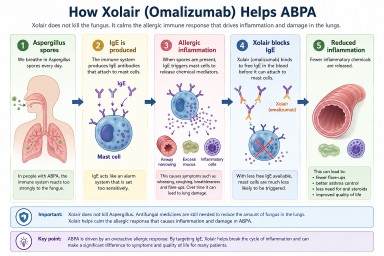
Omalizumab (Xolair) is a monoclonal antibody that can significantly relieve symptoms in patients with Allergic Bronchopulmonary Aspergillosis (ABPA) by targeting the underlying allergic response.
Here’s how it works and why it helps:
🧬 Mechanism of Action
-
Omalizumab binds to free IgE antibodies in the blood.
-
This prevents IgE from attaching to immune cells (like mast cells and basophils), blocking the allergic cascade.
-
Over time, this leads to downregulation of IgE receptors, reducing immune hypersensitivity.
🩺 Benefits for Patients with ABPA
ABPA is driven by an IgE-mediated hypersensitivity to Aspergillus fumigatus, so omalizumab directly targets a key driver of the disease.
✅ Key Clinical Effects:
| Effect | How Omalizumab Helps |
|---|---|
| Reduces airway inflammation | By calming the immune overreaction to Aspergillus |
| Improves asthma control | Fewer exacerbations and better lung function |
| Lowers total IgE levels | A marker of disease activity in ABPA |
| Reduces corticosteroid use | Helps wean off oral steroids safely |
| Improves quality of life | Less coughing, breathlessness, mucus plugging |
📊 Who Responds Best?
-
Patients with uncontrolled ABPA despite steroids and antifungals
-
Those with frequent exacerbations or steroid dependency
-
Particularly helpful in patients with asthma + ABPA
⚠️ Notes
-
Omalizumab is given by injection every 2–4 weeks (dose based on weight and IgE levels).
-
It is not a cure for ABPA but can significantly reduce flare-ups and steroid need.
-
Not all patients respond — monitoring is essential.