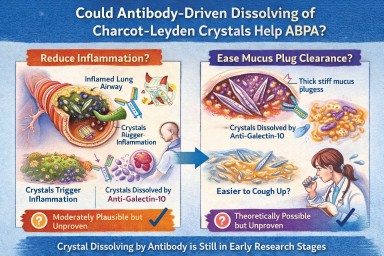
🧬 Could Antibody-Driven Dissolving of Charcot–Leyden Crystals Help ABPA?

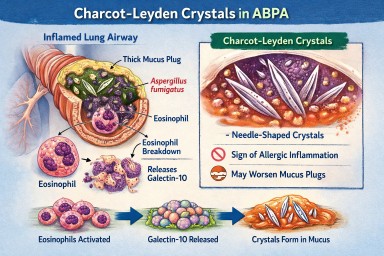
Researchers have recently discovered that Charcot–Leyden crystals (CLCs) — the needle-shaped structures formed from the eosinophil protein galectin-10 — are not just debris.

In laboratory studies, specially designed antibodies can dissolve these crystals.

This has raised two important questions:

  1. Could dissolving the crystals reduce airway inflammation?

  2. Could dissolving them make mucus plugs easier to clear?

Here is what we currently know.


1️⃣ Could dissolving crystals reduce airway inflammation?

What we know

Laboratory and animal studies have shown:

  • Charcot–Leyden crystals can activate immune cells (especially macrophages).

  • They can stimulate inflammatory pathways (including inflammasome signalling).

  • In mouse models, antibodies targeting galectin-10 dissolved the crystals.

  • When crystals were dissolved, airway inflammation decreased.

This suggests that the crystals themselves may amplify inflammation, rather than simply mark it.

What this means biologically

In ABPA and eosinophilic asthma:

  • Eosinophils release galectin-10.

  • Galectin-10 crystallises.

  • Crystals may trigger further immune activation.

  • That leads to more inflammation → more eosinophils → more crystals.

Dissolving the crystals could theoretically interrupt this feedback loop.

How likely is this to help inflammation in humans?

Moderately plausible, but not yet proven.

The biological mechanism is strong.
The animal data are encouraging.
But no human clinical trials have yet shown reduced inflammation through crystal dissolution.

If developed successfully, this approach could:

  • Reduce airway immune activation

  • Lower exacerbation risk

  • Potentially reduce steroid dependence

But at present, it remains investigational.


2️⃣ Could dissolving crystals make mucus plugs easier to cough up?

This is more speculative — but still biologically reasonable.

Why mucus plugs are so thick in ABPA

ABPA mucus plugs contain:

  • Gel-forming mucins

  • DNA from inflammatory cells

  • Dead cells

  • Fungal fragments

  • Eosinophil proteins

  • Charcot–Leyden crystals

The crystals are:

  • Rigid

  • Needle-shaped

  • Structurally stable

When embedded in mucus, they likely increase:

  • Mechanical stiffness

  • Plug density

  • Resistance to deformation

From a physics perspective:

Removing rigid crystalline structures from a gel should reduce stiffness and improve flow.

Do we have direct evidence?

No.

There are currently:

  • No human studies measuring mucus clearance after crystal dissolution

  • No trials showing improved plug expectoration from crystal-targeting therapy

So while it is plausible that dissolving crystals could soften plugs, this has not yet been demonstrated in patients.


3️⃣ How strong is the overall case?

Outcome Evidence strength Likelihood
Reduced inflammation Strong biological rationale + animal data Moderately promising
Easier mucus clearance Biophysical plausibility only Possible but unproven

Inflammation reduction is the more evidence-supported target.
Improved plug clearance is plausible but currently theoretical.


4️⃣ How does this compare to existing treatments?

Current therapies (e.g., anti-IL-5 biologics) reduce eosinophils upstream.

That leads to:

  • Less galectin-10 release

  • Fewer crystals forming

  • Reduced inflammation

  • Often improved mucus plugging

So biologics already indirectly reduce crystal burden.

A crystal-dissolving antibody would act downstream, targeting the structural product directly.

This could theoretically:

  • Accelerate resolution of existing plugs

  • Reduce residual inflammatory signalling

But again, this remains in early research stages.


5️⃣ Practical take-home message

At present:

  • Dissolving Charcot–Leyden crystals reduces inflammation in animal models.

  • It is biologically plausible that this could also soften mucus plugs.

  • There is no human clinical proof yet.

  • No approved therapy currently targets the crystals directly.

The concept is scientifically credible — but still under development.


🔭 The Bigger Picture

ABPA is increasingly understood as a condition driven by:

  • Eosinophils

  • Allergic immune signalling

  • Abnormal mucus biology

  • Structural plug formation

Crystal-targeting therapies may eventually become part of a more precise approach to treating eosinophilic airway disease.

But for now, they remain a promising research direction rather than a clinical option.


🔬 Charcot–Leyden Crystals in ABPA and Asthma

What are they? Why do they form? Do they matter?

If you live with Allergic Bronchopulmonary Aspergillosis (ABPA) or severe asthma, you may see the term Charcot–Leyden crystals in a sputum or pathology report.

They can sound worrying.

They are:

  • Not fungus

  • Not infection

  • Not cancer

They are a sign of a particular type of allergic inflammation in the airways.


🧬 What Are Charcot–Leyden Crystals?

Charcot–Leyden crystals are microscopic, needle-shaped structures found in mucus.

They are made from a protein called galectin-10, which is stored inside a type of white blood cell called an eosinophil.

Eosinophils are immune cells involved in:

  • Allergic asthma

  • ABPA

  • Severe asthma with fungal sensitisation

  • Parasitic infections

When eosinophils are activated and break down, they release galectin-10.
If enough of this protein accumulates in thick airway mucus, it crystallises into visible crystals.

So the crystals are made from your immune cells, not from Aspergillus.


🫁 Why Do They Appear in ABPA?

In ABPA:

  1. The immune system overreacts to Aspergillus fumigatus.

  2. This triggers a strong allergic (Type 2) immune response.

  3. Large numbers of eosinophils move into the airways.

  4. Eosinophils break down and release galectin-10.

  5. The protein crystallises inside mucus plugs.

The crystals are therefore a footprint of intense allergic inflammation, not fungal invasion.


🌡 Is Most ABPA Eosinophilic?

Yes — almost all classical ABPA is eosinophilic.

ABPA is fundamentally a Type 2 allergic condition, driven by immune pathways involving:

  • IL-4

  • IL-5

  • IL-13

  • IgE

  • Eosinophils

IL-5 in particular stimulates eosinophil production and survival.
Because of this, eosinophils are central to the disease process.

Historically, raised blood eosinophils have been part of diagnostic criteria.

However:

  • Eosinophil counts can fluctuate

  • Steroids can suppress blood levels

  • Eosinophils may still be present in airway mucus even if blood counts appear normal

So ABPA is biologically eosinophilic — even if a single blood test does not show a high count.

True non-eosinophilic ABPA would be unusual and would prompt clinicians to reconsider the diagnosis.


❓ Are Crystals Caused by Aspergillus Infection?

No.

They are caused by the immune reaction to Aspergillus — not by the fungus itself.

They can also be seen in:

  • Severe eosinophilic asthma

  • Parasitic infections

  • Other allergic lung conditions

They reflect eosinophil activity, not fungal growth.


🧠 Why Don’t All People with Asthma Develop These Crystals?

Asthma is not one single disease. It has different inflammatory patterns.

Type 2 (Eosinophilic) Asthma

This involves high eosinophils and allergic pathways.

Common in:

  • Allergic asthma

  • ABPA

  • Severe eosinophilic asthma

These patients can develop Charcot–Leyden crystals.


Non–Type 2 (Non-Eosinophilic) Asthma

This includes:

Neutrophilic asthma

Driven by neutrophils rather than eosinophils.

Paucigranulocytic asthma

Very few inflammatory cells present.

In these forms:

  • Eosinophils are low

  • Galectin-10 is not released in large amounts

  • Crystals are unlikely to form


🧱 Do Charcot–Leyden Crystals Make Mucus Plugs Worse?

Possibly.

Research suggests they may:

  • Increase mucus thickness

  • Contribute mechanically to airway blockage

  • Stimulate further inflammation

For many years they were thought to be harmless debris.
Modern studies suggest they may actively amplify inflammation when present in large amounts.


🎯 Do They Have a Purpose?

Eosinophils evolved mainly to help fight parasitic infections.

Galectin-10 probably has immune signalling roles inside cells.

However, when large amounts are released into thick airway mucus, crystallisation appears to be a by-product of excessive immune activity rather than a useful defence.

In ABPA and allergic asthma, they are more likely part of the problem than part of the solution.


💧 Can Their Formation Be Reduced?

Hydration alone does not stop them forming.

Drinking fluids helps:

  • Keep mucus less sticky

  • Support airway clearance

But it does not prevent eosinophils releasing galectin-10.

What reduces crystal formation?

Reducing eosinophilic inflammation:

  • Corticosteroids

  • Anti-IL-5 biologics

  • Anti-IL-4/IL-13 biologics

When eosinophil numbers fall:

→ Less galectin-10 is released
→ Fewer crystals form

Antifungal treatment in ABPA may indirectly help by reducing allergic stimulation, but the main driver is the immune response.


📊 Do They Change Treatment?

Not directly.

Doctors base treatment on:

  • Symptoms

  • Blood eosinophils

  • Total IgE

  • Imaging

  • Lung function

  • Exacerbation history

Crystals support the diagnosis of eosinophilic inflammation but do not determine treatment alone.


🔎 What Do They Tell Us?

Charcot–Leyden crystals tell us:

  • The airway inflammation is eosinophilic.

  • The immune response is strongly allergic.

  • Mucus plugging risk may be higher.

They are a marker of immune overreaction, not infection severity.


🧠 Key Points to Remember

  • They are made from proteins released by eosinophils.

  • They are not Aspergillus.

  • They do not mean invasive fungal infection.

  • Most classical ABPA is eosinophilic.

  • They are unlikely in non-eosinophilic asthma.

  • Reducing eosinophils reduces their formation.

  • Hydration helps clearance but does not prevent formation.

In simple terms:

Charcot–Leyden crystals are microscopic signs that the immune system is working too hard in the airways.