


Pulmonary rehabilitation: can it help people with aspergillosis?
Living with aspergillosis or another long-term lung condition can make everyday activities feel harder. Breathlessness, fatigue, cough and worry about triggering symptoms can gradually lead to doing less. Pulmonary rehabilitation may help some people safely rebuild confidence and fitness.
What is pulmonary rehabilitation?
Pulmonary rehabilitation (PR) is a structured programme of individually tailored exercise, education and support for people whose lung condition causes breathlessness or limits daily activity. It is not a test that you have to “pass”, and it is not simply being told to exercise harder.
Most programmes run for six to eight weeks, with supervised sessions at least twice a week. They usually include aerobic and strengthening exercises, advice about managing breathlessness and fatigue, and a plan for staying active afterwards.
Can it help people with aspergillosis?
Many people with aspergillosis also have bronchiectasis, asthma, COPD or another long-term lung condition. Current British Thoracic Society standards say pulmonary rehabilitation should be offered promptly to people with symptomatic chronic respiratory disease, including bronchiectasis, asthma and interstitial lung disease.
The 2025 European bronchiectasis guideline also strongly recommends pulmonary rehabilitation for people who experience breathlessness or reduced exercise capacity.
There is less research specifically in aspergillosis, so PR should be considered as part of your individual care rather than as treatment for the infection itself. Your clinical or physiotherapy team can advise whether it is appropriate and whether any adaptations are needed.
Is it worth it?
For many people, yes. Pulmonary rehabilitation cannot remove the underlying lung condition, but it may help you:
- do more before becoming breathless;
- build strength for everyday activities;
- feel more confident about moving and exercising safely;
- understand pacing, breathlessness and energy conservation better; and
- maintain activity after the course has ended.
A good programme should be adapted to you. Tell the team if you find a group setting tiring, have transport difficulties, are recovering from a deterioration in symptoms, or need adaptations around oxygen use, pain, fatigue or other health conditions. Centre-based PR is not the only option: evidence-based home or digital programmes may be available where these are more suitable.
What do patients say?
A large international survey of 1,685 people with chronic lung disease found strong support for pulmonary rehabilitation among people who had experienced it. Participants also highlighted real barriers, including travel, cost and limited awareness of the service. Aspergillosis was not specifically represented in that survey, but the message remains useful: a well-designed programme can be valuable, while access and individual support matter.
How do I access pulmonary rehabilitation?
Ask your GP, respiratory consultant, specialist nurse or physiotherapist whether pulmonary rehabilitation could help you. Services vary locally. If centre-based sessions are not practical, ask whether there is an evidence-based home, digital or community-based alternative.
Do not begin a demanding exercise programme alone if you are currently unwell, have had a recent deterioration in symptoms, or have been advised to limit activity. Seek individual advice from your clinical team.
Further reading
- NHS England: Pulmonary rehabilitation
- British Thoracic Society quality standard for pulmonary rehabilitation (2026)
- European Lung Foundation: bronchiectasis guideline information
- Patients’ perspective on pulmonary rehabilitation


Lung function tests
Lung function tests, sometimes called pulmonary function tests (PFTs), measure how well your lungs move air in and out and how effectively oxygen passes from your lungs into your blood. They are commonly used alongside symptoms, scans, blood tests and sputum tests to help assess lung conditions, including aspergillosis.
The tests can be tiring because they need your best effort, but the staff carrying them out will explain what to do and can pause if you need a rest. A result is one part of the overall picture; it should never be interpreted in isolation.
Why might I have lung function tests?
Your clinical team may use them to:
- help investigate breathlessness, cough or wheeze
- identify patterns that suggest narrowed airways or reduced lung volume
- monitor asthma, COPD, bronchiectasis or other lung disease alongside aspergillosis
- assess whether treatment is helping
- provide a baseline before some treatments or surgery
- follow changes over time.
Spirometry: the most common test
Spirometry measures how much air you can blow out and how quickly you can do it. You sit upright, breathe into a mouthpiece and are usually asked to take a full breath in, then blow out as hard and as long as you can. You will normally repeat the manoeuvre several times so the best reliable result can be recorded.
It can feel surprisingly demanding. The encouragement from the physiologist is not a judgement: it helps make sure the result genuinely reflects the best you could do on that day.
FEV1
Forced expiratory volume in one second (FEV1) is the amount of air you can force out in the first second of a full exhalation. It is one useful measure of airflow through the airways.
FVC
Forced vital capacity (FVC) is the total amount of air you can force out after taking the deepest breath possible.
The FEV1/FVC ratio
Comparing these two values helps clinicians look for a pattern of airflow obstruction, which can occur in conditions such as asthma or COPD. A low FEV1 does not, by itself, explain why it is low or diagnose a particular condition.
Other lung function tests
Peak flow
Peak flow measures the fastest speed at which you can blow air out. It is often used to monitor asthma, especially when readings are recorded regularly at home. A single reading is less useful than the pattern over time and how it relates to your symptoms.
Bronchodilator reversibility testing
You may be asked to repeat spirometry after using an inhaler that opens the airways. This can show whether airflow improves after bronchodilator medicine. Follow the appointment instructions carefully: you may be asked to take, or to temporarily withhold, particular inhalers before the test.
Gas-transfer testing
A gas-transfer test, also called diffusion capacity testing, looks at how effectively oxygen moves from the tiny air sacs in your lungs into your bloodstream. You may be asked to breathe in a harmless test gas, hold your breath briefly, then breathe out. This can provide useful information when assessing a range of lung conditions.
Lung volumes
Some people have more detailed tests to measure the total volume of their lungs and the amount of air left after breathing out fully. These tests can help distinguish between different patterns of lung disease and may be arranged in a specialist lung-function laboratory.
What do the results mean?
Your results are compared with reference values for people with similar characteristics, including age, height and sex. They may be shown as a percentage of the predicted value or alongside a reference range.
It is understandable to focus on a number, but trends are usually more useful than one result. Readings can be affected by a recent infection or flare-up, tiredness, cough, technique, whether you have taken an inhaler, and how well you feel on the day.
Your team will interpret the results alongside your symptoms, examination, scans, blood tests and previous lung-function results. Ask what your results mean for you, whether they have changed over time, and whether any action is needed.
Preparing for your test
Your appointment letter should tell you whether to take your usual inhalers and other medicines before the test. Do not stop any prescribed medicine unless you have been specifically asked to do so.
- Wear comfortable clothing that does not restrict your chest or abdomen.
- Arrive in good time so you are not rushed.
- Tell the physiologist if you feel unwell, have recently coughed up blood, have chest pain, or are recovering from an illness or procedure.
- Tell them if you feel dizzy, very breathless or anxious during testing. You can ask to pause.
Key message
Lung function tests are not a pass-or-fail test and they do not measure effort or determination. They give your clinical team useful information about how your lungs are working at that moment, particularly when compared with earlier results and the rest of your clinical picture.
This page provides general information and does not replace advice from your own clinical team.

Hot weather and aspergillosis: staying cool and breathing easier
Hot weather can be uncomfortable for anyone, but it can be especially difficult if you have aspergillosis, asthma, bronchiectasis, COPD or another long-term lung condition. Heat can make breathing feel harder, disturb sleep, worsen tiredness and, in some people, contribute to dehydration or a flare-up of respiratory symptoms.
A little planning can make hot days safer and more manageable.
Why heat can affect breathing
When it is hot, your body works harder to keep cool. This can increase your heart rate and make you feel short of breath or exhausted more quickly. Hot, humid or polluted air can also irritate sensitive airways. Some people find that pollen, smoke or poor air quality add to the problem.
People who are older, have heart or lung disease, take several medicines, or have limited mobility may be at greater risk of becoming unwell in hot weather.
Keep cool at home
- Close curtains or blinds in rooms facing the sun during the day.
- Keep windows closed when the air outside is hotter than indoors; open them later in the evening or overnight if it is safe to do so.
- Move to the coolest room in the house, especially during the hottest part of the day.
- Use a fan to improve comfort, but remember that a fan does not lower the room temperature. Cool your skin too, with a cool shower, damp cloth or spray of water.
- Wear loose, lightweight clothing and use light bedding at night.
- Turn off lights and electrical equipment that are not needed, as these can add heat.
Drink regularly
Have regular cold drinks throughout the day, even if you do not feel very thirsty. Water is a good choice; cold foods with a high water content can help too. Limit alcohol, which can contribute to dehydration.
If a clinician has told you to restrict fluids because of heart, kidney or another health condition, follow their advice rather than increasing your intake.
Plan outdoor activity carefully
- Try to avoid the hottest part of the day, usually from 11 am to 3 pm.
- If you need to go out, seek shade, wear a hat and take water with you.
- Move exercise, walks and essential jobs to early morning or later evening.
- Check the weather forecast and air-quality information. On days with high pollution, smoke or pollen, staying indoors may be more comfortable.
- Take your usual inhalers and other essential medicines with you.
Medicines and hot weather
Continue to take prescribed medicines as directed. Do not stop or change medicines because of the weather without speaking to your pharmacist, GP or specialist team. Ask a pharmacist if you are unsure how to store a medicine during hot weather, as some treatments should not be left in a hot car or direct sunlight.
If you use an inhaler, nebuliser, oxygen or airway-clearance equipment, make sure you have the supplies you need before a period of hot weather begins.
Air conditioning and fans
Air conditioning can make a room more comfortable and can reduce indoor humidity. However, units that become damp, dirty or poorly maintained can support mould growth. If you use air conditioning, follow the manufacturer’s cleaning and maintenance instructions, empty or drain portable units as directed, and arrange servicing where needed.
Read more: Air conditioning units and mould: what people with aspergillosis should know.
Know when to get help
Heat exhaustion can cause tiredness, dizziness, headache, nausea, heavy sweating, cramps, thirst or weakness. Move to a cool place, drink cool fluids if you can, cool your skin and ask someone to stay with you.
Call 999 if someone is confused, collapses, has a seizure, is very hot and unwell, or does not improve quickly after cooling down.
Seek urgent medical advice if your breathlessness is substantially worse than usual, you have chest pain, blue or grey lips, new confusion, or your usual rescue treatment is not helping. For non-emergency urgent advice in England, call NHS 111.
Prepare before a heatwave
- Keep drinks, easy cold food and regular medicines available.
- Make sure someone knows to check in on you if you live alone or are likely to struggle in the heat.
- Keep your care plan and important contact numbers accessible.
- Watch for UKHSA and Met Office Heat-Health Alerts during warmer weather.
For current general advice, see the NHS guide to coping in hot weather and UKHSA guidance on staying safe in hot weather.
Reviewed: September 2026

This Week in Aspergillosis Research: Dupilumab and ABPA
This week in aspergillosis research
Each week we look at recently published research that may be relevant to people affected by aspergillosis, their families and healthcare professionals. Most new studies are early pieces of a much larger evidence base, so they rarely change treatment immediately. They can, however, point towards promising areas for future care.
Dupilumab and ABPA in children with cystic fibrosis
The most directly relevant paper this week is a small case series describing three children with cystic fibrosis (CF) and difficult-to-control allergic bronchopulmonary aspergillosis (ABPA).
ABPA is an allergic inflammatory reaction to Aspergillus in the airways. It can cause worsening asthma-like symptoms, mucus plugging, lung inflammation and repeated flare-ups. Treatment commonly includes steroid medicines and antifungal medication, but both can be difficult to use over the long term because of side effects, interactions or limited response.
In this report, the children received dupilumab, a biologic medicine that blocks parts of the type 2 allergic-inflammatory pathway. The authors reported falls in total IgE and that treatment was well tolerated.
This is encouraging, particularly for people whose ABPA remains active despite standard treatment or where steroids cause major problems. However, it is important to keep the finding in proportion: this was a report of only three children with CF, not a controlled clinical trial. It cannot yet show which patients will benefit, how it compares with other treatments, or whether the results apply to adults or people with ABPA who do not have CF.
Read the paper: Dupilumab for ABPA in three children with cystic fibrosis
COVID-19-associated pulmonary aspergillosis
A study from a Brazilian tertiary hospital examined Aspergillus isolates from critically ill patients with suspected COVID-19-associated pulmonary aspergillosis (CAPA). The researchers analysed 17 isolates from respiratory samples, focusing on species identification and susceptibility to antifungal medicines.
CAPA remains an important concern for people who are severely unwell with COVID-19 in intensive care. Studies like this help laboratories and clinical teams understand which Aspergillus species are involved locally and whether there are signs that treatment may be affected by antifungal resistance.
This is primarily a specialist and hospital-based study. It does not suggest that ordinary COVID-19 infection causes aspergillosis in otherwise well people, but it adds useful evidence about a serious complication in critically ill patients.
Read the paper: CAPA study from Brazil
Why antifungal resistance continues to matter
A new review looks at how Aspergillus fumigatus causes disease in people with different levels of immune function. It also discusses resistance to azole antifungal medicines, a group that includes commonly used treatments such as itraconazole, voriconazole, posaconazole and isavuconazole.
Resistance does not mean that antifungal treatment will fail for every person. It does underline why specialist care often includes identifying the fungus where possible, testing its susceptibility to treatment, monitoring medicine levels and reviewing treatment response carefully.
The paper is a narrative review rather than new clinical-trial evidence, but it is a useful overview of why resistance is an ongoing issue for clinicians and researchers.
Read the review: Aspergillus fumigatus, disease and triazole resistance
What this means for patients
The dupilumab report is a welcome early signal, but it is not yet enough to change usual ABPA treatment. If you have questions about biologic medicines, steroids, antifungal treatment or treatment side effects, discuss them with your aspergillosis or respiratory team. They can consider your diagnosis, test results, other medicines and individual circumstances.
Research helps build the evidence base, one study at a time. We will continue to share developments that are likely to be useful to the aspergillosis community.

Getting the Best from Aspergillosis Support Groups
Talking to other people who live with aspergillosis can be enormously helpful. Someone else may understand the fatigue, uncertainty, treatment difficulties or everyday frustrations in a way that even supportive family and friends sometimes cannot.
Patient groups can provide friendship, practical ideas, reassurance and the simple knowledge that you are not the only person dealing with this illness.
But support groups can sometimes be difficult too. Reading about somebody who is very unwell can be frightening. Advice that was appropriate for one person may be completely inappropriate for another. And spending too much time reading about illness can occasionally leave you feeling more anxious rather than better supported.
During a recent Thursday Session, patients discussed how they use support groups and how different people find different levels of involvement helpful.
What can a patient support group give you?
Research into peer support for people living with long-term health conditions has found a wide range of potential benefits. These include emotional support, practical information, increased confidence, a greater sense of belonging and help with managing life with illness.
For people with an uncommon condition such as aspergillosis, meeting somebody else who understands the disease can be particularly valuable. You may never encounter another person with aspergillosis in everyday life.
Support does not always mean receiving advice. Sometimes it is simply being able to say, “This has happened to me too,” and knowing that somebody understands.
You don't have to join every conversation
People participate in patient communities in very different ways.
Some people ask questions or contribute regularly. Others read discussions, watch recordings or listen to meetings without saying very much themselves. Some join only when something changes in their health and then disappear again when things settle down.
Research into online health communities suggests that this quieter form of participation can still be useful. You do not have to become an active member of a group to benefit from it.
If simply knowing that support is there when you need it is enough for you, that is a perfectly reasonable way to use a patient community.
Remember that the people you hear from are not necessarily typical
One important feature of patient groups is that the people who have something happening in their lives are often the people most likely to post.
Someone who is worried about a new symptom, struggling with treatment or experiencing a deterioration has a reason to ask for help. Someone whose aspergillosis has been stable for months may have much less reason to start a conversation.
This can make a support group appear as though everybody is having problems, even when many people in the wider patient community are relatively stable.
As we have discussed previously in Your Aspergillosis Story Is Not Someone Else's Future, another patient's experience can be valuable information, but it is not a prediction of what will happen to you.
Be careful with medical advice from other patients
Patients often accumulate considerable knowledge about their own illness. That experience can be extremely useful to others.
But there is an important distinction between sharing experience and giving medical advice.
“I had this side effect when I took this medicine” is useful lived experience.
“You should stop taking that medicine” is medical advice.
This distinction matters particularly in aspergillosis because the word covers several different diseases. Allergic bronchopulmonary aspergillosis (ABPA), chronic pulmonary aspergillosis (CPA), Aspergillus bronchitis and invasive aspergillosis are not interchangeable conditions. Patients may also have asthma, bronchiectasis, COPD or other illnesses alongside aspergillosis.
A treatment that makes sense for one person may therefore be unsuitable for somebody else.
If something you read in a patient group makes you think you should change your medication or treatment, discuss it with your healthcare team first.
Good moderation can help
Peer support works because patients can talk openly to one another. It should not become another medical appointment.
However, some degree of moderation can be valuable, particularly when discussions move into medical advice.
A well-run community can allow people to share experiences while correcting potentially dangerous misunderstandings, directing people towards reliable information and reminding participants when a question really needs to be discussed with a healthcare professional.
That does not reduce the value of lived experience. It helps protect it.
What if a support group makes me anxious?
This can happen.
Research on peer support has found many positive effects, but studies also describe possible negative experiences, including distress from reading about other people's illness, information overload and anxiety.
You may notice that you enter a group looking for reassurance but leave worrying about complications that you had never previously considered.
That doesn't necessarily mean there is anything wrong with the group. It may simply mean that you need a different level of engagement at that particular point in your illness.
You can mute notifications. Read only subjects relevant to you. Attend occasionally rather than every week. Stop reading a discussion that is upsetting you. Or take a break completely and return when you want to.
Support should be available when you need it, not become another obligation.
Check frightening information before assuming it applies to you
If somebody describes a serious complication or a difficult treatment experience, it is natural to wonder whether the same thing could happen to you.
Before drawing that conclusion, remember that you may know very little about that person's complete medical situation.
They may have a different type of aspergillosis, other lung diseases, a different immune system, different medications or a very different medical history.
If something genuinely concerns you, use the discussion as a starting point for a question rather than an answer:
“I read about this happening to another person with aspergillosis. Is this something that is relevant to me?”
That is a useful question to take to your clinical team.
Find the kind of support that works for you
A live patient meeting will not suit everybody.
Some people enjoy conversation and getting to know a small group of familiar faces. Others prefer a larger online community where they can read occasionally without participating. Some prefer written information, videos or recordings. Others mainly want support from family, friends or their healthcare team.
Your preference may also change. You might want considerable support soon after diagnosis or during a difficult period, but very little when your condition is stable.
There is no requirement to become part of a patient community simply because you have aspergillosis.
A useful question to ask yourself
Every so often, ask:
“Is being part of this group helping me?”
If it helps you understand your illness, feel less isolated, discover useful questions to ask or simply enjoy talking to people who understand, it is doing something valuable.
If it repeatedly leaves you frightened, overwhelmed or feeling that everybody else's problems are going to become yours, change how you use it or take a break.
Joining the Thursday Sessions
The National Aspergillosis Centre holds informal online Thursday Sessions each week for people affected by aspergillosis.
You are welcome to join the conversation, ask questions or simply listen. There is no pressure to speak and no expectation that you attend every week.
You can also explore other ways of connecting with people affected by aspergillosis through the NAC Communities Hub.
The main message
Patient communities can provide something that medical information alone cannot: the experience of other people who actually live with the condition.
Use that experience as support, perspective and a source of questions — but not as a prediction of your future or a replacement for individual medical advice.
And participate as much or as little as helps you. A good support community should be there when you need it.
This article is for general information and support and does not replace advice from your healthcare team. Do not change prescribed medication or treatment on the basis of advice from other patients without discussing it with an appropriate healthcare professional.

How Much Do I Need to Know About My Aspergillosis?
Some people want to understand every detail of their aspergillosis. Others would rather know the essentials and leave the medical detail to their healthcare team. Both approaches can be perfectly reasonable — and what feels right for you may change over time.
During one of our Thursday online support meetings, a simple question led to a surprisingly thoughtful discussion:
How much does someone with aspergillosis actually need to know about their illness?
Some people in the group described wanting to understand as much as possible. Knowing what their scans show, what blood tests mean, how treatments work and what the latest research says can make them feel more involved and more in control.
But another perspective was equally important: sometimes knowing more can mean having more things to worry about.
That raises a question relevant not only to aspergillosis, but to anyone living with a long-term health condition.
There is no “correct” amount to know
People differ greatly in the amount of medical information they want.
Health psychologists have long recognised different responses to threatening health information. Some people naturally seek information when they are worried. They want details, explanations and answers. Others prefer to limit the amount of information they receive and concentrate on what they need to do next.
Research has sometimes described these tendencies as “monitoring” and “blunting”. Studies suggest that people may cope better when the amount and style of information they receive is closer to what they actually want, rather than assuming that everyone should receive — or want — the same level of detail.
You can read more about this research in studies of monitoring, coping style and health information.
There is therefore nothing unusual about one person wanting to read research papers about aspergillosis while another says:
“I trust my specialist. Just tell me what I need to know.”
Your information needs can change
These preferences are not necessarily fixed.
Someone newly diagnosed with aspergillosis may initially want to know everything they possibly can. Searching for information can help make an unfamiliar diagnosis feel less mysterious and restore some sense of control.
Another person may respond to the same diagnosis very differently:
“I can’t take all this in at the moment.”
They may want only the essentials.
Months later, those positions may reverse.
Someone who initially read everything may reach a point where they understand their condition well enough and no longer want aspergillosis occupying so much of their life. Someone who initially avoided information may gradually become more interested as they adjust to the diagnosis.
A change in health can alter things again. A new symptom, CT scan, treatment, hospital admission or change in diagnosis may suddenly generate new questions.
A large review of longitudinal research found that health-information seeking may increase, decrease or remain stable over time, and that people’s reasons for seeking or avoiding information can change with circumstances. Read the review on changing health-information behaviour.
So there may not be a simple journey from shock → learning → acceptance.
Real life is usually less tidy.
You need enough information to be safe
Saying that you can choose how much you want to know does not mean that important medical information should be avoided.
Everyone needs enough information to:
- take medicines safely and understand important instructions;
- know about significant side effects or interactions they have been asked to watch for;
- recognise important deterioration or warning symptoms;
- know when and how to seek medical help;
- understand the important choices being made about their treatment;
- know how and when their condition is being monitored.
Your healthcare team can help you identify these essentials.
Beyond that safety minimum, however, there is an enormous difference between what you need to know and everything that it is possible to know.
You are not required to become an expert in your disease.
And it is perfectly reasonable to want to become an expert
The opposite message matters just as much.
Some patients genuinely enjoy understanding their condition in considerable depth.
They may want to understand their CT reports, Aspergillus IgG or IgE results, lung function, antifungal drug monitoring, microbiology, immunology and emerging treatments.
For some people, understanding these things reduces uncertainty. It allows them to ask better questions and participate more confidently in decisions about their care.
There is no reason to discourage that curiosity.
Reliable patient information should therefore cater for different levels of interest. Some people need a straightforward explanation; others want to follow links into increasingly detailed material.
That is one reason Aspergillosis.org contains both introductory patient information and more detailed resources for people who want to explore further.
You should be able to decide how deep you want to go.
When information starts producing anxiety
There is an important warning, however.
More information is not automatically better information.
Research has found an association between health anxiety and repeated online health-information searching. That does not prove that searching causes anxiety — anxious people may understandably search more — but it demonstrates that information seeking does not always lead to reassurance. Read the systematic review and meta-analysis.
Most of us recognise the experience.
You search for an answer to one question.
That answer raises another question.
You search again.
Eventually you encounter an uncommon complication, frightening prognosis or dramatic personal story.
An hour later, instead of understanding your original problem better, you are considerably more frightened.
At that point, the search has stopped achieving its purpose.
Information should ideally help you understand, decide, cope or act.
If it is repeatedly making you more frightened without helping you do any of those things, it may be worth changing how you are looking for information.
That might mean stopping for the day, using one reliable source rather than searching widely, writing down a question for your healthcare team, or talking to someone who can put what you have read into context.
It is OK to stop reading
This deserves saying explicitly.
You have permission to stop.
You don’t have to read every article about your condition.
You don’t have to investigate every possible complication.
You don’t have to follow every new piece of research.
You don’t have to listen to a discussion that is making you anxious.
And you don’t have to Google every new sensation or symptom.
Taking a break from information is not the same as ignoring your health.
Medical-information avoidance is actually quite common. A recent large systematic review found that people may avoid health information for many reasons, including feeling overwhelmed. Read the systematic review on medical-information avoidance.
The important distinction is between controlling the amount of information you consume and avoiding information that you need to stay safe or make an important decision.
You can say:
“I don’t want to know all the possibilities. Tell me what I need to know now.”
Other people’s stories can help — but they are not your prognosis
People living with a rare condition often learn things from one another that are difficult to find elsewhere.
Another patient may understand what fatigue feels like, how difficult a particular side effect can be, what it is like waiting for scan results or how aspergillosis affects family life in ways that a medical textbook cannot describe.
That lived experience is enormously valuable.
But there is an important limitation:
Someone else’s aspergillosis story is their story, not a prediction of your future.
Aspergillosis covers several different diseases. People differ in their underlying lung conditions, immune systems, age, other illnesses, treatments and severity of disease.
People who participate frequently in patient communities may also not represent everybody living with the condition. Someone experiencing a difficult period may understandably have more reason to ask questions and seek support than someone whose condition has been stable for years.
Reading several difficult experiences can therefore create the impression that those experiences are typical or inevitable.
They may not be.
We explore this in more detail in Your Aspergillosis Story Is Not Someone Else’s Future.
Support groups can help — and sometimes overwhelm
Patient groups can provide something that medical appointments cannot easily provide: access to people who know what living with the condition is actually like.
Research across chronic illnesses suggests that peer communities can provide information, social connection, practical knowledge and help with adjustment and self-management.
However, reviews of peer support also recognise possible difficulties. Hearing repeatedly about other people’s severe symptoms, treatment failures or distress can sometimes increase anxiety, particularly for someone who is newly diagnosed or already worried.
The answer is not that support groups are inherently good or bad.
It is that different people need different things from them.
Some people enjoy joining every discussion.
Some attend occasionally when a particular subject interests them.
Some prefer simply to listen.
Some would rather read a summary afterwards.
Some use websites but have no interest in patient groups at all.
All are legitimate ways of engaging.
You don’t have to speak to benefit from listening
This is particularly important for people considering an online support meeting for the first time.
Joining a “support group” can sound like a significant commitment. You may imagine being expected to introduce yourself, describe your illness or discuss personal problems with strangers.
It doesn’t have to work that way.
In our Thursday Sessions, for example, people are welcome simply to listen.
You can hear what other people ask, learn from their experiences and decide for yourself whether the discussion is useful. There is no requirement to speak or turn your camera on.
Later you might ask a question.
Or you might never speak at all.
Both are fine.
Some people also prefer recorded talks, written articles or reading other people’s discussions in their own time.
Learning doesn’t require participation.
You can also explore other ways to connect through our NAC Communities Hub.
Choose how you want to receive information
It can help to think not only about how much information you want, but also how you prefer to receive it.
You might prefer:
A quick answer
“Just tell me the important thing I need to know.”
A patient-friendly explanation
“Explain what is happening without too much technical detail.”
A detailed explanation
“I want to understand why this happens and what the evidence says.”
A conversation
“I’d rather ask questions than read a long article.”
Other people’s experiences
“I’d like to hear from people who have lived through this.”
Time
“I don’t want to deal with this today. I’ll come back to it when I’m ready.”
These preferences can coexist.
You might want considerable detail about a treatment decision but have no desire whatsoever to read about long-term complications.
That is your choice.
Tell healthcare professionals what works for you
Doctors and nurses cannot always know how much information someone wants.
It is reasonable to tell them.
You could say:
“I’d like the main points first, please.”
or:
“I like detail — could you explain what the scan actually shows?”
You can also change your mind.
If a consultation becomes overwhelming, it is perfectly reasonable to say:
“That’s enough for me to take in today.”
Equally, if you leave an appointment feeling that you haven’t understood something important, you can ask for another explanation.
Good communication is not about giving every patient the maximum possible amount of information. It is about helping each person understand what they need and want to understand.
Ask yourself: is this helping me?
When deciding whether to keep reading, searching or listening, one simple question can be useful:
Is this helping me?
Perhaps you now understand your condition better.
Perhaps you have found a question you want to ask your doctor.
Perhaps another patient’s experience has made you feel less alone.
Perhaps you have discovered something practical that makes everyday life easier.
Those are useful outcomes.
But perhaps you have spent two hours moving from one frightening possibility to another and now feel substantially more anxious without having learned anything that changes what you should do.
That is useful information too — information about when to stop.
Find your own level
Living with a chronic illness does not mean that your illness has to become your principal interest.
For some people, understanding aspergillosis becomes fascinating and empowering.
For others, the ideal relationship with their condition is:
“I know what I need to know, I take my treatment, I attend my appointments — and then I get on with my life.”
Neither person is doing chronic illness “better”.
And you may be one of those people at one stage of your illness and the other at another stage.
The aim is not maximum knowledge.
It is enough useful knowledge for you.
If you would like to learn with other people
Our Thursday Sessions are informal online discussions for people affected by aspergillosis, including patients, carers, family members and supporters.
People talk about living with aspergillosis, treatments, symptoms, research and the everyday problems that do not always fit neatly into a medical appointment.
You are welcome to ask questions and join the discussion — but you are equally welcome simply to listen.
For some people that will be exactly the kind of support they want.
For others, reading information privately will suit them better.
The important thing is that reliable information and support are available when you want them — and that you remain in control of how much of either you use.
Find support, meetings and community resources →
The main message
There is no correct amount of information that everyone with aspergillosis should want.
Learn what you need to stay safe.
After that, read as much as helps you. Listen as much as helps you. Ask as many questions as help you.
And when more information is producing anxiety rather than understanding, it is reasonable to stop and come back another time.
Your information needs belong to you — and they are allowed to change.
Further reading
- Monitoring and blunting: different preferences for health information
- How health-information seeking changes over time
- Health anxiety and online health-information seeking: systematic review and meta-analysis
- Medical-information avoidance: systematic review and meta-analysis
- Your Aspergillosis Story Is Not Someone Else’s Future
- NAC Communities Hub
This article provides general information and does not replace individual medical advice. If you are unsure about your symptoms, treatment or medicines, please speak to your healthcare team.

Thursday Sessions: Support beyond clinic—finding information and connection that feels right for you
At this week’s Thursday Session, we discussed a question that matters to many people living with aspergillosis:
What support helps you live with aspergillosis, and how do you find information that feels right for you?
The discussion made clear that support is about far more than receiving medical facts. It can mean being able to speak openly with someone who understands, finding practical ideas for everyday problems, and feeling less alone when illness makes life smaller or more complicated.
Support from people who understand
People described online groups, video meetings and smaller messaging groups as valuable places to talk with others who have lived experience of aspergillosis and related lung conditions.
For some, a large social-media group was particularly helpful at the beginning: it showed that they were not the only person dealing with an unfamiliar diagnosis. For others, smaller groups felt more personal and easier to follow. Over time, people may find that the type of support they need changes.
What mattered most was not simply exchanging information. It was the emotional support of being heard by people who understand the uncertainty, frustration and practical limitations that can accompany long-term illness.
Isolation can have many forms
Several people spoke about how symptoms, oxygen use, fatigue, reduced mobility and the extra planning involved in everyday activities can gradually make it harder to get out, see people or do things spontaneously. Even apparently simple decisions can involve a great deal of thought.
Isolation is not always about being physically alone. You can have family or people around you and still feel that it is difficult to explain what living with a fluctuating respiratory condition is really like. A supportive conversation, online or in person, can make a real difference.
Small connections also matter: an impromptu video call, meeting someone locally for a short walk, or simply having a place where you can say, “This has been difficult today.”
There is no single “right” amount of information
An important theme was that people differ greatly in how much they want to know about their condition.
Some want detailed explanations and like to understand test results, treatment options and the reasons behind decisions. Others prefer their clinical team to hold the detail and want only the information they need at that point. Neither approach is wrong.
Too much information at the wrong time can feel worrying or overwhelming. Equally, clear and trustworthy information can help someone feel more in control, prepare questions for appointments and make sense of changes in their health.
It is also important to remember that another person’s experience is not a prediction of your own. Aspergillosis includes several different conditions, and people’s symptoms, treatment needs and wider health circumstances vary considerably.
Finding trustworthy information
Patients valued information that was clear, practical and detailed enough to answer the real questions that arise at home—not just a brief description of a diagnosis.
Peer groups can be an excellent source of shared experience, but they cannot replace individual medical advice. A treatment or symptom pattern that is relevant for one type of aspergillosis may not be right for another person. Moderated groups help keep conversations supportive and put shared experiences into the right perspective.
The Aspergillosis Patients & Carers website is continuing to refresh and expand its information in its Knowledge Hub, including detailed pages on different forms of aspergillosis and a dedicated Carers Hub. The aim is to make reliable information easier to find—whether people arrive directly on the website, through a search engine or via AI search tools.
Carers and family need support too
The session also highlighted that carers, partners, family members and friends may need information and support in their own right. Respiratory illness can be hard to understand from the outside, particularly when someone may look well but is coping with breathlessness, fatigue, chest clearance routines, oxygen equipment or the emotional impact of a long-term condition.
Some people prefer to keep these aspects of their illness private. Others find that involving a trusted family member or carer helps them feel understood and makes practical care easier. There is no single answer, but clear information can help families have more informed and compassionate conversations.
Would you like to join a Thursday Session?
Thursday Sessions are free, informal online discussions for people living with aspergillosis, as well as carers, family members and supporters. They are a friendly space to hear from others with similar experiences, share practical ideas and ask questions.
You do not need to be an expert on aspergillosis, and there is no pressure to speak. You are welcome simply to listen at first and join in when you feel comfortable.
The Thursday discussion group meets weekly at 10am UK time. We also run a Tuesday social chat at 2pm UK time and a longer monthly support meeting on the first Friday of each month.
To join, visit our patient and carer website for the current programme and joining information. You can join by computer, tablet or phone; a Teams account is not needed. After booking, you will receive the joining link by email—please check your junk or spam folder if it does not arrive.
We would be very pleased to welcome you.
Making support easier to find
Not everyone who could benefit from support will find it. Barriers include unfamiliarity with technology, uncertainty about joining an established group, illness, work and family commitments, and simply not knowing that specialist information exists.
Participants suggested that simple leaflets, posters in respiratory clinics and direct recommendations from local clinical teams could help more people discover reliable resources and patient support. Being welcomed into a group matters too: joining for the first time can feel intimidating, even when the group is friendly.
A shared message
The strongest message from the session was that good support brings together information, connection and reassurance. It does not remove the challenges of living with aspergillosis, but it can help people feel better equipped to manage them.
If you are newly diagnosed, feeling isolated or unsure where to start, you do not need to learn everything at once. Begin with the question that matters most to you today, use trusted sources, and consider talking with your healthcare team, a carer or another person with lived experience.
This article reflects discussion in a patient and carer support session. It is general information and does not replace advice from your own healthcare team. Seek medical advice for new, worsening or concerning symptoms.
More Thursday Sessions: explore discussion summaries and find out how to join.

Getting a Second Opinion or Specialist Advice for Aspergillosis
Aspergillosis can be difficult to diagnose and manage. Symptoms can overlap with other lung conditions, test results are not always straightforward, and some forms of aspergillosis are uncommon enough that many healthcare professionals will see relatively few cases.
If you are uncertain about your diagnosis or treatment, it is reasonable to ask whether another opinion or specialist advice might help.
This does not necessarily mean that your current doctor is wrong. Medicine often involves uncertainty, and another clinician with particular expertise may be able to confirm the existing plan, suggest further investigation or offer a different approach.
When might another opinion be useful?
You might consider discussing another opinion or specialist advice if:
- your diagnosis remains uncertain;
- your symptoms or test results do not seem to fit the diagnosis clearly;
- you have several conditions that make diagnosis or treatment complicated;
- treatment is not working as expected;
- you are experiencing significant treatment side effects;
- there are several possible treatment options and you are unsure which to choose;
- your condition is unusual or particularly difficult to manage;
- you would feel more confident if another clinician reviewed the diagnosis or treatment plan.
Sometimes a second opinion simply confirms that the current diagnosis and treatment are appropriate. That can itself be valuable.
Second opinion or specialist advice?
These are related but slightly different things.
A second opinion usually means asking another suitably qualified clinician to review your diagnosis, treatment or another aspect of your care.
Specialist advice may instead involve a clinician with particular expertise reviewing your case and advising your existing healthcare team. You may not always need to travel to another hospital or transfer your care.
For an uncommon condition such as aspergillosis, specialist advice can sometimes be particularly useful. Your local team may be able to discuss your case with clinicians who regularly manage aspergillosis while continuing to provide most of your care locally.
How to raise the subject with your healthcare team
You can start by explaining what is making you uncertain and what you hope another opinion might achieve.
For example, you might say:
“I understand this is a complicated condition. Would another opinion from someone with particular experience of aspergillosis help confirm the diagnosis or treatment plan?”
Or:
“I'm still worried because my symptoms haven't improved as we expected. Could we discuss whether specialist advice or another opinion would be useful?”
Try to make the question about the clinical problem rather than about whether one doctor is right or wrong.
It can also help to identify the specific question you want answered. Is the uncertainty about the diagnosis? A scan? Antifungal treatment? Side effects? Whether another condition could be contributing?
A focused question makes it easier for your healthcare team to decide what kind of additional expertise might be useful.
Do I have a right to a second opinion?
You can ask for a second opinion, and professional guidance recognises a patient's right to seek one.
However, this does not mean that every request automatically results in an NHS referral to any particular doctor or hospital. Referral arrangements depend on your clinical circumstances, the service involved and the way NHS services are commissioned and accessed.
If your clinician does not think another referral is appropriate, ask them to explain why and discuss what other options are available.
In England, patients also have legal rights to choice in some circumstances, particularly when being referred for a first outpatient appointment. These rights are not the same thing as an unrestricted right to a second opinion.
What if my doctor does not think another referral is needed?
Try first to understand the reason.
You could ask:
- Why do you think another opinion would not change my care?
- How confident are we about the diagnosis?
- What would make us reconsider the diagnosis or treatment?
- Could you obtain specialist advice without referring me for another appointment?
- What should happen if my symptoms continue or get worse?
There may be good clinical reasons for continuing with the existing plan. Equally, explaining your concerns may help your clinician understand why additional reassurance or expertise would be useful.
If you remain concerned, you can discuss the situation with your GP or another clinician involved in your care.
If the issue cannot be resolved through discussion and you are unhappy with how your concerns have been handled, NHS organisations have patient advice and complaints services that can explain the appropriate local process.
Specialist aspergillosis advice in the UK
The National Aspergillosis Centre (NAC) at Wythenshawe Hospital in Manchester is an NHS specialist centre with particular expertise in aspergillosis.
The referral route depends on the type of aspergillosis and the clinical circumstances. For chronic pulmonary aspergillosis (CPA), referrals to the NAC are made by the patient's local specialist consultant. For non-CPA cases, the current NAC referral information states that a consultant or GP can refer through the NHS e-Referral Service.
The NAC also provides advice and guidance for NHS clinicians managing people with aspergillosis. Complex or challenging cases can also be discussed by clinicians with the NAC multidisciplinary team.
This means that specialist expertise does not always require transferring all of your care to Manchester. In some circumstances, your existing healthcare team may be able to obtain specialist input while continuing to look after you locally.
Read the current National Aspergillosis Centre referral information.
Information for clinicians about NAC Advice & Guidance and remote MDT discussion.
Preparing for another opinion
A second opinion is most useful when the clinician has access to the relevant information.
This may include:
- a summary of your medical history;
- your current medication and previous treatments;
- important blood and microbiology results;
- lung function results;
- CT scans and other imaging;
- details of treatment responses or side effects;
- the particular questions you would like answered.
You do not need to assemble an enormous file yourself. The healthcare teams involved can usually arrange transfer of the clinical information they require. However, keeping your own concise health summary can help you explain your history and priorities.
See Do You Carry Your Aspergillosis Information With You? for advice on keeping a simple health summary.
For family members and carers
If the person you support wants you involved, you can help them prepare for the conversation without taking it over.
You might help them identify the main question they want answered, make a short list of important changes or symptoms, take notes during an appointment, or remind them about something they wanted to discuss.
It can be particularly useful to agree beforehand what role they would like you to have. Some people want a family member simply to listen; others may want help remembering information or speaking up if an important question has been missed.
See How to Ask Fewer, Better Questions in Appointments.
Another opinion does not have to mean changing doctors
Seeking another opinion should not automatically be seen as a breakdown in the relationship with your existing healthcare team.
With a complex condition, clinicians themselves frequently seek advice from colleagues with different or more specialised expertise.
The outcome may be a different diagnosis or treatment plan. But it may equally be confirmation that the investigations, diagnosis and treatment you already have are appropriate.
Either outcome can reduce uncertainty and help you and your healthcare team decide what to do next.
A final thought
If something about your diagnosis or treatment remains unclear, ask questions.
The aim is not to collect opinions until somebody gives the answer you want. It is to make sure that important uncertainty is recognised, that appropriate expertise is involved when needed, and that you understand the reasoning behind your care.
For a rare and sometimes complicated disease such as aspergillosis, asking whether specialist advice would help can be a perfectly reasonable part of good healthcare.
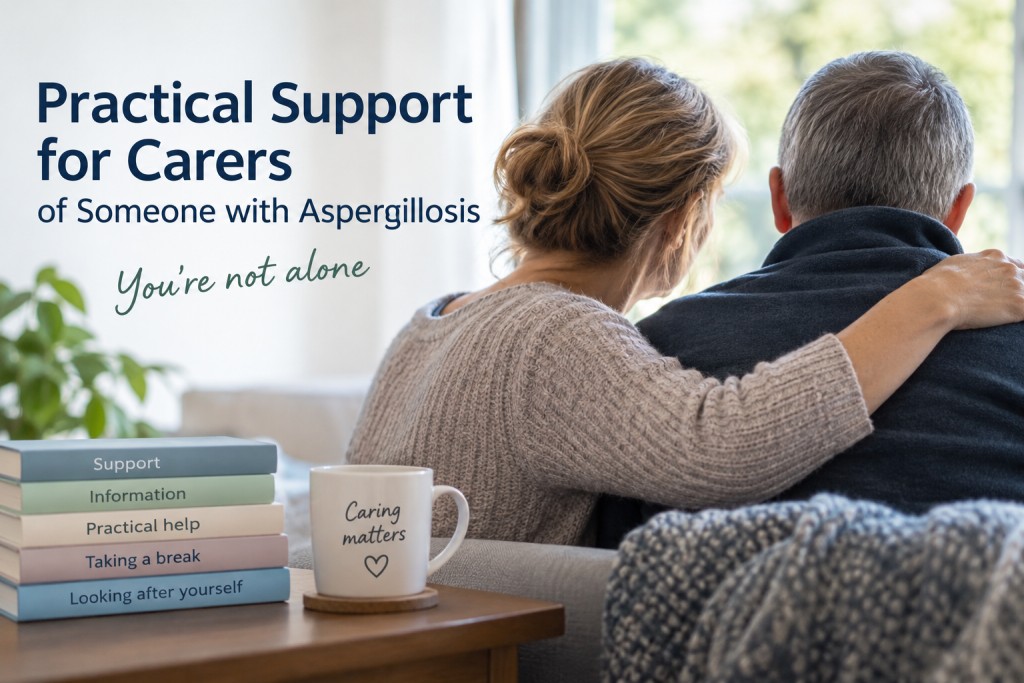
Practical Support for Carers of Someone with Aspergillosis
If you regularly help a partner, relative or friend who has aspergillosis, you may be a carer — even if you have never thought of yourself that way.
Caring does not only mean providing personal care. You might help with appointments, medicines, shopping, household tasks or transport. You may keep an eye on changes in someone's health, provide reassurance when they are unwell, or simply be the person they rely on when things become difficult.
Aspergillosis can be a long-term and sometimes unpredictable condition. There may be relatively stable periods followed by infections, worsening symptoms, medication changes or periods when considerably more help is needed. That can place demands on the people around the patient as well as on the person who is ill.
You do not have to wait until caring becomes overwhelming before asking for support.
Last updated: 9 September 2026
Last reviewed: 9 September 2026
Am I a carer?
Many people think, “I'm not a carer — I'm their husband, wife, daughter, son or friend.” You can be both.
In the UK, you may be considered an unpaid carer if you regularly look after or support someone because they are ill, disabled or need additional help. This can include practical help and emotional support.
You might, for example:
- help someone manage medicines or treatments;
- take them to medical appointments;
- help with shopping, cooking, cleaning or other everyday tasks;
- keep track of symptoms or changes in their health;
- help them communicate with healthcare services;
- provide reassurance or company when they are frightened or unwell;
- take on tasks that the person could previously manage themselves.
You do not need to live with the person you support, and you do not need to be related to them, to be a carer.
Ask for a Carer's Assessment
If you are an adult carer in the UK, one of the most useful first steps is to ask your local council for a Carer's Assessment.
This is not an assessment of whether you are a “good enough” carer. It looks at how caring affects your life and what might make your caring role more manageable.
The assessment is free and is separate from any assessment of the person you care for.
Depending on your circumstances and local services, support following an assessment might include:
- help so that you can take a break from caring;
- practical help around the home;
- help with transport;
- training to help you care safely;
- information about local carer support groups;
- support with your own physical or emotional wellbeing;
- advice about benefits and financial support.
Read the NHS guide to Carer's Assessments.
The person you support may also be entitled to practical help
Sometimes the best way to support a carer is to provide more support to the person who is ill.
If someone is struggling with everyday activities because of their health, they can ask their local council for a care needs assessment. This is also free.
Depending on their needs, this might identify help such as equipment, adaptations to the home, practical assistance from a paid carer or other social-care support.
This can help the person with aspergillosis remain as independent as possible while also reducing some of the practical pressure on family and friends.
Read the NHS guide to getting a care needs assessment.
Taking a break is part of sustainable caring
Caring can gradually expand until it occupies much of everyday life. This is particularly easy to miss when the person you support has good days and bad days, or when their needs have increased slowly over several years.
Time away from caring is not selfish. Having regular opportunities to rest, see friends, exercise, pursue interests or simply have time in which you are not responsible for somebody else can help make caring sustainable.
If you are finding it difficult to get any time away from caring, mention this during a Carer's Assessment. Care and support plans can include options for respite or replacement care to allow carers to take a break.
Share the responsibility where possible
One person can gradually become responsible for almost everything without anybody deliberately deciding that this should happen.
Where possible, think about whether particular jobs could be shared with relatives, friends or formal services. Someone else might be able to provide transport, collect prescriptions, shop, make a meal, accompany the person to an appointment or simply spend time with them.
It can be easier to establish this support before you desperately need it.
Our guide When Caring Becomes Overwhelming: Support for Family Carers looks in more detail at recognising carer strain, setting realistic limits and sharing responsibility.
Make a backup plan
Carers can become ill too.
It is worth thinking in advance about what would happen if you suddenly could not provide your usual support — even if only for a few days.
A simple backup plan might record:
- who should be contacted;
- important medical and emergency contacts;
- what help the person normally needs;
- where an up-to-date medication list can be found;
- who else has agreed to help;
- important routines or practical information another person would need to know.
The person with aspergillosis should be involved in this planning wherever possible. The aim is not to take control away from them, but to make sure everyone knows what to do if the usual arrangements suddenly stop working.
Money, benefits and work
Caring can affect household income, employment and pension contributions. Depending on your circumstances, you may be entitled to financial support.
For example, some carers may qualify for Carer's Allowance. People who care for someone but do not qualify for Carer's Allowance may in some circumstances qualify for Carer's Credit, which can help protect their National Insurance record.
The eligibility rules and payment rates change, and claiming one benefit can sometimes affect other benefits received by you or the person you care for. For that reason, it is better to check current government guidance or obtain benefits advice rather than relying on an old figure.
Check current Carer's Allowance information on GOV.UK
Check current Carer's Credit information on GOV.UK
If caring is affecting your employment, specialist carer organisations can also provide information about combining work and caring and your rights at work.
Let your GP know that you are a carer
If caring is having an effect on your own health, tell your GP practice about your caring responsibilities. Some practices can record that you are a carer and may be able to direct you towards local support.
Do not ignore your own health because somebody else's needs seem more urgent. Your physical and emotional health matters in its own right — and maintaining it also makes a caring arrangement more sustainable.
Supporting without taking over
When someone is unwell, it is natural to want to solve problems for them. But support is usually most helpful when the person with aspergillosis remains involved in decisions about their own life and healthcare.
Ask what kind of help they would like. At an appointment, for example, they may want you to listen, take notes, remember questions or mention something they have forgotten — rather than speak for them throughout the consultation.
See How to Ask Fewer, Better Questions in Appointments for practical ways patients and carers can prepare for consultations.
You may also find Talking to Friends and Family about Aspergillosis useful when explaining the condition and the support someone may need.
Finding other people who understand
Talking to other carers can be useful because many of the difficulties of caring are hard to appreciate until you have experienced them yourself.
Support does not have to be specific to aspergillosis. Local carers' organisations, lung-disease communities and online groups can provide practical information, emotional support and contact with people dealing with similar challenges.
People with aspergillosis and their family members or carers can also take part in our online aspergillosis meetings.
Find out about our online aspergillosis meetings.
If caring is becoming too much
There is an important difference between caring being difficult and a situation becoming unsustainable.
If you are exhausted, becoming unwell yourself, unable to leave the person safely, struggling to provide the care they need or beginning to feel that you simply cannot continue, ask for help rather than trying to cope indefinitely.
Contact your GP, local council or the healthcare team involved in the person's care as appropriate. If someone's immediate health or safety is at risk, seek urgent help.
Being unable to provide unlimited care does not mean that you have failed. Sometimes it means that the level of support required has become greater than one family member or friend can reasonably provide.
If you live outside the UK
The social-care assessments and benefits described above apply to the UK, and some arrangements differ between the UK nations. Other countries have different systems for supporting unpaid carers or caregivers.
If you live elsewhere, look for your national or local health, social-care or caregiver organisation for information about assessments, respite care, financial assistance and local support.
A final thought
Supporting someone with a long-term illness can be rewarding, frustrating, exhausting and deeply important — sometimes all at the same time.
Good caring should not depend on one person quietly absorbing more and more responsibility.
The aim is not simply to keep the person with aspergillosis supported. It is to build a situation that is sustainable for everyone involved.

When Caring Becomes Overwhelming: Support for Family Carers
Caring for a partner, parent, child or friend with aspergillosis can be enormously important and rewarding. It can also become exhausting.
Aspergillosis is often a long-term and unpredictable illness. Breathlessness, fatigue, infections, medication side effects, appointments and periods when symptoms suddenly become worse can all increase the amount of help someone needs.
Over time, a family member can gradually take on more and more responsibility without either person really noticing how much the relationship has changed.
If caring is beginning to feel overwhelming, that does not mean you care any less. It may mean that the current arrangement needs more support.
Last updated: 9 September 2026
Last reviewed: 9 September 2026
Why caring for someone close to you can be particularly difficult
Caring within a family is different from providing professional care.
You may be simultaneously a partner, son, daughter, parent or friend — and a carer.
Illness can also change the balance of a relationship.
The person who is unwell may be coping with loss of independence, fear about their health, frustration or exhaustion. They may feel safest expressing those feelings with the person closest to them.
At the same time, the carer may feel responsible for keeping everything going.
Gradually, ordinary family roles can become blurred. A partner may feel increasingly like a nurse. An adult child may find themselves making decisions for a parent. Both people can find these changes difficult.
Recognising when caring is becoming too much
There isn't a precise point at which caring becomes "too much".
Warning signs can include:
- feeling exhausted much of the time
- becoming increasingly anxious, irritable or resentful
- having little or no time away from caring
- losing contact with friends, hobbies or activities that matter to you
- neglecting your own health or missing your own appointments
- feeling that you cannot leave the person alone, even briefly
- feeling guilty whenever you do something for yourself
- finding that disagreements about care are affecting your relationship
- being the only person who knows what to do or who can provide particular care
- worrying about what would happen if you became ill yourself
These are not signs that you are a bad carer.
They are signs that the care arrangement may no longer be sustainable without additional support.
Aspergillosis can make caring unpredictable
One difficulty with aspergillosis is that the amount of support someone needs may vary considerably.
There may be relatively stable periods followed by infections, worsening breathlessness, severe fatigue or treatment changes.
Someone who manages independently most of the time may suddenly need much more help.
This unpredictability can make carers reluctant to make plans or leave the person they care for. Over time, life can become increasingly organised around the possibility that something might go wrong.
Planning for difficult periods can help. It may be useful to agree in advance who else could help, who should be contacted if symptoms worsen and which tasks another person could take over.
You do not have to do everything yourself
Many carers gradually become the only person who knows the routines, medicines, appointments and practical needs of the person they support.
That can make accepting help surprisingly difficult.
Someone else may not do things exactly as you would. The person you care for may also prefer you because you understand them so well.
But being indispensable can eventually become a problem for both of you.
Sharing some responsibilities can make the whole arrangement more resilient.
Help might come from:
- other family members
- friends or neighbours
- community or voluntary organisations
- health or social-care services
- paid carers
- respite services
- support groups
It doesn't have to begin with a major change.
Someone else might initially take over one regular task, provide transport to an appointment, prepare a meal or stay with your relative while you go out.
Small changes can make accepting help easier for everyone.
Protecting the relationship as well as providing care
One of the hidden costs of long-term caring is that the caring role can begin to dominate the original relationship.
A husband or wife can start to feel primarily like a carer. A daughter can become the person who organises medicines and appointments rather than simply being a daughter.
Where possible, try to preserve parts of the relationship that have nothing to do with illness.
That might mean watching something together, going somewhere you both enjoy, talking about subjects other than health or allowing somebody else to handle a routine caring task.
Professional or outside support does not replace your relationship.
Sometimes it protects it.
Talk about what you can realistically do
Boundaries can be particularly difficult within families.
It can help to have an honest conversation during a relatively calm period rather than waiting until both of you are exhausted or frustrated.
You might discuss:
- what help is genuinely needed
- what the person can still do independently
- which tasks you are comfortable providing
- which tasks are becoming difficult
- what somebody else could reasonably do
- what would happen if you became unavailable
- what support might be needed in the future
The aim isn't to withdraw care. It is to find a way of providing support that both people can live with.
Ask for help before reaching crisis point
You don't have to wait until you can no longer cope.
In England, adults who provide regular unpaid care can ask their local authority for a Carer's Assessment. This looks at how caring affects your physical and mental health, work, relationships and everyday life, and what support might help.
Similar arrangements exist elsewhere in the UK. Carers UK explains Carer's Assessments and the equivalent arrangements in England, Scotland, Wales and Northern Ireland.
Depending on circumstances and local services, support may include practical help, respite or replacement care, advice about benefits, help with transport or household tasks, training and links to local support groups.
Your GP can also be an important source of support, particularly if caring is affecting your own physical or mental health.
Carers' organisations and peer-support groups can be valuable too. Sometimes simply talking to people who understand the pressures of caring reduces the feeling that you have to manage everything alone.
For wider practical and financial information, Carers UK provides current factsheets and guides for carers.
Include other people before they are urgently needed
If possible, build a small support network before a crisis occurs.
Make sure at least one other trusted person knows important practical information such as:
- key contacts
- regular medicines
- where important information is kept
- normal routines
- what help the person usually needs
- who to contact if their health deteriorates
This is not only about giving you a break.
It also protects the person you care for if you suddenly become ill or unavailable.
When caring feels unsafe or impossible
Sometimes caring moves beyond ordinary tiredness and becomes a crisis.
Seek help promptly if:
- you feel physically or emotionally unable to continue providing essential care
- exhaustion means you are worried that either of you may be unsafe
- the person you care for suddenly needs substantially more help than you can provide
- conflict or distress at home makes either person feel unsafe
- your own physical or mental health is deteriorating significantly
Depending on the situation, this may mean contacting your GP, the person's healthcare team or local adult social-care services.
If someone is in immediate danger or there is a medical emergency, seek urgent medical help.
Supporting someone does not mean replacing their clinical team
Carers often become extremely knowledgeable about the person they support and may notice changes before anybody else.
That knowledge is valuable.
You can help by keeping track of important changes, helping prepare questions for appointments and making sure the healthcare team understands what is happening at home.
But you do not have to carry clinical responsibility yourself.
If there are concerns about aspergillosis treatment or the person's condition, these should be discussed with their healthcare team.
Where a case is particularly complex, clinicians can seek specialist advice or refer patients to the National Aspergillosis Centre where appropriate.
Looking after yourself is part of the care plan
Carers sometimes treat their own needs as optional.
They aren't.
Sleep, exercise, friendships, medical appointments, hobbies and simply having time when you are not responsible for somebody else all contribute to your ability to continue caring.
You do not have to earn a break by becoming completely exhausted first.
A sustainable caring arrangement needs to protect two people, not one.
A final thought
Good caring does not mean doing everything yourself.
Sometimes the most important change is moving from:
"I have to look after them"
to:
"We need to make sure they are well supported."
That opens the door to family, friends, healthcare professionals, social-care services and community support sharing some of the responsibility.
You remain an important person in their life.
But you should not have to carry the whole weight of their illness alone.