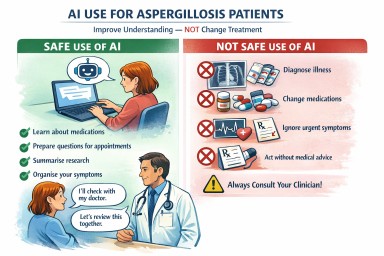
Using AI Safely When You Have Aspergillosis
Artificial intelligence (AI) tools (for example, ChatGPT and other “medical chatbots”) can help people living with aspergillosis understand information, prepare for appointments, and feel more confident asking questions.
Used well, AI can be like a helpful explainer.
Used badly, it can be misleading — especially for conditions like aspergillosis where treatment decisions are complex.
This page explains what is safe, what is not safe, and how to use AI in a way that supports (not replaces) your clinical team.
Who is this page for?
This guidance is for people affected by:
-
Chronic Pulmonary Aspergillosis (CPA)
-
Allergic Bronchopulmonary Aspergillosis (ABPA)
-
Severe Asthma with Fungal Sensitisation (SAFS)
-
Aspergillus bronchitis
-
Other long-term Aspergillus-related lung problems
A simple rule that keeps you safe
AI should improve your understanding — it should not change your treatment.
If an AI tool suggests starting, stopping, or changing medication, do not act on it without speaking to your clinician.
What AI is good for
AI tools are usually helpful for:
Explaining medical words in plain language
Examples:
-
“What is Aspergillus Immunoglobulin G (IgG)?”
-
“What does ‘eosinophils’ mean?”
-
“What is a CT scan finding such as ‘cavity’ or ‘bronchiectasis’?”
Understanding medicines (general information)
AI can explain:
-
What a medicine is for
-
How it works in the body
-
Common side effects (in general terms)
-
Why monitoring is needed
This can be helpful for antifungal medicines such as itraconazole, voriconazole, posaconazole, and isavuconazole.
Preparing for appointments
AI can help you create a list of questions, for example:
-
“What monitoring do I need while on antifungals?”
-
“What symptoms should prompt urgent review?”
-
“How do we judge whether treatment is working?”
Summarising research articles
If you paste a paragraph from a paper (or describe it), AI can often translate it into patient-friendly language.
(Always remember: AI can sometimes get details wrong — see below.)
Organising your story
Many people find it useful to ask AI to format:
-
A timeline of symptoms
-
A list of medicines and dates
-
A short “what I want from this appointment” summary
This can make consultations more productive.
What AI is NOT safe for
AI should not be used for:
Diagnosis
Aspergillosis diagnosis usually depends on a careful combination of:
-
Symptoms and clinical history
-
Imaging (often computed tomography, CT)
-
Blood tests
-
Sputum tests / microbiology
-
Sometimes bronchoscopy results
AI cannot reliably “diagnose” from symptoms or a single test result.
Treatment decisions
Do not use AI to decide:
-
Whether you should start or stop antifungals
-
Steroid doses or tapering plans
-
Whether you “should” try biologics (for example, omalizumab)
-
Whether a side effect is safe to ignore
These decisions must be individualised and clinician-led.
Urgent situations
If you have worsening breathlessness, fever, chest pain, or coughing blood (haemoptysis), seek medical advice urgently.
AI is not an emergency service.
Why aspergillosis needs extra caution
Aspergillosis care can be complicated because:
-
Some antifungal medicines have important drug interactions
-
Blood levels may need monitoring (therapeutic drug monitoring)
-
Side effects can overlap with symptoms of lung disease
-
Different Aspergillus-related conditions can look similar but need different management
AI tools can also:
-
Over-generalise from asthma guidance
-
Confuse chronic disease with invasive disease
-
“Hallucinate” (invent) facts, references, or confident-sounding explanations
-
Be out of date
Privacy and confidentiality: what not to share with AI
To protect your privacy, avoid typing in:
-
Your full name
-
Date of birth
-
NHS number
-
Home address
-
Phone number
-
Identifiable clinic letters or reports (unless anonymised)
A safer way to write questions
Instead of pasting an entire letter, use a summary like:
“Adult with chronic lung disease, on itraconazole 200 mg daily, recent CT shows cavities, asking about monitoring and side effects.”
That’s usually enough for education and planning questions.
A safe “4-step” way to use AI
-
Ask AI to explain (terms, tests, general concepts)
-
Ask AI to help you prepare questions
-
Discuss those questions with your clinician
-
Only change treatment after clinical advice
A quick safety checklist
Before trusting an AI answer, ask:
-
Is this general education, or is it telling me what I should do?
-
Does it recommend changing my medicine or dose?
-
Does it mention checking interactions or monitoring?
-
Does it conflict with my current plan?
-
Is this situation urgent?
If any answer worries you: pause and ask your care team.
Example prompts patients can use safely
You can copy/paste these into an AI tool:
-
“Explain Chronic Pulmonary Aspergillosis (CPA) in plain language.”
-
“What questions should I ask about long-term itraconazole treatment?”
-
“What monitoring is commonly recommended for antifungal medicines?”
-
“Can you help me write a one-page symptom and medication summary for my clinic appointment?”
-
“Here is a paragraph from a research paper — can you summarise it in patient-friendly language and list any uncertainties?”
Tip: If you want a more cautious response, add:
“Please be conservative and tell me what you’re unsure about.”
Signs an AI answer may be unreliable
Be cautious if the AI:
-
Sounds very confident but gives no clear reasoning
-
Gives exact doses or taper schedules
-
Claims “this is definitely ABPA/CPA” from limited information
-
Provides references you cannot find elsewhere
-
Dismisses side effects, interactions, or monitoring
-
Encourages you to delay medical care
Final reminder
AI can be a helpful tool for understanding and preparing — but it is not a substitute for a specialist team.
If you are unsure, or something feels wrong, it is always reasonable to contact your clinician, specialist nurse, or GP.
Medical disclaimer
This page is for general information only and is not medical advice. Always follow the guidance of your healthcare team, especially regarding diagnosis, medicines, and urgent symptoms.