When doctors talk about risk, it can sound worrying — especially when you’re already living with a lung condition.
But every day, we all take small, managed risks without realising it.
Understanding how everyday risks compare with medical or vaccine risks helps put the numbers into perspective — and shows why treatment is almost always worth it.
🚶♀️ Everyday activities carry small risks
Everyday life is full of tiny risks we accept because the benefits are clear — exercise, travel, independence, and social connection.
| Activity | Estimated risk of serious harm | Equivalent comparison |
|---|---|---|
| Driving a car for 250 miles | About 1 in 1 million chance of fatal accident | Roughly the same as the risk of a severe vaccine reaction |
| Cycling for 30 minutes | About 1 in 3 million | Similar to being struck by lightning in your lifetime |
| Walking near traffic for a day | Around 1 in 15 million | Negligible, but not zero |
| Taking a domestic flight (UK) | Less than 1 in 10 million chance of fatal accident | Far safer than most road journeys |
| Catching flu during winter | Around 1 in 10 chance of getting ill | Much higher risk than most medicine side effects |
We don’t think of these activities as “dangerous” because the benefit far outweighs the risk — just as it does with most treatments.
💊 Medicines and vaccines we take safely every day
Most common medicines have mild, short-lived side effects. Serious reactions are possible but extremely rare.
| Medicine | Typical mild effects | Serious reactions (approx. frequency) | Comment |
|---|---|---|---|
| Paracetamol (acetaminophen) | Nausea, rash | Serious liver injury ≈ 1 in 100,000 (usually after overdose) | Very safe when taken correctly |
| Ibuprofen | Heartburn, upset stomach | Ulcer or stomach bleed ≈ 1 in 1,000 if used long term | Safer when taken with food |
| Amoxicillin | Diarrhoea, mild rash | Severe allergic reaction ≈ 1 in 5,000–10,000 | Rare but recognised |
| Influenza vaccine | Sore arm, tiredness | Severe allergic reaction ≈ 1 in 1 million | Prevents thousands of serious infections yearly |
| COVID-19 vaccine | Mild flu-like symptoms (≈ 1 in 10) | Severe allergic reaction ≈ 1 in 100,000 | Benefits far outweigh risks |
| Oral steroids (short course) | Increased appetite, insomnia | Major side effects only with prolonged use | Vital during ABPA or asthma flares |
⚕️ What does “serious side effect” really mean?
When you read about serious reactions in medical leaflets or vaccine information, it doesn’t necessarily mean life-changing.
The term “serious” has a specific medical meaning, used by the MHRA, EMA, and WHO.
A reaction is called serious if it:
-
leads to hospitalisation,
-
is life-threatening at the time,
-
causes temporary disability or incapacity,
-
results in death, or
-
causes a birth defect.
👉 It’s about medical urgency, not always long-term harm.
In reality, most serious reactions are short-lived and fully reversible with prompt treatment.
For example:
-
An anaphylactic reaction to a vaccine is medically serious because it needs immediate care — but nearly everyone recovers completely once treated.
-
A high fever or rash that requires a day in hospital may be serious in reporting terms, but causes no permanent damage.
By contrast, life-changing reactions (such as nerve injury or organ failure) are extraordinarily rare — far rarer than being struck by lightning.
“When doctors say ‘serious reaction’, they mean something that needs urgent medical attention — not something that will leave you permanently unwell.”
🩺 More common health risks we all face
While medicine risks are very small, the everyday risks to life and health are much higher — especially if conditions go untreated.
| Health event or cause | Approximate annual risk (UK adult) | Lifetime risk | Notes |
|---|---|---|---|
| Heart attack | Around 1 in 200–300 per year | 1 in 4 men, 1 in 6 women | Increases with age, smoking, and high blood pressure |
| Stroke | Around 1 in 250 per year | About 1 in 5 adults | Preventable with healthy lifestyle and medication |
| Cancer (any type) | Around 1 in 125 per year | Around 1 in 2 people in their lifetime | Most treatable when found early |
| Serious road accident | About 1 in 15,000 per year | Around 1 in 100 lifetime | Far higher than a vaccine reaction |
| Severe flu needing hospital care | Around 1 in 500 per winter | Higher for people with lung disease | Preventable by flu vaccination |
| Fatal asthma attack | About 1 in 100,000 per year | Higher in uncontrolled asthma | Preventable with good management |
| COVID-19 death (current UK levels) | Around 1 in 2,000–5,000 per year for older/vulnerable adults | Major reason vaccination still matters | |
| Lightning strike | About 1 in 15 million per year | Around 1 in 300,000 lifetime | Benchmark for “extremely rare” risk |
⚖️ Making sense of the numbers
-
A 1 in 1,000 risk means one person in a large GP practice might experience it.
-
A 1 in 100,000 risk means one person in a football stadium crowd.
-
A 1 in 1 million risk is so rare that most doctors never see it in their career.
So when you hear that a serious vaccine reaction occurs in one in a million people, that’s about the same as:
-
being struck by lightning once in your life, or
-
winning a small lottery prize several times in a row.
❤️ The real takeaway
The greatest risks to life and health are the common diseases we can prevent or treat — not the rare side effects of treatment.
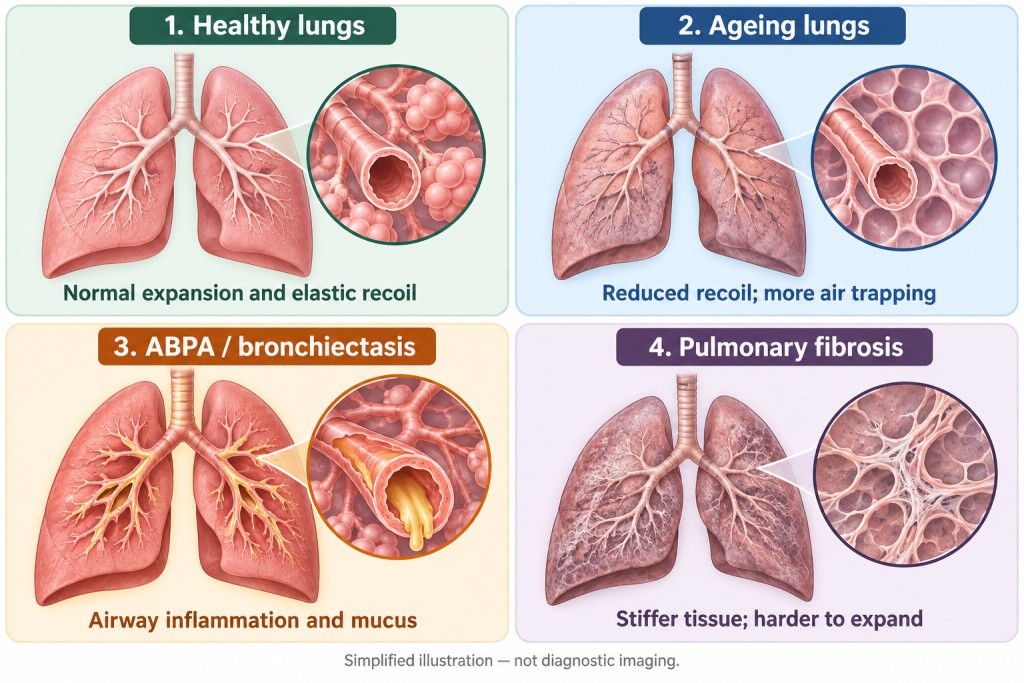
Every vaccine or medicine is carefully assessed so that its benefits far outweigh its risks, especially for people with asthma, ABPA, bronchiectasis, or weakened immunity.
Treatments don’t add danger — they reduce the much bigger risks from infection, inflammation, and lung damage.
🧭 Key message
We all live with risk, but:
-
Most everyday and health-related risks are far greater than the tiny chance of a medicine reaction.
-
Managing your lung condition well — with the right treatment, vaccines, and follow-up — protects your lungs and lengthens your life.
-
The safest path is always informed care, not avoidance through fear.

Did this page help you?
Tell us in one minute