
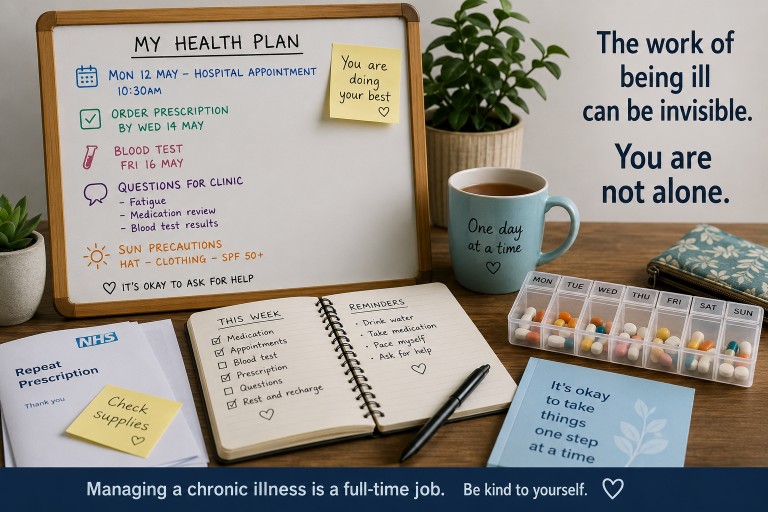
For many people, the hardest part of chronic illness is not always the symptoms. It is the constant work of managing them.
Key Points
- Chronic illness often creates a significant hidden workload.
- Patients manage medications, appointments, prescriptions, side effects, monitoring and healthcare administration.
- Fatigue and brain fog can make this workload even harder.
- Organisation helps, but organisation itself requires effort.
- Technology, pharmacists, medication reviews, family support and patient communities can help reduce the burden.
- Nobody should feel they have failed because they occasionally forget something.
Contents
- The Work Nobody Sees
- The Constant Background Process
- The Hidden Impact of Fatigue
- Grieving the Loss of Simplicity
- The Expert Nobody Wanted to Become
- Building an External Brain
- When Organisation Itself Needs Help
- Practical Ways to Reduce the Mental Load
- The Annual Medication MOT
- You Do Not Have to Carry It All Alone
- Final Thoughts
The Work Nobody Sees
When people think about chronic illness, they usually think about symptoms.
Breathlessness.
Pain.
Fatigue.
Cough.
Hospital appointments.
Medication.
These are certainly part of the picture.
But many patients would argue that another challenge receives far less attention.
The work.
Not paid work.
The hidden work of being a patient.
For many people, living with a chronic illness means becoming the organiser, administrator, coordinator and decision-maker for an ongoing healthcare programme.
There are prescriptions to order.
Appointments to attend.
Letters to understand.
Blood tests to arrange.
Side effects to monitor.
Questions to remember.
Symptoms to interpret.
Forms to complete.
Information to absorb.
And unlike most jobs, there are no weekends off.
Many patients are not only managing an illness. They are managing an entire healthcare programme.
The Constant Background Process
One patient recently described chronic illness as being like a computer running a programme permanently in the background.
Even on good days, the process never completely switches off.
Questions quietly run through the mind:
- Do I have enough medication?
- When is my next appointment?
- Should I order my prescription?
- Is this symptom normal?
- Is this a side effect?
- Have I forgotten something important?
Most healthy people can devote their attention entirely to daily life.
Many patients are simultaneously running this constant background process.
That process consumes energy.
It consumes concentration.
And over time it can become exhausting.
The work of being ill can sometimes feel almost as exhausting as the illness itself.
The Hidden Impact of Fatigue
Fatigue affects much more than physical energy.
It can affect:
- Memory.
- Concentration.
- Planning.
- Organisation.
- Decision-making.
This creates a difficult cycle.
The more tired someone becomes, the harder it is to stay organised.
The harder it is to stay organised, the easier it becomes to miss a prescription, forget an appointment or overlook an important detail.
That can create stress.
Stress itself is tiring.
Many patients eventually discover that they are not simply carrying the burden of their illness.
They are carrying the burden of managing the illness.
This is not weakness.
It is a normal human response to a sustained workload.
Grieving the Loss of Simplicity
Many people are not only grieving the loss of health.
They are grieving the loss of simplicity.
Remember when you could:
- Go away for the weekend without checking medication supplies?
- Accept invitations without calculating energy levels?
- Spend a day outdoors without thinking about medication side effects?
- Plan months ahead without wondering how you might feel?
Spontaneity often gives way to planning.
Simple decisions become calculations.
Many people find themselves missing the ease and simplicity they once took for granted.
That feeling is entirely understandable.
The Expert Nobody Wanted to Become
One of the remarkable things about people living with chronic illness is how much they learn.
Over time, patients often become experts in:
- Medications.
- Blood tests.
- Side effects.
- Hospital systems.
- Insurance.
- Benefits.
- Referral pathways.
Most never intended to acquire this knowledge.
They learned because circumstances required it.
As one patient put it:
“I never applied for the job, but somehow I became the project manager for my illness.”
Many readers will recognise that immediately.
A person with aspergillosis may spend five minutes taking medication.
They may spend an hour thinking about medication.
The burden is often not the tablet itself.
The burden is remembering the tablet, remembering to reorder the tablet, remembering what it interacts with, remembering the blood test, remembering the side effects and remembering what to do if something changes.
Building an External Brain
One lesson many patients learn is that memory alone is not enough.
This is especially true when fatigue, pain, poor sleep or brain fog are present.
Successful long-term management often depends on creating systems that do some of the remembering for us.
Examples include:
- Paper diaries.
- Calendars.
- Whiteboards.
- Medication reminder apps.
- Smartphone reminders.
- Alexa or Siri reminders.
- Weekly pill organisers.
- Shared family calendars.
One patient described this as creating an “external brain”.
The exact system matters less than the principle behind it.
The aim is not to remember everything. The aim is to build systems that do some of the remembering for you.
Technology Can Help
Smart speakers such as Amazon Alexa and voice assistants such as Apple Siri can act as simple reminder systems.
They can be used for:
- Medication reminders.
- Prescription reminders.
- Appointment reminders.
- Weekly health checks.
- Shopping lists.
- Clinic preparation.
For example:
“Alexa, remind me every Sunday evening to check my medication supplies.”
Or:
“Hey Siri, remind me every first Monday of the month to order my repeat prescriptions.”
For many patients these systems reduce stress and make it less likely that important tasks will be forgotten.
When Organisation Itself Needs Help
People are often told to “stay organised”.
It is good advice.
But it overlooks something important.
Organisation itself requires effort.
Creating reminders.
Maintaining calendars.
Sorting medication.
Reading letters.
Booking appointments.
Ordering prescriptions.
All of these tasks require energy.
For someone already dealing with fatigue, breathlessness, pain or brain fog, even staying organised can sometimes feel overwhelming.
This is why support matters.
Support is not always about physical assistance.
Sometimes it is about sharing the responsibility of remembering.
A partner who reminds you about an appointment.
A family member who collects a prescription.
A friend who helps complete a form.
A pharmacist who helps simplify medication schedules.
These small acts can remove a surprising amount of pressure.
Organisation helps. But sometimes organisation needs help too.
Practical Ways to Reduce the Mental Load
Many patients find it helpful to:
- Schedule a weekly “health admin” session.
- Use a diary, whiteboard or calendar.
- Set medication reminders.
- Use a weekly pill organiser.
- Ask about pharmacy reminder services.
- Consider medication packaging systems.
- Share calendars with family members.
- Keep a running list of questions for clinic appointments.
The goal is not perfection.
The goal is to make life easier.
The Annual Medication MOT
Cars receive regular servicing.
Computers receive updates.
Financial plans are reviewed.
Yet many people take the same collection of medications for years without anyone stepping back and looking at the whole picture.
A structured medication review or polypharmacy review can help answer questions such as:
- Do I still need all these medicines?
- Could any side effects be contributing to symptoms?
- Are there interactions?
- Can the schedule be simplified?
- Is every medication still serving a clear purpose?
Sometimes the most useful prescription is not a new medication.
It is a review of the medications already being taken.
Sometimes the most useful prescription is not a new medication, but a review of the medications already being taken.
You Do Not Have to Carry It All Alone
Many of us value independence.
That is understandable.
However, there is a difference between independence and carrying every burden alone.
Help may come from:
- Pharmacists.
- Occupational therapists.
- Family.
- Friends.
- Carers.
- Charities such as Age UK.
- Patient support groups.
Often the most valuable support is not somebody doing something for us.
It is somebody helping us remember.
A second pair of eyes.
A second memory.
A second person asking:
“Have you got everything you need for next week?”
Final Thoughts
Living with a chronic illness is often described in terms of symptoms, test results and treatments.
But behind every clinic letter is a person carrying a mental checklist that never completely disappears.
The medications.
The appointments.
The prescriptions.
The side effects.
The blood tests.
The questions.
The worries.
The constant balancing act.
If you sometimes feel tired not only from your illness, but from the work of managing it, that feeling is understandable.
It may simply be a reflection of how much you are carrying.
No patient should feel they have failed because they forgot something, ran out of medication, missed a reminder or needed support.
Managing chronic illness is complex.
Nobody does it perfectly.
The aim is not perfection.
The aim is to build enough support, systems and kindness around ourselves that daily life becomes a little easier to manage.
The goal is not to prove that you can manage everything alone.
The goal is to build enough support around yourself that life becomes easier, safer and more enjoyable.
Author: National Aspergillosis Centre Patient Support Team
Last reviewed: June 2026
Medical disclaimer: This article provides general information and support. It should not replace advice from your own doctor, pharmacist, nurse or specialist team.
Useful sources and further reading
-
Suggested Internal Links
National Aspergillosis Centre Patient Support
https://aspergillosis.org/patients/Living with Aspergillosis
https://aspergillosis.org/living-with-aspergillosis/Chronic Pulmonary Aspergillosis (CPA)
https://aspergillosis.org/chronic-pulmonary-aspergillosis/Allergic Bronchopulmonary Aspergillosis (ABPA)
https://aspergillosis.org/allergic-bronchopulmonary-aspergillosis-abpa/Aspergillus Bronchitis
https://aspergillosis.org/aspergillus-bronchitis/Understanding Fatigue in Chronic Illness
Medication Information Hub
https://aspergillosis.org/antifungal-drugs/Voriconazole Information
https://aspergillosis.org/voriconazole/Itraconazole Information
https://aspergillosis.org/itraconazole/Posaconazole Information
https://aspergillosis.org/posaconazole/Isavuconazole Information
https://aspergillosis.org/isavuconazole/Adrenal Insufficiency and Steroid Information
National Aspergillosis Centre Online Support Meetings
https://aspergillosis.org/patient-meetings/The Aspergillosis Trust
https://aspergillosistrust.org/
Suggested External Links
Age UK
https://www.ageuk.org.uk/Carers UK
https://www.carersuk.org/NHS Structured Medication Reviews
https://www.england.nhs.uk/primary-care/pharmacy/smr/NHS Repeat Prescriptions
https://www.nhs.uk/nhs-services/prescriptions/

Latest News posts
News archive