
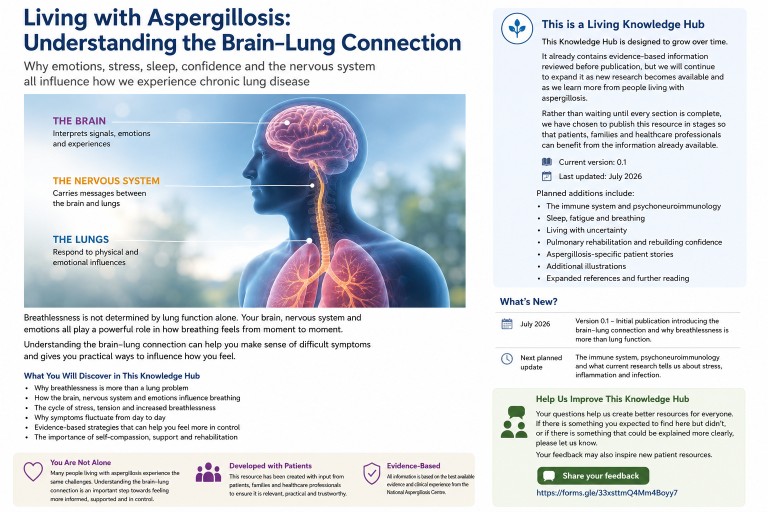
Why emotions, stress, sleep, confidence and the nervous system all influence how we experience chronic lung disease
Aspergillosis Living Knowledge Hub | Built with patients | Living document
This is a Living Knowledge Hub
Unlike a traditional article, this Knowledge Hub is designed to evolve.
As new scientific research becomes available, and as people living with aspergillosis ask new questions, we will continue to expand and improve this resource.
The current version already contains evidence-based information that has been reviewed before publication, but it is only the beginning.
This approach allows us to share useful information now, rather than waiting until every section is complete, while continuing to improve the resource over time.
- Current version: 0.1
- Last updated: July 2026
- Status: Living Knowledge Hub
- Reading time: approximately 18 minutes
- Who is this for? People living with aspergillosis, families, carers and healthcare professionals
- Review policy: This Knowledge Hub is reviewed whenever important new evidence becomes available and at least annually to ensure it remains accurate and up to date.
Planned additions
- The immune system and psychoneuroimmunology
- Sleep, fatigue and breathing
- Stress hormones, inflammation and infection
- Living with uncertainty
- Pulmonary rehabilitation and rebuilding confidence
- Additional illustrations and diagrams
- Expanded references and further reading
Contents
Before you begin…
If you have arrived here because someone suggested that stress or anxiety might be affecting your breathing, this page is for you.
If you have arrived here because you are wondering why some days are so much harder than others, this page is for you.
If you have ever worried that family members, friends or even healthcare professionals thought your symptoms were “all in your head”, this page is for you too.
And if you are a family member or healthcare professional trying to understand what it is really like to live with aspergillosis, we hope this guide helps explain an aspect of chronic lung disease that is rarely discussed in detail.
The most important message comes first.
Your illness is real.
Your symptoms are real.
Modern respiratory medicine recognises that the brain, lungs, nervous system and immune system constantly work together. Understanding that relationship does not make your illness any less real. It helps explain why living with chronic lung disease can sometimes be so challenging.
Why we wrote this guide
Over many years at the National Aspergillosis Centre, we have listened to many people living with aspergillosis.
Again and again, we hear similar questions.
“Why do I feel much worse today when my scan hasn’t changed?”
“Why does poor sleep affect my breathing so much?”
“Can stress make my symptoms worse?”
“If my emotions affect my breathing, does that mean my illness isn’t real?”
These are important questions. Unfortunately, they can be difficult to answer fully during a busy clinic appointment.
This guide has been written to provide the explanation many people tell us they never had.
It brings together modern respiratory medicine, neuroscience, immunology, pulmonary rehabilitation and the lived experience of people with aspergillosis.
Our aim is not simply to explain the science. Our aim is to help you understand your own experience.
A false choice
Many people living with chronic illness feel they have been offered two very different explanations for their symptoms.
Either the symptoms are caused by the lungs, or the symptoms are caused by anxiety.
Modern medicine increasingly recognises that this is a false choice.
The lungs are real. The brain is real. The nervous system is real. The immune system is real. Hormones are real.
Every one of these systems communicates continuously with the others. When we understand that partnership, many experiences that once seemed confusing begin to make sense.
More than just the lungs
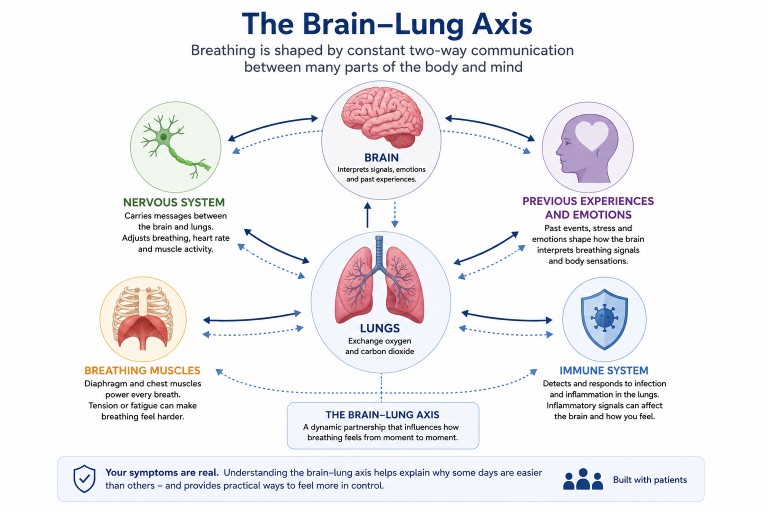
Most of us think breathing happens entirely inside the lungs. In reality, every breath depends on an extraordinary partnership between many different parts of the body.
| Body system | Its role in breathing |
|---|---|
| The lungs | Exchange oxygen and carbon dioxide. |
| The brain | Interprets breathing signals and decides how much air the body needs. |
| The nervous system | Adjusts breathing, heart rate and muscle activity. |
| The breathing muscles | Power every breath you take. |
| The immune system | Responds to infection and inflammation in the lungs. |
| Your previous experiences | Help the brain judge whether breathing feels safe or threatening. |
Scientists often describe this constant communication as the brain–lung axis.
Understanding how this partnership works has transformed the way respiratory specialists think about chronic breathlessness.
What you will learn
By the end of this guide you will understand:
- why scans and lung function tests do not always match how you feel
- why frightening experiences can change the way breathing feels
- why sleep, fatigue and emotions influence symptoms
- what scientists know about stress and the immune system
- why pulmonary rehabilitation works
- how confidence can be rebuilt after serious illness
- what is known, and what is still uncertain, about these important questions.
If you remember only one thing from this opening section, remember this:
Your illness is real. Your symptoms are real. The science that explains the connection between the brain and lungs is real too.
Why Does My Breathing Feel Worse When My Scan Hasn’t Changed?
This is probably one of the most common questions asked by people living with chronic lung disease.
“My doctor says my CT scan looks stable, so why do I feel so much worse?”
It is an excellent question. It is also one that causes enormous frustration.
Many people begin wondering whether they are imagining their symptoms or whether something has been missed.
Fortunately, modern respiratory medicine has a much better explanation.
The first thing to understand
A CT scan is an extraordinarily useful investigation. It allows doctors to see inflammation, cavities, bronchiectasis, scarring and many other important changes inside the lungs.
But a scan has one important limitation.
It shows what your lungs look like.
It cannot show what breathing feels like.
Those are two different things.
Structure versus function
A useful way to think about this is to separate structure from function.
| Structure | Function and lived experience |
|---|---|
| CT scans | Breathing comfort and effort |
| X-rays | Exercise tolerance |
| Blood tests | Energy and fatigue |
| Lung function tests | Quality of life and confidence |
Your medical team needs both kinds of information. One does not replace the other.
Breathlessness is an experience
The American Thoracic Society defines breathlessness, also called dyspnoea, as:
“A subjective experience of breathing discomfort that consists of qualitatively distinct sensations that vary in intensity.”
That definition is important. It tells us that breathlessness is something that is experienced.
The lungs send information. The brain turns that information into the experience of breathing.
An orchestra, not a solo instrument
Imagine listening to an orchestra. You do not hear only the violins. You hear the combined sound of strings, woodwind, brass and percussion.
Breathing works in much the same way. What you experience is produced by many different systems working together.
| System | Contribution |
|---|---|
| Lungs | Move oxygen and carbon dioxide. |
| Heart | Delivers oxygen. |
| Breathing muscles | Generate each breath. |
| Brain | Interprets signals. |
| Nervous system | Adjusts breathing. |
| Sleep | Influences fatigue and resilience. |
| Confidence | Changes how safe breathing feels. |
| Previous experiences | Influence future breathing responses. |
No single instrument produces the whole performance.
What your scan cannot see
Your CT scan cannot show:
- how well you slept
- whether your breathing muscles are tired
- whether you recently recovered from a viral infection
- whether you feel anxious about another haemoptysis
- whether today’s humidity is making your chest feel tight
- whether your body is still recovering from yesterday’s activity
- how much mental effort breathing requires today.
All of these may influence how breathing feels. None of them mean your illness is imaginary.
Research Spotlight
Why the modern definition of breathlessness matters
Older medical thinking often treated breathlessness as a simple consequence of lung damage.
Research over recent decades has shown that the experience of breathlessness depends upon interactions between the lungs, brain, nervous system and many other factors.
This is why modern respiratory medicine increasingly measures quality of life alongside scans and lung function tests.
Why this matters: it validates what patients have always known: how they feel cannot always be predicted by test results alone.
Why this matters if you have aspergillosis
If your scan has not changed but your breathing feels worse, this does not automatically mean:
- the disease has suddenly progressed
- the scan is wrong
- your symptoms are “all in your head”.
It means breathing is influenced by many different parts of the body working together.
Understanding those interactions is one of the biggest advances in modern respiratory medicine.
Why Does the Brain Matter If My Lungs Are the Problem?
This question worries many people.
“If my doctor starts talking about my brain, are they saying my illness isn’t real?”
The answer is simple. No.
Talking about the brain is not changing the diagnosis. It is explaining how breathing works.
Your lungs cannot create the sensation of breathlessness on their own, just as your ears cannot create music on their own, or your eyes cannot create vision on their own.
Every one of these experiences depends on the brain interpreting information coming from the body. Breathing is no different.
Your brain is your body’s prediction machine
Most of us imagine the brain as a computer that simply receives information. Modern neuroscience paints a much more interesting picture.
The brain is constantly trying to predict what is about to happen.
Every second it asks questions such as:
- Am I safe?
- Am I getting enough oxygen?
- Should I breathe faster?
- How hard are my breathing muscles working?
- Does this feel familiar?
It compares what it expects to happen with what is actually happening.
If everything matches, breathing usually fades into the background. If something unexpected happens, breathing suddenly becomes the centre of attention.
This is one reason healthy people rarely notice their breathing, while people living with chronic lung disease may think about it many times each day.
The smoke alarm inside your brain
A smoke alarm has one job: to detect danger. It would rather ring unnecessarily than miss a real fire.
Your brain works in much the same way.
If you have experienced:
- a severe asthma attack
- haemoptysis
- being unable to catch your breath
- an emergency admission to hospital
- months of unexplained symptoms before diagnosis
your brain learns something very important.
“Breathing can sometimes become dangerous.”
Once that lesson has been learned, your brain naturally pays much closer attention to breathing than it did before.
This is not a fault. It is exactly what evolution intended. Your brain is trying to protect you.
Patient Perspective
“After coughing up blood I became frightened every time I coughed.
I knew the bleeding had stopped, but every cough made me wonder whether it was happening again.
Learning that my brain was trying to protect me, not trick me, changed the way I understood my recovery.”
The Brain–Lung Axis
Scientists describe the close communication between the brain and lungs as the brain–lung axis.
This communication works in both directions.
| The lungs tell the brain… | The brain tells the lungs… |
|---|---|
| How much oxygen is available. | How fast to breathe. |
| How much carbon dioxide is present. | How deeply to breathe. |
| Whether the airways are irritated. | When to cough. |
| How hard the breathing muscles are working. | How to respond to exercise. |
Every breath is the result of this continuous conversation.
Why this matters if you have aspergillosis
If you understand that breathing is created by a partnership between the lungs and brain, several confusing experiences suddenly make much more sense.
- Why one day can feel much harder than another.
- Why sleep affects breathing.
- Why fatigue affects breathing.
- Why confidence affects breathing.
- Why pulmonary rehabilitation improves symptoms even when scans remain unchanged.
- Why frightening respiratory events can continue to affect confidence long after the lungs have recovered.
None of these observations suggest your illness is psychological.
They demonstrate how remarkably sophisticated the breathing system really is.
Research Spotlight
Brain imaging studies have shown that breathlessness activates areas of the brain involved in attention, emotion and decision-making, as well as areas involved in sensory processing.
This reinforces an important message:
Breathlessness is not simply a signal from the lungs. It is a whole-body experience.
Can Emotions Really Change My Breathing?
Many people living with aspergillosis are reluctant to ask this question.
Some worry that even mentioning stress or emotions will mean their symptoms are no longer taken seriously. Others have experienced exactly that in the past.
Modern respiratory medicine takes a very different view.
It recognises two equally important facts.
- Your lung disease is real.
- Your emotional state can influence how that disease is experienced.
These statements are not contradictory. They describe how the human body normally works.
Every emotion has a physical effect
Think about the last time you were startled. Before you had time to think, your body had already responded.
- Your heart rate increased.
- Your breathing became faster.
- Your muscles tightened.
- Your mouth became dry.
- Your attention narrowed onto the potential danger.
You did not choose any of those reactions. They happened automatically.
This is because emotions are not separate from the body. They are produced by the body and immediately affect the body’s physiology.
Breathing is especially sensitive
Unlike many other organs, the breathing system has to respond continuously to both physical demands and emotional demands.
| Situation | What happens? |
|---|---|
| Walking upstairs | Your breathing increases because your muscles need more oxygen. |
| Receiving frightening news | Your breathing may also increase, even though your muscles are resting. |
| Laughing | Your breathing pattern changes completely. |
| Crying | Your breathing becomes irregular and deeper. |
| Feeling calm and relaxed | Your breathing usually slows and becomes more efficient. |
These changes happen in everyone.
People with chronic lung disease often notice them more because their breathing system is already working harder.
Why frightening experiences matter
Imagine two people climbing exactly the same flight of stairs.
One has never experienced serious breathing problems. The other has previously been admitted to hospital with severe breathlessness.
Their lungs may be working equally hard. But their brains interpret those signals differently.
The first person thinks:
“I’m out of breath because I climbed the stairs.”
The second person may immediately wonder:
“Is something going wrong again?”
Neither response is irrational. They reflect different life experiences.
This is one reason why previous severe respiratory events can continue to influence confidence long after recovery.
Patient Perspective
“I realised I wasn’t frightened of exercise.
I was frightened of becoming breathless because, in the past, breathlessness had meant I was seriously ill.”
The vicious circle of fear
Fear itself does not damage the lungs. However, fear can unintentionally make breathing feel more difficult.
Breathlessness
       ↓
Concern
       ↓
Breathing becomes faster
       ↓
Chest muscles tighten
       ↓
Breathing feels harder
       ↓
More concern
This is not imaginary. Every stage involves genuine physical changes.
The encouraging news is that this cycle can also be interrupted.
Understanding
       ↓
Greater confidence
       ↓
Calmer breathing
       ↓
More efficient breathing
       ↓
Activity feels easier
       ↓
Confidence grows
This does not remove aspergillosis. It changes how effectively the whole breathing system works together.
Research Spotlight
Why pulmonary rehabilitation improves confidence
Research consistently shows that pulmonary rehabilitation improves quality of life, exercise capacity and confidence, even when lung function changes only modestly.
Patients often describe feeling more in control of their breathing.
This improvement reflects better physical conditioning, improved breathing efficiency, increased confidence and a better understanding of symptoms.
These benefits are recognised internationally and form an important part of managing many chronic respiratory diseases.
Why this matters if you have aspergillosis
You are not expected to ignore your emotions.
You are not expected to “stay positive” all the time.
You are not expected to pretend your illness is less serious than it is.
Instead, understanding how emotions influence breathing gives you another tool.
It helps explain why:
- some days feel harder than others
- confidence matters
- breathing techniques can help
- pulmonary rehabilitation works
- being listened to is part of good medical care
Knowledge does not remove the disease.
But it can remove unnecessary fear and replace it with understanding.
Emotions do not make aspergillosis imaginary.
They are one of the many biological systems that influence how living with aspergillosis feels from day to day.
What’s New?
This Knowledge Hub is updated regularly as new evidence becomes available and in response to questions from readers.
Version 0.1 – July 2026
- Initial publication.
- Introduced the Brain–Lung Connection.
- Explained why breathlessness is more than lung function alone.
- Explored how previous experiences and emotions can influence breathing.
Next planned update
- The immune system and psychoneuroimmunology.
- Stress hormones, inflammation and infection.
- Sleep and breathing.
Help Shape Future Editions
Every month we review this Knowledge Hub.
Some improvements come from newly published scientific research.
Others come directly from the questions and experiences shared by people living with aspergillosis, their families and healthcare professionals.
Many of the most valuable pages on aspergillosis.org have started with a single patient question.
If there was something you expected to find but didn’t…
If something wasn’t explained clearly…
If your own experience has been different…
Or if there is a question you think every patient should have answered…
Please tell us.
Your feedback will help shape future editions of this Knowledge Hub and may inspire entirely new patient resources.
📝 Share your feedback (2–3 minutes)
Thank you for helping us build one of the world’s most comprehensive patient education resources on aspergillosis.
This Knowledge Hub has evolved thanks to our readers
Future updates will be listed here so you can see how this resource has grown over time.
| Version | What’s changed |
|---|---|
| 0.1 | Initial publication introducing the Brain–Lung Connection, explaining why breathlessness is more than lung function, and describing how previous experiences and emotions can influence breathing. |
| 0.2 | Coming soon: immune system, psychoneuroimmunology, stress hormones, inflammation and sleep. |
| 0.3 | Coming soon. |
| 1.0 | First complete edition. |
Further reading and references
- American Thoracic Society Statement: Update on the Mechanisms, Assessment, and Management of Dyspnea
- American Thoracic Society PDF: Mechanisms, Assessment, and Management of Dyspnea
- American Thoracic Society patient information: Pulmonary Rehabilitation
- British Thoracic Society: Pulmonary Rehabilitation resources
- Global Initiative for Asthma (GINA)
- Global Initiative for Chronic Obstructive Lung Disease (GOLD)
- PubMed search: brain imaging and dyspnoea reviews
- PubMed search: quality of life in chronic pulmonary aspergillosis
- Aspergillosis Patients & Carers website
Suggested citation: National Aspergillosis Centre. Living with Aspergillosis: Understanding the Brain–Lung Connection. Aspergillosis.org. Version 0.1. July 2026.

Latest News posts
News archive