Last reviewed: 23 June 2026
Author: National Aspergillosis Centre Team
Audience: People living with aspergillosis, carers, healthcare professionals, and interested readers.
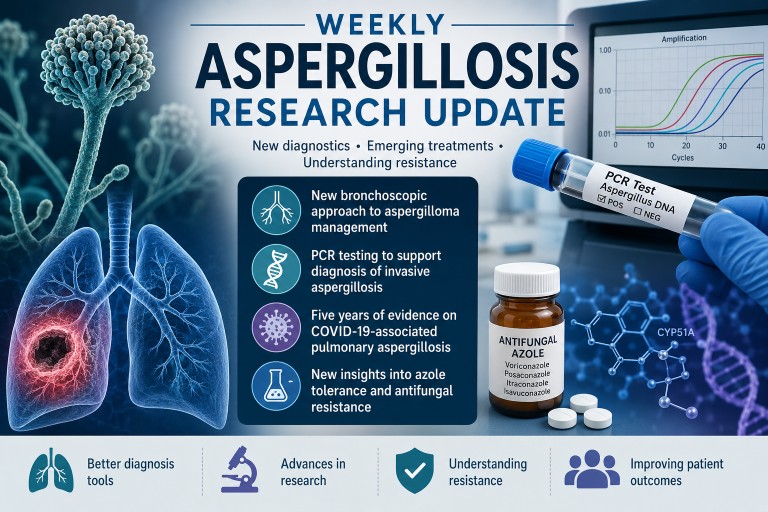
In one sentence: This week’s aspergillosis research highlights a possible new bronchoscopic approach to aspergilloma management, growing use of PCR diagnostics, a major review of COVID-19-associated pulmonary aspergillosis, and new discoveries explaining how Aspergillus fumigatus may survive antifungal treatment.
Research Highlight of the Week
Why azole tolerance is more complex than resistance
The most important scientific theme this week is the growing recognition that Aspergillus fumigatus can sometimes survive antifungal treatment without possessing classic resistance mutations. Three separate studies suggest that iron availability, cellular stress responses, epigenetic regulation and long non-coding RNA may all influence how the fungus responds to azole drugs. These findings do not change treatment today, but they could shape future approaches to antifungal resistance monitoring and antifungal drug development.
Who Should Read This Update?
This update may be particularly relevant for:
- People living with chronic pulmonary aspergillosis (CPA)
- People with aspergilloma or a history of haemoptysis (coughing up blood)
- Patients receiving antifungal treatment such as itraconazole, voriconazole, posaconazole or isavuconazole
- Healthcare professionals interested in aspergillosis diagnostics and antifungal resistance
- Anyone following developments in fungal disease research
Key Points
- A study explored bronchoscopic removal of aspergilloma in selected patients with post-tuberculosis chronic cavitary pulmonary aspergillosis.
- Real-time polymerase chain reaction (PCR) testing may provide additional support when diagnosing invasive aspergillosis.
- A major review confirms that COVID-19-associated pulmonary aspergillosis (CAPA) remains a serious complication of severe COVID-19.
- New research suggests that antifungal treatment response is influenced by much more than simple resistance mutations.
- None of these findings should lead patients to change treatment without specialist medical advice.
Contents
- Overview
- A possible new approach for aspergilloma
- PCR testing and invasive aspergillosis
- COVID-19-associated pulmonary aspergillosis
- Why azole tolerance is more complex than resistance
- Also noted this week
- What this means for patients
- When to speak to your clinical team
- References
Overview
Research into aspergillosis continues to advance on several fronts. This week’s papers range from practical clinical studies investigating new ways to manage aspergilloma, through to laboratory research exploring how Aspergillus fumigatus survives antifungal treatment.
While none of these studies are likely to change patient care immediately, they highlight important trends in the field. Researchers are working to improve diagnosis, develop new treatment approaches, and better understand why some infections persist despite treatment.
The strongest overall message this week is that aspergillosis research is moving beyond simple categories such as “susceptible” or “resistant”. Aspergillus fumigatus can adapt to stress, tolerate antifungal pressure, and sometimes survive long enough to acquire more stable resistance.
Most of the studies featured this week improve our understanding of aspergillosis rather than changing treatment directly. Nevertheless, several findings point towards future improvements in diagnosis, patient monitoring and antifungal therapy.
A Possible New Approach for Aspergilloma
One of the most clinically interesting papers this week investigated bronchoscopic removal of aspergilloma in patients with post-tuberculosis chronic pulmonary aspergillosis (CPA).
An aspergilloma, sometimes called a fungal ball, develops when Aspergillus grows within an existing cavity in the lung. These cavities can develop after conditions such as tuberculosis, sarcoidosis, or previous severe lung infections.
Post-tuberculosis chronic cavitary pulmonary aspergillosis refers to CPA developing in lung cavities left behind after previous tuberculosis.
Traditionally, treatment options include antifungal medication, surgery in carefully selected patients, and procedures such as bronchial artery embolisation to control significant bleeding.
This study explored whether bronchoscopy could be used to remove fungal material directly from affected cavities.
Why many patients will find this interesting: Antifungal treatment can help control chronic pulmonary aspergillosis, but it does not usually remove an established fungal ball. Surgery can sometimes be curative, but many patients are not suitable surgical candidates because of reduced lung function or other medical conditions. A successful bronchoscopic approach could eventually provide an additional option for selected patients.
Why is this important?
Many patients with chronic pulmonary aspergillosis are not suitable candidates for surgery because of reduced lung function or other health problems. A bronchoscopic approach could potentially offer a less invasive alternative in selected cases.
However, several important questions remain unanswered:
- Which patients benefit most?
- How often does the aspergilloma return?
- What is the risk of bleeding?
- Is antifungal treatment still required afterwards?
- How durable are the results over longer follow-up?
At present, this should be viewed as a promising specialist-centre approach rather than a new standard of care.
Evidence strength: Clinical interventional study.
Practice-changing now? No. Potentially important, but not yet routine management.
Bottom line: Bronchoscopic removal of aspergilloma is an interesting specialist approach that may eventually help some patients who are unsuitable for surgery, but it is not yet standard treatment.
Read more:
Investigating the efficacy and safety of bronchoscopic removal of aspergilloma in PTB-CCPA
PCR Testing May Help Diagnose Invasive Aspergillosis
Another paper examined the role of real-time polymerase chain reaction (PCR) testing in diagnosing invasive aspergillosis.
PCR detects fungal genetic material and can potentially identify infection more quickly than conventional culture methods.
Why is this important?
Diagnosing invasive aspergillosis remains challenging. No single test is perfect, and clinicians often need to combine information from:
- CT scans and other imaging
- Bronchoscopy findings
- Fungal culture
- Microscopy
- Galactomannan testing
- Clinical risk factors
PCR has been studied for many years, but its performance varies depending on the patient group, sample type, laboratory method and whether the patient has already received antifungal treatment.
This study supports the growing role of molecular diagnostics but does not suggest that PCR should replace existing tests. Instead, it reinforces the idea that combining several diagnostic approaches usually provides the most reliable diagnosis.
A key caution is that PCR detects fungal DNA. It does not always prove invasive disease. This is especially important in people with structurally abnormal lungs, where colonisation can complicate interpretation.
Evidence strength: Diagnostic utility study.
Practice-changing now? No. PCR may be a useful additional test but should always be interpreted alongside the wider clinical picture.
Bottom line: PCR is becoming an increasingly useful diagnostic tool, but it works best when combined with scans, biomarkers, culture results and clinical assessment.
Read more:
Utility of Real-Time PCR in the Diagnosis of Invasive Aspergillosis
Five Years of Evidence on COVID-19-Associated Pulmonary Aspergillosis
Researchers also published a major umbrella review examining evidence from 2020 to 2025 on COVID-19-associated pulmonary aspergillosis (CAPA).
CAPA emerged during the COVID-19 pandemic as an important complication affecting some patients with severe COVID-19, particularly those requiring intensive care.
What did the review find?
The review confirms that CAPA remains associated with:
- Severe illness
- Intensive care admission
- Mechanical ventilation
- High mortality
However, estimating exactly how common CAPA is remains difficult.
Different studies used different definitions, diagnostic methods and screening approaches, making direct comparison challenging. Bronchoscopy was also limited in many settings early in the pandemic, which affected how cases were detected and classified.
Studies have also differed because of:
- Different diagnostic criteria
- Changes in COVID-19 treatment over time
- Vaccination status
- Use of corticosteroids and immunomodulators
- Different intensive care unit screening practices
The review is valuable because it brings together several years of evidence, but it is unlikely to change current management directly.
Evidence strength: Umbrella review and meta-meta-analysis.
Practice-changing now? No. It reinforces awareness rather than introducing a new treatment approach.
Bottom line: CAPA remains a serious complication of severe COVID-19, but this review largely confirms what clinicians already suspected rather than changing current practice.
Read more:
Incidence, Mortality and Risk Factors in COVID-19-Associated Pulmonary Aspergillosis (CAPA)
Why Azole Tolerance Is More Complex Than Resistance
The most scientifically important theme this week comes from three studies investigating how Aspergillus fumigatus survives exposure to azole antifungal drugs.
For many years, discussions about antifungal treatment failure have focused heavily on resistance mutations, particularly changes involving the CYP51A gene. These mutations can make the fungus less susceptible to antifungal drugs such as itraconazole, voriconazole, posaconazole and isavuconazole.
However, these new studies suggest the situation may be considerably more complicated.
Researchers found that fungal survival may also be influenced by:
- Iron availability
- Mitochondrial function
- Epigenetic regulation
- Long non-coding RNA molecules
Why this matters for patients: Laboratory testing may sometimes suggest that an Aspergillus isolate is susceptible to treatment, yet the infection can still prove difficult to control. Researchers increasingly believe that fungal tolerance and stress-response mechanisms may help explain some of these situations. Understanding these processes could eventually lead to better resistance monitoring and more effective treatments.
Resistance vs Tolerance: What’s the Difference?
Resistance and tolerance are related but different concepts.
Resistance usually refers to genetic changes that allow the fungus to continue growing despite exposure to an antifungal drug.
Tolerance refers to the ability of some fungal cells to survive drug exposure without necessarily having permanent resistance mutations.
This distinction matters because tolerance may allow the fungus to persist long enough to eventually acquire more stable resistance.
In simple terms, researchers are increasingly asking whether some cases of treatment failure occur because the fungus first becomes tolerant and only later becomes resistant.
The emerging model:
Azole exposure → Temporary tolerance → Fungal survival → Opportunity for resistance mutations → Stable resistance
Iron Starvation and Azole Tolerance
One study found that iron starvation may increase azole tolerance in Aspergillus fumigatus through effects on mitochondrial function.
Iron is essential for both humans and fungi. During infection, the immune system attempts to limit fungal access to iron as part of a defence strategy known as nutritional immunity.
The study suggests that when iron becomes scarce, the fungus may alter its metabolism in ways that help it survive antifungal stress.
This does not mean that iron supplements or dietary changes would affect antifungal treatment. The work is exploring complex biological processes occurring within infected tissues.
Instead, the study provides another clue about how the fungus adapts to hostile conditions inside the body.
Evidence strength: Mechanistic laboratory research.
Practice-changing now? No.
Epigenetics and the Development of Resistance
Perhaps the most influential paper this week examined an epigenetic mechanism that appears to promote azole tolerance and facilitate the later development of antifungal resistance.
Epigenetics refers to changes in gene activity that occur without altering the underlying DNA sequence itself.
In recent years, researchers have increasingly recognised that fungal adaptation is not driven solely by permanent genetic mutations. Instead, fungi can alter gene activity in response to environmental stress.
This study supports a model in which antifungal exposure may trigger a temporary tolerant state. That tolerant state may then allow some fungal cells to survive long enough to acquire permanent resistance mutations.
Importantly, this does not replace the existing understanding of CYP51A-mediated resistance. Instead, it expands it.
Rather than viewing resistance as a single event, researchers are increasingly seeing it as a process that may develop over time.
Evidence strength: Strong mechanistic evidence.
Practice-changing now? No, but potentially important for future resistance monitoring and antifungal development.
Long Non-Coding RNA and Antifungal Susceptibility
The third paper identified a long non-coding RNA that appears to influence triazole susceptibility in Aspergillus fumigatus.
Long non-coding RNAs are molecules that do not produce proteins themselves but can still influence how genes are switched on or off.
Although these molecules are increasingly recognised as important regulators of biological processes, their role in fungal antifungal susceptibility remains relatively unexplored.
The researchers found that altering the activity of a specific long non-coding RNA changed how the fungus responded to azole antifungal drugs in laboratory experiments and animal models.
This is still early-stage science and has no immediate impact on patient treatment. However, it provides another example of how fungal responses to antifungal drugs may be regulated by multiple biological pathways.
Evidence strength: Moderate to strong mechanistic evidence.
Practice-changing now? No.
Bottom line: These studies suggest that antifungal treatment response is influenced by much more than classic resistance mutations. Scientists are uncovering a complex network of stress responses, metabolic adaptations and gene regulation mechanisms that may help Aspergillus survive antifungal exposure. While this research will not change treatment today, it may eventually lead to better ways of predicting, preventing and overcoming antifungal resistance.
Also Noted This Week
Breakthrough Aspergillosis Despite Prophylaxis
A case report described tracheobronchial aspergillosis developing in a lung transplant recipient despite receiving combined antifungal prophylaxis. The infection involved Aspergillus calidoustus and Aspergillus niger.
While only a single case, it serves as a reminder that prophylactic treatment reduces risk but cannot eliminate it completely, particularly in highly immunosuppressed patients and where less common or resistant Aspergillus species may be involved.
Evidence strength: Case report. Clinically notable, but very low-level evidence.
Practice-changing now? No.
Read more:
View on PubMed |
Read via DOI
Therapeutic Drug Monitoring Remains Important
A bibliometric review highlighted growing interest in antifungal therapeutic drug monitoring (TDM).
Therapeutic drug monitoring means measuring antifungal drug levels in the blood to help ensure that treatment is high enough to be effective while minimising toxicity and drug interactions.
This does not provide new clinical trial evidence, but it supports the growing importance of antifungal stewardship, pharmacokinetic monitoring, toxicity prevention and pharmacy-led optimisation of antifungal treatment.
Evidence strength: Bibliometric and service-focused review.
Practice-changing now? No, but relevant to service development and pharmacy practice.
Read more:
View on PubMed |
Read via DOI
Potential Future Drug Targets
A bioRxiv preprint investigated the mannitol biosynthesis pathway in Aspergillus fumigatus, focusing on mannitol-2-dehydrogenase as a possible antifungal target.
This is early preclinical research and does not affect current treatment. However, it is worth watching as part of wider efforts to identify fungal-specific metabolic vulnerabilities that could eventually support new antifungal strategies.
Evidence strength: Preclinical antifungal-target discovery.
Practice-changing now? No. Interesting, but very early.
Read more:
Search bioRxiv for this preprint
Why This Research Matters
- Diagnosis continues to improve through molecular testing.
- Researchers are exploring less invasive options for managing aspergilloma.
- COVID-19-associated pulmonary aspergillosis remains an important complication of severe COVID-19.
- Scientists are discovering new mechanisms that help Aspergillus survive antifungal treatment.
- Future antifungal therapies may target fungal stress responses as well as traditional resistance mechanisms.
What Researchers Will Be Watching Next
- Whether bronchoscopic aspergilloma removal can be replicated in larger studies and specialist centres.
- How PCR testing can be integrated most effectively into routine diagnostic pathways.
- Whether CAPA rates continue to change as COVID-19 evolves and vaccination remains widespread.
- How fungal tolerance contributes to treatment failure and acquired azole resistance.
- Whether new antifungal drugs can exploit pathways such as mannitol metabolism, stress adaptation and epigenetic regulation.
What This Means for Patients
This week’s research illustrates how aspergillosis science is advancing in two important directions at the same time.
Firstly, researchers are developing better ways to diagnose and manage disease through improved testing and new interventional approaches.
Secondly, scientists are learning much more about the biology of Aspergillus itself, particularly how it survives antifungal treatment and adapts to stressful environments.
Although none of these studies should change individual treatment decisions today, they contribute to a growing body of knowledge that may improve diagnosis, monitoring and treatment options in the future.
The most immediate clinical relevance comes from studies investigating diagnosis and management. The laboratory studies are less likely to affect care in the short term but may contribute to future advances in treatment and resistance prevention.
For now, the main message is that aspergillosis remains a complex condition that requires specialist assessment and interpretation of test results within the wider clinical picture.
None of the papers discussed in this update support changing treatment without specialist medical advice.
When to Speak to Your Clinical Team
Contact your clinical team promptly if you experience:
- Significant haemoptysis (coughing up blood)
- Worsening breathlessness
- Persistent fever
- New or worsening chest pain
- Severe side effects from antifungal treatment
- New confusion or sudden deterioration
- A sudden worsening of your usual aspergillosis symptoms
Do not stop, reduce, or change antifungal treatment without discussing it with your healthcare team first.
If you cough up a large amount of blood, have severe breathlessness, chest pain, collapse, or feel acutely unwell, seek urgent medical help.
Evidence Strength Summary
| Topic | Evidence type | Clinical relevance | Practice-changing now? |
|---|---|---|---|
| Bronchoscopic aspergilloma removal in post-tuberculosis CPA | Clinical interventional study | Medium to high | No |
| Real-time PCR for invasive aspergillosis | Diagnostic utility study | Moderate | No |
| CAPA umbrella review | Evidence synthesis | High | No |
| Iron starvation and azole tolerance | Mechanistic study | Medium | No |
| Epigenetic azole tolerance | Mechanistic study | Medium to high | No |
| Long non-coding RNA and triazole susceptibility | Mechanistic study | Medium | No |
| Breakthrough tracheobronchial aspergillosis case report | Case report | Low to moderate | No |
| Antifungal therapeutic drug monitoring | Bibliometric/service review | Moderate for services | No |
| Mannitol pathway preprint | Preclinical target discovery | Low at present | No |
Frequently Asked Questions
What is azole tolerance in Aspergillus?
Azole tolerance describes the ability of some Aspergillus cells to survive exposure to antifungal drugs without possessing the classic resistance mutations normally associated with azole resistance. Researchers believe tolerance may sometimes contribute to persistent infection and could provide an opportunity for more stable resistance to develop later.
Can PCR diagnose aspergillosis?
Polymerase chain reaction (PCR) testing can help detect Aspergillus genetic material and may support diagnosis, particularly when combined with imaging, culture, galactomannan testing and clinical assessment. PCR alone cannot confirm invasive disease.
What is COVID-19-associated pulmonary aspergillosis (CAPA)?
COVID-19-associated pulmonary aspergillosis, or CAPA, is a form of aspergillosis that can occur in some patients with severe COVID-19, particularly those requiring intensive care treatment.
Can aspergilloma be removed without surgery?
Research is exploring bronchoscopic removal of aspergilloma in carefully selected patients. However, this remains a specialist procedure and is not currently considered standard treatment. Further studies are needed to determine which patients benefit most.
Does antifungal resistance mean treatment will stop working?
Not necessarily. Many patients respond well to antifungal treatment. Resistance is only one factor influencing treatment success. Drug levels, immune function, disease severity and fungal tolerance mechanisms may also influence outcomes.
Should I change my antifungal treatment because of these studies?
No. None of the studies discussed in this update support changing treatment without specialist medical advice. Patients should always discuss treatment decisions with their clinical team.

Did this page help you?
Tell us in one minute