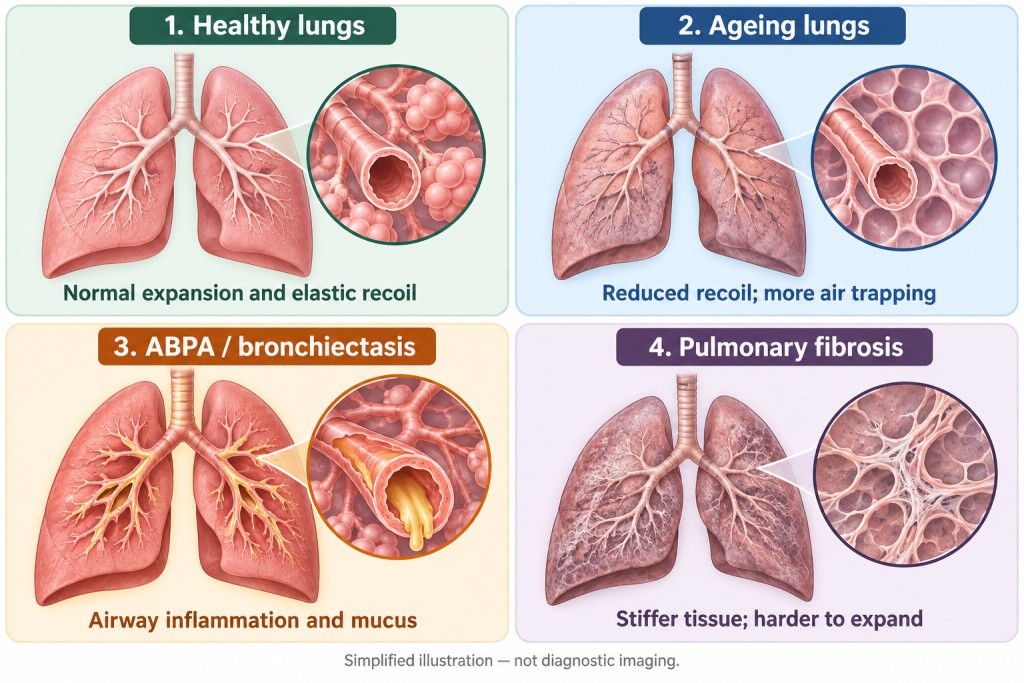
Research suggests that some variants in the CFTR gene may be more common among people with allergic bronchopulmonary aspergillosis (ABPA). However, the connection remains uncertain, and carrying one CFTR variant does not mean that someone has cystic fibrosis.
Reviewed and updated: 22 July 2026
What is the CFTR gene?
The CFTR gene provides instructions for making a protein that helps regulate the movement of salt and water across cell surfaces. This contributes to keeping mucus in the lungs and other organs at the correct consistency.
Cystic fibrosis (CF) is usually caused by disease-causing variants in both copies of the CFTR gene—one inherited from each parent. A person with only one disease-causing variant is generally described as a CF carrier and does not have cystic fibrosis.
Nevertheless, research increasingly suggests that some carriers may have a slightly greater susceptibility to certain respiratory conditions. This does not mean that every carrier will develop lung disease.
What did the original ABPA study find?
Researchers at the National Aspergillosis Centre and Manchester Centre for Genomic Medicine studied 156 people with ABPA who underwent genetic screening.
They reported that 18 people—11.5% of the group—had at least one detected CFTR variant. This was higher than the estimated carrier frequency used for comparison at the time. Two patients had variants in both copies of the gene and were subsequently diagnosed with cystic fibrosis.
The researchers suggested that CFTR testing and genetic counselling might be appropriate for selected people with ABPA.
However, this was a retrospective study conducted at a specialist referral centre. The genetic tests used did not identify every possible CFTR variant, and the study could not establish that carrying one variant caused ABPA.
Read the original study in the Journal of Asthma.
What has newer research found?
A large genomic study published in 2025 examined health conditions among people carrying one disease-causing CFTR variant. ABPA was observed more frequently among carriers, with an estimated odds ratio of 2.50.
That result needs careful interpretation. ABPA was uncommon, and the association did not remain statistically significant after the researchers accounted for the large number of conditions being investigated. The study’s overall analysis did not find conclusive evidence that CFTR carriers had an increased risk across the range of cystic-fibrosis-associated conditions.
The researchers also noted that some earlier studies recruited patients who were already receiving specialist care or genetic testing. This can create selection bias: the people included may not be representative of carriers in the wider population.
Read the 2025 study in JAMA Internal Medicine.
Other recent research indicates that CF carriers who develop bronchiectasis may experience more severe disease or particular respiratory infections. These findings support further investigation of CFTR function in chronic lung disease, but they do not prove that carrier status causes bronchiectasis or ABPA.
Read the 2024 study of CF carriers with bronchiectasis.
Should everyone with ABPA have CFTR testing?
Current international ABPA guidance does not recommend routine CFTR genetic testing for every person with ABPA.
A respiratory specialist may consider investigating cystic fibrosis or a CFTR-related disorder when other clinical features raise suspicion. These might include:
- bronchiectasis beginning unusually early in life;
- recurrent or persistent respiratory infections;
- repeated isolation of organisms commonly associated with cystic fibrosis;
- chronic sinus disease or nasal polyps;
- digestive problems or pancreatic insufficiency;
- male infertility caused by congenital absence of the vas deferens;
- a family history of cystic fibrosis; or
- previous genetic results that require further interpretation.
Depending on the circumstances, assessment could include a sweat test, genetic testing and referral to a cystic fibrosis or clinical genetics service.
Read the revised international guidance on diagnosing and treating ABPA.
What does a positive genetic result mean?
Finding one CFTR variant does not automatically explain a person’s ABPA, establish a diagnosis of cystic fibrosis or indicate that their treatment should change.
There are thousands of known CFTR variants, and they do not all have the same effects. Results need to be interpreted alongside symptoms, medical history, sweat-test results and other clinical findings.
Genetic counselling can help people understand what a result means for them and whether it has implications for relatives or future children.
Does CF carrier status change ABPA treatment?
There is currently no evidence that someone should receive antifungal treatment, corticosteroids, biologic treatment or a CFTR modulator solely because they carry one CFTR variant.
ABPA treatment should continue to be based on the person’s symptoms, test results, lung imaging, underlying condition and response to treatment. CFTR modulators are approved for eligible people with cystic fibrosis; they are not an established treatment for ABPA in people who do not have CF.
The current position
CFTR variants may contribute to respiratory susceptibility in some people with ABPA, but the size and clinical importance of the association remain uncertain. More prospective research involving representative patient groups is needed.
If you have ABPA and are concerned about cystic fibrosis or a genetic test result, discuss this with your specialist team. They can decide whether further assessment or genetic counselling would be useful in your particular circumstances.
This information is intended for general education and does not replace individual medical advice.

Did this page help you?
Tell us in one minute