Week ending 6 July 2026
Overall summary
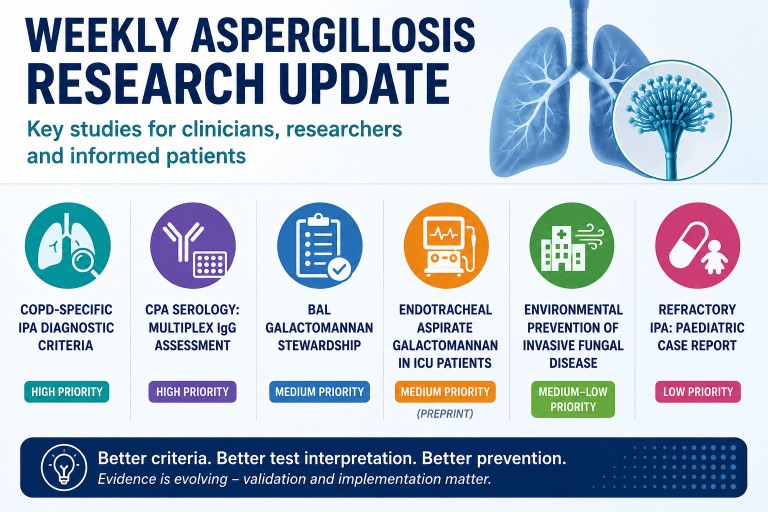
This week’s strongest theme is improved recognition and interpretation of Aspergillus disease in high-risk respiratory and immunocompromised patients.
The headline paper proposes COPD-specific diagnostic criteria for invasive pulmonary aspergillosis (IPA), addressing a long-standing gap between classic immunocompromised-host definitions and real-world respiratory practice. Other important papers focus on chronic pulmonary aspergillosis (CPA) serology, bronchoalveolar lavage galactomannan stewardship, endotracheal aspirate galactomannan in ICU patients, and environmental prevention of invasive fungal disease in paediatric cancer care.
Overall, this is a week of cautious progress: better criteria, better test interpretation, and better diagnostic systems — but several findings still require prospective validation.
High priority
Diagnostic criteria for invasive pulmonary aspergillosis in COPD patients
Denning DW, Rogers TR, Takazono T, Su X, Lagrou K, White PL, James DA, Bafadhel M, Lopez JB, Bulpa P, Chotirmall SH, et al.
American Journal of Respiratory and Critical Care Medicine. Published 1 July 2026.
DOI: 10.1093/ajrccm/aamag310
PMID: 42384914
This is the likely headline paper of the week. It proposes COPD-specific diagnostic criteria for IPA in non-ventilated hospitalised patients with COPD exacerbations. The criteria focus on patients with a hospitalised exacerbation plus at least two risk factors, such as systemic or high-dose inhaled corticosteroids, bronchiectasis, diabetes, cardiovascular disease, or prolonged antibiotic exposure.
Recommended investigation includes CT chest imaging, respiratory fungal microscopy and culture, preferably Aspergillus PCR, BAL or bronchoscopy galactomannan where available, serum galactomannan, and Aspergillus IgG. Diagnosis is supported by the combination of a high-risk COPD patient, compatible imaging, and any two positive Aspergillus tests, either from different samples or from different tests on the same respiratory sample.
Why it matters: COPD patients with IPA often do not fit classic EORTC/MSGERC host-factor definitions, which are strongest for haematology and transplant populations. This paper provides a respiratory-focused framework for a group in whom IPA may be missed, diagnosed late, or dismissed as colonisation.
Clinical or diagnostic relevance: The criteria could help respiratory teams investigate hospitalised COPD patients who deteriorate unexpectedly or fail to respond to standard treatment. They may encourage earlier CT imaging and broader fungal testing rather than relying on a single sputum culture.
Limitations / cautions: These are proposed consensus criteria based on literature review and Delphi methodology, not externally validated diagnostic criteria. Further studies are needed to validate them and to improve performance data for fungal assays in COPD. There remains a risk of overdiagnosis from colonisation and underdiagnosis where good respiratory samples or bronchoscopy are unavailable.
Diagnostic performance of IgG against multiplex Aspergillus antigens (mx4) for identifying chronic pulmonary aspergillosis
Sehgal IS, Agarwal R, Muthu V, Prasad KT, Dhooria S, Singh M, Rudramurthy SM, Aggarwal AN, Garg M, Chakrabarti A.
Medical Mycology. Published 2 July 2026.
DOI: 10.1093/mmy/myag071
PMID: 42392187
This prospective diagnostic study compared a multiplex Aspergillus IgG assay, mx4-IgG, with standard A. fumigatus-IgG for diagnosing CPA. The mx4 antigen preparation includes extracts of A. fumigatus, A. flavus, A. niger, and A. terreus. Among 332 adults with suspected CPA, 230 had CPA and 102 were diseased controls with structural lung disease.
Against the primary reference standard, mx4-IgG had sensitivity of 83.0% and specificity of 73.5%, compared with 95.2% and 88.2% for A. fumigatus-IgG.
Why it matters: The study tests an attractive idea: that broader multiplex Aspergillus antigen testing might improve CPA diagnosis. However, the results suggest that mx4-IgG was not superior to standard A. fumigatus-IgG.
Clinical or diagnostic relevance: A. fumigatus-IgG should remain the first-line serological test for CPA based on these findings. A practical finding was that a hierarchical strategy using A. fumigatus-IgG followed by A. flavus-IgG identified 97.7% of CPA cases at the lowest reported cost, USD 24 per patient, and outperformed strategies incorporating mx4.
Limitations / cautions: This was a tertiary chest-clinic cohort with high CPA prevalence, so predictive values may differ in lower-prevalence settings. The abstract does not provide confidence intervals, ROC values, or detailed subgroup data. The subgroup most likely to benefit from A. flavus-IgG requires full-text review.
Medium priority
The clinical utility of bronchoalveolar lavage galactomannan result stewardship within a tertiary medical system
Apostolopoulou A, Hammond SP, Turbett SE, Fishman JA.
Medical Mycology. Published 1 July 2026.
DOI: 10.1093/mmy/myag069
PMID: 42384022
This retrospective quality-improvement study examined stewardship of elevated BAL galactomannan results in a tertiary medical system. The Transplant Infectious Disease team monitored all elevated BAL GM results and, 24 hours after a positive result, sent a standardised email to the primary team if the result appeared unaddressed in the clinical documentation.
Among 55 cases with BAL GM >1.0, 17 cases (31%) had antifungal therapy started after a single positive BAL GM result. The stewardship team contacted primary teams in 14 cases (25%), leading to a new start or change in antifungal therapy.
Why it matters: Fungal diagnostics are only useful if results are recognised and interpreted correctly. This paper highlights a practical gap in BAL GM interpretation and shows how specialist result stewardship may help close the loop.
Clinical or diagnostic relevance: The intervention is highly practical: monitor positive BAL GM results, check whether they have been acknowledged, and provide specialist infectious diseases or mycology input where needed. This could be relevant to transplant, haematology, ICU, and tertiary respiratory services.
Limitations / cautions: The study is small, retrospective, and a quality-improvement evaluation rather than a controlled before-and-after study. It shows that stewardship influenced management, but it does not prove improved survival, reduced harm, or reduced inappropriate antifungal prescribing.
Diagnostic utility of endotracheal aspirate galactomannan for invasive pulmonary aspergillosis in ICU patients
Kumar R, Gupta A, Kumar A, Rao Kordcal S, Baitha U, Singh G, Xess I, Madan K, Soneja M, Wig N.
medRxiv preprint. Published 1 July 2026.
DOI: 10.64898/2026.06.29.26356826
PPR: PPR1271604
This prospective observational cohort study assessed endotracheal aspirate galactomannan as a supportive diagnostic test for IPA in mechanically ventilated ICU patients. The study enrolled 120 medicine ICU patients in India, aged over 14 years and ventilated for more than 48 hours, meeting BM-AspICU entry criteria.
Forty-four patients (37%) were classified as probable IPA and 76 as colonisers or possible IPA. The optimal ETA GM cut-off was 1.097, giving sensitivity of 72.73%, specificity of 84.2%, positive likelihood ratio of 4.86, negative likelihood ratio of 0.35, and AUC of 0.844.
Why it matters: ETA sampling is less invasive and easier than bronchoscopy or BAL in ventilated ICU patients. A useful ETA GM test could support earlier recognition of IPA where BAL is unsafe, delayed, or unavailable.
Clinical or diagnostic relevance: ETA GM may be useful as an adjunct or triage tool in ventilated ICU patients with suspected IPA. A positive result may increase suspicion, but a negative result should not exclude disease.
Limitations / cautions: This is a preprint and may not yet have been peer reviewed. It is single-centre and uses a clinical classification reference standard rather than a perfect gold standard. ETA samples are vulnerable to the colonisation-versus-invasion problem, and the proposed cut-off needs external validation.
The underestimated role of environmental factors in the prevention of invasive fungal disease: experience from a European childhood cancer centre
Malvestiti S, Andresen F, Hufnagel M, Speckmann C, Strahm B, Feuchtinger T, Puzik A.
Mycoses. Published 1 July 2026.
DOI: 10.1111/myc.70204
PMID: 42367057
This retrospective single-centre before-and-after study examined invasive fungal disease incidence in high-risk paediatric cancer and transplant patients before and after relocation from an older 1990s building to a new facility with improved environmental protection standards. The study included 186 patients: 140 before relocation and 46 after relocation.
Antifungal prophylaxis followed local standards throughout, with adherence above 98%. Invasive fungal disease incidence fell from 25 cases in the older building (17.9%) to no cases after relocation (p=0.002). Most cases were pulmonary aspergillosis and occurred in HSCT recipients.
Why it matters: The study highlights environmental protection as an under-recognised component of fungal disease prevention. Pharmacological prophylaxis is important, but building design, air quality, and environmental controls may also strongly influence risk.
Clinical or diagnostic relevance: The findings are relevant to paediatric oncology, HSCT, adult haematology, transplant units, and hospitals undergoing refurbishment or ward relocation. Environmental protection should be part of fungal infection prevention planning.
Limitations / cautions: This is observational, retrospective, and single-centre. The post-relocation period was shorter than the pre-relocation period, and the post-relocation cohort was smaller. The abstract does not list the specific environmental measures, so the reduction should be interpreted as being associated with a prevention bundle rather than any single intervention.
Lower priority
Combination antifungal therapy and formulary optimization for progressive invasive pulmonary aspergillosis in a pediatric patient with acute myeloid leukemia: a case report
Khamis F, Al Busaidi A, Al Bahrani K, Al-Rashdi A.
Clinical Case Reports. Published 1 July 2026.
DOI: 10.1002/ccr3.73041
PMID: 42389035
This case report describes a paediatric AML patient with progressive or refractory IPA. Radiological improvement followed combination antifungal therapy and a switch to brand-name liposomal amphotericin B. The authors suggest that refractory IPA management may require attention not only to antifungal class escalation but also to formulation choice and individualised optimisation.
Why it matters: The case raises a practical stewardship issue: when IPA progresses despite apparently appropriate therapy, clinicians should reassess drug exposure, formulation, host immune recovery, resistance, drug interactions, and combination strategy.
Clinical or diagnostic relevance: This is most relevant to paediatric haemato-oncology, AML, prolonged neutropenia, refractory IPA, and formulary decisions.
Limitations / cautions: This is a single case report and should be treated as hypothesis-generating only. It does not prove superiority of one amphotericin formulation over another. Improvement could reflect combination therapy, immune recovery, timing, supportive care, or other factors.
What to highlight this week
- The COPD IPA diagnostic criteria paper is the headline item. It addresses a major diagnostic gap in respiratory practice, but should be described as a proposed consensus framework requiring prospective validation.
- The CPA serology study is an important negative study. Broader multiplex IgG testing was not better than standard A. fumigatus-IgG. The practical message is to keep A. fumigatus-IgG first-line while considering whether targeted reflex A. flavus-IgG deserves further evaluation in selected settings.
- BAL galactomannan stewardship offers a clear implementation message. Fungal diagnostics need interpretation pathways, not just laboratory reporting. A positive fungal biomarker should trigger documented clinical review.
- Endotracheal aspirate galactomannan in ICU patients is promising but not practice-changing yet. ETA GM may help where BAL is difficult, but results must be interpreted alongside clinical, radiological, and microbiological evidence.
- Environmental protection may substantially reduce invasive fungal disease risk in paediatric cancer and HSCT settings. However, the evidence is observational and bundled, so individual protective measures cannot be credited from the abstract alone.
- The paediatric AML case report is clinically thought-provoking but low-level evidence. It is best mentioned briefly as a reminder to reassess drug exposure, formulation, resistance, immune status, and combination strategy in refractory IPA.
Evidence note
This update is based on available evidence notes and abstracts for some papers. Full-text review may refine details, especially around methodology, subgroup findings, confidence intervals, and implementation implications.

Did this page help you?
Tell us in one minute