Inhaled itraconazole shows promise for ABPA
Week ending 21 July 2026
This week brought encouraging early results for an inhaled form of itraconazole,
alongside new research into chronic pulmonary aspergillosis (CPA), lung surgery
and the effects of influenza on our antifungal immune defences.
Paper of the week: inhaled itraconazole for ABPA
A phase 2 clinical trial has produced promising results for an inhaled form of
itraconazole in adults with asthma and allergic bronchopulmonary aspergillosis
(ABPA).
Itraconazole is normally taken by mouth. It can help reduce the amount of
Aspergillus in the airways, but oral treatment can cause side effects,
interact with other medicines and produce unpredictable drug levels.
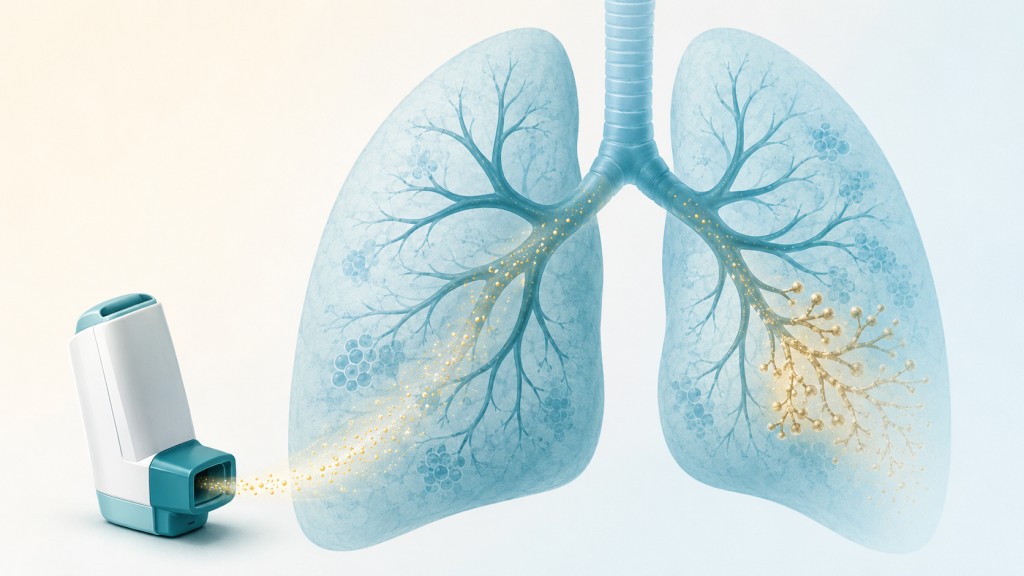
PUR1900 is a dry-powder form of itraconazole designed to deliver the drug
directly into the lungs. The aim is to produce higher concentrations in the
airways while reducing the amount of itraconazole circulating through the rest
of the body.
What did the trial find?
The trial included 43 adults with asthma and ABPA. Participants received either
20 mg or 40 mg of inhaled itraconazole, or a placebo, once daily for 16 weeks.
Compared with placebo, people receiving the 40 mg dose experienced:
- An average placebo-adjusted improvement in FEV1 of approximately 0.28 litres.
- Better asthma-control questionnaire scores.
- A reduction in total IgE, a marker associated with allergic activity.
- No serious adverse events during the trial.
The lower 20 mg dose did not produce the same pattern of improvement.
What does this mean?
These are encouraging results because delivering itraconazole directly into the
lungs could potentially reduce some of the toxicity and drug interactions
associated with oral treatment.
However, this was a small exploratory study. Only nine participants received
placebo, and the study did not have one prespecified primary outcome against
which success or failure would be judged. The results therefore need confirmation
in a larger phase 3 trial before inhaled itraconazole could become a routine
treatment for ABPA.
PUR1900 remains an investigational treatment and is not currently available on
prescription.
Chronic pulmonary aspergillosis and sarcoidosis
A new clinical review examines the difficult relationship between pulmonary
sarcoidosis and chronic pulmonary aspergillosis.
Advanced sarcoidosis can cause fibrosis, cavities and structural changes in the
lungs. These damaged areas may provide an opportunity for Aspergillus
to grow and CPA to develop.
The two conditions can be difficult to separate because both may cause:
- Increasing breathlessness.
- Persistent coughing.
- Fatigue and weight loss.
- Changes on chest scans.
- Declining lung function.
This creates an important treatment dilemma. Corticosteroids and other
immune-suppressing medicines may be needed to control active sarcoidosis, but
they can also make fungal infection more difficult to control.
The practical message is that deterioration in someone with fibrotic or cavitary
sarcoidosis should not automatically be assumed to represent worsening
sarcoidosis. CPA may need to be investigated before immunosuppressive treatment
is increased.
This article is a review of existing evidence rather than a new clinical trial,
but it draws attention to an important and sometimes overlooked association.
Could smaller operations preserve more lung in CPA?
Surgery can sometimes remove localised CPA, particularly a simple aspergilloma
or an affected part of the lung causing repeated bleeding. Surgery is not
suitable for everyone because many people with CPA already have reduced lung
function or extensive underlying lung disease.
A 15-year study examined 151 people with CPA who underwent video-assisted
thoracoscopic surgery, commonly called keyhole lung surgery. Researchers compared
removal of an entire lung lobe with smaller, sublobar resections that preserved
more healthy lung tissue.
People receiving a smaller resection experienced less loss of lung function.
Overall complication rates were similar in the two surgical groups, as were the
observed recurrence rates. Across all participants with sufficient follow-up,
CPA recurred in approximately 11%.
CPA operations remained more technically difficult than comparable lung-cancer
surgery. Severe adhesions and lesions larger than 3 cm were associated with a
greater risk of postoperative complications.
The study suggests that a lung-sparing operation may be possible for carefully
selected people with localised disease. It does not prove that a smaller operation
is suitable for everyone: the study was retrospective, conducted at one centre
and did not randomly assign people to the different surgical approaches.
Research corner: why can influenza increase the risk of aspergillosis?
Influenza-associated pulmonary aspergillosis, or IAPA, is a serious complication
that can develop in people admitted to intensive care with severe influenza.
It can occur even when someone did not previously have the traditional risk
factors for invasive fungal infection.
Two linked laboratory studies have investigated how influenza changes the immune
environment inside the lungs.
One study found widespread changes in lung immune cells, including functional
problems in particular groups of neutrophils. Neutrophils normally play a central
role in recognising and killing invading Aspergillus.
The second study examined a signalling molecule called interleukin-27, or IL-27.
Its results suggest that IL-27 may help protect against IAPA by limiting an
unhelpful type-2 immune response while strengthening antifungal activity.
Together, the studies help explain why recovery from influenza is not simply a
return to normal immunity. The infection can leave temporary defects in the
lungs’ ability to control fungi.
These studies used experimental models and have been released as preprints,
meaning they have not yet completed formal peer review. They do not currently
change how IAPA is diagnosed or treated.
What are this week’s main messages?
- Inhaled itraconazole produced promising improvements in a small phase 2 ABPA
trial, particularly at the higher dose. - Larger trials are required before inhaled itraconazole can become a routine
treatment. - CPA should be considered when someone with fibrotic or cavitary sarcoidosis
experiences unexplained deterioration. - Smaller lung resections may preserve more lung function in carefully selected
people with localised CPA. - Influenza can disrupt several parts of the lung’s antifungal immune response,
helping to explain the development of IAPA.

Did this page help you?
Tell us in one minute