
People with aspergillosis, asthma, bronchiectasis, chronic lung disease, allergies, or a weakened immune system are often understandably concerned about whether dampness or mould in the home could be affecting their health.
This guide explains:
- what signs to look for
- what practical steps may help
- the limitations of mould air testing
- who is most likely to provide reliable professional help
- and what support may be available for tenants.
Key points
- Dampness and mould can matter for people with respiratory disease.
- The most important question is usually: why is moisture present?
- Air sampling and mould spore counts have major limitations and should not be relied on alone.
- A “normal” air test does not reliably prove that a home is free from damp or hidden mould.
- The best assessments usually focus on building defects, condensation, ventilation, leaks and moisture sources.
- For complex problems, experienced chartered building professionals and occupational/environmental hygienists are often more useful than simple “mould testing” services.
- Dust and dirt accumulation may contribute to mould growth and respiratory irritation, especially in damp environments.
- Recent UK housing guidance increasingly recognises the health impact of damp and mould.
Why damp and mould matter
Fungi are a normal part of the environment. Tiny fungal spores are present in outdoor air, soil, gardens, compost and many indoor spaces. Most people breathe in small numbers of spores every day without becoming ill.
However, persistent dampness indoors can allow mould growth to increase. This may worsen irritation, allergy, asthma symptoms or respiratory symptoms in some people.
People who may be more sensitive include those with:
- Allergic Bronchopulmonary Aspergillosis (ABPA)
- Chronic Pulmonary Aspergillosis (CPA)
- Severe Asthma with Fungal Sensitisation (SAFS)
- bronchiectasis
- Chronic Obstructive Pulmonary Disease (COPD)
- cystic fibrosis
- severe asthma
- significant allergies
- or a weakened immune system.
Signs your home may have a damp problem
Visible signs
- black, green or white mould growth
- condensation on windows
- damp patches
- peeling wallpaper or paint
- bubbling plaster
- staining on walls or ceilings
- warped wood
- persistent condensation
Smell
A persistent musty, earthy or “damp” smell can sometimes indicate hidden moisture or mould growth, even when little is visible.
Possible building causes
- leaks from roofs, gutters or plumbing
- poor ventilation
- condensation
- cold external walls
- thermal bridging
- rising damp
- penetrating damp
- blocked air vents
- drying clothes indoors without enough ventilation.
Can dust and dirt make mould problems worse?
Yes. Accumulated dust and dirt can sometimes contribute to indoor mould problems, especially when combined with moisture or high humidity.
Dust is not simply “dirt” — it often contains:
- skin cells
- textile fibres
- pollen
- bacteria
- fungal spores
- organic material
- and microscopic debris.
When dust accumulates in damp or poorly ventilated areas, it can provide nutrients that allow mould growth to establish more easily on surfaces.
This is particularly common:
- behind furniture placed against cold walls
- around windows
- on curtains and blinds
- inside wardrobes
- under beds
- around ventilation grilles
- and in areas with condensation.
For people with asthma, allergy or aspergillosis, heavy dust accumulation may also worsen irritation or respiratory symptoms independently of visible mould.
Symptoms that may be triggered or worsened
Damp or mould exposure may contribute to:
- coughing
- wheezing
- chest tightness
- breathlessness
- increased sputum
- nasal irritation
- sinus symptoms
- eye irritation
- fatigue
- worsening asthma control
- increased allergy symptoms.
Symptoms may be more noticeable in certain rooms, overnight, during winter, after rainfall, or when ventilation is poor.
However, symptoms alone cannot prove that mould exposure is the cause. Many respiratory conditions can cause similar symptoms, so medical advice is important if symptoms are worsening.
Should you get air testing done?
Many companies offer indoor air sampling, mould spore counts or fungal testing. Patients often hope this will provide reassurance or proof that a home is safe.
Unfortunately, air sampling has important limitations.
Limitations of air sampling
- There are no universally agreed “safe” mould spore levels for homes.
- Results can vary enormously throughout the day.
- Outdoor air can strongly influence indoor results.
- Cleaning, vacuuming, opening windows or walking around can alter results.
- A short air sample may not represent usual exposure.
- Hidden damp or mould may not show up in an air sample.
- A “normal” air test does not reliably prove that a building is free from damp or mould problems.
Air sampling may sometimes be useful when carried out by experienced specialists as part of a wider investigation. However, it should not be used as the only basis for deciding whether a home is safe or whether remediation has worked.
What usually matters most?
The key question is usually:
Why is moisture present in the home?
Without moisture, significant mould growth usually cannot continue. Therefore, the most important step is to identify and correct the source of dampness.
This may involve:
- repairing leaks
- improving ventilation
- reducing condensation
- correcting insulation or thermal bridging problems
- repairing gutters, roofs or plumbing
- addressing overcrowding or excessive indoor humidity.
What you can do yourself
Improve ventilation
- Use extractor fans in bathrooms and kitchens.
- Open windows when practical and safe.
- Do not block air vents.
- Ventilate after showering, cooking or drying clothes.
Reduce indoor humidity
- Dry clothes outdoors where possible.
- Use lids on pans while cooking.
- Avoid drying clothes on radiators without ventilation.
- Consider a humidity monitor.
- Aim to avoid persistently high indoor humidity.
A dehumidifier may help reduce humidity in some situations, but it does not fix the underlying cause of dampness if there is a leak, structural defect or ventilation problem.
Reduce dust accumulation
- Clean regularly using methods that minimise dust disturbance.
- Pay particular attention to hidden or poorly ventilated areas.
- Move furniture slightly away from cold external walls where possible.
- Reduce clutter that traps dust and moisture.
- Wash soft furnishings and curtains regularly if practical.
Clean small areas carefully
Small areas of surface mould can sometimes be cleaned carefully using appropriate cleaning products. Avoid dry brushing or actions that disturb mould and release spores into the air.
People with significant lung disease, severe asthma, severe allergy or aspergillosis may prefer somebody else to carry out cleaning to reduce exposure.
Large, recurring or hidden mould problems usually need professional assessment.
Who is most likely to provide reliable help?
The most useful professionals are usually those who investigate the building and the source of moisture, not just the air.
For complex damp or mould problems, more robust help may come from:
- experienced chartered building surveyors
- building pathology specialists
- chartered building engineers
- occupational hygienists
- environmental hygienists with experience in indoor air quality and moisture assessment.
Relevant UK professional bodies
- Royal Institution of Chartered Surveyors (RICS)
- Chartered Institute of Building (CIOB)
- Chartered Association of Building Engineers (CABE)
- British Occupational Hygiene Society (BOHS)
Some damp and remediation companies may also be associated with the Property Care Association (PCA). This may indicate relevant industry training, but membership alone does not guarantee expertise. Experience and independence still matter.
Is impartial advice available?
Sometimes. People are often unsure where to obtain trustworthy, independent advice about damp and mould.
Possible sources of impartial guidance may include:
- local council Environmental Health departments
- housing officers (for tenants)
- Citizens Advice services
- NHS guidance
- UK Health Security Agency (UKHSA) guidance
- recognised professional bodies.
Local councils may sometimes inspect severe housing conditions, particularly where:
- children or vulnerable adults are involved
- landlords are failing to act
- there is extensive visible mould
- or housing conditions may present health hazards.
Support varies considerably between areas, and services are often stretched, but councils can sometimes require landlords to take action where housing conditions are unsafe.
Awaab’s Law and what it may mean for tenants
For people living in rented accommodation, especially social housing, recent changes in UK housing law may provide stronger protection where damp and mould problems are affecting health.
Awaab’s Law was introduced following the death of two-year-old Awaab Ishak in Rochdale after prolonged exposure to severe mould in social housing.
The law strengthens expectations that social landlords:
- investigate damp and mould complaints promptly
- assess potential risks to health
- carry out repairs within defined timescales
- and respond more urgently where vulnerable people are involved.
This is particularly important for people with:
- aspergillosis
- asthma
- bronchiectasis
- Chronic Obstructive Pulmonary Disease (COPD)
- cystic fibrosis
- or weakened immune systems.
What tenants should do
If you are concerned about damp or mould in rented accommodation, it may help to:
- report problems formally and in writing where possible
- keep photographs and dates
- record repeated complaints
- document worsening conditions
- keep copies of correspondence
- retain relevant medical letters if symptoms are worsening.
Where severe respiratory disease is present, medical evidence may help demonstrate vulnerability and the need for urgent action.
Important limitations
Awaab’s Law does not mean that every mould problem becomes an emergency or that all homes can be repaired immediately. Housing shortages, structural problems, funding limitations and contractor delays still affect what can be achieved.
However, the law has strengthened the expectation that damp and mould complaints should be taken seriously and addressed promptly, particularly where vulnerable people are affected.
NICE guidance and UK guidance
The National Institute for Health and Care Excellence (NICE) has increasingly recognised the importance of indoor air quality and housing conditions in respiratory health.
In addition, the UK Health Security Agency (UKHSA) has published major guidance emphasising that:
- damp and mould should be addressed promptly
- visible mould should not be ignored
- people with respiratory disease may be more vulnerable
- and simply blaming lifestyle alone is often inappropriate.
Recent UK guidance has increasingly shifted away from treating damp and mould purely as cosmetic issues, recognising their potential health impacts — especially for vulnerable people.
Questions to ask before paying for an assessment
- What qualifications and experience do you have in damp, mould and building moisture problems?
- Are you independent, or do you also sell remediation work?
- Will you investigate moisture sources, ventilation and building defects?
- Will I receive a written report explaining the likely cause?
- How will you decide whether remediation has worked?
- Will you explain the limitations of any air sampling?
- Do you use air sampling as part of a wider assessment, or as the main test?
Be cautious if…
- the assessment mainly consists of a quick air sample
- dramatic health claims are made
- the report presents spore counts as a simple “safe/unsafe” result
- expensive remediation is recommended immediately
- the company creates pressure to buy treatment packages
- there is little attention to leaks, condensation, ventilation or building defects.
How do you know remediation has worked?
Success should usually be judged by practical outcomes, including:
- visible mould has been removed safely
- the source of moisture has been corrected
- damp patches are drying out
- musty smells have reduced
- ventilation has improved
- humidity is better controlled
- mould does not quickly return
- symptoms improve over time, where mould exposure was contributing.
Repeat air sampling alone is not a reliable way to prove that a home is safe.
When to seek medical advice
People with aspergillosis or other lung conditions should seek medical advice if they experience:
- worsening breathlessness
- coughing blood
- rapidly worsening asthma symptoms
- fever or signs of infection
- unexplained weight loss
- significant deterioration in chest symptoms
- new or worsening fatigue with chest symptoms.
If symptoms appear linked to a damp or mouldy environment, discuss this with your healthcare team. They may not be able to assess the building, but they can help assess your health and whether your respiratory condition is changing.
Related information on Aspergillosis.org
- Reducing mould exposure
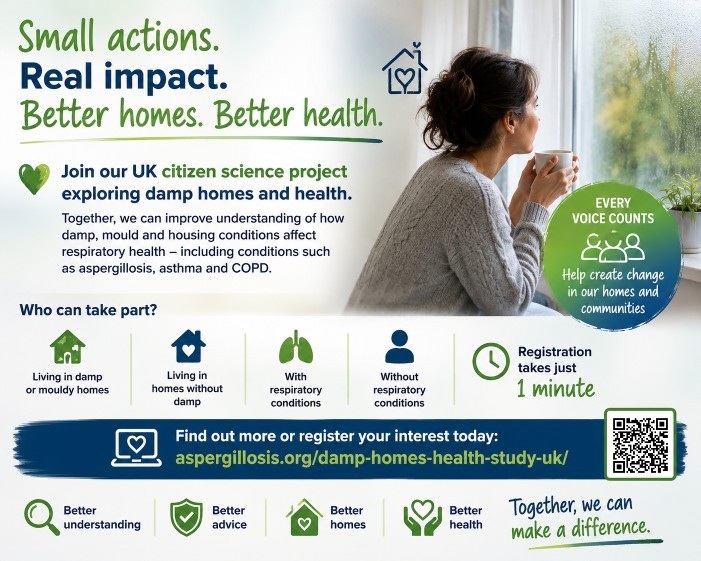
- Damp homes and health study
- What is aspergillosis?
- Living with aspergillosis
- Patient information hub
Useful resources
- UK Health Security Agency: Damp and mould guidance
- NICE: Indoor air quality at home
- NICE: Excess winter deaths and illness and the health risks associated with cold homes
- UK Government: Awaab’s Law factsheet
- Shelter UK: Damp and mould in rented homes
- Citizens Advice: Housing disrepair

Latest News posts
News archive