
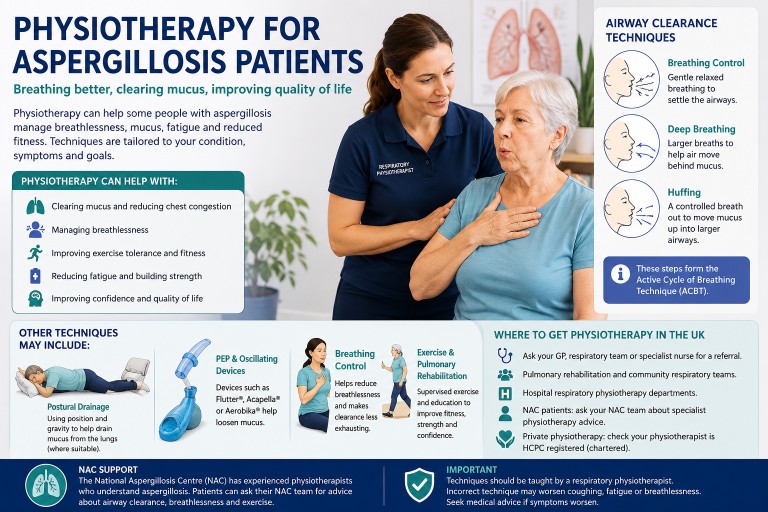
Physiotherapy can be an important part of supportive care for some people living with aspergillosis. It does not treat the fungal infection itself, but it can help with breathlessness, mucus clearance, strength, fitness, posture, fatigue and confidence with activity.
This may be especially helpful for people with Chronic Pulmonary Aspergillosis (CPA), Allergic Bronchopulmonary Aspergillosis (ABPA), Severe Asthma with Fungal Sensitisation (SAFS), Aspergillus bronchitis, bronchiectasis, asthma, Chronic Obstructive Pulmonary Disease (COPD), or lung damage from previous infection.
Key points
- Physiotherapy can help some aspergillosis patients manage mucus, breathlessness and reduced activity.
- Airway clearance techniques may be useful when mucus is difficult to clear.
- The Active Cycle of Breathing Technique (ACBT) is commonly used in respiratory physiotherapy.
- Other approaches include huffing, breathing control, postural drainage, airway clearance devices, exercise training and pulmonary rehabilitation.
- Technique matters — airway clearance should ideally be taught by a respiratory physiotherapist.
- National Aspergillosis Centre (NAC) patients can ask for advice from experienced physiotherapists who understand aspergillosis.
Contents
- Why physiotherapy matters in aspergillosis
- Airway clearance and mucus management
- Active Cycle of Breathing Technique (ACBT)
- Other physiotherapy techniques
- Pulmonary rehabilitation and exercise
- Breathing retraining and breathlessness
- Where to get physiotherapy in the UK
- Useful NHS videos and guides
- When to seek medical advice
Why physiotherapy matters in aspergillosis
Many people with aspergillosis have underlying lung conditions that affect how the lungs clear mucus, expand during breathing and cope with exertion. Long-term illness can also lead to muscle weakness, reduced fitness and loss of confidence with activity.
Common problems include:
- thick or persistent mucus
- frequent coughing
- breathlessness on exertion
- fatigue
- reduced walking distance
- weakness after illness or hospital admission
- poor posture from chronic breathlessness or coughing
- anxiety around breathing
- dysfunctional breathing patterns
Physiotherapy aims to improve function and quality of life. It is often most useful when it is personalised to the patient’s lung condition, symptoms, fitness level and treatment plan.
Airway clearance and mucus management
Some people with aspergillosis produce mucus every day. This is particularly common in people who also have bronchiectasis, asthma, Aspergillus bronchitis or repeated chest infections.
Mucus that remains in the lungs can contribute to:
- blocked or narrowed airways
- more coughing
- chest tightness
- breathlessness
- fatigue
- recurrent infections
Respiratory physiotherapists can teach airway clearance techniques to help move mucus from smaller airways towards larger airways, where it can be cleared more easily by huffing or coughing.
Active Cycle of Breathing Technique (ACBT)
ACBT stands for Active Cycle of Breathing Technique. It is one of the most commonly used airway clearance methods in respiratory physiotherapy.
It usually includes three parts:
- Breathing control – gentle relaxed breathing to settle the airways.
- Deep breathing exercises – larger breaths to help air move behind mucus.
- Huffing – a controlled breath out through an open mouth to move mucus upwards.
ACBT can often be adapted depending on symptoms, oxygen levels, energy, breathlessness and the amount of mucus being produced.
Other physiotherapy techniques
Huffing
A huff is a controlled breath out through an open mouth and throat. It can move mucus without the effort of repeated hard coughing. Many patients find huffing less exhausting than forceful coughing.
Postural drainage
Postural drainage uses body position and gravity to help drain mucus from different parts of the lungs. It may not be suitable for everyone, especially people with reflux, severe breathlessness, frailty, oxygen requirements or certain heart and lung complications.
Positive Expiratory Pressure and oscillating devices
Some patients may be advised to use airway clearance devices such as Flutter®, Acapella® or Aerobika®. These devices create resistance or vibration during breathing out, helping to loosen mucus and keep the airways open.
Breathing control
Breathing control can help settle the breathing pattern, reduce panic during breathlessness and make airway clearance less tiring.
Posture and mobility work
Chronic coughing and breathlessness can affect posture. Physiotherapy may include stretching, shoulder mobility, chest wall movement, gentle strengthening and exercises to improve comfort when breathing.
Fatigue management and pacing
Fatigue is common in aspergillosis. Physiotherapists may help patients pace activities, avoid “boom and bust” patterns, and gradually rebuild function without triggering prolonged exhaustion.
Pulmonary rehabilitation and exercise
Pulmonary rehabilitation is a structured programme of exercise and education for people with long-term lung disease who experience breathlessness. NHS England describes pulmonary rehabilitation as an exercise and education programme for people with lung disease who have symptoms of breathlessness.
Programmes may include:
- supervised exercise
- walking or cycling
- strength training
- breathing advice
- education about managing long-term lung disease
- confidence-building around activity
For aspergillosis patients, pulmonary rehabilitation may be particularly useful when breathlessness, weakness or reduced activity are affecting daily life.
Breathing retraining and breathlessness
Some people feel very breathless even when oxygen levels are normal or near normal. This can happen because breathlessness is influenced by airway inflammation, muscle effort, anxiety, breathing pattern, air trapping and the brain’s perception of breathing discomfort.
Breathing retraining may include:
- slower, calmer breathing
- diaphragmatic breathing
- pursed-lip breathing
- relaxation techniques
- coordinating breathing with walking, stairs or other activity
These techniques can be especially useful for patients who feel frightened by breathlessness or who have developed an inefficient breathing pattern.
Where to get physiotherapy in the UK
Access to physiotherapy varies across the UK, but patients with long-term lung disease may be able to obtain support through several routes.
1. Through your GP or respiratory team
Your GP, respiratory consultant, specialist nurse or hospital team may be able to refer you to a respiratory physiotherapist, community respiratory team or pulmonary rehabilitation service.
2. Through pulmonary rehabilitation services
Many local NHS pulmonary rehabilitation services accept referrals for people with chronic respiratory disease, including conditions such as Chronic Obstructive Pulmonary Disease (COPD), bronchiectasis, asthma, interstitial lung disease and other long-term breathing problems. Some services accept GP referrals, hospital referrals or self-referrals, but criteria vary locally.
3. Through community respiratory teams
Some areas have community respiratory teams that provide assessment, education, pulmonary rehabilitation, breathlessness support, oxygen-related advice and airway clearance support.
4. Through hospital respiratory physiotherapy departments
Hospital respiratory physiotherapists often support patients during admissions, after exacerbations, or through specialist outpatient respiratory clinics.
5. Through the National Aspergillosis Centre
National Aspergillosis Centre (NAC) patients can ask their NAC team whether specialist physiotherapy advice would be helpful. NAC has experienced physiotherapists who understand aspergillosis and the particular problems patients may face, including mucus clearance, breathlessness, fatigue, reduced fitness and co-existing lung disease.
6. Private physiotherapy
Some patients choose to see a private physiotherapist. The NHS advises that private physiotherapists should be chartered and registered with the Health and Care Professions Council (HCPC). The Chartered Society of Physiotherapy provides a “Find a Physio” directory that can be searched by location and specialty.
Useful UK links:
- National Aspergillosis Centre Physiotherapy
- NHS: Physiotherapy
- NHS England: Pulmonary rehabilitation
- Chartered Society of Physiotherapy: Find a physiotherapist
- Association of Chartered Physiotherapists in Respiratory Care
Useful NHS videos and guides
The following NHS resources may help patients understand airway clearance techniques. They should not replace individual advice from a respiratory physiotherapist.
Royal Free London NHS Foundation Trust – Active Cycle of Breathing
A clear patient-focused demonstration of ACBT.
Watch: Active Cycle of Breathing – Royal Free London NHS Foundation Trust
NHS Greater Glasgow & Clyde – Active Cycle of Breathing
A detailed demonstration from respiratory physiotherapy services.
Watch: Respiratory Physiotherapy Service – Active Cycle of Breathing
University College London Hospitals NHS Foundation Trust – breathing and airway clearance videos
UCLH has a useful set of patient information videos covering breathing exercises and airway clearance.
Watch: UCLH patient information videos – breathing exercises
UCLH – How to clear phlegm from your chest
A short, practical NHS video explaining how ACBT can help clear phlegm.
Watch: How to clear phlegm from your chest – ACBT
Cambridge University Hospitals NHS Foundation Trust
A patient information page explaining airway clearance and ACBT.
Read: Airway clearance – Active Cycle of Breathing Technique
Hull University Teaching Hospitals NHS Trust
A detailed patient leaflet on ACBT as a secretion clearance technique.
Read: Active Cycle of Breathing Technique – secretion clearance
University Hospitals Plymouth NHS Trust
A step-by-step patient guide to breathing control, thoracic expansion exercises and huffing.
Read: Active Cycle of Breathing Technique
When to seek medical advice
Airway clearance techniques should ideally be taught by a respiratory physiotherapist. Incorrect technique may sometimes worsen coughing, fatigue, airway irritation or breathlessness.
Seek medical advice urgently if you develop:
- new or worsening coughing of blood
- sudden worsening breathlessness
- chest pain
- fever or signs of infection
- dizziness or fainting
- significant oxygen desaturation
- rapid deterioration after starting a new exercise or airway clearance routine
Summary
Physiotherapy can be an important supportive treatment for some people with aspergillosis. It may help with mucus clearance, breathlessness, posture, fatigue, strength, confidence and activity levels.
Techniques such as ACBT, huffing, breathing control, postural drainage, airway clearance devices and pulmonary rehabilitation can all help selected patients. The best approach depends on the person’s symptoms, underlying lung condition and overall health.
For NAC patients, specialist physiotherapy advice is available from professionals experienced in aspergillosis care. If mucus clearance, breathlessness or reduced activity are becoming difficult, it is worth asking the NAC team whether physiotherapy input may help.
Medical note: This article is for general information only. It does not replace advice from your doctor, specialist nurse or respiratory physiotherapist. Airway clearance and exercise plans should be tailored to the individual patient.
Last reviewed: May 2026

Latest News posts
News archive