
 Last reviewed: March 2026
Audience: Patients, carers, and non-specialist healthcare professionals
Applies to: Chronic Pulmonary Aspergillosis (CPA), bronchiectasis, and related lung conditions
Key Points
- Coughing up more than a few spots or streaks of blood is a medical emergency
- If bleeding is heavier or affects breathing, call 999 immediately
- The main immediate risk is airway blockage, not just blood loss
- Emergency care focuses on keeping airways clear and protecting breathing
- Some general positioning approaches are commonly used in healthcare settings
- This page provides general information only and is not a substitute for medical care
Table of Contents
- What is haemoptysis?
- Why can it happen in aspergillosis?
- Why does it feel so frightening?
- When is it an emergency?
- What happens during emergency care?
- While waiting for help (general guidance)
- Why positioning matters
- Understanding airway safety
- What is generally avoided
- What happens after hospital care?
- Medications such as tranexamic acid
- Common questions
- When to seek medical help
What is haemoptysis?
Haemoptysis means coughing up blood from the lungs or airways. This can range from small streaks in sputum to larger bleeds.
In people with Chronic Pulmonary Aspergillosis (CPA) and related lung conditions, haemoptysis can occur due to changes in lung structure and blood vessels.
Why can it happen in aspergillosis?
- Areas of lung damage (such as cavities) may develop
- Blood vessels in these areas can become fragile
- Inflammation may increase susceptibility to bleeding
Not all patients will experience haemoptysis, but awareness is important.
Why does it feel so frightening?
Many patients describe a strong sensation of being unable to breathe during a lung bleed.
This can occur because blood enters the airways, which may interfere with airflow. Even small amounts in the wrong place can feel overwhelming.
This reaction is common and understandable.
When is it an emergency?
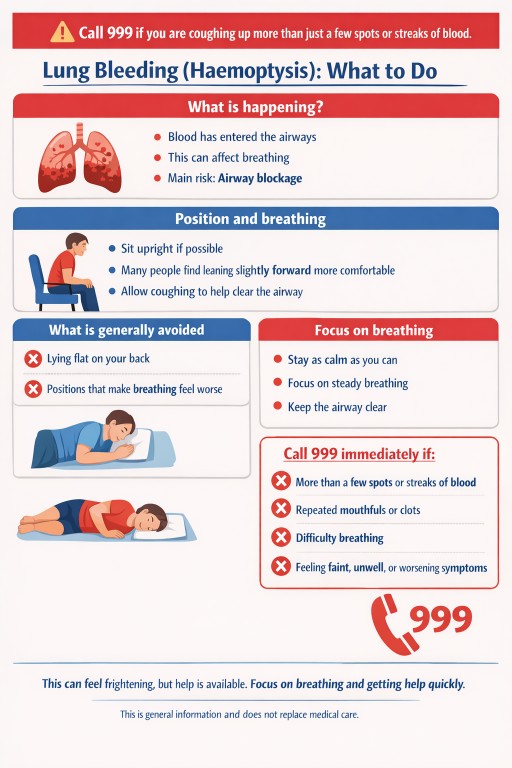
NHS guidance advises calling 999 if you are coughing up more than just a few spots or streaks of blood.
Call 999 immediately if:
- You are coughing up more than just a few spots or streaks of blood
- You are coughing up repeated mouthfuls or clots
- You have difficulty breathing
- You feel faint, unwell, or symptoms are worsening
Small streaks or flecks of blood should still be checked by a healthcare professional, but larger or increasing amounts should be treated as an emergency.
What happens during emergency care?
Emergency responders and hospital teams focus on:
- Supporting breathing (for example, with oxygen)
- Monitoring vital signs
- Identifying the source of bleeding
- Protecting unaffected areas of the lung where possible
In some cases, procedures such as bronchial artery embolisation may be used to control bleeding.
While waiting for help (general guidance)
If you are waiting for emergency services to arrive, general first-aid principles often focus on maintaining comfort and supporting breathing.
- If possible, try to remain in a position that feels easiest for breathing
- Many patients find that being upright or slightly forward is more comfortable
- Try to keep the airway clear by allowing coughing if needed
The priority is to seek urgent medical help rather than attempting to manage the situation alone.
In an emergency, it may not be possible to adopt an “ideal” position—focus on calling for help.
Why positioning matters
In healthcare settings, positioning is sometimes used to help:
- Keep airways as clear as possible
- Reduce the spread of blood within the lungs
- Maintain breathing while further treatment is arranged
This is based on general principles of lung anatomy and airflow. The aim is not to stop bleeding, but to support breathing.
Many people find it easier to breathe when upright or leaning slightly forward. This may help fluid move out through the mouth rather than further back into the main airways.
Understanding airway safety
In situations where there is bleeding (or sometimes vomiting), the main concern is keeping the airway clear so that air can move in and out of the lungs.
Fluid in the airway can interfere with breathing, which is why emergency care focuses on maintaining airway clearance as well as treating the underlying cause.
Positions that allow fluid to move out of the mouth rather than back into the airway are generally preferred. Many people find being upright or slightly forward helps with this.
If someone becomes unable to remain upright, is very drowsy, or is vomiting, placing them on their side (recovery position) may help keep the airway clear while waiting for emergency services.
This information is general and does not replace emergency care. Always call 999 if symptoms are severe.
What is generally avoided
In clinical practice, certain positions are usually avoided because they may make breathing more difficult.
- Lying flat on the back
- Positions that feel like they worsen breathing
If you feel unsure, prioritise comfort and breathing while waiting for help.
What happens after hospital care?
After an episode of haemoptysis, your clinical team may:
- Investigate the cause of bleeding
- Review your current treatment
- Discuss whether any preventative measures are appropriate
If you have experienced haemoptysis, it may be helpful to ask your team whether you need an individualised plan.
Medications such as tranexamic acid
Some patients may be prescribed tranexamic acid to help reduce bleeding.
If you have been given this medication with clear instructions, it may be intended for use during bleeding episodes. It should only be taken exactly as directed by your clinical team.
Tranexamic acid does not replace the need to seek urgent medical help. If you are coughing up more than a few spots or streaks of blood, or feel unwell or breathless, call 999.
If you are unsure whether to take it during an episode, seek urgent medical advice.
Common Questions
Is coughing up blood always serious?
Any new or unexplained bleeding should be assessed. Larger amounts require urgent attention.
Can I manage this at home?
Significant haemoptysis should not be managed at home. Always seek urgent medical help.
Will it happen again?
This varies between individuals. Your specialist team can advise based on your condition.
When to seek medical help
Call 999 immediately if:
- You are coughing up more than just a few spots or streaks of blood
- You have difficulty breathing
- You feel faint, unwell, or symptoms are worsening
Seek medical advice urgently (NHS 111 or GP) if:
- You notice new or increasing blood in sputum
- You have recurrent or ongoing minor bleeding
Important safety note
This information is for general education only and does not replace medical advice. In an emergency, always seek immediate professional care.
References
- NHS. Coughing up blood (haemoptysis): https://www.nhs.uk/symptoms/coughing-up-blood/
- European Respiratory Society and interventional radiology guidance on haemoptysis
Author and review
Author: National Aspergillosis Centre (Patient Education Team)
Review: Specialist clinicians, Manchester University NHS Foundation Trust
Next review due: March 2027

Latest News posts
News archive