
Key points
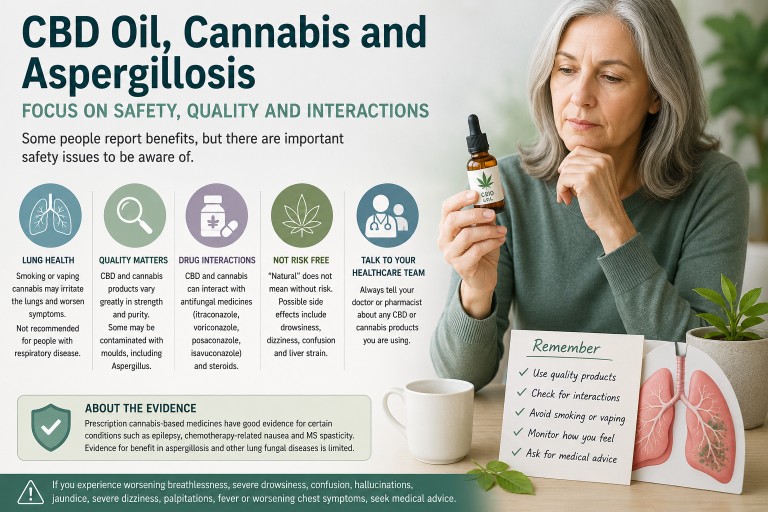
- Some people with chronic illnesses report that CBD or cannabis products help with pain, anxiety, sleep or wellbeing.
- Evidence for benefit in aspergillosis itself remains limited.
- Smoking or vaping cannabis may irritate the lungs and may not be suitable for people with respiratory disease.
- CBD and cannabis products can interact with antifungal medicines and steroids.
- Product quality varies greatly, especially with over-the-counter or online products.
- Always let your healthcare team or pharmacist know about any CBD or cannabis products you are using.
Why this topic comes up
People living with aspergillosis often cope with long-term symptoms such as fatigue, chronic cough, breathlessness, pain or chest discomfort, anxiety, poor sleep, steroid side effects and reduced quality of life.
Because of this, discussions about CBD oil, cannabis or “medical marijuana” occasionally appear in patient groups and online communities. Some people report that these products help them cope better with symptoms or improve sleep and wellbeing.
At the same time, there are important safety issues that people with respiratory fungal disease should be aware of, particularly around lung irritation, product quality and drug interactions.
CBD and cannabis are not the same thing
CBD: cannabidiol
CBD, or cannabidiol, is one of the compounds found in cannabis plants. CBD products usually contain little or no THC, or tetrahydrocannabinol, the chemical responsible for the “high” associated with cannabis.
CBD products may be sold as oils, capsules, gummies, creams, drinks or food supplements. CBD is generally less intoxicating than THC-containing cannabis products.
Cannabis or marijuana
Cannabis products may contain varying amounts of THC. THC is more strongly associated with intoxication, impaired concentration, sedation, anxiety or panic, hallucinations or paranoia in some people, and impaired driving or coordination.
Different cannabis products can vary enormously in strength and purity.
What conditions have good evidence for medical cannabis?
Cannabis-based medicines are prescribed in some situations where evidence is reasonably strong.
In the UK, prescription cannabinoid medicines are mainly used for certain severe forms of epilepsy, chemotherapy-related nausea and vomiting, and muscle spasticity in multiple sclerosis. There is also ongoing research into chronic pain and palliative care use.
However, evidence for benefit in aspergillosis, bronchiectasis, asthma, allergic bronchopulmonary aspergillosis (ABPA) or chronic pulmonary aspergillosis (CPA) remains limited.
This does not mean that people never feel benefit. Some clearly do. But respiratory fungal disease is not currently one of the better-established medical indications.
Lung safety concerns in aspergillosis
This is probably the most important issue for many aspergillosis patients.
Smoking cannabis
Smoking any substance exposes the lungs to heat, particulates, irritants and combustion products.
For people who already have asthma, bronchiectasis, chronic lung infection, airway inflammation or fungal lung disease, this may worsen symptoms such as coughing, wheezing, chest tightness, mucus production or breathlessness.
Vaping
Some people assume vaping is automatically safer than smoking, but this is not always true.
Vaping can still irritate the airways and lungs, and the long-term effects are not fully understood. For people with fragile or inflamed lungs, clinicians are often cautious about recommending inhaled cannabis products of any kind.
Contamination and quality problems
One important issue is that cannabis and CBD products are not all produced to the same standards.
Product quality can vary greatly
Some products may contain more or less CBD or THC than stated, contain contaminants, contain pesticides or solvents, or vary significantly between batches.
This is especially true for unregulated products purchased online or from unofficial sources.
Mould contamination
Cannabis products can occasionally become contaminated with moulds, including Aspergillus species.
This is particularly concerning for immunocompromised patients, transplant patients, people on long-term steroids, and people with chronic lung disease.
Although this appears uncommon, it is one reason respiratory specialists are often cautious about smoked cannabis products in fungal disease patients.
Drug interactions: a very important issue
Many antifungal medicines are processed through liver enzyme systems that can also be affected by CBD or cannabis compounds. This means interactions are possible.
Antifungal medicines of concern
Potential interactions may occur with antifungals such as:
- itraconazole
- voriconazole
- posaconazole
- isavuconazole
These medicines already require careful monitoring because blood levels can vary significantly between people.
Adding CBD or cannabis products may potentially alter antifungal levels, liver metabolism or side-effect risks.
Steroids and other medicines
Interactions may also occur with prednisolone, methylprednisolone, opioid pain medicines, sleeping tablets, antidepressants and anti-anxiety medicines.
Possible effects may include increased sedation, dizziness, falls, confusion, liver irritation or worsening side effects.
This does not automatically mean the products are unsafe, but it does mean healthcare teams should know about them.
“Natural” does not always mean low risk
Many patients understandably assume that CBD products are “gentle” or “natural.”
However, natural products can still interact with prescription medicines, doses may be inconsistent, some products are poorly regulated, and side effects can still occur.
This is especially important in aspergillosis because patients are often already taking multiple medicines, including antifungals and steroids.
Why patients may still be interested
Despite the uncertainties, it is understandable why some patients explore these products.
People sometimes report improvement in sleep, anxiety, pain, appetite, overall wellbeing or coping with chronic illness. These experiences are real and important to acknowledge respectfully.
At present, however, there is still limited high-quality research specifically in aspergillosis and chronic fungal lung disease.
Practical safety advice
If someone chooses to use CBD or cannabis products, it is sensible to:
- tell their healthcare team or pharmacist,
- mention all supplements and oils being used,
- watch for new side effects after starting,
- avoid assuming “natural” means risk-free,
- be especially cautious with smoked or inhaled products,
- avoid driving or hazardous activities if feeling impaired.
When to seek medical advice
Medical review is important if new symptoms appear after starting CBD or cannabis products, especially:
- worsening breathlessness,
- severe drowsiness,
- confusion,
- hallucinations,
- jaundice,
- severe dizziness,
- palpitations,
- fever or worsening chest symptoms.
The bottom line
CBD and cannabis products are becoming more widely discussed in chronic illness communities, including among people with aspergillosis.
Some people report benefits for sleep, anxiety or quality of life, and there are a small number of medical conditions where prescription cannabis-based medicines are supported by stronger evidence.
However, for aspergillosis patients, important concerns remain around lung irritation, mould contamination, product quality, and interactions with antifungal medicines and steroids.
Because of this, healthcare teams are usually cautious and prefer open discussion rather than patients using these products without medical awareness.
Further information
- NHS guidance on medical cannabis
- Specialist pharmacist advice on antifungal interactions
- Specialist pharmacist advice on steroid interactions
- National Aspergillosis Centre resources on antifungal medicines
Author and review information
Prepared for aspergillosis patients and carers as general educational information. This article is not intended to replace personalised medical advice.
Last reviewed: May 2026

Latest News posts
News archive