
COPD, autoimmune disease and new approaches to antifungal treatment
Published: 29 June 2026
Every week we review the latest research on aspergillosis and related fungal diseases, selecting the studies most likely to influence patient care and clinical practice. This week’s research focuses on an increasingly important theme: recognising Aspergillus disease in patient groups where it has traditionally been overlooked.
The highlight is a large systematic review suggesting that allergic Aspergillus disease may be more common in people living with chronic obstructive pulmonary disease (COPD) than previously appreciated.
Featured Paper
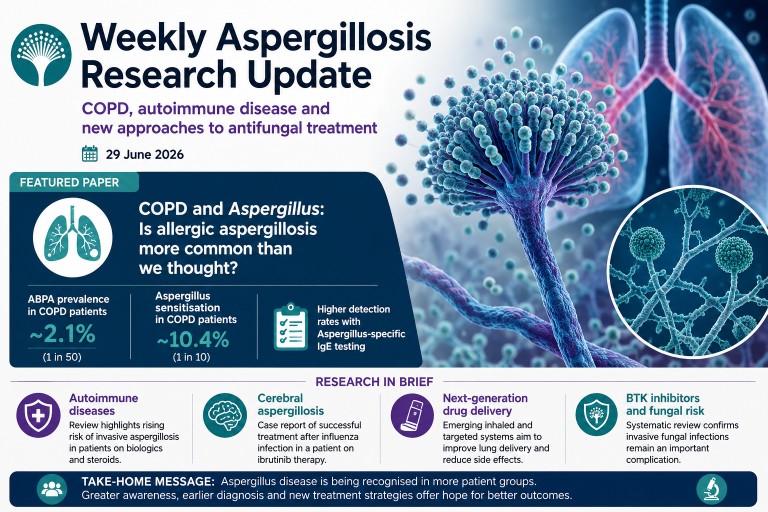
COPD and Aspergillus: Is allergic aspergillosis more common than we thought?
For decades, allergic bronchopulmonary aspergillosis (ABPA) has been regarded primarily as a complication of asthma and cystic fibrosis. However, respiratory specialists have increasingly reported Aspergillus-related disease in patients with COPD.
A new systematic review and meta-analysis has now brought together the available evidence.
Paper: Ajayababu A, Antony A, Goyal B, Ray A. Prevalence of allergic bronchopulmonary aspergillosis/Aspergillus sensitization in chronic obstructive pulmonary disease: A systematic review and meta-analysis. Respiratory Investigation. 2026. PubMed PMID: 42361722
What did the researchers do?
The authors searched four major medical databases for studies reporting either:
- Allergic bronchopulmonary aspergillosis (ABPA)
- Aspergillus sensitisation (AS)
Among patients with COPD, the review identified 23 suitable studies, including:
- 1,529 patients for analysis of ABPA
- 3,505 patients for analysis of Aspergillus sensitisation
Pooling data from many studies provides a more reliable estimate than individual reports alone.
What did they find?
The results suggest Aspergillus-related disease is not rare in COPD.
The pooled prevalence was:
- ABPA: 2.1%
- Aspergillus sensitisation: 10.4%
Put another way:
- around 1 in 50 people with COPD may have ABPA
- approximately 1 in 10 have evidence of sensitisation to Aspergillus
Studies using Aspergillus-specific IgE as part of their diagnostic strategy detected more ABPA than studies using skin testing or total IgE alone. This suggests that the choice of diagnostic tests may influence how many patients are identified.
Why is this important?
Many symptoms of COPD overlap with Aspergillus-related disease, including:
- persistent cough
- breathlessness
- increased sputum production
- recurrent exacerbations
As a result, some patients may continue to receive repeated courses of antibiotics or steroids while an underlying Aspergillus-related condition remains unrecognised.
This study does not suggest that everyone with COPD should undergo routine fungal testing. However, it supports considering Aspergillus investigations in selected patients with:
- recurrent exacerbations despite optimal therapy
- unexplained eosinophilia or raised IgE
- bronchiectasis
- persistent mucus plugging
- radiological abnormalities that do not fit the expected pattern
Strengths and limitations
This is currently one of the largest reviews examining COPD and Aspergillus disease.
Its strengths include:
- systematic literature search
- formal meta-analysis
- inclusion of more than 5,000 patients overall
However, the included studies differed considerably in patient populations, diagnostic methods and disease severity. This statistical heterogeneity means the true prevalence almost certainly varies between different clinical settings.
The review also demonstrates an association rather than proving that COPD itself causes ABPA.
What does this mean for patients?
The main message is one of greater awareness.
For patients with COPD whose symptoms remain difficult to explain despite appropriate treatment, clinicians may increasingly consider whether Aspergillus sensitisation or ABPA could be contributing to ongoing respiratory problems.
Earlier recognition has the potential to improve diagnosis and ensure that patients receive the most appropriate investigations and treatment.
Research in Brief
Invasive aspergillosis in autoimmune inflammatory rheumatic diseases
Paper: Liang P, Zhang X, Cai S, Hu Z, Dong L. Invasive aspergillosis in autoimmune inflammatory rheumatic diseases: epidemiology, risk factors, diagnosis, management and challenges. Annals of Medicine. 2026. PubMed PMID: 42343869
A comprehensive new review highlights the growing importance of invasive aspergillosis in people with autoimmune inflammatory rheumatic diseases such as rheumatoid arthritis and systemic vasculitis.
The increasing use of corticosteroids, biologic therapies and other immunosuppressive medications has expanded the population at risk. The authors note that invasive aspergillosis remains uncommon but carries a high mortality when diagnosis is delayed.
A particular challenge is that symptoms and imaging findings can resemble a flare of the underlying autoimmune disease, making diagnosis difficult. The review emphasises combining clinical assessment with microbiological tests, including galactomannan, PCR and bronchoalveolar lavage where appropriate, and careful interpretation of imaging findings.
Why it matters: Clinicians should maintain a high index of suspicion for invasive fungal disease in immunosuppressed patients who fail to respond as expected to conventional treatment.
Cerebral aspergillosis following influenza and ibrutinib therapy
Paper: Haraguchi M, Kimura M, Uruga H, Takahashi Y, Takaya H, Arisawa K, et al. Cerebral aspergillosis caused by Aspergillus flavus following seasonal influenza infection in a patient receiving ibrutinib for Waldenström’s macroglobulinemia. Journal of Infection and Chemotherapy. 2026. PubMed PMID: 42331321
A Japanese case report describes successful treatment of cerebral aspergillosis caused by Aspergillus flavus in a patient receiving the Bruton tyrosine kinase inhibitor ibrutinib after seasonal influenza infection.
The patient developed both pulmonary and cerebral aspergillosis, underwent neurosurgical debridement and was successfully treated with isavuconazole.
Although this represents a single case, it reinforces growing evidence that BTK inhibitors and severe viral infections are emerging risk factors for invasive aspergillosis.
Why it matters: Patients receiving targeted therapies who develop persistent respiratory or neurological symptoms following influenza warrant careful assessment for opportunistic fungal infection.
Looking ahead: New ways to deliver antifungal drugs
Paper: Martins YA, Anselmo-Lima WT, Tamashiro E, Ho E, Valera FCP. Next-generation drug delivery systems for aspergillosis: Overcoming barriers in antifungal therapy. Biomedicine & Pharmacotherapy. 2026. PubMed PMID: 42361622
Another review this week explores next-generation drug delivery systems designed to improve treatment of aspergillosis.
Researchers are developing inhaled formulations, nanoparticles and targeted drug-delivery technologies that aim to increase antifungal concentrations directly within the lungs while reducing systemic side effects.
Most of these approaches remain experimental, but they offer possibilities for the future management of chronic pulmonary aspergillosis and other forms of pulmonary fungal disease.
What this week’s research tells us
Although these papers address different aspects of aspergillosis, they all point in the same direction.
Increasingly, Aspergillus disease is being recognised in patient groups previously considered to be at relatively low risk, including people with COPD and those receiving modern immunosuppressive therapies.
At the same time, advances in diagnostics and drug delivery are creating opportunities for earlier diagnosis and more targeted treatment.
For patients, the message is reassuring but important: persistent or unexplained respiratory symptoms deserve careful evaluation, particularly when standard treatments are not achieving the expected improvement.
As awareness continues to grow, more patients may receive the correct diagnosis earlier in the course of their illness.
References
- Ajayababu A, Antony A, Goyal B, Ray A. Prevalence of allergic bronchopulmonary aspergillosis/Aspergillus sensitization in chronic obstructive pulmonary disease: A systematic review and meta-analysis. Respiratory Investigation. 2026. doi:10.1016/j.resinv.2026.101469. PubMed
- Liang P, Zhang X, Cai S, Hu Z, Dong L. Invasive aspergillosis in autoimmune inflammatory rheumatic diseases: epidemiology, risk factors, diagnosis, management and challenges. Annals of Medicine. 2026. doi:10.1080/07853890.2026.2685285. PubMed
- Haraguchi M, Kimura M, Uruga H, Takahashi Y, Takaya H, Arisawa K, et al. Cerebral aspergillosis caused by Aspergillus flavus following seasonal influenza infection in a patient receiving ibrutinib for Waldenström’s macroglobulinemia. Journal of Infection and Chemotherapy. 2026. doi:10.1016/j.jiac.2026.103020. PubMed
- Martins YA, Anselmo-Lima WT, Tamashiro E, Ho E, Valera FCP. Next-generation drug delivery systems for aspergillosis: Overcoming barriers in antifungal therapy. Biomedicine & Pharmacotherapy. 2026. doi:10.1016/j.biopha.2026.119691. PubMed
“`

Latest News posts
News archive