
Key Points
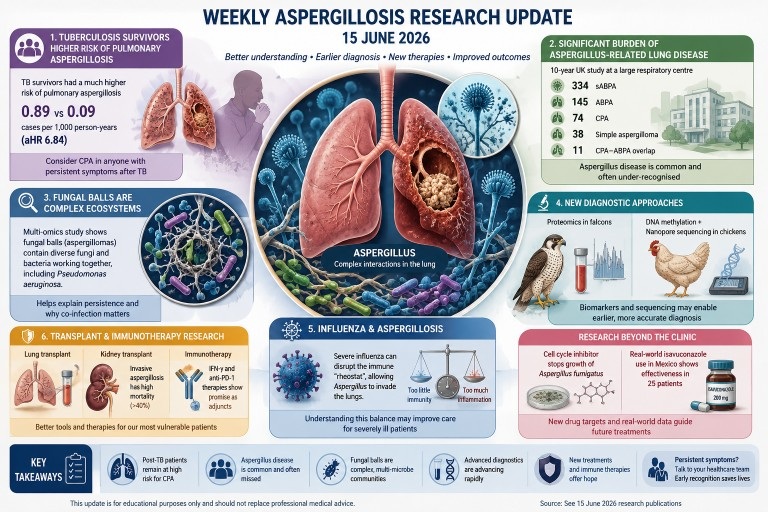
- A large population study confirms that people who have survived tuberculosis (TB) have a substantially increased risk of developing chronic pulmonary aspergillosis (CPA).
- New UK data highlight the significant burden of Aspergillus-related chronic lung diseases in routine respiratory care.
- Research suggests that fungal balls (aspergillomas) are complex microbial ecosystems rather than simple collections of fungal growth.
- New diagnostic approaches using proteomics, DNA methylation and sequencing continue to show promise.
- Several studies explore improved diagnosis and treatment of aspergillosis in transplant recipients and other highly vulnerable patients.
Contents
- Tuberculosis Survivors and Aspergillosis Risk
- New UK Data on Aspergillus-Related Lung Disease
- Understanding Fungal Balls
- New Diagnostic Technologies
- Influenza-Associated Pulmonary Aspergillosis
- Transplantation and Immunotherapy Research
- What Does This Mean for Patients?
- References
Tuberculosis Survivors Face a Much Higher Risk of Pulmonary Aspergillosis
One of the most important studies published this week examined the long-term risk of pulmonary aspergillosis among people who have previously had tuberculosis (TB).
Researchers analysed nationwide health data and found that pulmonary aspergillosis occurred almost ten times more frequently in TB survivors than in matched controls. The incidence was 0.89 cases per 1,000 person-years among TB survivors compared with 0.09 cases per 1,000 person-years in the control group.
After adjusting for other risk factors, individuals with a history of TB remained nearly seven times more likely to develop pulmonary aspergillosis.
This finding reinforces a growing body of evidence showing that chronic pulmonary aspergillosis (CPA) is an important long-term complication of tuberculosis. Residual lung cavities and structural lung damage may provide an environment in which Aspergillus can establish chronic infection.
- Zo S, Lee KN, Han K, et al. Risk of Pulmonary Aspergillosis in Tuberculosis Survivors: A Nationwide Population-based Study.
International Journal of Antimicrobial Agents. 2026.
Patients who have previously had tuberculosis and continue to experience symptoms such as chronic cough, breathlessness, fatigue, weight loss or coughing up blood should discuss the possibility of CPA with their healthcare team.
New UK Data Highlight the Burden of Aspergillus-Related Lung Disease
A 10-year retrospective study from Imperial College Healthcare NHS Trust provides valuable insight into the scale of Aspergillus-related lung disease seen within a large UK respiratory service.
The researchers identified:
- 334 patients with serological allergic bronchopulmonary aspergillosis (sABPA)
- 145 patients with allergic bronchopulmonary aspergillosis (ABPA)
- 74 patients with chronic pulmonary aspergillosis (CPA)
- 38 patients with simple aspergilloma
- 11 patients with CPA-ABPA overlap disease
These figures demonstrate that Aspergillus-related conditions are encountered across a broad range of respiratory clinics and are not confined to specialist fungal centres.
- Venkatesan T, Nagi N, Nwankwo L, et al. Describing the Burden and Characteristics of Aspergillus-related Chronic Lung Disease at Imperial College Healthcare Trust: a 10-year Retrospective Study.
BMJ Open Respiratory Research. 2026.
The study highlights the importance of awareness among respiratory specialists, general physicians and primary care clinicians. Early recognition remains one of the biggest challenges in Aspergillus-related lung disease.
Fungal Balls Are More Complex Than Previously Thought
A fascinating multi-omics study examined fungal balls (aspergillomas) removed from patients with chronic pulmonary aspergillosis.
Traditionally, aspergillomas have been viewed as relatively simple accumulations of fungal material within pre-existing lung cavities. However, this research paints a much more complex picture.
The investigators found evidence that aspergillomas function as resilient microbial ecosystems involving interactions between Aspergillus species and bacteria, including organisms such as Pseudomonas aeruginosa.
The fungal communities also showed metabolic adaptations that may help them survive within the challenging environment of the lung cavity.
These findings may help explain why some aspergillomas remain difficult to eradicate and why bacterial co-infections can sometimes influence symptoms and treatment outcomes.
New Diagnostic Technologies Continue to Advance
Two veterinary studies published this week demonstrate the rapid development of advanced fungal diagnostic technologies.
Proteomics in Falcons
Researchers studying aspergillosis in falcons used plasma proteomics to identify potential biomarkers that may allow earlier diagnosis of infection.
Current diagnostic approaches often detect disease only after significant progression. The identification of blood-based biomarkers could eventually improve earlier detection and monitoring.
- Vieu S, Lozano C, Azmanis P, et al. Falcon Plasma Proteomics to Improve Avian Aspergillosis Diagnosis.
Journal of Proteomics. 2026.
DNA Methylation and Nanopore Sequencing in Chickens
A second study used host cell-free DNA methylation combined with nanopore sequencing to diagnose Aspergillus fumigatus infection in chickens with high accuracy.
Although these studies involve birds, they reflect wider trends in fungal diagnostics, where researchers are increasingly exploring:
- Proteomics
- Cell-free DNA analysis
- Next-generation sequencing
- Machine learning approaches
- Biomarker-based diagnostics
Future human diagnostics may rely less on culture-based testing and more on sophisticated molecular techniques that can identify disease earlier and more accurately.
Influenza and Aspergillosis: Understanding the Immune Response
A review published in Trends in Microbiology explores the mechanisms underlying influenza-associated pulmonary aspergillosis (IAPA).
Over the past decade, clinicians have recognised that severe influenza can predispose some patients to invasive Aspergillus infection.
The review discusses how viral infection can disrupt the delicate balance of immune responses in the lungs, creating conditions that allow Aspergillus to invade tissue.
The authors describe this balance as an inflammatory “rheostat” that regulates protection against infection while avoiding excessive tissue damage.
- Charrier Le Blan M, Biquand E, Briard B. Critical Role of the Inflammatory Rheostat in Influenza-associated Pulmonary Aspergillosis.
Trends in Microbiology. 2026.
While primarily relevant to critically ill hospitalised patients, the work improves our understanding of how viral infections and fungal infections interact.
Transplantation and Immunotherapy Research
Several studies this week focused on patients with severe immune suppression and organ transplantation.
Improved Diagnosis After Lung Transplantation
The GALACTBAS study suggests that galactomannan testing of tracheobronchial aspirates may improve detection of Aspergillus infection in lung transplant recipients.
The findings support the idea that some transplant-associated Aspergillus infections begin within the bronchial tree and may not always be detected early using traditional bronchoalveolar lavage (BAL) samples.
- Monforte A, Martín-Gómez MT, Berastegui C, et al. Diagnostic Value of Galactomannan in Tracheobronchial Aspirate for Aspergillus Infection in Lung Transplant Recipients.
Journal of Clinical Microbiology. 2026.
Kidney Transplant Patients
A prospective multicentre study found that invasive aspergillosis remained one of the most serious fungal complications after kidney transplantation, with mortality exceeding 40%.
Emerging Immunotherapies
Another review evaluated growing evidence supporting the use of immune-enhancing treatments such as:
- Interferon-gamma (IFN-γ)
- Anti-programmed death-1 (anti-PD-1) therapies
These approaches aim to strengthen antifungal immunity alongside standard antifungal treatment in selected patients with severe invasive mould infections.
Although still considered specialist therapies, interest in immunomodulation continues to grow.
What Does This Mean for Patients?
Several themes emerge from this week’s publications:
- Previous tuberculosis remains one of the most important risk factors for chronic pulmonary aspergillosis.
- Aspergillus-related lung diseases continue to be under-recognised outside specialist centres.
- Fungal balls are biologically complex and involve interactions between fungi, bacteria and the lung environment.
- Diagnostic technology is advancing rapidly, particularly in biomarker and sequencing-based approaches.
- Research into immune-based treatments continues to expand alongside antifungal drug development.
Although many of these studies are early-stage or aimed primarily at researchers and specialists, together they show a field that is continuing to improve our understanding of how Aspergillus causes disease and how it might be diagnosed and treated more effectively in the future.
When to Seek Medical Advice
Patients with known lung disease should seek medical advice if they experience:
- Persistent or worsening breathlessness
- New or worsening cough
- Unexplained weight loss
- Fatigue that is worsening over time
- Coughing up blood (haemoptysis)
- New chest pain
- Persistent fever or night sweats
Individuals who have previously had tuberculosis should be particularly aware that chronic pulmonary aspergillosis can develop months or years after apparent recovery from TB.
References
- Zo S, Lee KN, Han K, et al. Risk of Pulmonary Aspergillosis in Tuberculosis Survivors: A Nationwide Population-based Study.
International Journal of Antimicrobial Agents. 2026. - Venkatesan T, Nagi N, Nwankwo L, et al. Describing the Burden and Characteristics of Aspergillus-related Chronic Lung Disease at Imperial College Healthcare Trust: a 10-year Retrospective Study.
BMJ Open Respiratory Research. 2026. - Liu C, Ribeiro MM, Yang J, et al. Multi-omics Profiling of Fungal Balls in Chronic Pulmonary Aspergillosis Patients Reveals Microbiome Dynamics and Metabolic Adaptations.
mBio. 2026. - Vieu S, Lozano C, Azmanis P, et al. Falcon Plasma Proteomics to Improve Avian Aspergillosis Diagnosis.
Journal of Proteomics. 2026. - Drag MH, Hvilsom C, Poulsen LL, et al. MethylSense: High Accuracy Machine Learning-Based Diagnostics for Aspergillus fumigatus Infection in Chickens Using Host Cell-free DNA Methylation and Nanopore Sequencing.
Journal of Clinical Microbiology. 2026. - Charrier Le Blan M, Biquand E, Briard B. Critical Role of the Inflammatory Rheostat in Influenza-associated Pulmonary Aspergillosis.
Trends in Microbiology. 2026. - Monforte A, Martín-Gómez MT, Berastegui C, et al. Diagnostic Value of Galactomannan in Tracheobronchial Aspirate for Aspergillus Infection in Lung Transplant Recipients.
Journal of Clinical Microbiology. 2026. - Serris A, Guihot A, Joffre J, et al. Emerging Evidence for Anti-PD-1 and IFN-γ as Adjunctive Immunotherapy in Invasive Mold Infections.
mBio. 2026.
Author: Graham Atherton, National Aspergillosis Centre (NAC)
Clinical Review: National Aspergillosis Centre Clinical Team
Last Reviewed: 15 June 2026
For Patient Education Only: This article is intended for educational purposes and should not replace professional medical advice.

Latest News posts
News archive