
Last reviewed: April 2026
Key points
- Harmful air pollution can be visible or invisible.
- The Air Quality Index (AQI) is more reliable than how the air looks.
- Air pollution comes from natural, industrial, and everyday urban sources.
- Staying indoors can reduce exposure, but it does not remove it completely.
- People with aspergillosis, asthma, or bronchiectasis may be more sensitive to polluted air.
- Simple steps such as checking AQI, closing windows, and using filtration can help reduce exposure.
A practical guide for patients with lung conditions
Air pollution can make breathing symptoms worse for many people, especially those with existing lung disease. If you live with aspergillosis, asthma, bronchiectasis, chronic obstructive pulmonary disease (COPD), or other long-term lung problems, outdoor air quality can make a noticeable difference to how you feel day to day.
This guide explains what outdoor air pollution is, where it comes from, how to judge risk, what practical steps may help reduce exposure, and how to think sensibly about buying an air purifier.
Contents
- What is outdoor air pollution?
- Where does it come from?
- Visible or invisible pollution
- Understanding AQI (Air Quality Index)
- Where to check AQI
- Why air pollution matters in aspergillosis
- Dust storms, haze and extreme events
- How much protection does staying indoors give?
- Practical ways to reduce exposure
- Masks and air filtration
- Buying an air purifier: what matters and what does not
- Travel and changing environments
- Common misconceptions
- Managing your condition during high air pollution
- When to seek medical help
- References
What is outdoor air pollution?
Outdoor air pollution is a mixture of particles and gases in the air that can irritate the lungs and worsen breathing symptoms.
The main pollutants discussed in health guidance include:
- PM2.5 – very fine particles small enough to travel deep into the lungs
- PM10 – slightly larger particles that can still irritate the airways
- Nitrogen dioxide (NO2) – often linked to traffic and combustion
- Ozone (O3) – a gas that can irritate the lungs, especially in hot weather
- Smoke, dust and soot – depending on local conditions
Some of these pollutants are easy to see, but some are not. This is one reason why it is important not to rely only on appearance when judging air quality.
Where does it come from?
Outdoor air pollution usually comes from a combination of sources, not just one.
Natural sources
- Desert dust or sandstorms
- Wildfire smoke
- Wind-blown soil and dust
- Pollen (not usually included in AQI in the same way, but still relevant for symptoms)
Commercial and industrial sources
- Factories
- Power stations
- Shipping emissions
- Aviation emissions
- Construction and demolition dust
Domestic and urban sources
- Road traffic
- Heating systems
- Wood burners and solid fuel burning
- Cooking emissions in densely populated areas
In some situations, one source clearly dominates. For example, a severe dust event in North Africa or the Middle East may be mainly caused by natural desert dust. In a busy city, day-to-day pollution may be more strongly linked to traffic, heating, and industry. In many real-life situations, however, several sources are contributing at the same time.
Visible or invisible pollution
One of the most important things for patients to know is that harmful air pollution can be visible or invisible.
Visible pollution
- Dust or sand in the air
- Smoke
- Grey or brown smog
- Heavy haze
Invisible pollution
- Fine particles such as PM2.5
- Gases such as ozone or nitrogen dioxide
Clear sky does not always mean clean air. Equally, hazy air is not always the only dangerous situation. Some invisible pollutants can be especially harmful because they are easy to miss and can still reach deep into the lungs.
Key message: If you can see it, it may be harmful. If you cannot see it, it still may be harmful.
Understanding AQI (Air Quality Index)
The Air Quality Index (AQI) is often the most useful practical tool for patients. It gives a simple way of describing how healthy or unhealthy the air is likely to be.
| AQI | Meaning |
|---|---|
| 0–50 | Good |
| 51–100 | Moderate |
| 101–150 | Unhealthy for sensitive groups |
| 151–200 | Unhealthy |
| 201–300 | Very unhealthy |
| 300+ | Hazardous |
Very high readings can occur in severe dust events, smoke events, or heavily polluted urban conditions. For patients with lung disease, even levels well below the highest categories may still trigger symptoms.
Why AQI matters more than appearance
AQI can help you judge risk more reliably than what you can see or smell. Dust may have no obvious smell. Fine particles may be invisible. Air that looks like fog may actually be carrying a heavy particle load. Because of this, it is usually safer to trust the AQI reading rather than appearance alone.
Where to check AQI
Reliable sources for checking air quality include:
- QAir AirVisual
– widely used internationally, with real-time air quality data, forecasts, and health guidance - UK Department for Environment, Food & Rural Affairs (DEFRA) – UK-AIR
– official UK air quality data and health advice - Plume Labs
– useful for air-quality maps and forecasts - Windy
– helpful for visualising dust, smoke and weather patterns
For most people, it is best to use one app consistently, and occasionally cross-check with a second source if readings seem unusual.
Why air pollution matters in aspergillosis
People living with aspergillosis may already have lungs that are inflamed, structurally damaged, or more easily irritated. This may include people with:
- Allergic bronchopulmonary aspergillosis (ABPA)
- Chronic pulmonary aspergillosis (CPA)
- Bronchiectasis
- Asthma
- Chronic obstructive pulmonary disease (COPD)
Air pollution can potentially worsen:
- Cough
- Breathlessness
- Chest tightness
- Wheeze
- Mucus production
- General irritation of the airways
It can also make it harder to work out what is causing symptoms. A flare in symptoms is not always due to infection. Sometimes symptoms may be made worse by air pollution, airway irritation, or inflammation, even when there is no new infection.
Dust storms, haze and extreme events
In some parts of the world, especially in North Africa and the Middle East, very high AQI readings are often caused by dust and sand in the air. This can sometimes be mistaken for fog.
Clues that this may be dust rather than fog include:
- Very high AQI readings
- Dry-looking haze rather than damp mist
- Dust collecting on surfaces
- Weather reports mentioning dust, sand, or reduced visibility
Dust does not always have a noticeable smell, so the absence of smell does not mean the air is safe.
How much protection does staying indoors give?
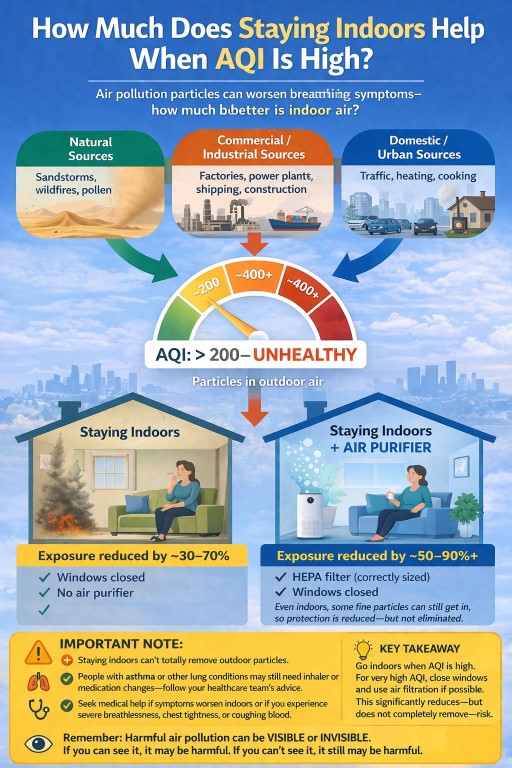
Staying indoors usually does help, but the amount of protection varies.
Typical home with windows closed
In general terms, staying indoors with windows closed may reduce exposure by around 30% to 70%, depending on:
- How well sealed the building is
- Whether windows or doors are being opened
- The age and condition of the property
- How long the pollution event lasts
Indoors with HEPA filtration
Using a correctly sized High Efficiency Particulate Air (HEPA) purifier can improve indoor air further. In some situations, this may reduce indoor particle exposure by around 50% to 90% or more.
Important limits
- Fine particles can still get indoors
- Older or drafty buildings may offer less protection
- Opening windows can quickly increase indoor particle levels again
The realistic goal is usually to reduce exposure as much as possible, not to expect complete protection.
Practical ways to reduce exposure
When outdoor AQI is high, the following steps may help:
- Stay indoors as much as possible
- Keep windows and doors closed
- Avoid strenuous outdoor activity
- Use air filtration if you have it
- Delay non-essential trips outdoors if practical
- Check AQI more than once per day during unstable conditions
For some people, symptoms may still occur even indoors. If so, it may help to reduce physical activity, keep rescue medication available if prescribed, and monitor symptoms closely.
Masks and air filtration
Masks
Well-fitted particle-filtering masks such as FFP2 or FFP3 may reduce exposure to fine particles when you need to go outdoors. Their usefulness depends heavily on fit, comfort, and wearing them correctly.
Not everyone can tolerate masks easily, especially if they are already short of breath, so they are not always a complete solution.
Air purifiers
A HEPA purifier may be especially useful in the room where you spend the most time, such as a bedroom or living room. Performance depends on:
- Correct room size
- Good maintenance of filters
- Keeping windows closed during high pollution periods
Buying an air purifier: what matters and what does not
Air purifiers can help reduce indoor particle levels, but it is important to be realistic about what they can and cannot do.
Important: An air purifier does not treat aspergillosis, does not cure asthma or bronchiectasis, and does not remove all particles. It is best thought of as one way to reduce exposure.
What matters most
- True HEPA filtration (or a clearly specified high-efficiency particle filter)
- Room-size coverage that matches the room where it will be used
- Clean Air Delivery Rate (CADR), where provided
- Noise level, especially if used in a bedroom
- Replacement filter cost and availability
What these terms mean
True HEPA: This usually means the purifier is designed to remove very small airborne particles efficiently. For patients concerned about dust and polluted air, this is generally more important than extra “smart” features.
Room size: A purifier that is too small for the room may not make much difference. It is usually better to buy the correct size for the room where you spend the most time than to buy a very cheap device that cannot handle the space.
CADR: This is a measure of how quickly a purifier can clean the air. Higher CADR usually means faster particle removal, though room size and real-life use still matter.
What to be cautious about
- Very cheap devices with vague claims but no clear filter specification
- Small USB-powered “desk purifiers” claiming to clean large rooms
- Ioniser-only devices with no proper particulate filter
- Products that make sweeping medical claims
Practical buying advice
- Start with the room you use most, often the bedroom or living room
- Choose a purifier that is rated for that room size
- Check how often filters need replacing and how much replacements cost
- Read the real specifications, not just the marketing headline
- If you are noise-sensitive, look at the sleep-mode or low-speed sound level
Reasonable expectations
Used properly, a good air purifier may make a meaningful difference during high pollution periods, especially when combined with keeping windows closed. However, it is only one part of managing exposure.
Travel and changing environments
Air quality can change dramatically between regions and countries. Some places have persistent urban pollution, while others may experience sudden dust events, wildfire smoke, or seasonal changes.
If you are travelling, it may help to:
- Check local AQI before travel and during your stay
- Be aware of seasonal dust or wildfire risks
- Know where you can spend time indoors if air quality worsens
- Keep regular medications with you
This can be particularly important if you already know that poor air quality tends to worsen your symptoms.
Common misconceptions
Myth: “If I cannot see pollution, it is safe.”
Fact: Invisible pollution such as PM2.5 and gases can still be harmful.
Myth: “If the air looks foggy, it must just be water vapour.”
Fact: Hazy air can sometimes be caused by dust or pollution rather than fog.
Myth: “Staying indoors completely solves the problem.”
Fact: Staying indoors usually reduces exposure, but does not remove it completely.
Myth: “If my symptoms worsen, it must be an infection.”
Fact: Pollution and airway irritation can also worsen symptoms.
Myth: “Air pollution is always caused by traffic.”
Fact: Pollution may come from natural, industrial, and domestic sources, often in combination.
Managing your condition during high air pollution
For people with aspergillosis, asthma, bronchiectasis or other lung conditions, air pollution can trigger symptoms even when there is no infection. Having a simple plan can help you feel more in control.
Continue your regular medication
- Take your prescribed medications as usual, including inhalers or antifungal treatments
- Do not stop or reduce medication without medical advice
Have your reliever medication available
- Carry your reliever inhaler (if prescribed) when leaving the house
- Make sure it is within easy reach, not packed away
- Check that it is in date and not empty
Plan ahead before going outdoors
- Check the AQI before leaving home
- Avoid going out during peak pollution times if possible
- Consider shorter trips or lower-exertion activities
Adjust activity levels
- Reduce strenuous activity when AQI is high
- Walk more slowly and allow extra time
- Take breaks if you feel breathless
Know your early warning signs
Be aware of symptoms that may indicate your lungs are being affected:
- Increased breathlessness
- More coughing or wheezing
- Chest tightness
- Unusual fatigue
Have a simple action plan
- Know what you usually do if symptoms worsen
- Follow any personalised plan provided by your clinical team
- Seek advice if symptoms are different from your usual pattern
Practical tip: On high pollution days, think ahead before leaving home—take medication with you, plan shorter trips, and allow extra time so you do not have to rush.
When to seek medical help
Seek medical advice promptly if you notice:
- Worsening breathlessness
- New or worsening wheeze
- Chest tightness that is not settling
- A major increase in cough
- Coughing blood (haemoptysis)
- Symptoms that are more severe than your usual pattern
If you have a severe flare, marked breathing difficulty, or significant haemoptysis, seek urgent medical help.
Final takeaway
Outdoor air pollution is an important and often under-recognised trigger for people with lung disease. For patients with aspergillosis and related lung conditions, it can worsen symptoms even when there is no new infection.
The most helpful practical points are:
- Use AQI rather than appearance alone
- Remember that pollution may be visible or invisible
- Stay indoors when AQI is high
- Use air filtration where possible
- Keep an eye on changing symptoms and seek help if needed
References
- World Health Organization. WHO Global Air Quality Guidelines. 2021.
- UK Department for Environment, Food & Rural Affairs (DEFRA). UK-AIR: Air Information Resource.
- IQAir AirVisual air quality app.
- European Respiratory Society statements and guidance on air pollution and respiratory health.
- British Thoracic Society resources on respiratory health and environmental exposure.
Author: Prepared for aspergillosis.org
Review note: This article is intended for general education and should not replace advice from your own clinical team.

Latest News posts
News archive