
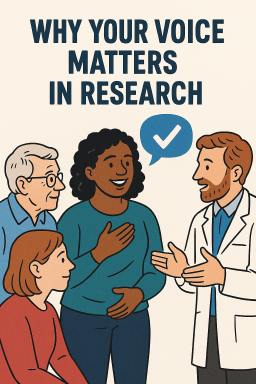
How Patients Help Shape Better, Fairer Medical Trials
💬 Why Are Patients Being Asked to Help with Research?
If you’re living with a health condition — especially one that’s under-researched or misunderstood — your experience is vital.
Today, researchers, funders, and charities are working hard to involve patients and carers in medical research. Your insights help ensure:
-
The right questions are asked
-
Outcomes that matter to patients are measured
-
Studies are practical and inclusive
-
Public funds are used fairly and effectively
💷 Why Pharmaceutical Companies Are Involved — And Why We Still Need Them
Pharmaceutical companies develop and test most new medicines. Their funding, staff, and infrastructure are essential — especially for:
-
Rare or complex diseases
-
Treatments that require large, international trials
-
Speeding up the path from discovery to clinic
But as for-profit organisations, pharma companies also have business goals — such as:
-
Making a return on investment
-
Releasing new drugs before competitors
-
Promoting products over alternatives
This can create conflicts of interest — even unintentionally — which is why we need strong checks and balances.
⚖️ What Can Go Wrong: Risks to Impartiality
Because of commercial influence, research funded by the pharmaceutical industry can sometimes include bias, such as:
| 🧪 Risk | 💬 What It Means |
|---|---|
| Sponsorship bias | Results may be more positive for a company’s own product. |
| Selective publication | Negative or neutral results might not be published. |
| Design bias | Studies may be designed in ways that favour one outcome. |
| Ghostwriting | A company may write a scientific article but publish it under an academic’s name. |
| Unclear side effects | Real-world harms may be underreported or downplayed. |
This is why independent safeguards — and your involvement — are so important.
🛡️ What Keeps Research Honest?
Impartiality is protected through a shared responsibility between:
👥 Patients & Public
-
Help ensure that research reflects real experiences
-
Ask important questions researchers may miss
-
Keep science grounded in real-world needs
🧪 Independent Scientists
-
Analyse and critique study methods and findings
-
Conduct publicly funded or non-commercial research
-
Publish systematic reviews (e.g. Cochrane) to assess all evidence
🏛️ Regulators & Ethics Committees
-
Agencies like MHRA (UK), EMA (Europe), and FDA (USA) review trial designs, monitor safety, and can demand extra data
-
Research Ethics Committees (RECs) review every trial in advance to check for fairness, patient safety, and scientific value
📚 Journal Editors & Reviewers
-
Scientific journals require researchers to disclose conflicts of interest
-
Peer reviewers (often unpaid experts) critically assess studies before publication
Together, these layers help reduce bias, protect patients, and promote better science.
👩🔬 How Patients Improve Research — Step by Step
| 🧩 Stage | 👥 Your Role as a Patient |
|---|---|
| Choosing the research question | Help identify what matters most — not just what’s easiest to measure |
| Designing the trial | Suggest realistic visit schedules, help choose fair inclusion criteria, review consent forms |
| Helping people take part | Improve how studies are advertised and explained, especially for underserved groups |
| Monitoring the trial | Sit on trial oversight committees, flag practical or ethical concerns |
| Sharing the results | Help write plain-English summaries and guide where and how results are shared |
🔍 Why Patient Involvement Helps Reduce Bias
✅ You’re not tied to commercial goals
✅ You speak from lived experience
✅ You help researchers stay grounded
✅ You ask different — often better — questions
Your involvement increases trust, relevance, and fairness in research. It also complements the role of scientists, ethics reviewers, and regulators who are working behind the scenes to protect public interest.
🫶 Could You Help?
You don’t need a science degree — just your experience and willingness to contribute.
You might:
-
Join a patient advisory group
-
Help review research proposals for funding
-
Take part in a clinical trial (as a participant or advisor)
-
Share your experience with researchers, charities, or the NHS
-
Help write or test patient information materials
🚀 How to Get Started
-
Explore Be Part of Research (UK-wide clinical research opportunities)
-
Ask your GP or specialist if any research is happening near you
-
Join patient groups connected to your condition — many are research partners
-
Contact a university or NHS trust involved in research — most have PPI (Patient and Public Involvement) teams
Research works best when it’s done with patients — not just about them.
Your voice helps keep science honest, relevant, and focused on real lives.

Latest News posts
News archive