
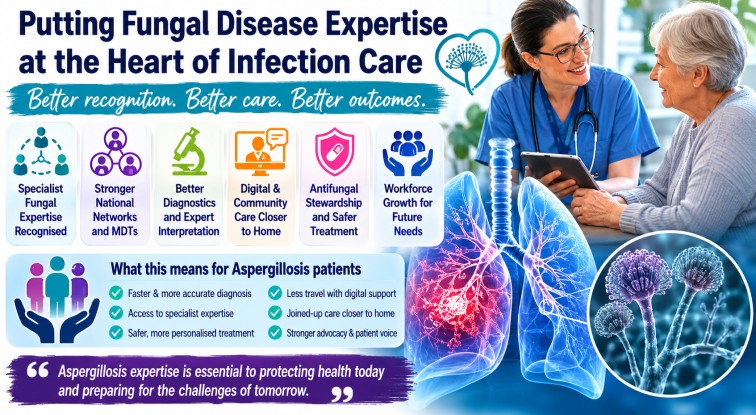
Summary: A major new UK infection-specialist workforce report recognises fungal disease expertise as an essential part of modern healthcare. The report has important implications for aspergillosis diagnosis, specialist services, digital care, antifungal stewardship and future workforce planning.
Key points
- Medical mycology is now recognised as part of essential UK infection infrastructure.
- Rising immunosuppression and chronic lung disease are increasing demand for aspergillosis expertise.
- The report supports networked specialist care, closely matching the National Aspergillosis Centre model.
- Advanced fungal diagnostics and specialist interpretation are increasingly important.
- Digital and community-based care could improve access for patients living far from specialist centres.
- Antifungal stewardship and resistance monitoring are likely to become much more prominent.
Why was this report produced?
This report was produced in 2026 by a coalition of the UK’s leading infection societies, including organisations representing infectious diseases physicians, microbiologists, virologists, infection prevention specialists, pharmacists, laboratory scientists and medical mycologists.
It reflects growing concern that the UK infection-specialist workforce is under increasing strain at a time when infectious diseases are becoming more complex, more resistant to treatment and more internationally connected.
The report was produced in response to several major pressures affecting the NHS and wider healthcare system:
- the long-term impact of the COVID-19 pandemic;
- rising antimicrobial resistance (AMR);
- an ageing population with more chronic disease;
- increasing use of immunosuppressive medicines, biologics and transplantation;
- workforce shortages in infection specialties;
- concerns about future pandemics and emerging infections;
- growing demand for complex diagnostics and specialist infection advice;
- the NHS shift toward community and digitally enabled care.
The report also aligns closely with the NHS 10-Year Plan and wider UK health-security planning. It repeatedly refers to the need for three major shifts in healthcare delivery:
- moving care from hospital to community;
- shifting from reacting to illness toward prevention;
- accelerating digital and data-driven healthcare systems.
Importantly for aspergillosis and fungal disease, the report recognises that modern infection medicine now extends far beyond traditional bacterial infections. Infection specialists are increasingly dealing with:
- complex fungal infections;
- drug-resistant organisms;
- infections linked to immunosuppression;
- global travel and climate change;
- high-risk vulnerable patients;
- and emerging pathogens.
The report can therefore be seen as both:
- a warning that infection services are under significant pressure and risk workforce shortages; and
- a strategic argument for greater investment in specialist infection expertise, diagnostics, digital infrastructure and networked care.
For aspergillosis specialists, one of the most important aspects is that medical mycology and fungal diagnostics are now being recognised as part of essential national infection infrastructure rather than as peripheral specialist services.
In many ways, the report reflects lessons learned during the COVID-19 pandemic. During COVID, the NHS saw how rapidly infection services, diagnostics, surveillance systems and specialist expertise became critical to national resilience. The experience also highlighted how vulnerable immunocompromised patients are to opportunistic infections, including fungal disease such as COVID-associated pulmonary aspergillosis (CAPA).
The report therefore represents a broader move toward building a more resilient, better-connected and more prevention-focused infection system for the future.
1. Fungal disease expertise is recognised as core infection infrastructure
One of the most significant implications is that the report explicitly includes mycologists and fungal diagnostics specialists within the UK infection-specialist workforce.
This matters because fungal disease services have often been under-recognised compared with bacterial and viral infection services. For aspergillosis specialists, the report strengthens the argument that medical mycology is not a niche extra, but a necessary part of safe, modern infection care.
For patients, this recognition may help support better access to specialist fungal expertise, particularly for complex conditions such as chronic pulmonary aspergillosis (CPA), allergic bronchopulmonary aspergillosis (ABPA) and invasive aspergillosis.
2. Aspergillosis is likely to become more important
The report highlights several pressures on infection services, including ageing populations, multi-morbidity and increasing use of immunosuppressive treatments. These are also major risk factors for Aspergillus-related disease.
This means clinicians may see increasing numbers of patients with:
- chronic pulmonary aspergillosis (CPA);
- invasive aspergillosis;
- Aspergillus disease in bronchiectasis;
- Aspergillus complications in people receiving biologics, chemotherapy or transplant medicines;
- azole-resistant Aspergillus infections.
For patients, this could eventually mean better awareness and diagnosis. However, unless the specialist workforce grows, increased recognition may also place more pressure on already stretched fungal services.
3. The report supports networked specialist care
The report strongly supports regional and national specialist networks, shared expertise, multidisciplinary team working and digital advice models.
This is highly relevant to aspergillosis. Many patients are looked after locally by respiratory, microbiology or infectious diseases teams, but need input from specialist fungal centres for diagnosis, treatment decisions and monitoring.
This supports a model where local teams remain involved, but have rapid access to national fungal expertise when needed.
4. Diagnostics are central to better aspergillosis care
Aspergillosis is often difficult to diagnose. Test results need careful interpretation because Aspergillus can represent colonisation, allergy, chronic infection or invasive disease depending on the clinical context.
The report’s focus on rapid diagnostics, molecular testing, genomics, digital laboratory systems and expert interpretation is therefore highly relevant.
For aspergillosis, improved diagnostic pathways could include better access to:
- Aspergillus immunoglobulin G (IgG);
- Aspergillus immunoglobulin E (IgE);
- galactomannan testing;
- fungal polymerase chain reaction (PCR);
- azole resistance testing;
- fungal culture and sequencing;
- specialist radiology review.
For patients, this could mean fewer missed diagnoses, shorter diagnostic delays and more personalised treatment.
5. Community and digital care could help patients
The report supports moving appropriate care closer to home, using outpatient antimicrobial therapy, virtual services and digitally enabled community pathways.
For people with aspergillosis, this could be very beneficial. Many patients have long-term breathlessness, fatigue and mobility limitations, and may live far from specialist centres.
Potential benefits include:
- fewer long-distance hospital visits;
- remote monitoring of symptoms and test results;
- shared-care arrangements with local hospitals;
- virtual multidisciplinary team review;
- faster specialist advice for local clinicians.
However, fungal disease management is complex. Community pathways must still include specialist oversight because antifungal treatment can involve drug interactions, liver toxicity, therapeutic drug monitoring, adrenal suppression and resistance issues.
6. Antifungal stewardship should become more prominent
The report focuses heavily on antimicrobial stewardship. Although much of this is framed around antibiotics, the same principles apply to antifungal medicines.
For aspergillosis care, antifungal stewardship means using the right antifungal, at the right dose, for the right duration, with careful monitoring.
This is especially important because of:
- azole resistance in Aspergillus fumigatus;
- long courses of antifungal treatment;
- drug interactions with steroids, anticoagulants, immunosuppressants and other medicines;
- the need for therapeutic drug monitoring;
- side effects affecting the liver, skin, nerves or adrenal system.
For patients, better antifungal stewardship should mean safer and more effective treatment.
7. Fungal disease has a role in pandemic preparedness
The report includes mycology within pandemic preparedness planning. This is important because fungal complications can emerge during major respiratory outbreaks.
COVID-associated pulmonary aspergillosis (CAPA) showed that fungal disease can become highly relevant during pandemics, especially in intensive care and immunocompromised patients.
Future preparedness should therefore include fungal diagnostics, fungal surveillance, resistance monitoring and specialist mycology input.
8. Workforce expansion is essential
The report warns that the infection-specialist workforce is under pressure. This is particularly important for fungal disease because the UK has a limited number of specialist medical mycologists, fungal pharmacists, laboratory scientists and specialist nurses.
For aspergillosis services, workforce planning should include:
- more medical mycology training opportunities;
- more specialist fungal pharmacists;
- more fungal diagnostics scientists;
- more specialist nurses supporting long-term fungal disease care;
- protected time for multidisciplinary team meetings and advice services.
Without this, diagnostic delays and unequal access to specialist care may persist.
9. What this means for patients
For patients, the report supports several important messages:
- fungal disease expertise matters;
- specialist diagnosis and treatment are important;
- long-term fungal lung disease requires joined-up care;
- access to expert advice should not depend too heavily on postcode;
- digital and shared-care systems could reduce the need for repeated travel;
- patient education should be part of infection service planning.
The report may also be useful for patient advocacy because it provides national-level support for strengthening infection services, including fungal infection expertise.
10. What is still missing?
Although the report is very helpful, aspergillosis itself is not discussed in detail. Areas that would benefit from stronger future emphasis include:
- chronic pulmonary aspergillosis (CPA);
- allergic bronchopulmonary aspergillosis (ABPA);
- severe asthma with fungal sensitisation (SAFS);
- Aspergillus bronchitis;
- azole-resistant Aspergillus;
- environmental mould exposure and health;
- long-term patient support and rehabilitation.
This creates an opportunity for aspergillosis specialists, patient groups and charities to build on the report and make the case for more visible fungal disease planning.
Conclusion
This report is a positive development for aspergillosis. It recognises that fungal disease expertise is part of the UK’s essential infection workforce and supports many of the changes aspergillosis patients need: better diagnostics, stronger specialist networks, digital care, community support, workforce expansion and safer antimicrobial use.
The key challenge is ensuring that fungal disease does not remain only briefly mentioned within broader infection policy. Aspergillosis specialists and patient advocates can use this report to argue that fungal infection services need sustained investment, national planning and equitable access across the UK.

Latest News posts
News archive