
19 November 2026 | National Aspergillosis Centre Patient Support
Living with aspergillosis involves much more than managing a lung condition. There are medicines to organise, infections to avoid, treatments to fit around everyday life, and sometimes an exhausting succession of appointments and investigations.
At this week’s Thursday Session, patients discussed many of these challenges. What began as a conversation about treatment routines and digestive problems eventually developed into a particularly thoughtful discussion about anxiety, pain and the remarkable resilience of people living with chronic illness.
It was a reminder that living with aspergillosis is not simply about controlling symptoms. It is also about finding ways to live alongside them.
Finding time for everything
For some patients, managing respiratory illness can occupy several hours every day.
One participant described spending around two hours each evening preparing and taking nebulised medicines and completing airway clearance. Others recognised the difficulty of fitting physiotherapy around meals, medication and ordinary family life.
Eating too close to airway clearance can be uncomfortable, but leaving treatment until late in the evening may mean being too tired to complete it.
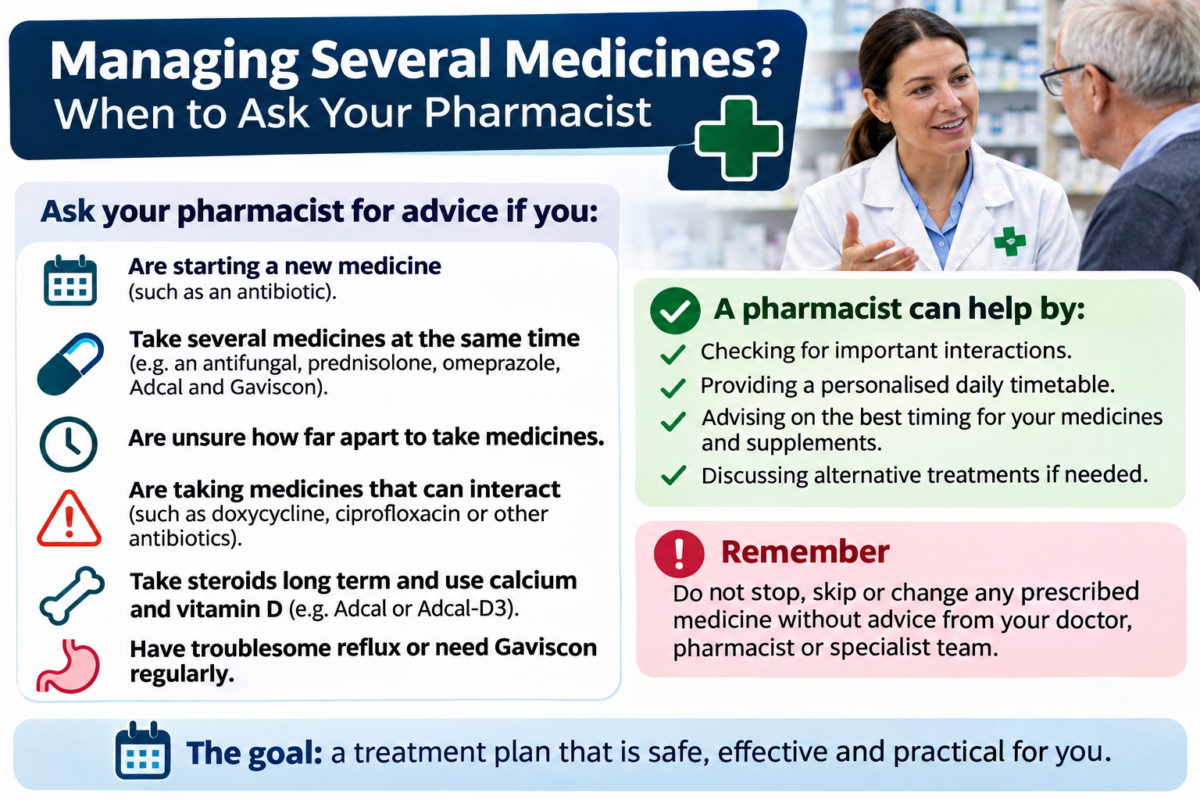
Taking several medicines adds another layer of complexity. Some need to be taken with food, others on an empty stomach, while certain medicines must be separated to avoid interactions.
Our recent article, Taking Gaviscon, Omeprazole, Adcal, Steroids and Antifungals: A Practical Medication Guide, explores these problems in more detail.
These are the practical challenges that are often invisible during a hospital appointment. A treatment may be clinically effective, but making it work alongside everything else requires considerable effort.
When eating becomes difficult
Digestive problems became a major topic of conversation.
Patients described diarrhoea following antibiotic treatment, unpredictable reactions to particular foods and increasingly restricted diets.
One participant explained how difficult it was to experiment with foods after finally achieving a period of relative stability. Although they wanted to broaden their diet, they were reluctant to risk triggering another episode of illness.
That uncertainty can become particularly troublesome when patients are already losing weight.
Several participants described struggling to eat enough, with some foods causing discomfort and larger meals leaving them feeling excessively full or breathless.
The group discussed smaller, more frequent meals, calorie-rich foods, probiotics and fermented products such as kefir.
However, there are some important distinctions.
Antibiotics and the gut
Antibiotics can disturb the normal gut microbiome and cause diarrhoea. However, persistent diarrhoea should not automatically be attributed to harmless changes in gut bacteria.
Occasionally, antibiotic treatment allows an infection called Clostridioides difficile (C. difficile) to develop.
The NHS advises seeking urgent GP advice or NHS 111 help if diarrhoea develops while taking antibiotics or after a recent course, or if diarrhoea lasts more than seven days.
Read the NHS guidance on C. difficile.
Are restrictive diets always helpful?
Some people are advised to follow a low-fibre or otherwise restricted diet for a specific medical reason. Such advice may be appropriate for their individual circumstances.
However, continually excluding foods without identifying the underlying problem can make it increasingly difficult to maintain a balanced diet.
This is especially important for people with chronic lung disease who may already be struggling with weight loss, poor appetite or fatigue.
Patients experiencing continuing weight loss, persistent diarrhoea or difficulty eating enough should discuss this with their clinical team. A dietitian may be able to help identify suitable foods and improve nutritional intake without unnecessary restrictions.
Probiotics and fermented foods are also not suitable for everyone. People with significant immune suppression or other serious health problems should seek individual advice before using live microbial supplements or homemade fermented products.
Respiratory infections and the worry of becoming unwell again
The group also discussed seasonal respiratory infections, vaccination and the difficulties of avoiding viruses when spending time with family and grandchildren.
An important observation was that the initial viral illness is not always the greatest problem.
For someone with chronic lung disease, the consequences can continue long after the virus itself has cleared. Increased coughing, airway inflammation or secondary infections may prolong recovery.
This helps explain why patients can be particularly concerned about apparently minor infections.
What might be a few days of illness for one person can sometimes mean weeks of additional symptoms for someone whose lungs are already vulnerable.
When diagnoses and treatments change
Another participant described uncertainty after previously receiving antifungal treatment that appeared to improve their symptoms, only for subsequent specialist assessments to reach different conclusions about their condition.
This raised a difficult but important question: How should patients understand conflicting diagnoses or changing treatment recommendations?
Aspergillus-related conditions are complex. Finding Aspergillus in the airways does not always mean that it is causing active infection. Allergic disease, fungal colonisation and chronic infection can sometimes be difficult to distinguish.
A patient’s response to treatment is useful information, but it is not always sufficient to establish a diagnosis.
Patients should feel able to ask their specialist what has changed, how the diagnosis was reached and what findings might justify reconsidering treatment.
Understanding the reasoning behind a decision can be particularly important when a treatment that previously seemed helpful is no longer recommended.
Anxiety, pain and the body’s response to illness
Towards the end of the meeting, the discussion moved in a particularly interesting direction.
A recent television programme presented by mathematician Hannah Fry prompted a conversation about the relationship between anxiety, pain and the nervous system.
Anxiety can influence how the brain processes pain and other physical sensations. When someone is already frightened or distressed, their experience of discomfort may become more intense.
But there is another side to this relationship.
For someone struggling to breathe, anxiety may be a completely understandable response to a frightening physical experience.
Anxiety can make physical symptoms harder to manage, while physical symptoms themselves can generate anxiety.
One participant expressed the relationship very simply:
“You’re suffering from anxiety, that’s because I can’t breathe.”
This captures something important.
Patients may sometimes feel that being told they are anxious means their physical symptoms are being dismissed.
But anxiety and physical illness are not competing explanations. Both can be present, and each can influence the other.
Anxiety does not mean that symptoms are imaginary, nor does it mean that patients are somehow responsible for making themselves ill.
Our guide to mental health and coping with aspergillosis explores these relationships and ways of finding support.
Can relaxation techniques help?
The group also discussed techniques intended to help manage anxiety and pain, including relaxation and hypnotherapy.
Such approaches may help some people cope with symptoms, although responses vary and the evidence differs between techniques and conditions.
They do not replace investigation or treatment of underlying physical illness.
Importantly, new or worsening breathlessness should never simply be dismissed as anxiety.
The aim of psychological support is not to persuade patients that their illness is less real. It is to help them manage the additional distress that illness can create.
The anxiety of yet another investigation
One participant described facing another medical investigation, this time involving a skin biopsy.
Although the procedure itself might be relatively minor, the prospect was distressing because of previous medical experiences and concerns about fragile skin.
This prompted a wider recognition of how much patients have to cope with.
Living with a chronic condition can mean repeated appointments, unfamiliar procedures, waiting for results and worrying about what might be discovered next.
Each investigation may be routine for the healthcare professionals involved, but it is not necessarily routine for the person undergoing it.
And the emotional burden can accumulate.
Patients may already be dealing with breathlessness, fatigue, disrupted sleep and demanding treatment schedules. A new symptom or another hospital appointment can feel like one more problem added to an already considerable load.
This is one reason why emotional support when adjusting to long-term illness is an important part of healthcare, rather than an optional extra.
Are people with chronic illness weak — or remarkably strong?
Perhaps the most memorable exchange came right at the end.
One participant wondered whether people with aspergillosis were somehow physically weaker than other people, given the health problems they experienced.
Another offered a very different perspective:
“I think you must be incredibly strong to do as well as you do with what you have to put up with.”
It was a simple observation, but an important one.
People living with chronic illness often measure themselves against what they used to be able to do.
They notice the activities they can no longer manage, the treatments they need, the energy they have lost and the limitations that illness imposes.
But this can obscure the extraordinary amount of effort required simply to maintain an ordinary life.
Taking medicines, completing physiotherapy, coping with setbacks, attending appointments, adapting to new symptoms and continuing to participate in family and community life all require persistence.
Sometimes that persistence is described as stubbornness.
Perhaps it is also a form of resilience.
Having a chronic illness does not mean someone is weak. Nor does having aspergillosis necessarily mean that someone’s immune system is generally weak. Different forms of aspergillosis arise for different reasons, including underlying lung damage, allergic responses and particular immune vulnerabilities.
And finding life difficult does not mean someone is failing to cope.
Resilience is not about never feeling anxious, frightened or exhausted. Sometimes it is simply about continuing to do what needs to be done despite those feelings.
It is also important to recognise that nobody should be expected to demonstrate endless strength. Asking for help, accepting support and acknowledging that things are difficult are equally valid responses to illness.
Why sharing experiences matters
Thursday Sessions provide an opportunity for patients to discuss aspects of illness that may receive relatively little attention during clinical appointments.
There are opportunities to exchange practical suggestions, ask questions and discover that others experience similar difficulties.
But the value goes beyond information.
Sometimes another patient can recognise the effort involved in living with illness more clearly than the person experiencing it.
That was particularly evident this week.
A conversation that began with medicines, digestive problems and daily routines ended with patients recognising the strength they see in one another.
It is a reminder that patient support and community can offer something that clinical treatment alone cannot always provide: understanding from people who have experienced similar challenges.
Living with aspergillosis is not just about treating the disease. It is also about finding ways to live alongside it — and recognising the strength that takes.
Join our Thursday Sessions
Our Thursday Sessions are friendly, informal online discussions for people affected by aspergillosis, including patients, families and carers.
You are welcome to share experiences, ask questions or simply listen.
Visit our online meetings page for current meeting times and joining information.
These discussions reflect individual patient experiences, shared anonymously. They are not a substitute for medical advice. Please discuss new symptoms, treatment changes or concerns about your health with your own clinical team.

Did this page help you?
Tell us in one minute