
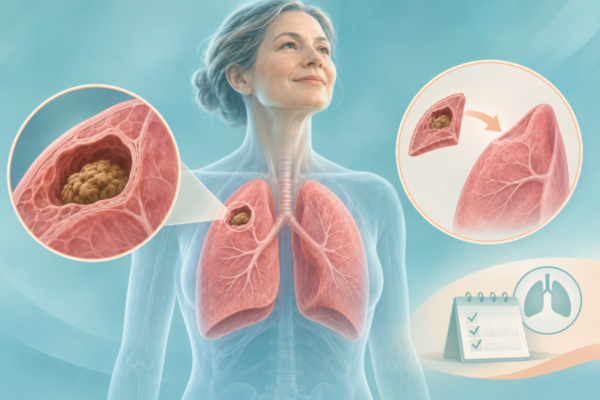
Surgery can offer a cure for some people with an aspergilloma. For others, it can help control troublesome symptoms and provide a worthwhile period of better health. But an operation is a significant decision, and it is natural to have questions about recovery, risks and whether the disease could return.
The key distinction is this: surgery can remove the disease present at the time, but it may not remove the underlying reasons a person was vulnerable to developing it. Understanding that distinction can help you approach the decision with realistic hope.
What does surgery remove?
An aspergilloma is a ball of fungal material, usually Aspergillus, growing inside a cavity in the lung. The cavity may have formed following an earlier illness or as part of another lung condition. Our main guide to aspergilloma explains this in more detail.
Surgery usually removes the affected part of the lung containing both the fungal ball and its cavity. The amount removed depends on its position, extent and the condition of the surrounding lung.
A single aspergilloma, or disease confined to one lobe, can sometimes be cured by surgery. However, the person needs sufficient lung function and overall fitness to manage the operation and recovery.
An aspergilloma is not always the whole problem
The 2025 British Thoracic Society (BTS) statement distinguishes a simple aspergilloma, which causes no attributable symptoms, from a complicated aspergilloma, associated with symptoms such as coughing up blood. Progressive changes in the cavity indicate chronic pulmonary aspergillosis (CPA), rather than an isolated stable aspergilloma.
A fungal ball can therefore be one feature of more extensive disease. Removing one affected area may not remove every site of infection. This is why your team needs to assess the surrounding lung and compare scans over time, rather than considering the fungal ball alone.
Who may benefit from surgery?
Not every aspergilloma needs an operation. BTS advises against routinely offering surgery or antifungals for an asymptomatic aspergilloma. Symptoms, bleeding, changes on scans and immune suppression can alter the treatment decision.
Before recommending an operation, specialists consider:
- Whether the disease is localised enough to remove.
- How much functioning lung would be lost and how well the remaining lungs would work.
- Overall fitness, other illnesses and ability to recover.
- Previous surgery, scarring and the technical difficulty of the operation.
- The likely benefit compared with monitoring, antifungals or treatment to control bleeding.
The decision involves both whether the disease can be removed and whether the person can safely manage the operation and recovery. Experienced respiratory, infection and thoracic surgical teams can help weigh these factors.
What are the risks and demands of recovery?
Lung surgery is a major undertaking. Possible complications include bleeding, prolonged air leakage and infection in the space around the lung. Removing lung tissue may also affect breathing capacity. The risks vary with the extent of disease, the operation and the person’s health.
Recovery requires time, energy and practical support. General NHS lung-surgery guidance suggests allowing around three to six months for fuller recovery, although some people recover sooner and others take longer. This is a guide, not a fixed timetable for aspergilloma surgery.
That does not usually mean being unable to do anything for several months. Recovery is generally a gradual process of building up activity and independence. Pain relief, breathing exercises, physiotherapy and a personalised activity plan can support progress. Fatigue and discomfort may mean needing help with everyday tasks, particularly early on.
Ask what you are likely to manage at home, how much help you may need, and when work, driving and other activities might be appropriate. Your surgical team can give advice suited to your circumstances.
Can surgery still be worthwhile if disease returns?
Yes. A later recurrence does not erase the benefit someone may have gained from an operation. The 2020 NAC study found reductions in cough and coughing up blood after surgery, supporting the potential for meaningful symptom improvement.
Some patients describe having years of better health after surgery, even when aspergillosis later returns. These are individual experiences, rather than a promise of a particular outcome. Neither the degree of improvement nor its duration can be guaranteed.
The potential benefit should be considered alongside the operation’s risks, the recovery period and the support available. An operation can be worthwhile without offering a lifelong guarantee that disease will never return.
Why can aspergillosis develop again?
Surgery may successfully remove the affected area while other factors remain: damaged lung elsewhere, other cavities, underlying respiratory disease or difficulties with immune defence.
Aspergillus spores are common in the environment, but exposure alone does not mean someone will develop disease. Individual susceptibility matters.
Later disease might reflect infection that remained after treatment or disease developing again in a susceptible area of lung. It is not always possible to distinguish these explanations with certainty.
Being cured of a localised aspergilloma is different from being guaranteed never to develop aspergillosis again. A new diagnosis years later, including in the other lung, does not by itself prove that the original operation failed. Recurrence is possible, but it is not inevitable.
What have NAC studies found about recurrence?
A 2013 National Aspergillosis Centre surgical study described 30 patients with different forms of pulmonary aspergillosis. It highlighted the importance of individual risk assessment and the differences between localised aspergilloma and more extensive cavitary disease.
The later study, published in 2020, included 61 surgically treated CPA patients. During follow-up, 25 patients (41%) experienced relapse. Many had undergone surgery because medical treatment had failed; others had initially been suspected of having lung cancer.
This is not the recurrence risk for everyone having a single, uncomplicated aspergilloma removed. It describes a selected group with different disease patterns and reasons for surgery, and cannot predict an individual’s outcome.
The study also found an association between antifungal treatment before surgery, or before and after surgery, and lower relapse risk. It was observational, so it cannot establish exactly how much treatment would reduce risk for any particular person.
Will I need antifungals and follow-up?
Not everyone needs antifungals following complete removal of an uncomplicated aspergilloma. They may be recommended if active disease remains or there is a risk of fungal material spilling into the space around the lung during surgery.
Ask for a clear plan covering medicines, follow-up appointments, any scans or blood tests, and symptoms to report. People with remaining or more extensive CPA need ongoing specialist assessment. ,
Questions to ask your team
- Do I have an isolated aspergilloma, CPA or another form of aspergillosis?
- Is the aim to cure localised disease, reduce symptoms or control bleeding?
- What benefit is realistic for me, and what are the alternatives?
- How much lung would be removed, and how might this affect my breathing?
- What are my individual surgical risks?
- What might recovery involve, and what help should I arrange?
- Will I need antifungals or longer-term follow-up?
It is natural to feel apprehensive. For carefully selected patients, surgery offers a realistic prospect of worthwhile benefit and sometimes cure. You deserve time to understand the options and discuss your fears, so that the decision reflects both your medical circumstances and what matters most to you.
References and resources
- Brown JS, et al. British Thoracic Society Clinical Statement on Aspergillus-related chronic lung disease. Thorax. 2025;80(Suppl 1):3–21. Read the BTS statement.
- Farid S, et al. Results of surgery for chronic pulmonary Aspergillosis, optimal antifungal therapy and proposed high risk factors for recurrence—a National Centre’s experience. Journal of Cardiothoracic Surgery. 2013;8:180. Read the open-access study.
- Setianingrum F, Rautemaa-Richardson R, Shah R, Denning DW. Clinical outcomes of patients with chronic pulmonary aspergillosis managed surgically. European Journal of Cardio-Thoracic Surgery. 2020;58:997–1003. Read the study.
- Leeds Teaching Hospitals NHS Trust. Enhanced recovery after lung surgery: your guide to a good recovery.
- Patterson TF, et al. Practice guidelines for the diagnosis and management of aspergillosis: 2016 update by the Infectious Diseases Society of America. Clinical Infectious Diseases. 2016;63:e1–e60. Read the guideline.

Did this page help you?
Tell us in one minute