Why do most people breathe in Aspergillus spores without becoming ill? How does the immune system protect us—and why can that same response sometimes contribute to lung damage?
In this video series from the National Aspergillosis Centre, Graham Atherton explores these questions using accessible explanations and illustrations.
Recorded during our November 2026 patient meeting, the videos introduce the immune system and explain how its response helps us understand different forms of aspergillosis.
You can watch the full talk or choose a shorter video on a subject that interests you. No scientific background is needed.
Watch the complete video series:
Your Immune System and Aspergillosis — National Aspergillosis Centre
Watch the full talk
How your immune system fights Aspergillus—and why it can cause damage
The full presentation brings the subjects together: our first-line defences, how immune responses are controlled, and what happens in allergic bronchopulmonary aspergillosis (ABPA) and chronic pulmonary aspergillosis (CPA).
Running time: approximately 56 minutes.
https://www.youtube.com/watch?v=iKIC5aITc0Y
Explore the shorter videos
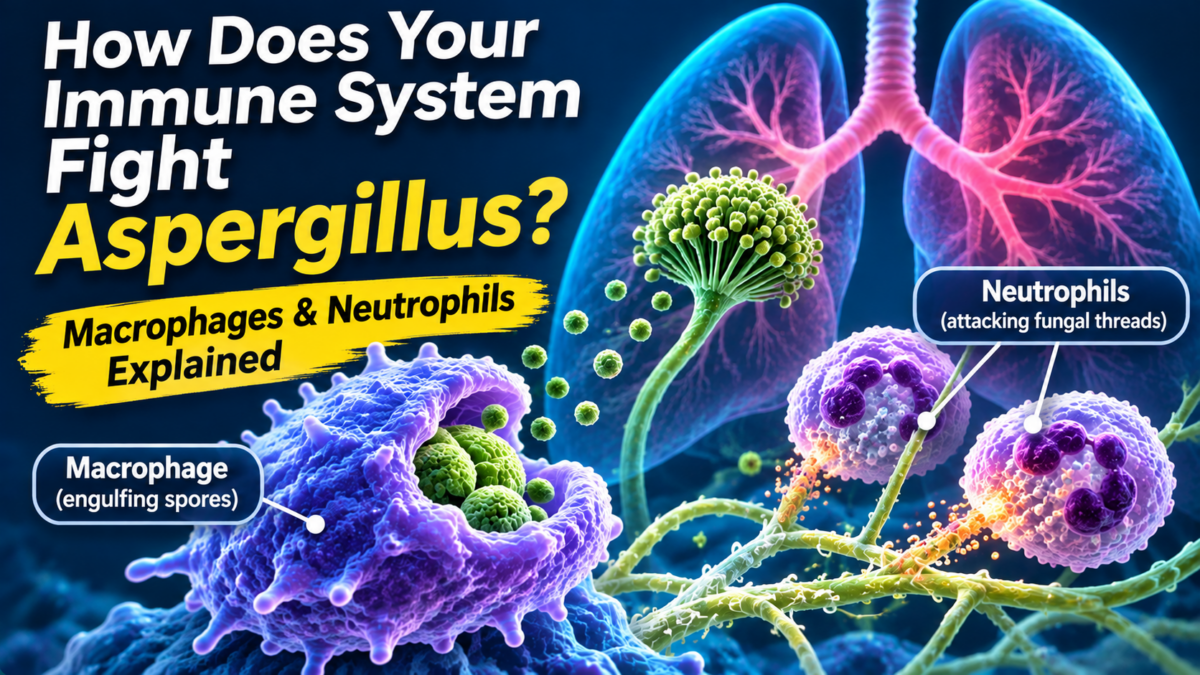
1. How does your immune system fight Aspergillus?
Macrophages and neutrophils
Meet two types of immune cell involved in defending our lungs. This introduction explains their different roles and uses an analogy to show how a response that protects us can also affect surrounding tissue.
Running time: approximately 7 minutes.
https://www.youtube.com/watch?v=cQwjEUKl8zo
2. How does your immune system know what to attack?
Immune tolerance explained
An effective immune system needs controls as well as weapons.
This video introduces how the immune system learns to recognise the body’s own tissues and how it regulates its responses. It provides background for understanding why immune activity needs to be carefully balanced.
Running time: approximately 11 minutes.
3. When your immune system causes damage
Inflammation explained
Inflammation is part of the body’s protective response. This video explores why that response can become harmful when it is excessive or continues for too long.
It builds on the earlier clips to explain why controlling inflammation can be an important part of treatment.
Running time: approximately 5 minutes.
4. Why does ABPA keep coming back?
Mucus, eosinophils and biologics
This video explores the relationship between Aspergillus, inflammation and mucus in ABPA. It introduces eosinophils and discusses why treatments that target parts of the immune response are of interest.
Running time: approximately 7 minutes.
5. Why is CPA so difficult to treat?
Chronic pulmonary aspergillosis explained
This clip considers why Aspergillus can persist in damaged lungs and why the interaction between the fungus, lung structure and immune defences makes CPA challenging to treat.
Running time: approximately 4 minutes; final edited length may vary.
Watch at your own pace
You do not need to watch everything at once. Start with a subject that interests you, pause whenever you wish and return to the other videos later.
If the immune system is unfamiliar territory, the macrophages and neutrophils video is a useful starting point. The immune tolerance and inflammation clips then explain how those defences are controlled.
The illustrations and analogies simplify complex processes. They are intended to make the ideas easier to follow rather than describe every detail of how immunity works.
Questions and support
If a video prompts a question, you are welcome to bring it to one of our online meetings.
Members share their experiences of living with aspergillosis, while Graham can add context, help find reliable information or identify questions to discuss with your healthcare team.
Find out about NAC online support meetings.
These videos provide general education. Different forms of aspergillosis involve different processes, and your own circumstances will affect your treatment. Do not change medicines on the basis of these videos; discuss treatment questions with your healthcare team.

Did this page help you?
Tell us in one minute