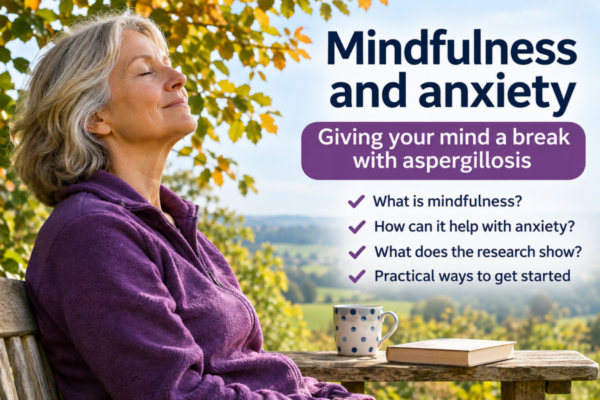
Living with aspergillosis can mean spending a great deal of time worrying about our health. There may be concerns about changes in symptoms, medication side effects, the results of our next scan or what the future might hold.
During our Thursday patient support meeting on 26 November 2026, we discussed anxiety and whether mindfulness might help us manage some of these worries.
There was considerable support among those attending for the idea that finding something else to focus on can give us a welcome break from worrying. For many, this was something they already knew from personal experience: it can and does work.
But can we develop this ability further, and what does the scientific evidence tell us?
When does worrying become unhelpful?
Anxiety is a natural response to uncertainty and potential danger. It can be useful, encouraging us to seek medical advice, prepare for appointments and pay attention to important changes in our health.
However, we can also find ourselves repeatedly thinking about things that we cannot currently do anything about.
We cannot change the past, and although we can prepare for the future, constantly worrying about what might happen can be mentally exhausting.
Living with a long-term illness can make it particularly difficult to escape this pattern of thinking. There may always be something else to worry about.
This can affect our sleep, energy levels, relationships and ability to enjoy life.
We may not be able to remove the causes of our worries, but we may be able to reduce the amount of time we spend worrying about them.
What is mindfulness?
Think of mindfulness as a way of giving your mind a break from worrying.
Have you ever sat down with a cup of tea, only to realise that you have finished it without really noticing its taste or warmth? Perhaps you were thinking about something that happened yesterday or worrying about something that might happen tomorrow.
Our minds are often occupied with things other than what we are actually doing.
Mindfulness encourages us to pay more attention to what we are experiencing right now. This might be something as simple as enjoying the taste of our tea, listening to birdsong or feeling the warmth of the sunshine.
When worries enter our minds, we do not have to fight them or try to push them away. Instead, we can recognise them and gently return our attention to what we are doing.
Our problems will still be there afterwards, but we may feel more rested and better able to deal with them.
With practice, we may become better at recognising when worrying is taking over our thoughts and choosing to give ourselves a break.
Mindfulness is not about ignoring our problems. It is about learning that we do not have to spend every waking moment thinking about them.
Something many of us already do
For many years, during our patient support meetings, we have discussed the benefits of finding something interesting or enjoyable to occupy our minds.
Examples might include:
- Gardening.
- Knitting, sewing or other crafts.
- Reading a good book.
- Painting or drawing.
- Doing a jigsaw or crossword puzzle.
- Listening to music.
- Watching wildlife.
- Spending time with family and friends.
- Learning something new.
During our latest discussion, patients confirmed that finding something else to focus on can be an effective way of taking their minds off their worries.
There is considerable overlap between this and mindfulness, although they are not quite the same thing.
Distraction involves finding something else to occupy our minds. Mindfulness involves deliberately directing our attention and learning to recognise worrying thoughts without becoming caught up in them.
For example, we might become so absorbed in gardening that we temporarily forget our worries. Alternatively, we might deliberately pay attention to the colours of the flowers, the texture of the leaves and the sounds around us, gently returning our attention to these things whenever our minds wander.
Mindfulness builds on an experience that many of us already recognise as helpful.
Can we learn to manage anxiety better?
One attendee at our Thursday meeting described how a member of their family had experienced significant problems with anxiety. He attended a 12-week course and, according to the attendee, was considerably improved afterwards.
Although everyone’s experience will be different, this is an encouraging example of how learning ways to manage anxiety can make a difference. Changing the way you think can be done!
We can sometimes come to accept anxiety as an inevitable part of our lives, particularly when living with a chronic illness. It can become an unnoticed habit that we return to under pressure. However, there are techniques and treatments that may help us manage it more effectively.
Mindfulness is one of several approaches that can be learned and practised.
What does the scientific evidence tell us?
Mindfulness has been studied extensively, including in people living with long-term respiratory conditions.
A systematic review published in August 2025 examined 13 studies, including eight randomised controlled trials, investigating mindfulness in people with chronic lung disease.
An analysis combining the results of four trials found meaningful average improvements in both anxiety and depression among participants receiving mindfulness interventions.
Some studies also reported improvements in stress and quality of life.
However, the evidence is not equally strong for all potential benefits.
| Potential benefit | What the research suggests |
|---|---|
| Anxiety | Encouraging evidence of improvement |
| Depression and low mood | Encouraging evidence of improvement |
| Stress | Potential benefits |
| Quality of life | Improvements reported in some studies |
| Breathlessness | Possible benefits in coping with symptoms, but evidence is less certain |
| Sleep | Potential benefits, with limited respiratory-specific evidence |
| Fatigue | Benefits remain uncertain |
| Lung function | No established reliable benefit |
| Aspergillosis itself | No established therapeutic benefit |
The number of trials available for combined analysis was relatively small, and further research is needed to establish how long the benefits last.
There is also a lack of research specifically involving people with aspergillosis. Much of the evidence comes from studies of other long-term respiratory diseases.
Nevertheless, many of the emotional challenges experienced by people with chronic respiratory illness are shared by those living with aspergillosis.
Can mindfulness help with breathlessness?
Breathlessness can be frightening, particularly if you have previously experienced a serious deterioration in your health.
Anxiety can sometimes make breathlessness feel more distressing. This can create a cycle in which breathlessness increases anxiety, and anxiety in turn makes the experience of breathlessness more difficult to manage.
Mindfulness may help some people respond to these symptoms with less distress.
However, this does not mean that breathlessness is caused by anxiety or that mindfulness can correct low oxygen levels, lung damage or infection.
New or worsening breathlessness should not be dismissed as anxiety. Seek medical advice if your breathing deteriorates. If you are experiencing severe breathing difficulties, seek emergency medical help.
When illness prevents us from doing things we enjoy
One of the less obvious consequences of chronic illness is that it can take away some of the activities that previously helped us cope with anxiety.
Someone who enjoyed gardening, walking, playing sport or travelling may find that breathlessness or fatigue makes these activities increasingly difficult.
We may have lost not only something we enjoyed but also an important way of taking our minds off our worries.
Finding new interests, or adapting existing ones to suit our abilities, can therefore be important for our mental wellbeing.
Mindfulness may offer another option because it requires very little physical effort. It can be practised while sitting in a chair or resting in bed.
Even on a particularly bad day, there may still be something we can enjoy or pay attention to for a short while.
Do I have to concentrate on my breathing?
No.
Many descriptions of mindfulness encourage people to concentrate on their breathing. However, for someone with a lung condition, this may not always be comfortable or helpful.
There are plenty of alternatives:
- Listening to sounds around you.
- Holding a warm cup of tea and noticing its warmth.
- Looking at trees, birds or clouds through a window.
- Listening attentively to a favourite piece of music.
- Noticing the texture of an object you are holding.
- Enjoying the taste and texture of your food.
There is no need to deliberately change your breathing, take deep breaths or hold your breath.
Find something that feels comfortable for you.
A simple way to try mindfulness
The next time you sit down with a cup of tea or coffee, try giving yourself a couple of minutes to enjoy it.
Notice the warmth of the cup, the smell of the drink and its taste. Try to give these sensations your attention.
If you find yourself thinking about your next hospital appointment or worrying about your health, recognise that your mind has wandered and gently bring your attention back to your drink.
Your mind may wander several times. This is entirely normal.
The aim is not to stop yourself from thinking. It is to practise choosing where you direct your attention.
You could try something similar while listening to music, looking out of a window or doing an activity you enjoy.
If it makes you feel uncomfortable or more anxious, stop. There is no need to force yourself to continue.
Would a mindfulness course help?
Some people may prefer to learn mindfulness through a structured course.
Two established approaches are:
- Mindfulness-Based Stress Reduction (MBSR) – designed to help people manage stress and the challenges of daily life.
- Mindfulness-Based Cognitive Therapy (MBCT) – combines mindfulness with techniques drawn from cognitive behavioural therapy.
Many formal mindfulness programmes run for around eight weeks and encourage regular practice between sessions.
Much of the stronger scientific evidence for mindfulness comes from structured programmes rather than occasional short exercises.
However, you do not need to enrol on a course or pay for a subscription simply to explore whether mindfulness might suit you.
Is mindfulness suitable for everyone?
No. Some people find mindfulness very helpful, while others find it frustrating, uncomfortable or ineffective.
For some people, particularly those experiencing significant psychological distress, mindfulness exercises may bring difficult thoughts or feelings to the surface.
There are other effective approaches to managing anxiety, including cognitive behavioural therapy (CBT), counselling, appropriate medication and support from healthcare professionals.
If anxiety is regularly affecting your sleep, relationships or enjoyment of life, speak to your GP or healthcare team. You do not have to manage it alone.
Mindfulness should complement, rather than replace, appropriate medical and psychological care.
Where can I learn more?
The following resources provide further information about mindfulness and managing anxiety:
- NHS – Mindfulness
- NHS Every Mind Matters – What is mindfulness?
- NHS Every Mind Matters – Anxiety
- Mental Health Foundation – How to look after your mental health using mindfulness
Scientific reference
Bramanti A, et al. (2025). Mindfulness-Based Interventions for Chronic Pulmonary Diseases: A Systematic Review of Effects on Anxiety, Depression, Stress, Dyspnea, and Quality of Life. Bioengineering, 12(9), 931.
Sharing our experiences
We would be interested to hear from people living with aspergillosis who have tried mindfulness or found other effective ways of managing anxiety.
Have you found something that helps you take your mind off your worries? Have you attended a course? Have you discovered new hobbies or interests since becoming ill?
Both positive and negative experiences are valuable.
You can share your experiences at one of our online patient support meetings, where we regularly discuss the practical and emotional challenges of living with aspergillosis.
Take-home message
Living with aspergillosis gives us plenty to worry about, but we do not have to spend all our time worrying.
Our patients already recognise the benefits of having something else to focus on. Mindfulness may help us build on that experience and develop a useful skill for managing anxiety.
We may not always have control over our illness, but there may be things we can do to improve our experience of living with it.

Did this page help you?
Tell us in one minute