
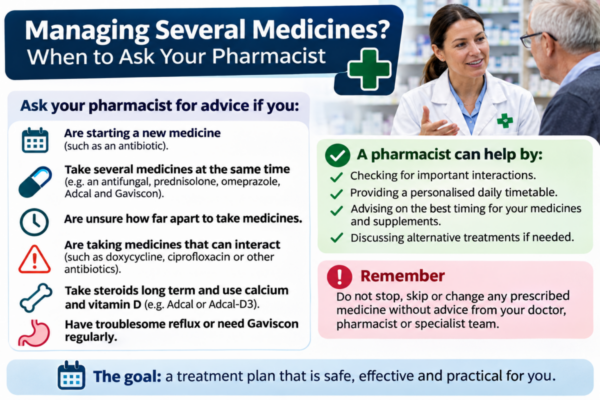
Taking several medicines every day can become surprisingly complicated. Some need to be taken with food, others on an empty stomach, and some must be separated by several hours.
For people living with aspergillosis, asthma and other long-term respiratory conditions, this is a familiar problem. A patient might take an antifungal, prednisolone, omeprazole, Adcal-D3 and Gaviscon, then be prescribed an antibiotic such as doxycycline.
Suddenly, fitting everything into the day becomes difficult.
The good news is that most medication schedules can be made manageable. The important thing is understanding which interactions matter and when simply leaving a gap between medicines is not enough.
Why does medication timing matter?
There are three main reasons why medicines sometimes need to be taken at different times:
- Absorption: Certain medicines can bind to calcium, magnesium or other minerals, reducing the amount absorbed into the bloodstream.
- Stomach acidity: Some medicines need an acidic stomach to be absorbed properly. Medicines that reduce stomach acid may interfere with them.
- Drug interactions: Some medicines affect how others are broken down or eliminated by the body. These interactions may occur even when doses are taken many hours apart.
It is important to distinguish these problems because they require different solutions.
Gaviscon: why does it interfere with some medicines?
Gaviscon is used to relieve acid reflux and heartburn. Its main action is to form a floating protective layer over the contents of the stomach, helping to prevent acid travelling back into the oesophagus.
Different formulations contain different ingredients. Some include calcium carbonate or other antacid ingredients that can affect the absorption of certain medicines.
NHS guidance recommends leaving at least two hours between Gaviscon and several other oral medicines, including certain antibiotics, antifungals, steroids, iron supplements and thyroid medicines.
Some medicines require longer intervals, so two hours should not be regarded as a universal rule.
Gaviscon is usually taken after meals and at bedtime, which can make it difficult to fit around other medicines.
Further information: NHS: Taking Gaviscon with other medicines.
Does Gaviscon prevent the absorption of nutrients from food?
Generally, no. Gaviscon does not stop normal digestion or prevent the body absorbing most nutrients from food.
It does not coat the entire digestive tract or create a barrier that blocks nutrients.
Some antacid ingredients may affect the absorption of particular minerals, especially iron, but clinically important nutritional deficiencies are not normally expected from Gaviscon used as directed.
People taking omeprazole or other proton pump inhibitors (PPIs) for long periods may have a greater reason to consider nutritional effects. Prolonged acid suppression can sometimes contribute to low vitamin B12, magnesium or iron levels.
For most patients, the bigger concern is Gaviscon interfering with their medicines rather than their food.
Adcal and Adcal-D3: an important consideration for patients taking steroids
People taking long-term corticosteroids such as prednisolone may be prescribed calcium and vitamin D supplements to help protect their bones.
Common examples include Adcal, which contains calcium carbonate, and Adcal-D3, which contains calcium carbonate and vitamin D.
These supplements are often an important part of treatment, but calcium can interfere with the absorption of certain medicines.
Which medicines interact with Adcal?
- Doxycycline and other tetracycline antibiotics: Calcium can bind to the antibiotic and reduce its absorption.
- Ciprofloxacin and other quinolone antibiotics: Calcium supplements can reduce absorption, potentially making treatment less effective. The extent of the interaction differs between individual antibiotics.
- Levothyroxine: Calcium can reduce absorption of thyroid replacement medication.
- Iron and zinc supplements: Calcium may reduce absorption when taken together.
- Bisphosphonates: Medicines such as alendronic acid, used to treat osteoporosis, need particular timing arrangements because calcium can prevent their absorption.
Adcal and Adcal-D3 product information generally recommends leaving approximately four hours between the calcium supplement and these interacting medicines. Some individual antibiotics require different intervals, so the instructions for both products must be checked.
For example, ciprofloxacin is generally taken at least two hours before or six hours after calcium supplements.
Further information: Adcal-D3 patient information leaflet.
Can Adcal be taken with prednisolone?
Yes. Calcium and vitamin D supplements are frequently prescribed for people taking long-term corticosteroids because steroids can increase the risk of osteoporosis.
However, calcium and vitamin D alone may not provide enough bone protection for everyone. Some patients also need other treatments, depending on their fracture risk.
Can Adcal interfere with antifungal medicines?
Adcal does not generally cause the same mineral-binding interactions with azole antifungals that it causes with certain antibiotics.
However, calcium carbonate can neutralise stomach acid. This may be relevant to conventional itraconazole capsules, which depend on stomach acidity for absorption.
Patients taking itraconazole should ask their pharmacist whether their calcium supplement needs to be separated from treatment.
Important: Patients taking both Adcal and Gaviscon should also check their total calcium intake, particularly if they have kidney problems or a history of kidney stones.
Omeprazole: why is it different from Gaviscon?
Omeprazole belongs to a group of medicines called proton pump inhibitors (PPIs).
Unlike Gaviscon, which forms a protective barrier against reflux, omeprazole reduces the amount of acid produced by the stomach.
It is commonly taken in the morning. Some preparations or treatment plans recommend taking it before breakfast, although many UK omeprazole preparations can be taken with or without food.
The important distinction is that omeprazole suppresses stomach acid for much longer than a simple antacid.
This means that taking omeprazole and another medicine several hours apart may not prevent an interaction caused by reduced stomach acidity.
Further information: NHS: Omeprazole.
Antifungal medicines: the formulation makes a difference
People with chronic pulmonary aspergillosis (CPA), allergic bronchopulmonary aspergillosis (ABPA) and other fungal conditions may need antifungal treatment for months or years.
Different antifungals have different requirements for food and stomach acidity.
Itraconazole
Conventional itraconazole capsules are generally taken immediately after a full meal and require an acidic stomach for good absorption.
Omeprazole and other medicines that reduce stomach acidity can significantly reduce the absorption of conventional itraconazole capsules.
Itraconazole oral solution behaves differently. It is usually taken on an empty stomach and is not dependent on stomach acidity in the same way.
Some newer itraconazole capsule formulations also have different instructions.
Itraconazole capsules and oral solution are not directly interchangeable. Patients should never switch formulations without medical advice.
Posaconazole
Posaconazole is available in different formulations:
- Delayed-release tablets: Generally much less affected by stomach acidity than the original oral suspension.
- Oral suspension: Absorption depends more heavily on food and can be reduced by acid-suppressing medicines.
These formulations are not interchangeable without specialist advice.
Voriconazole
Voriconazole tablets are generally taken at least one hour before or one hour after food.
Voriconazole can also interact with several other medicines, including certain antibiotics and corticosteroids.
Isavuconazole
Isavuconazole capsules can generally be taken with or without food, and their absorption is not significantly affected by stomach acidity.
However, isavuconazole can still interact with other medicines through effects on drug metabolism.
Patients should always know the name and formulation of their antifungal medicine. Advice that is correct for one formulation may be inappropriate for another.
For patients taking long-term azole treatment, blood tests to measure antifungal concentrations may be used where appropriate to check that treatment levels are adequate.
Antibiotics: which ones need particular care?
Some antibiotics are especially vulnerable to interactions with Gaviscon, Adcal and mineral supplements.
Doxycycline
Doxycycline is commonly prescribed for bacterial respiratory infections.
Calcium, magnesium and aluminium-containing products can bind to doxycycline and reduce its absorption.
Doxycycline should not be taken at the same time as Gaviscon or Adcal.
For Gaviscon, a gap of at least two hours is commonly advised. Adcal product information generally recommends a four-hour separation from tetracycline antibiotics. Follow the instructions for the specific medicines, as requirements can differ.
Doxycycline also requires some practical precautions:
- Take it with a full glass of water.
- Remain sitting or standing upright while taking it.
- Do not lie down for at least 30 minutes afterwards.
- Follow the product instructions about taking it with food.
Doxycycline can irritate the oesophagus, sometimes causing significant discomfort or pain when swallowing. This is particularly relevant to patients who already experience reflux.
Further information: NHS: Doxycycline.
Ciprofloxacin
Ciprofloxacin absorption can be significantly reduced by calcium, magnesium and aluminium-containing products.
It should generally be taken at least two hours before or six hours after calcium supplements such as Adcal.
For antacids, follow the ciprofloxacin product instructions, which may specify different intervals.
Further information: NHS: Ciprofloxacin.
Levofloxacin
Levofloxacin absorption can be reduced by magnesium- and aluminium-containing antacids, which generally need to be separated by at least two hours.
Calcium-only supplements do not necessarily produce the same clinically important interaction, but the precise formulation should be checked.
Other tetracycline antibiotics
Tetracycline and lymecycline can also interact with mineral-containing supplements and antacids.
Patients should ask their pharmacist about suitable intervals if taking these medicines with Gaviscon, Adcal, iron or zinc.
Azithromycin and clarithromycin
These antibiotics present somewhat different concerns.
Some antacids can affect azithromycin absorption characteristics, and product-specific timing instructions should be followed.
More importantly for people taking antifungals, azithromycin and clarithromycin can have interactions with certain azole medicines.
Some combinations may increase the risk of abnormal heart rhythms. Clarithromycin can also affect how several antifungal medicines are broken down.
These interactions cannot necessarily be prevented by taking the medicines at different times. A prescriber or pharmacist must check whether the combination is appropriate.
Important warning: fluoroquinolone antibiotics and steroids
Patients taking prednisolone or other systemic corticosteroids should be particularly careful if prescribed fluoroquinolone antibiotics such as ciprofloxacin or levofloxacin.
Fluoroquinolones can occasionally cause serious tendon inflammation or tendon rupture. The risk is increased in older adults and people taking systemic corticosteroids.
Clinicians should consider alternatives where appropriate.
Patients who develop new tendon pain, swelling or inflammation should stop the fluoroquinolone and seek medical advice immediately. They should avoid exercising the affected area.
Steroids: when should prednisolone and other corticosteroids be taken?
Prednisolone is usually taken in the morning with breakfast, unless a different schedule has been prescribed.
Taking it with food can reduce stomach irritation, and morning dosing may better reflect the body’s natural cortisol rhythm.
Other steroids, including methylprednisolone and hydrocortisone, may have different schedules.
People with adrenal insufficiency may require carefully timed replacement treatment and additional steroid doses during illness.
Never delay, omit or change essential steroid treatment simply to create a gap between medicines without advice from the prescribing team.
Further information: NHS: Prednisolone.
What about medicines for osteoporosis?
Some patients taking long-term steroids are also prescribed bisphosphonates such as alendronic acid.
These medicines have particularly strict administration instructions.
For example, alendronic acid is usually taken first thing in the morning with plain water, before food or other medicines. Patients must remain upright afterwards and follow the prescribed waiting period before eating or taking other medicines.
Calcium supplements such as Adcal should not be taken at the same time because they can substantially reduce bisphosphonate absorption.
Patients taking both treatments should ask their pharmacist to incorporate them into their medication schedule.
Quick reference: common medication timing problems
| Medicine | Main concern | Practical advice |
|---|---|---|
| Gaviscon | Can interfere with absorption of other medicines | Usually separate by at least 2 hours; some medicines need longer |
| Adcal / Adcal-D3 | Calcium binds to certain medicines | Often requires a 4-hour gap; check the specific medicine |
| Omeprazole | Reduces stomach acidity | Check compatibility with antifungal formulation |
| Itraconazole capsules | Conventional capsules need stomach acid | Usually take after a full meal; check acid-suppressing medicines |
| Itraconazole solution | Different absorption characteristics | Usually take on an empty stomach |
| Posaconazole | Formulation-dependent absorption | Follow instructions for tablets or suspension |
| Voriconazole | Food affects absorption | Usually take 1 hour before or after food |
| Isavuconazole | Important metabolic interactions | Can usually be taken with or without food |
| Doxycycline | Minerals reduce absorption | Separate from Gaviscon and Adcal; remain upright after taking |
| Ciprofloxacin | Minerals substantially reduce absorption | Follow specific spacing instructions; often 2 hours before or 6 hours after calcium |
| Prednisolone | Stomach irritation and steroid timing | Usually take with breakfast unless advised otherwise |
| Alendronic acid | Food and other medicines reduce absorption | Take according to strict empty-stomach instructions |
This table is a general guide, not a personalised dosing schedule. Exact instructions depend on the formulation and other medicines being taken.
How can patients manage all these medicines in one day?
Consider someone who takes:
- Omeprazole once daily
- Prednisolone with breakfast
- An oral antifungal once or twice daily
- Adcal-D3 twice daily
- Doxycycline twice daily for an infection
- Gaviscon after meals and at bedtime
Trying to fit these medicines around breakfast, lunch, dinner and bedtime can become extremely difficult.
Some medicines need to be taken with food, some need an empty stomach, and others require several hours between doses.
There is no single timetable that will work for every patient.
For example, a patient taking conventional itraconazole capsules has different requirements from someone taking itraconazole oral solution. A patient taking doxycycline twice daily may need a different Gaviscon schedule from someone taking an antibiotic without these absorption interactions.
Sometimes a pharmacist can simplify the schedule by adjusting the timing of non-essential supplements, reviewing the need for frequent antacids or discussing alternative treatments with the prescriber.
The aim is to make the schedule practical without compromising treatment.
Practical tips for taking several medicines safely
- Keep a complete medication list. Include prescribed medicines, Gaviscon, vitamins, calcium supplements and other over-the-counter products.
- Record the exact formulation. This is especially important for itraconazole and posaconazole.
- Ask your pharmacist for a written timetable. A personalised schedule can be much easier to follow than several separate medicine leaflets.
- Use phone reminders. Alarms can help when medicines must be taken at different times.
- Check every new medicine. Antibiotics, antacids and supplements can all introduce new interactions.
- Do not assume two hours is always enough. Some medicines require longer gaps, while others have interactions that cannot be solved by spacing doses.
- Do not skip important treatment. If the schedule seems impossible, ask for professional advice rather than omitting doses.
Frequently asked questions
Can I take Gaviscon and Adcal on the same day?
Yes, but both may contribute calcium or antacid effects depending on the Gaviscon formulation. Patients should check the total calcium intake and any interactions with their other medicines.
Can I take Gaviscon with doxycycline?
Not at the same time. Some Gaviscon ingredients can reduce doxycycline absorption. Follow the product instructions and ask a pharmacist about the correct interval.
Can I take Adcal with doxycycline?
Both may be prescribed, but they should not be taken together. Adcal product information generally recommends leaving approximately four hours between calcium supplements and tetracycline antibiotics.
Does Gaviscon prevent nutrient absorption?
Not normally. It does not prevent the body absorbing most nutrients from food, although some ingredients can interfere with particular minerals and medicines.
Can omeprazole reduce antifungal absorption?
Yes, particularly with conventional itraconazole capsules and posaconazole oral suspension. Other antifungal formulations are less dependent on stomach acidity.
Can I take Adcal with prednisolone?
Yes. Calcium and vitamin D are frequently prescribed alongside long-term steroids to help protect bone health.
Why can’t I simply take all my medicines two hours apart?
Because different medicines have different requirements. Some need longer intervals, and interactions caused by prolonged acid suppression or changes in drug metabolism may persist regardless of dose timing.
Who can help me organise my medicines?
Your community pharmacist, GP practice pharmacist or specialist hospital pharmacist can review the complete medication list and help develop a practical schedule.
The most important message
Taking several medicines should not become an impossible daily puzzle.
Gaviscon and Adcal can interfere with the absorption of some medicines, while omeprazole can affect antifungals that depend on stomach acidity. Certain antibiotics also interact with antifungal treatments or steroids in ways that cannot be prevented simply by separating doses.
The solution is not to guess or skip doses. It is to have the complete medication list reviewed and arrange a schedule that is both safe and realistic.
For people living with aspergillosis, particularly those taking long-term antifungals and corticosteroids, a pharmacist-led medication review can be an important part of effective treatment.
This article provides general information and does not replace individual advice from your clinician or pharmacist. Always follow the instructions for your specific medicines and formulations.
“`

Did this page help you?
Tell us in one minute