How to choose, use and clean a dehumidifier safely—and understand what it can and cannot do about damp and mould
Dehumidifiers can be useful when excess moisture is building up inside a home. They can reduce condensation, help laundry dry indoors and make it harder for mould to grow.
However, a dehumidifier is not a complete solution to every damp problem. It removes water from the air; it does not repair a leaking roof or pipe, stop rain entering through a wall, correct rising damp, insulate a cold surface or provide fresh air.
Quick answer
- Use an inexpensive digital hygrometer to measure relative humidity.
- A practical target for most homes is approximately 40–55% relative humidity.
- Try to prevent humidity remaining above 60%, where condensation and mould become more likely.
- Do not try to make the air extremely dry: prolonged humidity below about 30% may irritate the eyes, skin and airways.
- Choose a unit appropriate for the room temperature and size—not simply the largest number printed on the box.
- Empty and clean the water tank and filter regularly so that the appliance itself does not become contaminated.
Contents
- Where does indoor moisture come from?
- Find the cause before buying a dehumidifier
- What humidity should I aim for?
- When is a dehumidifier helpful?
- Compressor, desiccant or mini dehumidifier?
- How to choose a suitable model
- How to use it effectively
- Cleaning and preventing fungal growth
- How to calculate the running cost
- What does this mean for someone with aspergillosis?
- If you rent your home
Where Does Indoor Moisture Come From?
Moisture is continually added to indoor air by ordinary activities, including:
- breathing and perspiration
- showering and bathing
- cooking and boiling water
- drying washing indoors
- unvented tumble dryers
- paraffin or portable bottled-gas heaters
- aquariums and large numbers of houseplants
- water entering through leaks or defects in the building
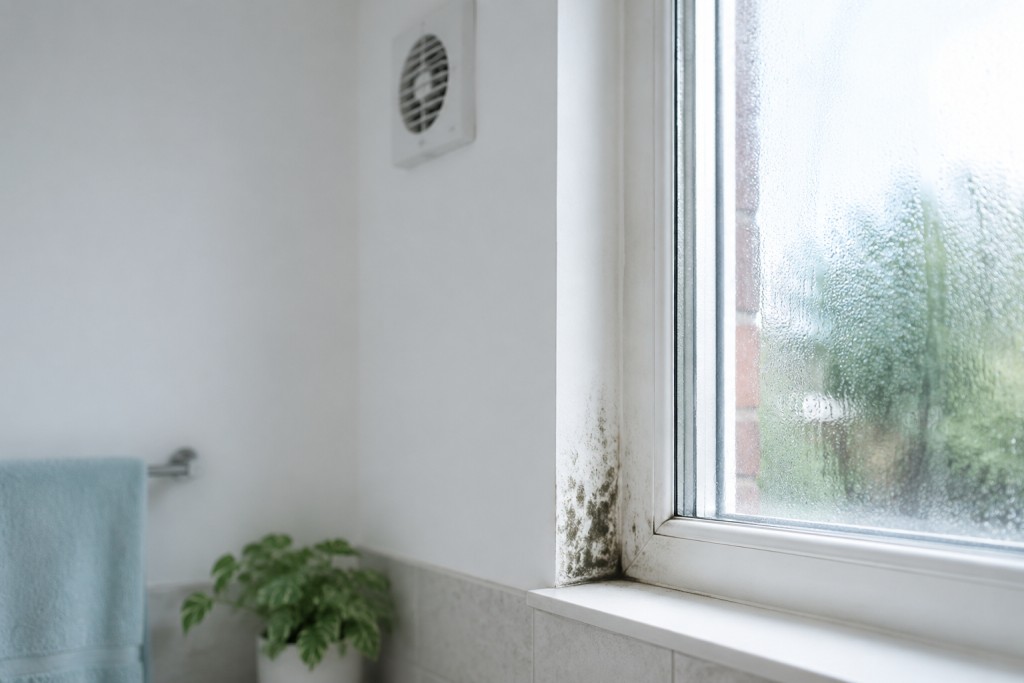
Warm air can contain more water vapour than cold air. When warm, moist air meets a cold window, outside wall or other cold surface, some of that water may condense. This is why dripping windows and mould in cold corners are often most noticeable during winter.
Find the Cause Before Buying a Dehumidifier
Different forms of damp require different solutions.
| Likely problem | Typical clues | What is needed? |
|---|---|---|
| Condensation | Water on windows; mould in corners, behind furniture or on cold outside walls; worse during cold weather or after cooking, showering or drying laundry. | Reduce moisture production, improve ventilation and heating, address cold surfaces and consider a dehumidifier. |
| Penetrating damp or a leak | A localised wet patch, staining, damaged plaster or worsening after rain; possible leaking roof, gutter, pipe or window. | Repair the source of water. A dehumidifier may help the structure dry afterwards but cannot repair the fault. |
| Rising damp | Damp and salts low down on ground-floor or basement walls, sometimes with a visible tide mark. | Professional investigation and appropriate building repair. |
| Construction moisture | A new building, extension, plastering or other recent wet building work. | Time, appropriate heat and ventilation; a suitable dehumidifier may speed drying. |
If water is entering the property, the priority is to stop it. Continuously operating a dehumidifier while a leak remains is like emptying a bath while leaving the tap running.
A dehumidifier does not replace ventilation. It removes water from existing indoor air but does not remove carbon dioxide, cooking pollutants, odours or other contaminants, and it does not bring fresh air into the home.
What Humidity Should I Aim For?
Relative humidity—usually shown as % RH—describes how much water vapour the air contains relative to the maximum it could contain at that temperature.
NHS advice recommends keeping indoor humidity between 40% and 60%. For a home with recurring condensation or for someone trying to reduce conditions favourable to mould, a practical operating target is often around 45–55%.
- Repeatedly above 60%: investigate moisture production, ventilation, heating, cold surfaces and building defects.
- Around 40–55%: a useful practical range for many occupied homes.
- Below 30% for long periods: may be unnecessarily dry and can irritate airways, skin and eyes.
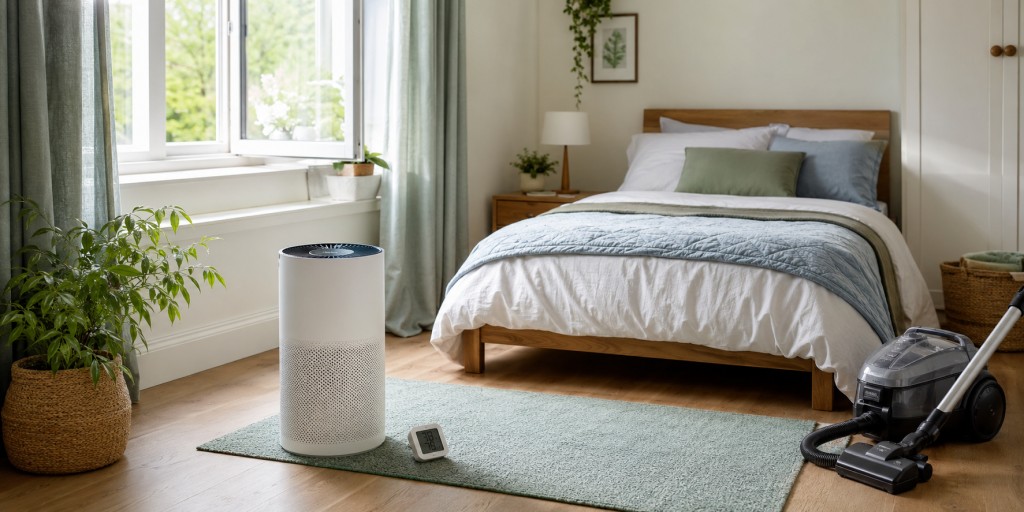
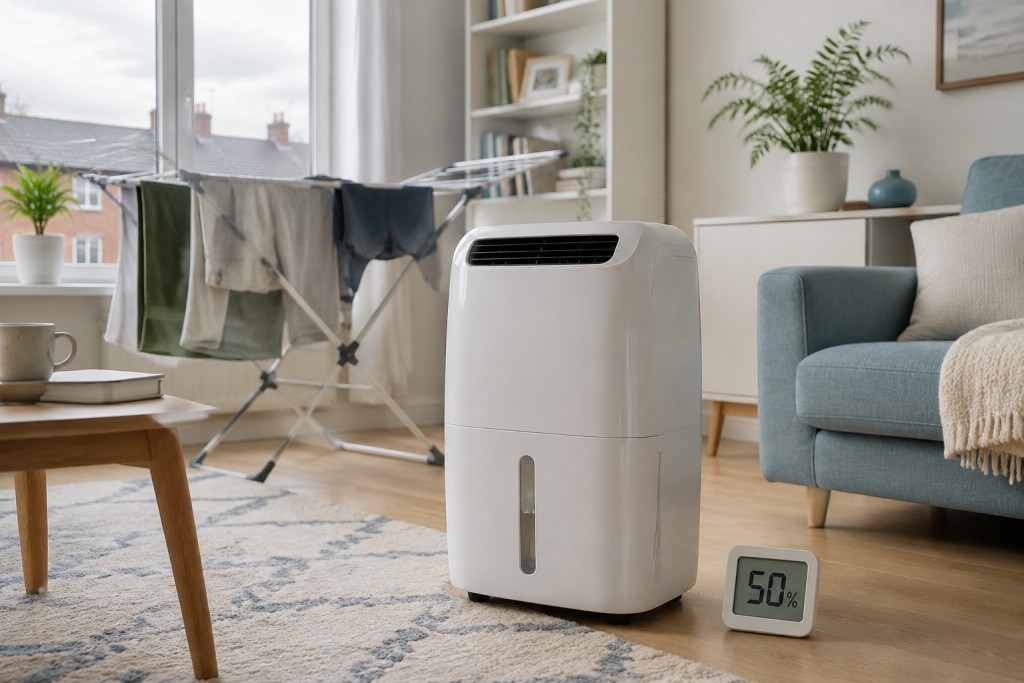
A small digital hygrometer is more useful than guessing. Place it away from radiators, windows, direct sunlight and the dehumidifier’s air outlet. If possible, move it between rooms or use more than one to identify where and when humidity rises.
Remember that relative humidity changes with temperature. A cold wall may still develop surface condensation even when the centre of the room appears acceptable.
When Is a Dehumidifier Helpful?
A dehumidifier may be useful:
- when condensation persists despite reasonable heating and ventilation
- in a basement or other area where effective ventilation is difficult
- while drying laundry indoors, particularly when outdoor drying is impossible
- after a leak or flood has been repaired
- during humid weather when opening windows does not lower indoor humidity
- as a temporary measure while a landlord or contractor investigates the underlying problem
On a dry day, opening windows and using extractor fans may remove moisture more cheaply while also improving air quality. On a very humid day, bringing outdoor air inside may not lower the humidity, so a hygrometer can help you judge what works.
A dehumidifier will not remove mould that is already growing. Existing mould and its underlying moisture source still need to be dealt with safely.
Compressor, Desiccant or Mini Dehumidifier?
| Type | Usually best for | Important limitations |
|---|---|---|
| Compressor or refrigerant | Heated living spaces. These cool humid air so that water condenses into a tank. | Performance falls in colder rooms, and the unit may need to pause for defrosting. Usually heavier and contains refrigerant. |
| Desiccant | Cooler spaces such as an unheated room, garage, boat or conservatory. An absorbent material captures moisture. | Often uses more electricity, although the warm outlet air can be useful in a cold space. |
| Thermoelectric or Peltier mini unit | A very small enclosed space with a minor moisture problem. | Removes far less water than a full-sized unit and is unlikely to control serious room-scale condensation. |
| Disposable moisture absorber | A cupboard, wardrobe or similarly small enclosed space. | Not a substitute for an electric dehumidifier in a damp room or home. The collected liquid also needs careful handling. |
For most normally heated UK bedrooms and living rooms, a compressor model is usually the starting point. A desiccant model may be more effective if the space is consistently cold.
How to Choose a Suitable Model
Do not rely on the advertised litres per day alone
Extraction figures are commonly measured under warm and very humid test conditions. A machine advertised as removing 12 or 20 litres per day will usually collect much less in an ordinary UK home, especially in a cooler room.
Use the manufacturer’s recommended room size as a starting point, but also consider how cold the space is, how severe the moisture problem is and whether you are trying to dry laundry. A very small machine may run continuously without ever reaching the target humidity.
Useful features
- An adjustable humidistat: allows the unit to stop automatically when the chosen RH is reached.
- Automatic restart: useful after a brief power interruption, where appropriate.
- Automatic defrost: important for compressor units used in cooler rooms.
- A washable or replaceable air filter: check how easily it can be removed and cleaned.
- A visible tank and full-tank shut-off: reduces the risk of overflow.
- Continuous drainage: useful if the unit will operate for long periods and a safe drain is available.
- Appropriate noise level: particularly important for a bedroom or shared living space.
- Clear power consumption: compare watts as well as the purchase price.
- Laundry mode: useful, but normally means a higher fan speed and greater noise or electricity use.
Independent comparative testing can be more informative than the headline extraction figure because it may measure performance at both normal room temperature and colder conditions.
How to Use a Dehumidifier Effectively
- Read the manufacturer’s instructions. Required clearances, operating temperatures and drainage arrangements differ between models.
- Place it where air can circulate. Do not cover the inlet or outlet, press it against curtains or furniture, or put laundry directly over it.
- Use the humidistat. Start at approximately 50–55% RH rather than running continuously at the driest possible setting.
- Close windows and outside doors while actively dehumidifying a room. Otherwise, the machine may continually try to dry incoming outdoor air.
- Contain high-moisture activities. When drying laundry, use a suitable room, close its internal door and follow the appliance’s safety instructions.
- Continue to ventilate the home appropriately. Use bathroom and kitchen extractors and trickle vents to remove pollutants and moisture at source.
- Keep the building reasonably and evenly heated. Warmer surfaces are less likely to collect condensation.
- Move the unit only as instructed. Compressor models may need to remain upright for a period after transport before being switched on.
If one unit is being used for several rooms, it is often more effective to treat the worst room with the door closed and then move the unit, rather than expecting a small machine in a hallway to control an entire home.
Cleaning and Preventing Fungal Growth
A dehumidifier deliberately collects water and dust. If neglected, its tank or filter can become dirty and may support microbial growth.
- Empty the tank whenever it is full and do not leave collected water standing unnecessarily.
- Wash and dry the tank at the interval recommended by the manufacturer.
- Clean the air filter regularly—some housing guidance recommends checking it weekly during frequent use.
- Inspect the tank, float, drainage hose and accessible surfaces for slime, deposits or visible growth.
- If using continuous drainage, make sure the hose falls correctly to a suitable drain and cannot develop stagnant loops of water.
- Do not add fragrances, bleach, disinfectants or other chemicals to the tank unless the manufacturer specifically permits this.
- Before storing the machine, clean it and allow the tank and accessible components to dry fully.
For people with aspergillosis or another chronic lung condition: if the machine smells musty, contains visible mould or has inaccessible contamination, avoid running it and blowing air through it. Ask someone else to clean it safely according to the instructions, or seek advice from the manufacturer.
How to Calculate the Running Cost
Electricity prices change, so a fixed “cost per day” quickly becomes inaccurate. You can calculate the approximate cost from the appliance’s power rating:
Power in watts ÷ 1,000 × hours used × your electricity price per kWh
For example, a 300-watt machine used for eight hours consumes up to:
300 ÷ 1,000 × 8 = 2.4 kWh
Multiply 2.4 by the price per kWh shown on your electricity tariff. A humidistat will usually reduce consumption once the target humidity is reached, so actual use may be lower than this maximum calculation.
Compare machines by how much useful water they remove under realistic conditions, not wattage alone. A low-powered but ineffective unit that runs continuously may not be the cheapest option.
What Does This Mean for Someone With Aspergillosis?
Damp and mould are associated with respiratory health problems, and people with existing respiratory disease may be more vulnerable to their effects. Reducing persistent dampness and preventing mould growth is therefore sensible.
However:
- a dehumidifier does not treat aspergillosis
- it does not remove fungal growth already present in a building
- it cannot guarantee that airborne fungal exposure has been eliminated
- there is not enough evidence to promise that buying one will improve an individual patient’s symptoms or prevent a relapse
Its role is practical: controlling excess indoor moisture when that is part of the problem.
People with significant lung disease should avoid personally disturbing large or extensive areas of mould. Dry brushing or sanding can release particles into the air. The moisture source and necessary remediation should be assessed, and appropriate professional help may be needed.
If You Rent Your Home
Do not allow a supplied dehumidifier to become the landlord’s only response to a leaking, structurally damp, poorly insulated or inadequately ventilated property.
Government guidance for England states that landlords should identify and address the underlying causes of damp and mould rather than dismissing the problem as the result of a resident’s “lifestyle”. Report problems in writing, keep photographs and dates, and record any effects on health or damage to belongings.
For social housing in England, the first phase of Awaab’s Law has applied since 27 October 2025 and covers emergency hazards and significant damp-and-mould hazards. Rights and procedures differ elsewhere in the UK and internationally, so use the housing guidance for your location.
A dehumidifier may be a useful temporary safety measure while investigation and repair take place. It should not transfer responsibility for a defective building to the tenant.
Summary
A dehumidifier can reduce excess moisture and condensation when it is correctly sized, correctly used and properly cleaned. Aim for a measured indoor relative humidity of approximately 40–55%, and investigate readings that remain above 60%.
The best long-term solution is always to control moisture at source: repair leaks, use effective extraction and ventilation, avoid unnecessary moisture production, provide appropriate heating and address cold or poorly insulated surfaces.
Control the moisture, but also find out why it is there.
Further Reading and References
- NHS: Condensation, damp and mould
- UK Government: Understanding and addressing the health risks of damp and mould in the home
- Energy Saving Trust: Fixing damp and condensation
- Energy Saving Trust: How to improve your home’s ventilation
- UK Government: Awaab’s Law in the social rented sector
- Which?: How to buy the best dehumidifier
Last reviewed: August 2026.

Did this page help you?
Tell us in one minute