Last reviewed: August 2026
Products described as “anti-allergen”, “allergy friendly” or “air purifying” are widely advertised. Some can reduce particular allergens or airborne particles, but others offer little practical benefit. No household product can completely remove Aspergillus or prevent or treat aspergillosis.
The most useful approach is to identify the source of exposure and deal with that first. An appliance or special cleaning product should support good ventilation, moisture control and appropriate cleaning—not replace them.
Key points
- Choose a product for a specific problem rather than relying on a general “anti-allergy” claim.
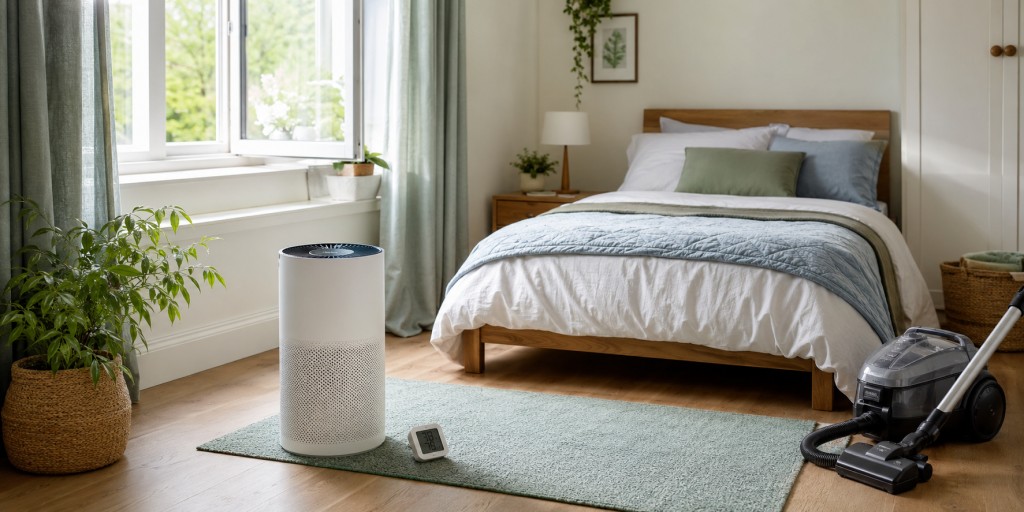
- A properly sized HEPA air cleaner can reduce airborne particles, including some mould spores, but cannot correct dampness or remove mould growing in a building.
- A sealed, high-filtration vacuum cleaner can reduce the amount of dust released while cleaning.
- Allergen-proof bedding is mainly intended for people with house dust mite allergy; it does not protect against aspergillosis.
- Dehumidifiers can help control condensation and humidity, but leaks, defective ventilation and other building problems still need repairing.
- Avoid air cleaners that deliberately generate ozone, and be cautious about ionisers and heavily scented cleaning products.
Start by identifying the problem
Different products are designed for different allergens. House dust mites, pollen, pet dander and mould spores do not behave in exactly the same way, so a product that helps with one may have little effect on another.
If allergy is contributing to asthma, rhinitis or other symptoms, a doctor or allergy specialist may be able to identify relevant sensitivities through the clinical history, skin-prick testing or blood tests. Testing must be interpreted alongside symptoms: a positive allergy test does not always mean that the allergen is causing the person’s current problems.
For people with allergic bronchopulmonary aspergillosis (ABPA) or another fungal allergy, reducing heavy exposure to mould may be sensible. However, it is almost impossible to avoid Aspergillus completely, and environmental measures do not replace prescribed treatment.
HEPA air cleaners
A portable air cleaner containing a genuine high-efficiency particulate air (HEPA) filter can reduce airborne particles passing through it. These may include pollen, pet allergens, fine dust and some airborne mould spores.
Evidence that air cleaners improve allergy or asthma symptoms is less consistent than the evidence that they remove particles. They are most likely to help when:
- there is a clearly identified airborne trigger;
- the cleaner is large enough for the room;
- it moves an adequate volume of air;
- it is operated regularly, rather than occasionally;
- doors and windows are managed appropriately while it is running;
- filters are replaced according to the manufacturer’s instructions.
Look at the recommended room size or clean air delivery rate, noise at a usable fan speed, energy consumption and the cost and availability of replacement filters. Descriptions such as “HEPA-type” or “HEPA-style” do not necessarily demonstrate the same filtration performance as a properly tested HEPA filter.
An air cleaner does not remove carbon dioxide, control most sources of moisture or replace ventilation. It also cannot solve mould growing behind furniture, beneath flooring or within damp building materials.
Avoid appliances that deliberately produce ozone. Air ionisers can also produce ozone and may offer little benefit compared with mechanical filtration. Current UK government guidance on air-cleaning units recommends HEPA filtration rather than ozone generators or ionisers.
Dehumidifiers and humidity monitors
A small digital hygrometer is inexpensive and can show whether indoor humidity is persistently high. Humidity varies during the day and between rooms, so it is the pattern over time that matters.
A dehumidifier may help where excess humidity and condensation are contributing to dampness. As a practical guide, indoor relative humidity is often best kept between about 40% and 60%; people trying to control dust mites may aim for below 50%, provided the air is not made excessively dry.
Empty and clean the water tank regularly and maintain the filter. A neglected dehumidifier can itself become dirty.
A dehumidifier will not repair a leaking roof, defective gutter, plumbing leak, penetrating damp or an inadequate extraction system. Government guidance emphasises that the underlying cause of damp and mould must be identified and corrected; simply cleaning the visible surface is not enough.
See also: Preventing damp in your home and Reducing exposure to mould at home.
High-filtration vacuum cleaners
Vacuuming can temporarily put fine dust and allergens back into the air. A well-sealed vacuum cleaner with effective filtration is therefore preferable to one that leaks air around its casing or dust container.
Useful features include:
- a genuine HEPA or similarly high-efficiency exhaust filter;
- a sealed body so air cannot bypass the filter;
- a bag or dust container that can be emptied without releasing a cloud of dust;
- replacement filters and bags that remain readily available.
If vacuuming triggers symptoms, ask someone else to do it where possible and stay out of the room while dust settles. Damp-dusting hard surfaces can remove dust without spreading as much of it into the air. Cambridge University Hospitals provides further practical advice for people with house dust mite allergy.
Do not vacuum visible mould from walls or porous building materials with an ordinary domestic vacuum cleaner. This can disturb the growth and spread spores.
Allergen-proof bedding
Mattress, duvet and pillow encasements are designed mainly to reduce exposure to house dust mite allergen. They may be worth considering when a person has confirmed dust mite allergy, particularly as part of a wider programme that includes washing suitable bedding and controlling humidity.
Encasements should completely surround the item, have a secure fastening and remain breathable and washable. Covers used alone do not consistently improve asthma symptoms, and they are not a specific measure against Aspergillus.
Cleaning sprays, laundry products and treated fabrics
“Anti-allergen” sprays, carpet treatments and laundry additives should not be assumed to produce a health benefit merely because they reduce an allergen under laboratory conditions. Aerosol sprays, perfumes and volatile chemicals can irritate sensitive airways.
Choose low-odour or fragrance-free products if scents provoke coughing or breathlessness. Follow the instructions, ventilate during and after cleaning, and never mix cleaning chemicals.
Special paints, surface treatments and mould-resistant coatings may help after the moisture source and contaminated material have been dealt with. Painting over active mould or applying repeated sprays without correcting the damp will not solve the problem.
Air conditioning and ventilation
Air-conditioning filters may capture some particles, but units must be maintained and their condensate drainage kept clean. Damp, dirty equipment can become a source of microbial growth. Portable evaporative air coolers are different from refrigerant air conditioners and deliberately add moisture to the air.
Read more: Air-conditioning units and Aspergillus.
What does an approval mark mean?
Independent certification is more useful than an unsupported claim made by a manufacturer. For example, products in the Allergy UK Approved Product Directory have been reviewed or tested against stated criteria.
However, an approval mark does not mean that everyone with allergy or aspergillosis will benefit. Check exactly what was tested: particle filtration, allergen reduction, chemical content or another property. Laboratory performance does not always translate into noticeable symptom improvement in a particular home.
Before spending money
- What allergen or source am I trying to reduce?
- Is there a damp, ventilation or building problem that needs fixing first?
- Is there independent test information for the product’s specific claim?
- Is the appliance adequately sized for the room?
- How much will replacement filters, bags and electricity cost?
- Can the product be cleaned and maintained safely?
- Does it produce ozone, fragrance or other potential airway irritants?
- How will I judge whether it is helping?
If you try a product, change one thing at a time where practical and record symptoms, reliever-inhaler use and any obvious environmental changes. Stop using it if it causes irritation or worsening breathing.
Most important: no anti-allergen product should delay medical assessment, prescribed treatment, repair of a damp building or professional mould remediation when this is needed.

Did this page help you?
Tell us in one minute