
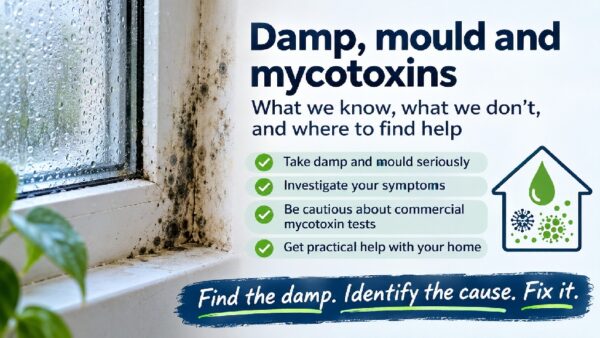
Damp and mould can affect your health. But finding mould in your home does not mean you have been poisoned, and an expensive urine mycotoxin test may not provide the answers you are looking for.
If you have been unwell for a long time, particularly without a clear diagnosis, it is understandable that you might search for explanations. You may have noticed that your symptoms worsen in certain buildings, or encountered alarming information online about toxic mould.
The important message is that damp and mould are genuine health concerns, but many claims about mycotoxin poisoning go further than the scientific evidence supports.
A September 2026 expert review from the American Industrial Hygiene Association (AIHA), Fungal Metabolites in the Indoor Environment, examines what is known about fungal chemicals in buildings and the limitations of tests marketed to people with suspected mould-related illness.
This guide explains the evidence, why doctors may question commercial test results, and what you can do to protect your health.
Should I be frightened of mould in my home?
Searching online for information about household mould can be alarming.
Some websites suggest that ordinary mould exposure causes toxins to accumulate in the body, resulting in permanent damage or a wide range of chronic illnesses.
Finding mould in your home does not mean that you or your family have been poisoned.
There is convincing evidence that damp and mould can affect respiratory health. However, there is not convincing evidence that typical indoor mould exposure routinely causes the widespread systemic mycotoxin poisoning described by some commercial websites.
The colour of mould, including whether it appears black, cannot reliably tell you how dangerous it is.
You should take damp and mould seriously, particularly if someone in your household has respiratory disease, but there is no reason to assume that discovering a patch of mould means you have suffered irreversible harm.
The sensible response is to identify the moisture problem and address it.
Don’t panic about mould. Don’t ignore damp.
What do we know about the health effects of damp and mould?
Scientific studies have established associations between damp or mouldy buildings and several respiratory problems, including:
- Worsening asthma, wheezing and breathlessness.
- Coughing and irritation of the airways.
- Allergic rhinitis and other allergic symptoms.
- An increased risk of some respiratory illnesses.
Fungi release spores and microscopic fragments containing substances that can stimulate the immune system.
These include fungal allergens, beta-glucans and chitin. In susceptible people, exposure can contribute to inflammation and respiratory symptoms.
Damp buildings may also contain bacteria and other biological or chemical substances. Their combined effects are not completely understood.
This is why it can be difficult to identify one particular substance as the cause of someone’s symptoms.
Some people are particularly sensitive to fungal exposure
Not everyone responds to airborne fungi in the same way.
A person without respiratory disease may experience no noticeable symptoms in an environment that causes considerable difficulties for someone with severe asthma or fungal sensitisation.
There are also recognised conditions in which the immune system responds strongly to fungal material.
Allergic bronchopulmonary aspergillosis (ABPA) involves an exaggerated immune response associated with Aspergillus in the airways. It can cause substantial inflammation, mucus plugging and worsening respiratory symptoms.
Severe asthma with fungal sensitisation (SAFS) describes severe asthma associated with sensitisation to fungal allergens.
Hypersensitivity pneumonitis (HP) is an uncommon immune-mediated lung disease triggered by inhaling particular antigens, which can include fungal material. Repeated exposure may cause inflammation deep within the lungs and, in some people, progressive lung damage.
These conditions have different underlying mechanisms, but they illustrate an important principle:
An exposure that causes little difficulty for one person may cause significant illness in another.
They are examples of allergic or other immune-mediated disease, not evidence that mycotoxins have poisoned the person.
Recognising this distinction is important because these conditions can be investigated using established clinical approaches. In HP, identifying and avoiding the responsible antigen can be particularly important.
People with significantly weakened immune systems may also face additional risks from fungal infections.
What are mycotoxins?
Mycotoxins are chemicals produced by certain fungi under particular conditions.
Some mycotoxins are genuinely dangerous. The clearest established human health risks involve contaminated food.
For example, aflatoxins produced by certain fungi on agricultural products can cause serious harm when ingested in sufficient quantities.
But the fact that mycotoxins can be harmful does not mean that mould growing on household walls exposes occupants to dangerous doses of those toxins.
Scientists have detected fungal metabolites in indoor air and dust. Some can have biological effects in laboratory experiments.
However, detecting a substance is not the same as demonstrating that people are exposed to enough of it to cause illness.
The AIHA review concludes that the available evidence does not establish typical indoor mycotoxin exposure as a general explanation for chronic systemic illness in people living or working in damp buildings.
This does not mean that researchers fully understand every effect of indoor fungal exposure. There are still important questions to investigate.
It means that we should distinguish what has been demonstrated from what remains a hypothesis.
Why doesn’t my doctor agree that mycotoxins are making me ill?
Imagine that you have experienced persistent symptoms for months or years.
Medical investigations have not provided a satisfactory explanation. You suspect that your home or workplace is contributing, perhaps because you feel worse there.
You discover a company offering a urine mycotoxin test. The result comes back positive.
At last, it feels as though you have an answer.
But when you show the result to your doctor, they do not accept it as proof of mycotoxin poisoning.
That can be frustrating, especially if you already feel that your concerns have not been heard.
Usually, the disagreement is not about whether you are ill. It is about what the test result actually proves.
There are three different questions:
- Are you experiencing genuine symptoms?
- Could damp or mould exposure be contributing to those symptoms?
- Is there reliable evidence that mycotoxins are causing your particular illness?
The answer to the first question may clearly be yes.
The second is also a reasonable possibility, particularly where respiratory symptoms are involved.
But the third requires evidence that commercially marketed urine mycotoxin tests cannot currently provide.
A positive result may indicate that a substance has been detected. It does not establish where it came from, whether the amount was harmful or whether it caused your symptoms.
Your doctor can believe that you are genuinely unwell while disagreeing with the explanation suggested by a commercial test.
Why commercial urine mycotoxin tests may not help
Some companies market urine mycotoxin tests to people who believe that mould exposure is affecting their health.
These tests may produce detailed reports, numerical measurements and apparently precise results.
However, there are important limitations.
Detection is not diagnosis. Finding a chemical in urine does not establish that it has caused illness.
The source may be uncertain. Some mycotoxins can enter the body through food, so a positive result cannot necessarily be attributed to a damp building.
Accepted diagnostic thresholds are lacking. There are no established urine concentrations that reliably diagnose illness caused by indoor mould exposure.
The test cannot establish causation. It cannot demonstrate that your home or workplace caused your symptoms.
The result may lead to unnecessary expense. Some people are offered costly detoxification programmes, supplements or other interventions based on results that do not establish a medically recognised diagnosis.
It is important to distinguish between a laboratory’s ability to measure a chemical and a test’s ability to diagnose an illness. A measurement may be technically accurate without being clinically useful for the purpose advertised.
Mycotoxin analysis has legitimate applications in research, food safety and exposure monitoring. The concern here is its commercial use to diagnose illness attributed to indoor mould.
The US Centers for Disease Control and Prevention has also warned about the potential for unvalidated urine mycotoxin tests to lead to misleading diagnoses and unnecessary treatment.
Our advice is not to spend money on commercial urine mycotoxin testing as a way of diagnosing illness caused by indoor mould exposure.
What if my symptoms still have no explanation?
Medicine does not have all the answers.
Some people experience persistent symptoms that remain difficult to explain despite appropriate investigations.
The biological effects of complex environmental exposures are still being studied, and there may be interactions between fungal material, bacteria, other substances and individual susceptibility that we do not yet fully understand.
It is reasonable to acknowledge these uncertainties.
However, uncertainty is not proof that a particular explanation is correct.
Fatigue, headaches, difficulty concentrating and other symptoms can have many possible causes. Attributing all of them to mycotoxins could mean that another treatable condition is overlooked.
The most useful approach is to investigate symptoms carefully, consider possible environmental contributors and avoid treatments based on diagnoses that have not been reliably established.
You do not need a positive mycotoxin test for your symptoms to deserve attention.
A practical guide: what can I do if I think damp or mould is making me ill?
1. Keep a record of your symptoms and surroundings
Record what symptoms you experience, when they occur and whether they change in different environments.
You might also record visible dampness, leaks, persistent condensation or strong musty smells.
Photographs of damp patches or water damage may be helpful.
These observations can support a discussion with your healthcare team, although feeling better away from a particular building does not, by itself, prove that mycotoxins caused the illness.
2. Ask your doctor to investigate your symptoms
Rather than asking for a mycotoxin test, explain what you are experiencing and why you suspect your environment may be contributing.
For example:
“I’ve noticed that my breathing and other symptoms seem worse when I spend time in a damp building. Could we investigate whether asthma, allergy or another condition might be contributing?”
Depending on your symptoms and medical history, your doctor may consider appropriate lung function tests, allergy investigations, blood tests, imaging or specialist referral.
Not everyone needs all these investigations. The aim is to identify conditions for which clinically meaningful tests and treatments are available.
3. Consider other possible explanations
Damp and mould may contribute to illness without necessarily explaining every symptom.
Respiratory infections, asthma, allergies and other medical conditions can produce overlapping symptoms.
Considering alternative explanations is not dismissing your experience. It helps ensure that important medical problems are not overlooked.
4. Fix the damp
This is our most important practical message:
Find the damp. Identify the cause. Fix it.
If there is visible mould, persistent dampness or water damage, the underlying moisture problem needs attention.
Possible causes include leaking roofs or pipes, water penetration, inadequate ventilation, poor insulation and persistent condensation.
Cleaning visible mould without addressing the source of moisture may allow it to return.
People with significant respiratory disease or weakened immune systems should avoid personally disturbing extensive mould contamination and seek appropriate help.
You do not need a urine mycotoxin test to justify repairing a damp building.
In England, government guidance makes clear that landlords should not wait for medical evidence before addressing damp and mould.
Read the UK government’s guidance on damp and mould.
5. Get help with housing problems
If you rent your home, report damp and mould to your landlord or housing provider, preferably in writing.
Keep records of your correspondence and photographs of the problem.
If it is not resolved, your local council’s housing or environmental health team may be able to help. The procedures and rights available depend on where you live.
Citizens Advice provides independent guidance about housing problems and tenants’ rights.
6. Be cautious about expensive tests and treatments
Before paying for a test or treatment advertised for mould toxicity, ask:
- Has the test been independently validated for the condition it claims to diagnose?
- Can it distinguish ordinary exposure from exposure that causes illness?
- Can it identify where the exposure occurred?
- Will the result lead to an evidence-based treatment?
- Are the proposed treatments safe and effective?
Be particularly cautious when the same company offers the test, interprets the result and sells the treatment.
A convincing explanation is not necessarily a correct diagnosis.
Where can I find reliable information and support?
For medical symptoms: Your GP or existing specialist team is the appropriate starting point for clinical assessment.
For damp and mould in housing: Use official government guidance, qualified building professionals and independent housing advice.
For aspergillosis: The National Aspergillosis Centre provides patient education and opportunities to connect with others affected by Aspergillus-related disease.
- Aspergillosis.org — patient information and guidance
- Online aspergillosis support meetings
- UK government guidance on damp and mould
- Citizens Advice — independent housing advice
Support groups can help people share experiences and prepare questions for clinicians, but individual medical decisions should be made with qualified healthcare professionals.
The message to remember
Fix the damp. Investigate the symptoms. Don’t pay for answers that a test cannot reliably provide.
Damp and mould can make people ill. Your symptoms deserve investigation, and problems with your home deserve action.
But you do not need to prove that mycotoxins are poisoning you before either concern can be taken seriously.
The best approach is to act on what we know, acknowledge what remains uncertain and avoid allowing frightening claims or expensive, unvalidated tests to distract from practical solutions.
Related articles on aspergillosis.org
We’ve published several other articles exploring mould exposure, fungal toxins and respiratory health. These provide more detail on the science and practical advice.
- Mycotoxins, Mould and Health: What Does Science Say? — Understanding what research tells us about mycotoxins and their health effects.
- Damp, Mould and Health: Be Careful About Unvalidated Tests and Detox Treatments — Why commercial testing and detoxification claims deserve caution.
- Mould, Toxins and Aspergillus: Understanding What’s True and What Isn’t — Separating established evidence from common misconceptions.
- Verified UK Resources for Damp, Mould and Health — Finding reliable advice and practical support.
- Air Quality Hub — Our wider collection of information about air quality and respiratory health.
Further reading and scientific sources
American Industrial Hygiene Association (2026). Fungal Metabolites in the Indoor Environment. An expert review examining fungal metabolites, indoor exposure and the limitations of commercial testing. AIHA white paper. Access may require AIHA membership or purchase.
American Industrial Hygiene Association. FAQs About Fungal Mycotoxins and Damp Indoor Environments. Read the AIHA FAQ.
UK government and UK Health Security Agency. Damp and mould: understanding and addressing the health risks. Read the government guidance.
Kawamoto M, Page E (2015). Use of Unvalidated Urine Mycotoxin Tests for the Clinical Diagnosis of Illness. US Centers for Disease Control and Prevention. Read the CDC report.
This article provides general educational information and does not replace individual medical advice. If you develop severe or rapidly worsening breathing difficulties, seek urgent medical attention.

Did this page help you?
Tell us in one minute