The evidence that damp and mouldy buildings can damage health is now well established.
New research is moving the field forward by measuring the fungi people actually breathe,
examining long-term exposure and mental health, and asking how homes can become more
energy efficient without trapping moisture.
The state of play
Damp and mould are no longer regarded simply as cosmetic housing problems. The
World Health Organization guidelines on indoor dampness and mould
concluded that occupants of damp or mouldy buildings have increased risks of respiratory
symptoms, respiratory infections and worsening asthma.
Since then, large reviews and newer studies have continued to associate damp or mouldy
homes with:
- the development and worsening of asthma;
- wheeze, cough and breathlessness;
- allergic rhinitis and fungal sensitisation;
- respiratory infections, particularly in children;
- hypersensitivity pneumonitis in susceptible people;
- fungal disease in a smaller number of clinically vulnerable people;
- stress, anxiety and poorer mental wellbeing.
These findings describe increased risks across populations. They do not mean that every
person living in a damp home will become ill, or that every symptom occurring in a mouldy
property was necessarily caused by mould.
Nevertheless, the overall evidence is sufficiently strong that public-health advice is to
prevent persistent dampness and remediate mould promptly. Current
UK Government guidance on the health risks of damp and mould
also makes clear that landlords should respond to the presence of damp and mould rather than
waiting for tenants to provide medical proof.
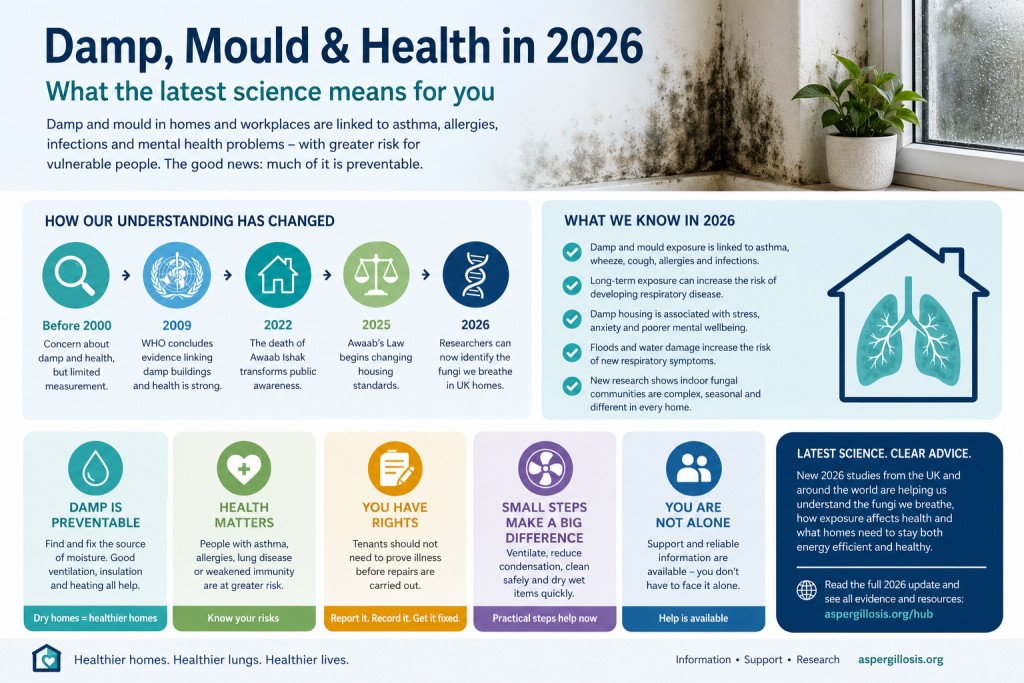
How our understanding has changed
Before 2000: concern but limited measurement
Doctors and housing researchers had long observed that people in damp buildings reported
more respiratory symptoms, but studies used many different definitions of dampness and
mould.
2009: an international evidence benchmark
The WHO reviewed the available evidence and concluded that preventing or minimising
persistent dampness and microbial growth was the most important protective measure.
2010s: stronger epidemiological evidence
Systematic reviews found consistent associations between visible dampness or mould and
asthma, wheeze, cough, respiratory infections and allergic symptoms. A widely cited
review by Mendell and colleagues
helped establish the modern evidence base.
2022–25: damp housing becomes a major UK policy issue
The death of two-year-old Awaab Ishak after prolonged exposure to mould in social housing
transformed public understanding and accelerated legal reform. The first phase of
Awaab’s Law
came into force for social housing in England in October 2025.
2026: measuring the indoor fungal environment
Researchers are now moving beyond questionnaires and visible mould to analyse the mixture
of fungal material present in indoor air. This does not yet provide a routine clinical test,
but it gives a much more detailed picture of exposure.
What has changed in 2026?
Several new papers have added important pieces to the evidence. They do not overturn the
existing consensus. Instead, they begin to answer questions that older research could not.
1. What fungi are people actually breathing inside UK homes?
The most important new UK exposure study was published in The Lancet Microbe by
Samuel Hemmings and colleagues.
The researchers sampled air in 118 West London households, with repeated
sampling across different seasons. They used passive air samplers, DNA sequencing and
quantitative PCR rather than relying only on visible mould or attempting to grow selected
fungi in culture.
Across 262 indoor and outdoor samples, the researchers detected more than
2,000 fungal genera. Indoor fungal communities were significantly richer,
more diverse and more variable between locations than the communities detected at the
outdoor sampling sites. Indoor communities also showed much stronger seasonal cycling.
:contentReference{index=0}
Several medically relevant genera, including Aspergillus,
Penicillium and Wallemia, were enriched indoors. Visible mould was
associated with some of the highest total fungal burdens measured in the study.
:contentReference{index=1}
Read the original open-access paper: Hemmings SJ et al. Diversity analysis of indoor and outdoor fungal bioaerosols in UK households
.
Visible mould was not the whole story
One of the most clinically interesting observations involved a home in which no visible mould
was found. A child living there had uncontrolled asthma, confirmed Aspergillus
allergy and repeated hospital admissions.
The total fungal burden in that home was close to the study median, but
Aspergillus was unusually prominent and its estimated absolute abundance was among
the highest in the study. :contentReference{index=2}
This single household cannot prove that the exposure caused the child’s hospitalisations.
It does, however, show why visual inspection alone cannot describe the full fungal environment
inside a property.
A home can have a potentially important airborne fungal profile even when no large patch of
mould is visible.
What this study does not tell us
This was principally an environmental exposure study, not a clinical trial designed to prove
that particular fungal measurements caused illness.
It does not establish:
- a safe or unsafe numerical threshold for indoor fungal exposure;
- that greater fungal diversity is necessarily harmful;
- that every home should undergo commercial air testing;
- that detecting Aspergillus means someone will develop aspergillosis;
- that one measurement can predict an individual patient’s symptoms.
Its importance is that it establishes a detailed UK baseline and demonstrates methods that
may support better research and surveillance in the future.
2. Long-term exposure and the development of respiratory disease
A second 2026 study examined dampness and mould exposure over approximately 20 years in more
than 8,400 adults participating in the Respiratory Health in Northern Europe
study.
Long-term exposure was associated with the later onset of respiratory symptoms, asthma and
rhinitis. Exposure reported in both the home and workplace appeared more concerning than
exposure in only one setting.
This is important because much of the earlier evidence was based on cross-sectional studies,
which measure housing conditions and health at roughly the same time. Longitudinal research
is better able to establish that exposure occurred before the new health outcome, although it
still cannot remove every possible confounding factor.
3. Damp housing and mental health
The health burden of damp housing is not limited to the lungs. Living with an unresolved
leak, damaged belongings, unpleasant smells, repeated cleaning, disputes over repairs and
fear for a child’s health can be profoundly stressful.
A 2026 analysis published in the American Journal of Epidemiology found an
association between damp housing and psychological distress. The association was stronger
among people who already had a chronic respiratory condition.
This does not establish that inhaled mould directly causes every mental-health effect. Much
of the burden may arise through the combined effects of physical symptoms, housing insecurity,
financial pressure, disrupted sleep, loss of belongings and difficulty obtaining repairs.
4. Flooding and water-damaged buildings
Climate change and more frequent extreme rainfall are increasing interest in the health
consequences of flooded buildings.
A 2026 study in the Journal of Cleaner Production examined new respiratory symptoms
following major flooding. Indoor mould, flood depth, roof condition, ventilation and other
building characteristics emerged as important predictors.
The findings support an established practical principle: after water damage, buildings need
to be dried, assessed and repaired promptly. Simply redecorating a surface while moisture
remains within walls, floors or furnishings may leave the underlying problem unresolved.
5. Can greener and better-insulated homes remain healthy?
Another important 2026 paper approached the problem from building science rather than
medicine.
The open-access review in npj Materials Degradation, part of the Nature Portfolio,
examined the mould susceptibility of bio-based insulation materials used in modern
construction.
Materials made from plant or other biological sources can reduce the environmental impact of
construction. However, because they contain organic material, some can support fungal growth
if they become persistently wet.
The review found that meaningful comparison between products is difficult because laboratory
testing methods vary and do not always reproduce conditions inside real buildings. The authors
called for standardised testing and better long-term evidence from occupied buildings.
Read: Wildman J et al. Mould susceptibility of bio-based insulation materials in modern construction
Energy efficiency and healthy indoor air are not competing goals. Buildings need insulation, moisture control and effective ventilation to be considered together.
What does all of this mean?
The new studies fit together rather than contradicting one another:
- Long-term population studies show that prolonged exposure is associated
with new respiratory disease. - The UK household study shows that indoor fungal communities can differ
greatly from outdoor air and from one home to another. - Mental-health research shows that the consequences extend beyond physical
respiratory symptoms. - Flood research highlights the importance of rapid drying and building repair.
- Building-material research shows that moisture resilience must be included
when homes are insulated or refurbished.
We are therefore moving from a fairly broad conclusion—
damp buildings are associated with poor health—towards more detailed questions:
- Which fungi and other microbial products are present?
- What are their sources?
- How does exposure vary through the year?
- Which people are most susceptible?
- What level and duration of exposure are harmful?
- Which repairs and ventilation interventions produce meaningful health improvements?
Why some people are more vulnerable
Most people inhale fungal spores every day without developing fungal disease. Health effects
depend on the person, the building, the mixture of exposures and the duration of exposure.
Greater caution is appropriate for:
- babies and children;
- people with asthma or severe asthma;
- people sensitised or allergic to fungi;
- people with ABPA;
- people with bronchiectasis, COPD or other chronic lung disease;
- people with CPA or another form of aspergillosis;
- people whose immune system is significantly weakened;
- older people and those with reduced mobility.
For people with asthma, fungal sensitisation or ABPA, exposure may trigger allergic airway
inflammation. In someone with damaged lungs, impaired mucus clearance or substantial immune
suppression, the clinical questions may be different and should be discussed with the
treating team.
Can indoor mould cause aspergillosis?
Aspergillus is common in the wider environment as well as indoors. Detecting it in a
home does not prove that it caused a person’s aspergillosis, and it is usually impossible to
trace an individual infection or allergic response to one particular building.
However, avoiding persistent and unnecessary high exposure is sensible, particularly for
people with fungal allergy, ABPA, damaged lungs or significant immune suppression.
Our guide to reducing exposure to mould and Aspergillus at home
explains practical steps without suggesting that a home can or should be made completely
free of fungal spores.
Should you buy a home mould test?
Routine commercial testing is not normally the first or most useful response to visible damp
or mould.
There are currently no universally accepted health-based numerical limits for total indoor
fungal bioaerosols. A sample may also vary according to the room, season, weather, sampling
method and activity in the home.
A result showing that fungi are present does not by itself establish:
- that the level is dangerous;
- that the fungi caused a particular illness;
- where the moisture is entering the building;
- what repair is required.
Where damp, leaks, condensation or mould are already apparent, the priority is usually a
competent inspection of the building and correction of the moisture source.
What to do if your home is damp or mouldy
- Record the problem. Photograph visible mould, staining, condensation, leaks
and damaged possessions. Record dates, affected rooms and previous reports. - Report it in writing. Tenants should notify their landlord or housing
provider and keep copies of messages and repair reports. - Ask for the underlying cause to be investigated. Possible causes include
plumbing or roof leaks, penetrating or rising damp, inadequate insulation, cold bridges,
defective extraction and insufficient ventilation. - Explain relevant health vulnerabilities. State clearly when a household
member has asthma, chronic lung disease, fungal allergy, aspergillosis, immune suppression
or another condition that may increase risk. - Reduce moisture where reasonably possible. Use working extractor fans,
ventilate after bathing or cooking, avoid blocking air vents and dry wet materials promptly. - Do not accept repeated surface treatment as a permanent repair. Cleaning or
painting may remove visible growth temporarily but will not solve an ongoing moisture defect.
Residents should not be blamed automatically for damp and mould. Everyday activities generate
water vapour, but a healthy building should be capable of managing normal moisture through an
appropriate combination of heating, insulation, extraction and ventilation.
Cleaning mould safely
A small, isolated area of surface mould may sometimes be cleaned after the moisture source has
been corrected. Larger areas, recurrent mould, sewage-contaminated water damage or mould within
porous building materials may require professional assessment.
People with severe asthma, significant fungal allergy, aspergillosis or immune suppression
should avoid carrying out extensive mould removal themselves, because cleaning can release
spores and fragments into the air.
More practical guidance is available in our Housing & Environment Hub
.
When to seek medical advice
Contact your healthcare team when:
- asthma or breathlessness has become more difficult to control;
- you are waking at night because of cough, wheeze or chest tightness;
- you are needing reliever medication more frequently;
- you have recurrent chest infections or worsening sputum production;
- symptoms repeatedly improve away from the building and return after coming home;
- you have aspergillosis, fungal allergy or immune suppression and substantial mould exposure;
- the housing problem is causing serious anxiety, poor sleep or psychological distress.
Severe breathlessness, blue or grey lips, confusion, collapse, marked difficulty speaking or
a rapidly deteriorating asthma attack requires urgent medical help.
What remains uncertain?
Important gaps remain despite the strength of the overall evidence.
- There is no single health-based threshold that defines a safe total indoor fungal count.
- No one test captures all spores, fragments, allergens, microbial compounds and co-exposures.
- The health importance of a fungal genus depends on species, quantity and individual susceptibility.
- Associations observed in populations cannot prove the cause of every individual illness.
- More high-quality intervention studies are needed to establish which repairs deliver the greatest health benefit.
A Cochrane review of remediation in damp and mould-damaged buildings found some evidence that repairs can reduce respiratory symptoms, but also highlighted the limited number and variable quality of intervention studies.
The benchmark conclusion in 2026
The current scientific position can be summarised carefully:
Persistent dampness and mould in homes and workplaces are preventable environmental health
hazards. They are associated with asthma, respiratory symptoms, infections, allergic disease
and psychological distress, with greater concern for people who already have respiratory or
immune vulnerability.
The most important practical intervention remains the same: identify and correct the source of
moisture, dry the building and remove damaged or mould-contaminated material appropriately.
What has changed is our ability to examine exposure. New DNA-based studies show that indoor
fungal communities are complex, seasonal and highly variable between homes. This may eventually
allow better exposure standards and more targeted interventions, but the science is not yet at
the point where a commercial air sample can reliably predict an individual person’s health risk.
Further information and support
- Aspergillosis.org Housing & Environment Hub
- Damp Homes resources from Aspergillosis.org
- Reducing exposure to mould and Aspergillus at home
- Verified UK resources for damp, mould and health
- UK Government: understanding and addressing the health risks of damp and mould
- WHO guidelines for indoor air quality: dampness and mould
Selected evidence
- Hemmings SJ, Varaden D, Barnes J, et al. Diversity analysis of indoor and outdoor
fungal bioaerosols in UK households: a prospective, observational, longitudinal study.
Lancet Microbe. 2026;7:101379.
View the paper. - World Health Organization. WHO Guidelines for Indoor Air Quality: Dampness and
Mould. WHO Regional Office for Europe; 2009.
View the guideline. - Mendell MJ, Mirer AG, Cheung K, Tong M, Douwes J. Respiratory and allergic health
effects of dampness, mould, and dampness-related agents: a review of the epidemiologic
evidence. Environmental Health Perspectives. 2011;119:748–756.
PubMed. - Varga MK, et al. Childhood asthma and mould in homes: a meta-analysis.
Allergy. 2025.
PubMed. - Groot J, et al. Residential mould and dampness and the risk of respiratory tract
infections and respiratory symptoms in children: a systematic review and meta-analysis.
PubMed. - Wang J, Holm M, Dahlman-Höglund A, Janson C, et al. Dampness and mould over 20 years
and new onset of respiratory symptoms, asthma and rhinitis.
Journal of Hazardous Materials. 2026.
View the paper. - Gatto MR, Li A, Martino E, Bentley R. The effect of damp housing on psychological
distress: does respiratory health matter?
American Journal of Epidemiology. 2026;195:1292–1299.
PubMed. - Pakdehi M, Ahmadisharaf E, Suliman AA, Abdelrazig Y. Impacts of major floods on new
human respiratory health symptoms in indoor environments.
Journal of Cleaner Production. 2026;557:148247.
View the paper. - Wildman J, Shea A, Cascione V, et al. Mould susceptibility of bio-based insulation
materials in modern construction. npj Materials Degradation. 2026;10:29.
View the open-access review. - Sauni R, Verbeek JH, Uitti J, Jauhiainen M, Kreiss K, Sigsgaard T. Remediating
buildings damaged by dampness and mould for preventing or reducing respiratory tract
symptoms, infections and asthma. Cochrane Database of Systematic Reviews. 2015.
View the review.

Did this page help you?
Tell us in one minute