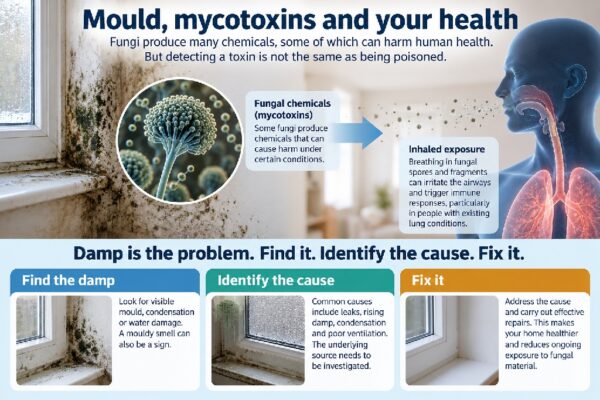
Fungi produce many chemicals, some of which can harm human health. But detecting a toxin is not the same as being poisoned, and living in a damp building does not necessarily mean that fungal toxins are causing illness. What do we actually know?
1. Are fungal toxins real?
Yes. Some fungi produce chemicals that can cause serious illness in humans and animals.
These substances are called mycotoxins.
Certain mycotoxins can damage organs, interfere with normal cell functions and increase the risk of cancer.
These are established biological effects, supported by laboratory research, animal studies and evidence from human exposure.
However, not every fungus produces mycotoxins, and not every substance produced by a fungus is poisonous.
Even when a fungus can produce a toxin, this does not mean that someone encountering that fungus has received a harmful dose.
The important distinction is between a substance being capable of causing harm and someone actually being harmed by it.
2. Why do fungi produce toxins?
Fungi did not evolve to make humans ill.
They evolved in environments where they compete with bacteria, other fungi and many different organisms for nutrients and space.
Some fungal chemicals help them compete, defend themselves or survive difficult conditions.
Others influence the organisms with which they interact.
A chemical that helps a fungus survive may also interfere with human cells, but this does not mean that every encounter with the chemical is dangerous.
Fungi also produce substances that humans have found extremely useful, including antibiotics and medicines that modify immune responses.
The effects depend on the particular substance, the amount present and the biological circumstances.
3. The dose matters
One of the most important principles in toxicology is that the dose makes the poison.
Our bodies encounter potentially harmful substances throughout our lives, including small quantities of naturally occurring chemicals in food.
Fortunately, we have sophisticated systems for metabolising, neutralising and eliminating many of them.
The liver, kidneys, digestive system and other protective mechanisms help prevent ordinary exposures from causing harm.
For many toxins, harmful effects are not expected below certain exposure levels.
However, the picture is not quite that simple.
Some substances can accumulate, while repeated exposure may produce effects that differ from those of a single exposure. Certain DNA-damaging carcinogens, including aflatoxin B1, cannot confidently be assigned an entirely risk-free threshold.
Individual susceptibility also matters.
The consequences of exposure depend on:
- Dose: How much of the substance enters the body.
- Duration: Whether exposure occurs once or repeatedly.
- Route: Whether it is swallowed, inhaled or absorbed through another route.
- Biological effects: What the substance does to particular cells or tissues.
- Individual susceptibility: Factors such as age, existing illness and the body’s ability to process the substance.
This is why detecting a potentially harmful chemical does not automatically mean that someone has been poisoned.
Exposure is not the same as harmful exposure.
4. What have we learned from toxins in food?
Food contamination provides some of the strongest evidence about mycotoxins and human health.
Certain fungi can grow on crops such as cereals, nuts, spices and dried fruits, particularly when growing or storage conditions favour fungal development.
Some produce toxins that remain in food even after the fungus has stopped growing.
Aflatoxins provide one of the clearest examples of mycotoxins that can harm human health.
Produced by certain Aspergillus species, they can contaminate crops such as maize, groundnuts and tree nuts. Very high exposure over a short period can cause serious liver damage, while repeated exposure over many years can increase the risk of liver cancer.
This is a significant public-health concern in some parts of the world, particularly where warm, humid conditions and inadequate food storage allow contamination to develop.
In the UK, however, the risk is generally well controlled. Food safety regulations limit permitted contamination, and higher-risk imported products are subject to additional checks.
This illustrates an important distinction: aflatoxins are genuinely dangerous substances, but that does not mean ordinary consumption of regulated food presents a high risk.
Indeed, the fact that most people rarely hear about aflatoxins reflects, in part, the food safety measures designed to keep exposure low.
Other important food-associated mycotoxins include ochratoxin A, fumonisins and trichothecenes.
These compounds differ in their toxicity and the organs they affect.
Food safety authorities have investigated dietary mycotoxin exposure extensively. For some toxins, this research supports health-based exposure limits. For others, particularly certain carcinogens, authorities aim to keep exposure as low as reasonably achievable.
Research into repeated low-level dietary exposure continues, including possible combined effects of different toxins.
Nevertheless, we understand considerably more about the risks of several mycotoxins in food than we do about their effects when inhaled in ordinary indoor environments.
The fact that a mycotoxin can cause harm when swallowed at a particular dose does not establish that inhaling it in a damp building will cause the same illness.
So what do we actually know about inhaling fungal toxins?
5. What happens when we inhale fungal material?
We inhale fungal spores and other microscopic biological particles throughout our lives.
Most encounters cause no illness.
Our airways possess protective mechanisms, including mucus clearance, immune surveillance and cells capable of recognising and removing microorganisms.
Fungal material can nevertheless affect respiratory health.
Some people develop allergic responses to fungal allergens. Others may experience airway irritation or inflammation. People with particular underlying conditions can develop fungal infections.
These effects do not necessarily involve mycotoxins.
For example, allergic bronchopulmonary aspergillosis (ABPA) involves an exaggerated immune response to Aspergillus associated with the airways.
Chronic pulmonary aspergillosis (CPA) involves persistent fungal disease, often in previously damaged lungs.
Neither condition is adequately explained simply as mycotoxin poisoning.
What about inhaled mycotoxins?
Some mycotoxins can be carried through the air on fungal particles or dust and may be inhaled.
However, the presence of a toxin does not mean that a harmful dose has entered the body.
Much of what we know about mycotoxin toxicity comes from studies involving contaminated food or controlled laboratory experiments.
These experiments do not establish that people living in damp homes inhale sufficient quantities of mycotoxins to produce the same harmful effects.
Research has demonstrated that some mycotoxins can affect lung cells and immune responses under experimental conditions.
But there is no convincing evidence that systemic mycotoxin poisoning is a common cause of illness in people living in damp buildings.
This does not mean that damp buildings are harmless. Quite the opposite: their association with respiratory illness is well established.
However, those health effects can involve fungal allergens, other biological particles, airway irritation and several interacting environmental factors. They do not require systemic mycotoxin poisoning as an explanation.
The practical conclusion is straightforward: damp buildings can be unhealthy, but describing their occupants as suffering from mycotoxin poisoning goes beyond what has been demonstrated.
6. What about gliotoxin and aspergillosis?
Gliotoxin is a particularly interesting substance produced by Aspergillus fumigatus and certain other fungi.
Laboratory experiments have shown that gliotoxin can interfere with immune-cell activity, including the functions of macrophages and neutrophils.
Experimental studies also indicate that gliotoxin can contribute to fungal virulence under some conditions.
These are genuine scientific findings.
There is also evidence that gliotoxin can be produced during some fungal infections.
However, a different question is whether gliotoxin causes particular symptoms in people with aspergillosis.
For example, fatigue, muscle pain and a general feeling of being unwell are experienced by some people with ABPA or CPA.
Although gliotoxin has demonstrated biological effects, there is currently no established clinical evidence that it is responsible for the fatigue, muscle pain or general ill health experienced by people with ABPA or CPA.
These symptoms deserve proper investigation, including consideration of the underlying disease, inflammation, medication effects and other possible causes.
A demonstrated effect on immune cells is not automatically a demonstrated cause of symptoms in patients.
7. Why are damp buildings associated with illness?
Damp buildings are associated with increased respiratory symptoms, asthma exacerbations and other respiratory health problems.
This is supported by substantial research.
But a damp building is not simply a building containing mould.
Moisture can encourage the growth of fungi and bacteria, increase populations of house dust mites and affect the release of chemicals from building materials.
Occupants may encounter mixtures of fungal spores, allergens, bacterial components, particles and other substances.
Humidity and ventilation can also influence the behaviour and transmission of some respiratory viruses, although viruses do not simply multiply in damp walls.
These different exposures may interact, and their effects can depend on an individual’s respiratory health and immune responses.
Researchers have investigated damp buildings for many years and have consistently identified respiratory health risks.
What has proved more difficult is determining exactly which components, or combinations of components, are responsible for every observed effect.
This is a genuine area of uncertainty.
We know that damp buildings can be unhealthy. We do not need to identify one particular fungus, bacterium or toxin to recognise that problem.
8. Damp is the problem. Fix the damp.
This is the most important practical message.
Damp is bad for buildings and can be bad for health. When damp is found, identify its cause and put it right.
There is no need to wait for mycotoxin testing or to establish exactly which microorganisms are present before taking action.
Homes vary enormously.
In the UK, we live in everything from modern, highly insulated houses to stone cottages that are hundreds of years old.
A solution that works in one type of building may be inappropriate in another.
Damp may arise from leaking roofs or plumbing, penetrating rain, condensation, inadequate ventilation, defective construction or other moisture problems.
Heating, ventilation, insulation, maintenance and how we use our homes all influence moisture levels.
The correct response is to understand the building and the cause of the problem.
For example, improving ventilation may help with condensation, but it will not repair a leaking roof. Equally, a building defect cannot reasonably be blamed on the occupant’s everyday activities.
Cleaning visible mould without correcting the underlying moisture problem may provide only temporary relief. For advice on investigating moisture sources, the limitations of air testing and choosing appropriate repairs, see our practical guide to damp, mould and aspergillosis.
The aim is to maintain a healthy indoor environment through appropriate building maintenance and moisture management.
People experiencing respiratory symptoms should also receive suitable medical assessment.
Fixing the damp and investigating someone’s illness are complementary actions. Neither needs to wait for the other.
What if you rent your home?
Tenants may recognise a damp problem but have limited control over the repairs needed to correct it. A medical diagnosis or treatment cannot substitute for making the home safe, and a tenant should not have to prove that a particular toxin caused an illness before reporting damp or mould.
In England, Awaab’s Law has required social housing landlords, since October 2025, to investigate significant damp and mould hazards within 10 working days and make them safe within five working days after the investigation, subject to the detailed rules. Emergency hazards have shorter deadlines. These particular deadlines do not yet apply to all private rentals; other housing safety and repair duties apply. Rules differ across the four UK nations.
Landlords should investigate the actual cause of damp. Government guidance warns against automatically blaming a tenant’s “lifestyle”: everyday activities such as cooking, bathing and drying clothes inevitably produce moisture. Buildings must be maintained and managed accordingly.
How can tenants show that their home has a damp problem?
You do not need to pay for mycotoxin tests, buy specialist humidity equipment or obtain a medical certificate before reporting a damp problem.
- Take dated photographs of mould, water staining, condensation, damaged plaster or recurring damp patches, and note any musty smell or leaks.
- Report the problem in writing to your landlord or managing agent. Keep messages, photographs and records of previous repairs or recurring problems.
- Explain if anyone in the home has asthma, lung disease or another vulnerability, so the landlord can assess urgency. Medical records may help document health needs but do not ordinarily need to prove the cause of illness before the building is investigated.
- Ask for the source of moisture to be identified and repaired, not simply for visible mould to be painted over.
- If the landlord does not act, seek help from your local council’s housing or environmental health team. Social housing tenants can also use their landlord’s complaints process and the Housing Ombudsman.
A specialist building assessment may sometimes be necessary, particularly for hidden or complicated defects, but tenants should not ordinarily have to commission one themselves just to report the problem.
For more detailed UK advice, see our guide to damp, mould and aspergillosis in rented homes and verified UK damp and mould resources. External support includes Shelter, Citizens Advice and the Housing Ombudsman.
The evidence needed to get damp investigated is not the same as the evidence that might be required to prove that it caused a particular illness in a compensation claim.
9. What if someone is ill and believes their home is responsible?
This situation deserves careful attention.
Someone may develop persistent cough, wheeze, breathlessness, fatigue, headaches or other symptoms while living in a damp property.
Their symptoms may be genuine, and the building may be unhealthy.
But that does not automatically establish that every symptom is caused by mould, or specifically by mycotoxins.
Respiratory symptoms may be associated with dampness, fungal allergy, asthma or other recognised conditions.
More general symptoms, such as fatigue and muscle pain, can have many causes.
These deserve proper investigation rather than being attributed automatically to a single environmental exposure.
For clinicians, the practical approach is to take the patient’s housing concerns seriously, investigate their symptoms using established medical methods and encourage correction of the damp.
For patients, the message is equally important: you do not have to prove mycotoxin poisoning to justify dealing with unhealthy housing.
What does NICE recommend?
The UK’s National Institute for Health and Care Excellence (NICE) recognises that indoor air pollutants, including damp and mould, can affect respiratory health.
Its guideline NG149: Indoor air quality at home encourages healthcare professionals to consider housing conditions when assessing relevant respiratory symptoms and to support action to improve indoor air quality.
This approach does not depend on diagnosing a proposed systemic toxin-related syndrome.
The priority is to address the environmental problem and provide appropriate medical care.
10. Can commercial mycotoxin tests tell us whether someone is ill?
Some laboratories can measure mycotoxins or their breakdown products in biological samples, including urine.
Such measurements can be valuable in research and particular exposure investigations.
However, detecting a mycotoxin does not necessarily identify its source or establish that it is causing illness.
For example, low-level dietary exposure can result in detectable mycotoxin metabolites.
Commercial urine mycotoxin tests marketed to diagnose illness from indoor mould exposure have not been validated for that clinical purpose.
There are no generally accepted urinary thresholds that reliably distinguish people suffering from systemic illness caused by indoor mould from those who are not.
This is important because a laboratory can accurately measure a substance without the result having a validated clinical interpretation.
A technically genuine result can therefore be misleading when presented as proof of a particular diagnosis.
Patients should be cautious about paying for tests that claim to identify the cause of complex symptoms without convincing evidence that they can do so.
11. What is Chronic Inflammatory Response Syndrome (CIRS)?
Some clinicians, particularly in the United States, use the term Chronic Inflammatory Response Syndrome (CIRS) to describe persistent symptoms such as fatigue, pain, difficulties concentrating and general ill health, sometimes attributing them to exposure in water-damaged buildings.
Clinicians and researchers who support CIRS have proposed diagnostic criteria, biological mechanisms and treatment programmes, including the Shoemaker Protocol. Some published reports describe improvement among patients receiving these interventions.
However, mould-related CIRS has not been established as a reliably validated clinical diagnosis through independent evaluation. The available evidence also does not establish, through robust independent controlled trials, that these protocols are effective for the proposed condition or that their suggested toxin-related mechanisms explain any benefit.
This distinction matters. A person may genuinely improve during treatment without that improvement proving the original diagnosis or the explanation offered for their illness. Some elements of a programme might help an individual for other reasons, including treatment of a recognised condition or improvements in their living environment.
The American Academy of Allergy, Asthma & Immunology and the American College of Medical Toxicology have reviewed claims concerning systemic illness from inhaled indoor mould toxins and raised concerns about unsupported diagnostic tests and toxin-removal treatments.
This does not mean that people given a CIRS diagnosis are not genuinely ill, or that no component of a treatment programme could benefit an individual. It means that claims about diagnosis, effectiveness and mechanisms should be distinguished and assessed against reliable evidence. Patients deserve a clear explanation of uncertainties, potential adverse effects and costs.
Can treatment replace dealing with damp?
No medical programme has been shown to make continued exposure to a damp, unhealthy home safe. Even if symptoms improve, the underlying moisture problem remains until its cause is corrected.
For people unable to move or persuade a landlord to carry out repairs, this may be especially difficult. They need practical housing support as well as appropriate medical care, not an assumption that treatment alone can solve an environmental problem.
Treating someone’s symptoms and making their home healthier are separate responsibilities. Neither replaces the other.
12. What have researchers investigated, and what remains uncertain?
When discussing medical evidence, wording matters.
Saying there is insufficient evidence can give the impression that researchers have barely looked at a question.
Sometimes that is true. But sometimes research has been undertaken and has failed to demonstrate the claimed effect.
We should distinguish these situations.
What is well established?
- Some mycotoxins cause serious illness, particularly through contaminated food.
- The harmful effects of several dietary mycotoxins depend on dose, duration and individual susceptibility.
- Fungal substances can influence immune responses.
- Damp buildings are associated with adverse respiratory health effects.
- Fungal allergy and infection are recognised medical conditions with established diagnostic and treatment approaches.
What has been investigated without convincing clinical support?
- The claim that ordinary indoor mould exposure routinely causes widespread systemic illness through circulating mycotoxins.
- The use of commercial urine mycotoxin tests to diagnose illness attributed to damp buildings.
- The use of proposed CIRS testing and toxin-removal treatments as established clinical practice.
Professional reviews have examined these claims and have not found convincing evidence to support their routine clinical application.
What remains genuinely uncertain?
- The precise contribution of individual microbial substances to the health effects of damp buildings.
- How combinations of fungal, bacterial and other environmental exposures interact.
- The consequences of particular chronic, low-level inhaled mycotoxin exposures under real-world conditions.
- Whether particular fungal metabolites contribute to specific symptoms or disease processes in some patients with aspergillosis.
These questions are legitimate subjects for research.
But uncertainty about a possible mechanism is not evidence that the mechanism is causing an illness.
We should not confuse what is possible, what has been investigated and what has actually been demonstrated.
13. What should people remember?
Fungi produce many substances, some of which can be harmful.
Mycotoxin poisoning is real, and the health consequences of certain dietary exposures are well established.
But the presence of mould does not establish that harmful quantities of mycotoxins are entering someone’s body.
Nor does a positive commercial test necessarily explain their symptoms.
Damp buildings can affect health through several different mechanisms, many of which do not require mycotoxin poisoning.
People who are unwell deserve proper medical investigation, and those living in damp homes deserve action to improve their environment.
The practical message is straightforward:
Find the damp. Identify the cause. Fix it.
You do not need to establish which microorganism or chemical is responsible before doing so.
And when someone proposes a particular diagnosis or expensive treatment, it is reasonable to ask what evidence demonstrates that the diagnosis is valid and that the treatment works.
Understanding fungal toxins helps us make better decisions, but we should not allow uncertainty about toxins to distract us from established health risks and practical solutions.
Part of our series: Understanding Fungi and Human Health
This article follows Fungus: Friend or Foe?, which explored how the immune system maintains a balance between tolerating fungi, controlling infection and preventing harmful inflammation.
Together, the articles explain why fungal exposure does not automatically mean fungal disease, and why the biological activity of a fungal substance does not automatically establish that it causes illness.
Future articles will examine fungal colonisation, infection, immune evasion and the ways fungi interact with our defences.
References and further reading
- World Health Organization. WHO Guidelines for Indoor Air Quality: Dampness and Mould (2009). https://www.ncbi.nlm.nih.gov/books/NBK143943/
- World Health Organization. Mycotoxins. https://www.who.int/news-room/fact-sheets/detail/mycotoxins
- European Food Safety Authority. Mycotoxins. https://www.efsa.europa.eu/en/topics/topic/mycotoxins
- NICE. Indoor air quality at home, guideline NG149 (2020). https://www.nice.org.uk/guidance/ng149/chapter/Recommendations
- UK Government. Understanding and addressing the health risks of damp and mould in the home. https://www.gov.uk/government/publications/damp-and-mould-understanding-and-addressing-the-health-risks-for-rented-housing-providers
- CDC. Use of Unvalidated Urine Mycotoxin Tests for the Clinical Diagnosis of Illness — United States, 2014. https://www.cdc.gov/mmwr/preview/mmwrhtml/mm6406a7.htm
- Medical clinical diagnostics for indoor mould exposure — update 2023. https://pmc.ncbi.nlm.nih.gov/articles/PMC11097193/
- Scharf DH and colleagues. Biosynthesis and function of gliotoxin in Aspergillus fumigatus (2012). https://doi.org/10.1007/s00253-011-3689-1
Access Options
- American College of Medical Toxicology. Medical Toxicology Considerations in the Diagnosis and Treatment of Patients with Concerns About Mold-Related Inhalation Exposures (2025). https://www.acmt.net/news/acmt-position-statement-medical-toxicology-considerations-in-thediagnosis-and-treatment-of-patients-with-concerns-aboutmold-related-inhalation-exposures/
- American Academy of Allergy, Asthma & Immunology. Toxic Mold Syndrome: Separating Fact from Fiction. https://www.aaaai.org/tools-for-the-public/conditions-library/allergies/toxic-mold
- UK Government. Awaab’s Law: Guidance for tenants in social housing (England). https://www.gov.uk/government/publications/awaabs-law-guidance-for-tenants-in-social-housing/awaabs-law-guidance-for-tenants-in-social-housing
- Shelter England. Damp and mould in rented homes. https://england.shelter.org.uk/housing_advice/repairs/damp_and_mould_in_rented_homes
This article provides general educational information and is not a substitute for individual medical advice.

Did this page help you?
Tell us in one minute