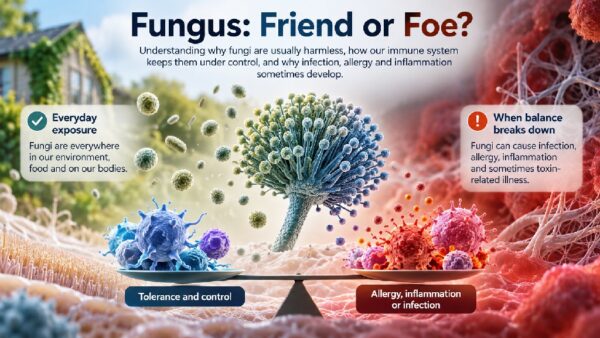
Understanding why fungi are usually harmless, how our immune system keeps them under control, and why infection, allergy and inflammation sometimes develop.
A fungus can be harmless in one person and potentially deadly in another.
Yet our immune system does not attempt to destroy every fungus it encounters.
Why not?
Because staying healthy involves more than killing microorganisms. Our bodies must control potential threats while avoiding unnecessary inflammation and damage to our own tissues.
Fungi are everywhere. We breathe in their spores, encounter them in food and the environment, and carry some fungi naturally on and within our bodies.
Most of these encounters cause no illness.
The relationship between humans and fungi is therefore a balancing act. Sometimes that balance breaks down because fungal growth escapes control. Sometimes the immune system responds too strongly or inappropriately. And sometimes both happen together.
Understanding this relationship helps explain why fungi can cause such different diseases—and why fungal infection, allergy, inflammation and toxin exposure must not be confused.
1. Why don’t we eliminate every fungus?
Our bodies are home to communities of microorganisms, including bacteria and fungi. Together, these form part of the human microbiome.
For example, Candida species commonly live in the mouth, digestive tract and vagina without causing symptoms.
Their presence does not necessarily mean that a person has an infection.
Several mechanisms help maintain this relationship:
- Physical barriers: Healthy skin and the lining of our airways and digestive tract prevent fungi from entering deeper tissues.
- Immune surveillance: Immune cells recognise and control fungi, often without producing noticeable inflammation.
- Competition from other microorganisms: Bacteria and other members of the microbiome compete with fungi for nutrients and space.
- Local environmental conditions: Temperature, acidity, nutrients and other factors influence whether fungi can grow or cause damage.
These mechanisms are supported by extensive experimental and clinical research.
For example, antibiotic treatment can disturb the normal bacterial microbiome, sometimes allowing Candida to multiply and cause thrush.
The fungus may already have been present. What changed was the environment that had previously kept it under control.
But this does not mean that every fungus living within us is beneficial or essential.
We have no convincing evidence, for example, that retaining Aspergillus fumigatus in the lungs provides a health benefit.
The important principle is that our immune system has evolved to maintain health in a world full of microorganisms, not to sterilise the human body.
2. The immune system: control without unnecessary damage
Our immune system must perform a difficult balancing act.
It needs to recognise and control potentially harmful organisms without producing an inflammatory response that damages our own tissues.
This involves both immune defence and immune regulation.
Immune defence allows the body to recognise and attack organisms that pose a threat.
Immune regulation helps limit unnecessary or excessive responses, particularly when an organism or substance is not causing harm.
This ability to avoid inappropriate immune responses is sometimes called immune tolerance.
Tolerance does not necessarily mean that the immune system is weak or unable to recognise a fungus. It can involve active processes that prevent harmful inflammation.
Why is this important?
Because immune responses themselves have costs. They consume energy, can damage tissues and may disturb otherwise stable relationships with microorganisms.
A healthy immune response is therefore not simply the strongest possible response.
It is the right response, in the right place, at the right time.
3. What happens when immune defences are insufficient?
Some fungi become dangerous when particular immune defences are weakened or ineffective.
Aspergillus fumigatus provides an important example.
Its microscopic airborne spores are regularly inhaled. In healthy lungs, mucus clearance and immune cells usually remove them before they establish persistent growth.
However, people with severely reduced neutrophil numbers, impaired immune-cell function or certain forms of immunosuppression are at increased risk of invasive aspergillosis.
In invasive aspergillosis, fungal hyphae invade living tissues and sometimes blood vessels.
This demonstrates that particular immune mechanisms are essential for controlling Aspergillus.
But not every form of aspergillosis results from general immune weakness.
In chronic pulmonary aspergillosis (CPA), existing lung damage, cavities and impaired local clearance can allow fungal growth to persist, even when a person does not have severe systemic immunosuppression.
The problem may be local conditions that favour fungal growth, rather than a generally weak immune system.
4. What happens when the immune system responds too strongly?
Fungi can also cause illness when the immune system reacts excessively or inappropriately to fungal substances.
Allergic bronchopulmonary aspergillosis (ABPA) is a particularly clear example.
In ABPA, an exaggerated allergic response to Aspergillus associated with the airways contributes to inflammation, mucus production, mucus plugging and sometimes lasting lung damage.
The fungus does not need to invade lung tissue to cause these effects.
Instead, much of the damage results from the body’s response to fungal allergens.
Fungal allergy can also contribute to certain forms of asthma and fungal rhinosinusitis.
This is why allergic disease is not simply another form of fungal infection.
The underlying mechanisms—and therefore the treatments—can be different.
5. Can excessive inflammation and poor fungal control occur together?
Yes, and this is particularly important in aspergillosis.
Someone may have an exaggerated allergic response to Aspergillus while also having difficulty clearing the fungus from their airways.
In ABPA, fungal persistence and allergic inflammation may reinforce one another.
The immune system is not simply too strong or too weak. Different immune pathways may be behaving differently.
CPA provides another example of complexity.
Persistent fungal growth, existing lung damage and chronic inflammation can all contribute to disease.
These interactions help explain why treatment sometimes combines antifungal medicines with treatments that modify inflammation.
Antifungal medicines aim to reduce or eliminate fungal growth. Corticosteroids and certain biologic treatments act on particular inflammatory pathways.
The objective is to control the disease process, not simply to stimulate or suppress the entire immune system.
6. How does the immune system recognise fungi?
Immune cells recognise fungi partly through substances found in fungal cell walls.
These include:
- Beta-glucans: carbohydrates recognised by receptors involved in innate immunity.
- Chitin: a structural component that can influence immune responses.
- Mannans: carbohydrates involved in interactions between fungal cells and the immune system.
These substances are not normally classified as mycotoxins.
Their biological importance comes largely from how the immune system recognises and responds to them.
Recognition can trigger inflammation, recruit immune cells and help control fungal growth.
This is usually protective.
However, persistent or poorly regulated inflammation may also damage surrounding tissues.
In chronic lung disease, fungal activity and the immune response can continue to influence one another over long periods.
7. How can fungi influence our immune responses?
Fungi do not simply wait to be attacked.
They possess characteristics that help them survive environmental stresses and interact with other organisms, including humans.
Some produce enzymes that break down proteins and other materials.
Certain fungal proteases can affect the protective lining of the airways and stimulate inflammatory responses.
Other fungal substances can influence immune recognition or help fungi resist attack by immune cells.
For example, Aspergillus fumigatus spores possess surface structures that can reduce their recognition by immune cells.
Melanin helps protect spores against some damaging conditions, while fungal enzymes and metabolites can influence interactions with the immune system.
Experimental research has demonstrated several of these mechanisms.
However, a substance affecting immune cells in a laboratory does not automatically establish that it causes particular symptoms in patients.
That distinction becomes especially important when considering fungal toxins.
8. What are mycotoxins, and how are they different?
Some fungi produce specialised chemicals known as secondary metabolites.
A subset of these compounds are called mycotoxins because they can cause toxic effects in humans or animals under particular conditions.
Examples include:
- Aflatoxins, produced by certain Aspergillus species. Exposure through contaminated food is a well-established human health concern, including an increased risk of liver cancer.
- Ochratoxin A, which can contaminate food and has demonstrated toxic effects in experimental systems.
- Trichothecenes, a family of toxins produced by several fungi, particularly certain Fusarium species.
- Gliotoxin, produced by Aspergillus fumigatus and some other fungi, which can interfere with immune-cell functions.
These substances differ considerably in their chemistry, effects and routes of exposure.
It is important to distinguish three questions:
- Can a fungus produce a particular toxin?
- Does it produce that toxin in the human body, and at what concentration?
- Has the toxin been demonstrated to cause a particular clinical effect in patients?
An answer to the first question does not establish the answers to the other two.
What do we know about gliotoxin?
Gliotoxin is particularly interesting in aspergillosis research.
Laboratory studies have demonstrated that it can alter immune-cell activity, including functions of macrophages and neutrophils.
Experimental studies also indicate that gliotoxin can contribute to the virulence of A. fumigatus under certain conditions.
These are genuine biological findings.
However, researchers have not demonstrated that gliotoxin causes widespread muscle pain, fatigue or similar systemic symptoms in people with ABPA or CPA.
Such symptoms should not automatically be attributed to mycotoxin exposure.
We will examine gliotoxin and other mycotoxins in greater detail in the next article in this series.
9. What about damp buildings and mould exposure?
Damp and mouldy buildings are associated with increased respiratory symptoms, asthma exacerbations and other respiratory health problems.
These associations are supported by substantial epidemiological evidence.
However, damp indoor environments contain more than fungal toxins.
They may include fungal spores, fragments, allergens, bacteria, dust mites and various chemical substances.
Some fungi found in buildings can produce mycotoxins under suitable conditions.
But finding a potentially toxin-producing fungus does not demonstrate that occupants have experienced harmful toxin exposure.
Claims that chronic, widespread symptoms are routinely caused by mycotoxins circulating in the body after ordinary indoor mould exposure have not been convincingly established by clinical research.
This does not diminish the established respiratory health risks of damp and mould.
Damp and mould should be addressed because they are recognised environmental health hazards, not because every proposed explanation of their effects has been demonstrated.
10. Can fungal disease affect the whole body?
People living with chronic fungal lung disease may experience symptoms beyond cough and breathlessness.
Fatigue, reduced exercise tolerance and a general feeling of being unwell can have a substantial impact on daily life.
Some people also report muscle or joint pain.
Several mechanisms may contribute, including chronic inflammation, respiratory impairment, disturbed sleep, reduced activity, medication adverse effects and other medical conditions.
Invasive fungal infections can also produce serious systemic illness, particularly when infection spreads beyond the lungs.
However, there is currently no convincing clinical evidence that circulating mycotoxins are a routine explanation for widespread pain or fatigue in people with ABPA or CPA.
It is important to investigate these symptoms rather than assume they have a single fungal cause.
11. How do we know whether a fungal substance causes disease?
Scientific research often begins by identifying something a fungus can do.
For example, researchers may discover that a particular fungal chemical interferes with immune cells in a laboratory.
That finding is valuable, but it does not immediately establish that the same chemical causes symptoms in patients.
To make that connection, researchers need to establish whether:
- The substance is actually produced during human disease.
- It reaches the relevant tissues at biologically meaningful concentrations.
- The observed effect occurs under conditions found in the human body.
- The effect contributes measurably to disease or symptoms.
- The findings can be reproduced and distinguished from other possible causes.
This is how an interesting biological mechanism becomes a credible explanation of human disease.
It also helps us distinguish established knowledge from plausible hypotheses and unsupported claims.
12. What does this mean for people with aspergillosis?
The relationship between humans and fungi is complex.
Fungi may live harmlessly alongside us, be removed by our normal defences or cause disease when circumstances change.
They may grow in damaged airways, invade tissues, trigger allergic reactions, provoke inflammation or produce biologically active substances.
Sometimes several of these processes operate together.
This helps explain why different forms of aspergillosis require different approaches to treatment.
It also explains why detecting a fungus does not automatically mean that it is causing disease, and why symptoms cannot always be attributed to a single fungal product.
Our immune system does not need to destroy every fungus it encounters. It needs to control genuine threats while avoiding unnecessary damage to our own tissues.
The central message is that fungal disease is not simply about the presence of a fungus. It is about what the fungus is doing, where it is growing and how the body responds.
Understanding that relationship provides a foundation for exploring fungal infection, allergy, inflammation and mycotoxins without confusing one with another.
Next in this series
Mycotoxins: What Are They, and What Do They Actually Do?
Our next article will explore the evidence behind fungal toxins, including gliotoxin, aflatoxins, ochratoxins and trichothecenes.
We will distinguish established toxic effects from experimental findings and claims that have not been demonstrated in patients.
References and further reading
- World Health Organization. WHO Guidelines for Indoor Air Quality: Dampness and Mould (2009). https://www.ncbi.nlm.nih.gov/books/NBK143943/
- UK Government. Understanding and addressing the health risks of damp and mould in the home. https://www.gov.uk/government/publications/damp-and-mould-understanding-and-addressing-the-health-risks-for-rented-housing-providers
- Pathogenicity and virulence of Aspergillus fumigatus. https://pmc.ncbi.nlm.nih.gov/articles/PMC10732619/
- Scharf DH, et al. Biosynthesis and function of gliotoxin in Aspergillus fumigatus. Applied Microbiology and Biotechnology (2012). https://doi.org/10.1007/s00253-011-3689-1
Access Options
- Centers for Disease Control and Prevention. Mold and Health. https://www.cdc.gov/mold-health/about/index.html
This article provides general educational information and is not a substitute for individual medical advice.

Did this page help you?
Tell us in one minute