Itraconazole is an antifungal medicine used to treat aspergillosis. Some people take it for several months or even years.
But what happens when you stop taking it? How long does it take to leave your body?
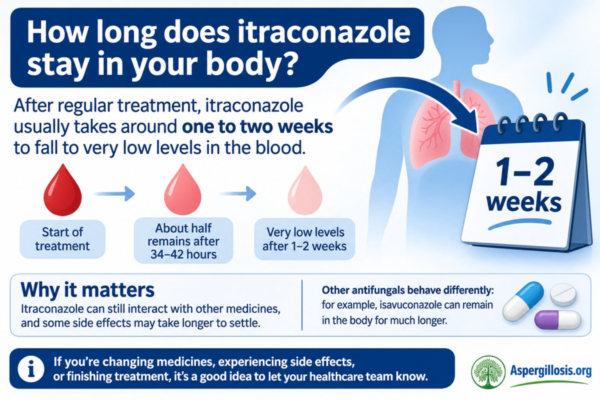
The short answer is that itraconazole usually takes around one to two weeks to fall to very low levels in the blood after regular treatment stops. The exact time varies from person to person.
Why does it take so long?
Medicines don’t usually disappear from the body all at once. Instead, the amount gradually decreases.
Doctors use the term half-life to describe how quickly this happens.
For itraconazole, the half-life is usually around 34–42 hours after regular treatment. That means the amount in the blood falls by roughly half over that period.
As the amount continues to fall, less and less remains.
Itraconazole also enters body tissues, including the lungs, so the amount in the blood doesn’t tell us everything about how long the medicine remains in the body.
Why does this matter?
There are several reasons why patients might want to know how long itraconazole stays in their body.
Other medicines: Itraconazole can interact with some other medicines, including certain steroids, heart medicines and cholesterol-lowering drugs. Some interactions can continue after itraconazole has been stopped.
Side effects: Some side effects may improve as the medicine leaves the body. Others can take longer to settle, so persistent or worsening symptoms should be discussed with a healthcare professional.
Monitoring: Specialists sometimes measure antifungal levels in the blood. This helps them understand how much medicine the body is absorbing and whether the level is appropriate.
Does aspergillosis return when itraconazole leaves the body?
Not necessarily.
The medicine leaving your body doesn’t automatically mean the infection will return.
Some people remain well after treatment finishes. Others need longer treatment or continued monitoring because their aspergillosis may become active again.
This depends on the type of aspergillosis, how well treatment has worked and the person’s overall health.
How long itraconazole stays in the body cannot tell us whether aspergillosis will return.
What about other antifungal medicines?
Different antifungal medicines leave the body at different rates.
| Antifungal | Approximate half-life |
|---|---|
| Itraconazole | 34–42 hours |
| Voriconazole | Variable, often around 6 hours |
| Posaconazole | 26–35 hours |
| Isavuconazole | Around 130 hours |
| Fluconazole | Around 30 hours |
These are approximate figures. They don’t tell us exactly when a medicine has completely left the body or when its effects have ended.
For example, isavuconazole stays in the bloodstream much longer than voriconazole, but that doesn’t mean it is necessarily more effective.
What should patients remember?
Itraconazole doesn’t disappear immediately after the last dose. It can remain in the body for days, and some interactions with other medicines may continue after treatment stops.
If you’re changing medicines, experiencing side effects or finishing antifungal treatment, it’s useful to tell your GP or pharmacist about any recent antifungal treatment.
The time a medicine takes to leave the body is only one part of understanding treatment. Your specialist will also consider how well your aspergillosis is controlled.
Further information
- Antifungal medicines: dosing, monitoring and the role of specialist care
- Itraconazole prescribing information
This article provides general information and does not replace advice from your healthcare team.

Did this page help you?
Tell us in one minute