Living with ABPA: What matters most to patients?
Allergic bronchopulmonary aspergillosis (ABPA) is a complex lung condition that can affect much more than breathing. People living with ABPA may experience persistent tiredness, coughing, breathlessness and difficulty maintaining their usual activities. Treatments can also create challenges of their own.
But which of these problems concern patients the most?
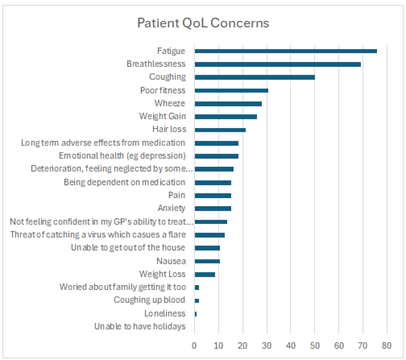
In October 2021, members of an online aspergillosis patient community were invited to share the aspects of their quality of life that they most wanted to improve. A total of 104 people with ABPA responded.
Their answers provide a useful insight into the everyday challenges of living with ABPA and why understanding patients’ priorities matters alongside clinical measurements and treatment decisions.
What did patients tell us?
The three most frequently reported concerns were:
- Fatigue: feeling exhausted or lacking the energy needed for everyday activities.
- Breathlessness: difficulty breathing during physical activity or sometimes even during ordinary daily tasks.
- Coughing: a persistent or troublesome cough that can interfere with sleep, conversation and social activities.
Some respondents selected as many as 16 different concerns, illustrating how ABPA can affect several aspects of life simultaneously.
The original survey chart is reproduced below to preserve the patient-reported findings.
Fatigue: More than simply feeling tired
Fatigue can be one of the most difficult symptoms of a long-term respiratory condition to explain to other people. It may involve physical exhaustion, difficulty concentrating and needing longer periods of recovery after activities that previously seemed straightforward.
In people with ABPA, fatigue may have several contributing factors, including ongoing respiratory symptoms, disturbed sleep, inflammation, other medical conditions and the effects of treatment.
Patients may find it helpful to discuss persistent fatigue with their clinical team rather than assuming that it is an unavoidable part of their condition. Some contributing problems may be treatable.
Read more about managing fatigue and energy with aspergillosis.
Breathlessness and loss of confidence
Breathlessness can make ordinary activities increasingly demanding. Walking, climbing stairs, shopping or doing housework may require more effort and more frequent rests.
It can also affect confidence. Some people begin avoiding activities because they worry about becoming breathless, which may contribute to physical deconditioning over time.
Appropriate treatment of the underlying lung disease is important, but patients may also benefit from individually tailored exercise, breathing techniques, pacing and pulmonary rehabilitation.
Read our guide to breathlessness and exercise with aspergillosis.
Living with a persistent cough
Coughing is another important concern for people with ABPA. It may be associated with airway inflammation, mucus production, asthma or coexisting bronchiectasis.
A persistent cough can be exhausting, disrupt sleep and make people uncomfortable in public or social situations.
Patients should tell their clinical team if their cough changes significantly, becomes more troublesome or is accompanied by new symptoms. Changes may require assessment rather than simply being attributed to established ABPA.
Airway clearance techniques may help some people who have difficulty clearing mucus, particularly those with bronchiectasis. These should be discussed with an appropriately trained respiratory physiotherapist.
Many problems can occur together
One striking feature of the survey was that some participants reported numerous concerns rather than one dominant symptom.
This reflects an important aspect of living with a chronic respiratory condition: symptoms can interact.
For example, coughing may disturb sleep, poor sleep may worsen fatigue, and fatigue may make physical activity more difficult. Reduced activity can then contribute to loss of fitness and greater breathlessness.
Recognising these connections may help patients and clinicians identify practical improvements even when the underlying lung condition cannot be completely resolved.
Why patient priorities matter
Clinical teams monitor ABPA using several measures, which may include symptoms, lung function, blood tests and chest imaging. These are important for assessing disease activity and treatment response.
However, improvements in clinical measurements do not always mean that a patient feels substantially better in everyday life.
Someone may have improved blood results but still struggle with fatigue, disrupted sleep or limited physical activity.
Asking patients what they most want to improve can help clinical teams focus on outcomes that are meaningful to them.
Patients may find it useful to prepare for appointments by identifying their two or three biggest difficulties and explaining how these affect everyday life.
What are the limitations of this survey?
This was an informal online patient-community poll conducted in October 2021, involving 104 respondents who identified as having ABPA.
Participation was voluntary, and respondents were drawn from an online support community. People experiencing more severe symptoms or particular concerns may have been more likely to participate.
Consequently, the findings should not be interpreted as showing how common individual symptoms are among all people with ABPA.
The survey was not designed to establish causes of symptoms, assess treatments or compare different patient populations.
Nevertheless, it provides a valuable record of the concerns that these patients chose to highlight.
What can we learn from patients’ experiences?
The message from this survey is straightforward: people living with ABPA are concerned not only about controlling their disease but also about maintaining their energy, breathing comfortably and managing everyday activities.
Fatigue, breathlessness and coughing deserve attention because they can substantially affect quality of life, even when they are not the primary measures used to assess treatment response.
Listening to patients’ priorities is an important part of delivering effective, compassionate respiratory care.
Further information and support
- ABPA information hub
- Managing fatigue and energy
- Breathlessness and exercise
- Community support for people with aspergillosis
Patient Voices preserves the experiences and priorities shared by members of our aspergillosis community. These accounts complement, but do not replace, clinical research and individual medical advice.

Did this page help you?
Tell us in one minute