Bronchiectasis and aspergillosis are separate conditions, but they can sometimes occur together. Bronchiectasis damages and widens the airways, making it more difficult to clear mucus and inhaled particles such as Aspergillus spores.
Most people with bronchiectasis will not develop aspergillosis. However, Aspergillus-related disease may be overlooked because its symptoms can resemble bronchiectasis itself, a bacterial chest infection or a flare-up.
What is bronchiectasis?
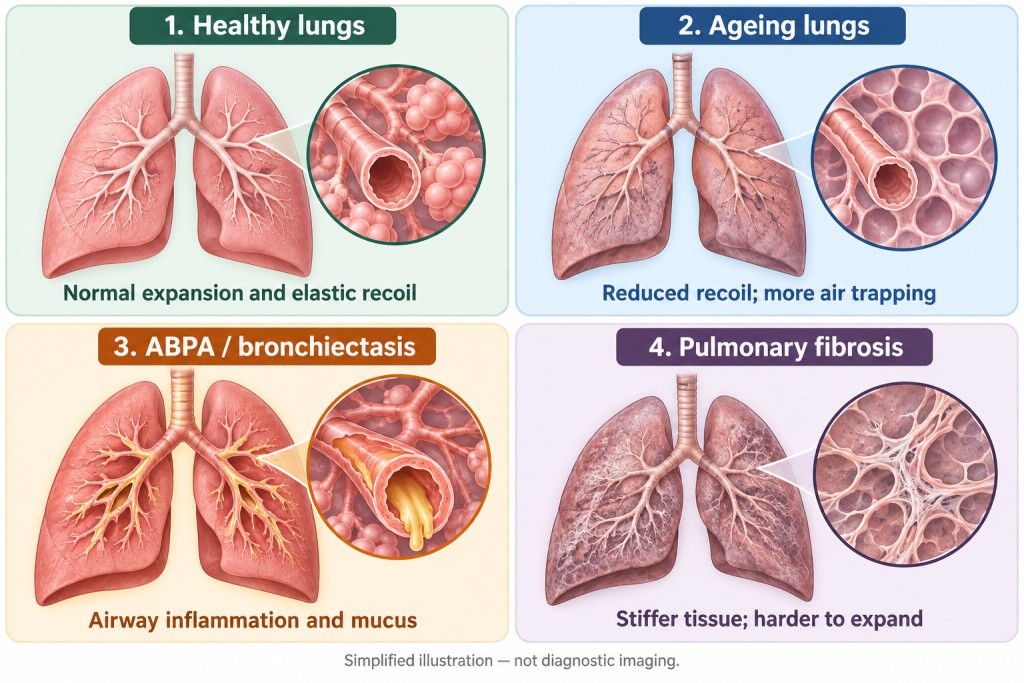
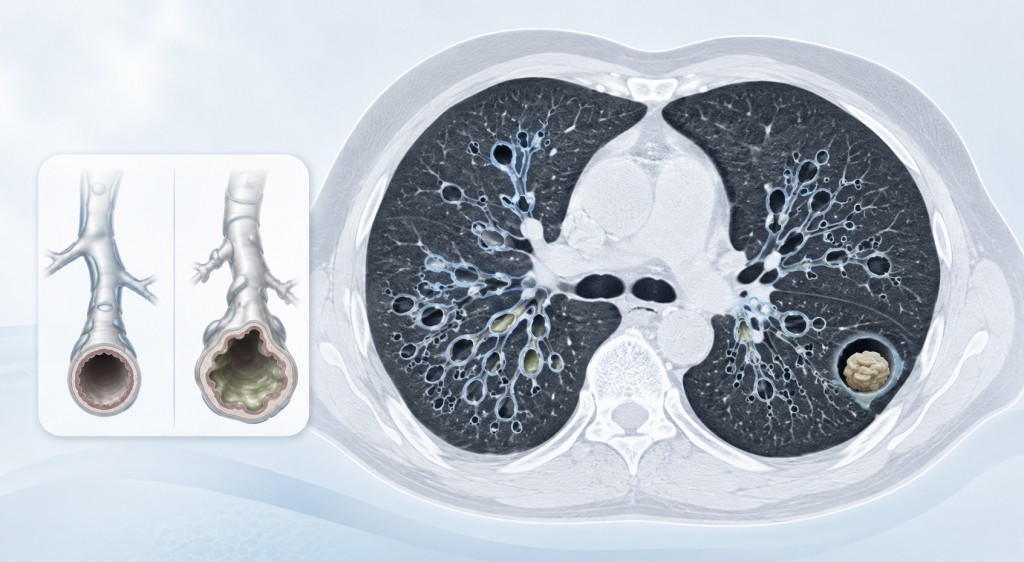
Bronchiectasis is a long-term lung condition in which one or more airways become permanently widened, thickened or scarred.
Healthy airways use a thin layer of mucus and tiny hair-like structures called cilia to remove dust, microbes and other particles. In bronchiectasis, damaged airways often clear mucus less effectively. Mucus can collect in widened parts of the airway, allowing bacteria and fungi to remain in the lungs for longer.
Bronchiectasis may develop after:
- severe or repeated chest infections
- tuberculosis or other lung infections
- immune-system problems
- asthma or allergic bronchopulmonary aspergillosis
- cystic fibrosis or primary ciliary dyskinesia
- autoimmune or inflammatory conditions
- airway blockage or inhaled foreign material
Sometimes no clear cause is found.
Common symptoms include:
- a long-term cough
- regular production of sputum
- repeated chest infections
- breathlessness
- wheezing
- fatigue
- coughing up blood
Find out more about mucus clearance and airway-clearance techniques.
Why can bronchiectasis increase the risk of aspergillosis?
Bronchiectasis changes the structure of the airways and makes it harder to remove mucus. This may allow Aspergillus spores to remain in the airways and interact with the immune system.
The risk of Aspergillus-related disease may be influenced by:
- the extent and location of bronchiectasis
- how much mucus is retained
- the number and severity of chest infections
- underlying asthma or allergy
- previous tuberculosis or other structural lung disease
- corticosteroid or other immunosuppressive treatment
- the individual immune response to Aspergillus
Aspergillus may be present in sputum without causing active disease. This is sometimes described as colonisation or airway carriage. Other people develop an exaggerated allergic response, Aspergillus bronchitis or a chronic fungal infection.
Different Aspergillus-related conditions
Several different Aspergillus-related conditions can occur in people with bronchiectasis. They should not be treated as if they are all the same.
Aspergillus sensitisation
Aspergillus sensitisation means that the immune system has developed an allergic response to Aspergillus. It may be associated with wheezing, airway inflammation or more frequent exacerbations, but it is not the same as an active fungal infection.
Allergic bronchopulmonary aspergillosis
Allergic bronchopulmonary aspergillosis (ABPA) occurs when the immune system reacts strongly to Aspergillus in the airways. It is traditionally associated with asthma and cystic fibrosis, but it can also occur in people with bronchiectasis who do not have either condition.
ABPA may cause:
- worsening wheeze or breathlessness
- thick or difficult-to-clear mucus
- recurrent chest symptoms
- increased eosinophils or IgE
- fleeting or changing shadows on chest imaging
- central bronchiectasis or high-attenuation mucus on CT
Read more about allergic bronchopulmonary aspergillosis.
Aspergillus bronchitis
Aspergillus bronchitis is a condition in which Aspergillus is repeatedly detected in the airways and is associated with a persistent productive cough, sputum and airway inflammation.
It is more likely to be considered when a person has:
- a chronic productive cough
- repeated detection of Aspergillus in sputum or bronchoscopy samples
- an increased Aspergillus IgG level
- no clear evidence of ABPA or CPA
Learn more in our guide to Aspergillus bronchitis.
Chronic pulmonary aspergillosis
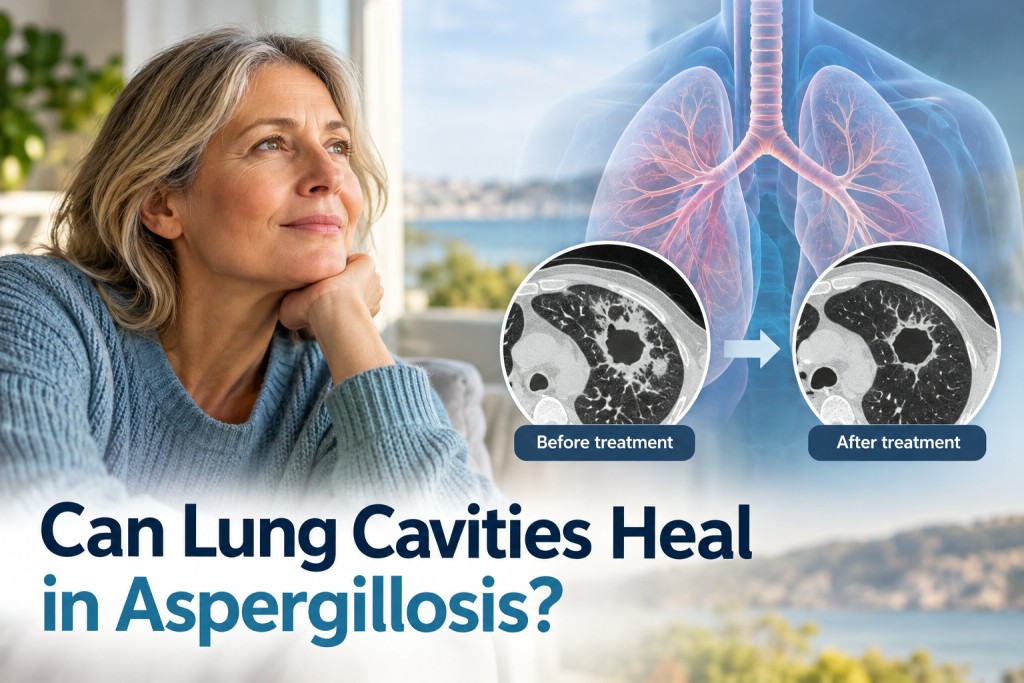
Chronic pulmonary aspergillosis (CPA) is a long-term fungal infection that usually develops in structurally abnormal lungs. It may cause cavities, nodules, thickening around cavities or progressive changes over time.
Symptoms may include:
- persistent cough
- increasing breathlessness
- weight loss
- fatigue
- night sweats or a low-grade fever
- persistent sputum
- coughing up blood
Read more about the different types of CPA.
What does recent research show?
A 2025 review examined ABPA and other Aspergillus-related airway diseases in bronchiectasis. It concluded that ABPA, Aspergillus sensitisation, chronic Aspergillus infection and Aspergillus bronchitis may form a spectrum of disease influenced by both airway damage and the immune response.
The review estimated that ABPA affects approximately 4% of people with bronchiectasis, although estimates vary substantially between studies and populations. It also reported that Aspergillus sensitisation and chronic Aspergillus infection may collectively affect up to 30% of people with bronchiectasis.
These figures should be interpreted cautiously. They do not mean that one in three people with bronchiectasis has an active fungal infection. Sensitisation, colonisation and active disease are different findings, and not everyone with a positive test requires antifungal treatment.
The review argued that Aspergillus-related disease may be associated with more severe bronchiectasis and more frequent exacerbations. It also noted that ABPA may sometimes contribute to bronchiectasis, rather than simply occurring as a result of already damaged airways.
A separate 2026 international study found that sensitisation to particular Aspergillus allergens was associated with markers of higher-risk bronchiectasis, including exacerbations, hospital admissions and Pseudomonas aeruginosa infection. The study does not prove that sensitisation causes bronchiectasis, but it suggests that fungal sensitisation may identify a subgroup needing closer assessment.
Can ABPA cause bronchiectasis?
The relationship between ABPA and bronchiectasis is complex.
Bronchiectasis may make it easier for Aspergillus to remain in the airways, increasing the opportunity for an allergic immune response. However, repeated Aspergillus-driven inflammation in ABPA may also damage the airways and contribute to bronchiectasis.
Recent research suggests that ABPA may contribute to bronchiectasis in some susceptible people, particularly when there is prolonged allergic inflammation and mucus plugging. However, not every person with ABPA develops bronchiectasis, and not every person with bronchiectasis has ABPA.
Symptoms can overlap
Bronchiectasis and Aspergillus-related disease may all cause:
- cough
- breathlessness
- wheeze
- fatigue
- increased sputum
- repeated chest infections
- reduced exercise tolerance
This overlap can make it difficult to know whether symptoms represent a usual fluctuation, a bacterial infection, ABPA, Aspergillus bronchitis, CPA or a combination of conditions.
Further assessment may be useful when symptoms are unusually persistent, severe or different from previous exacerbations.
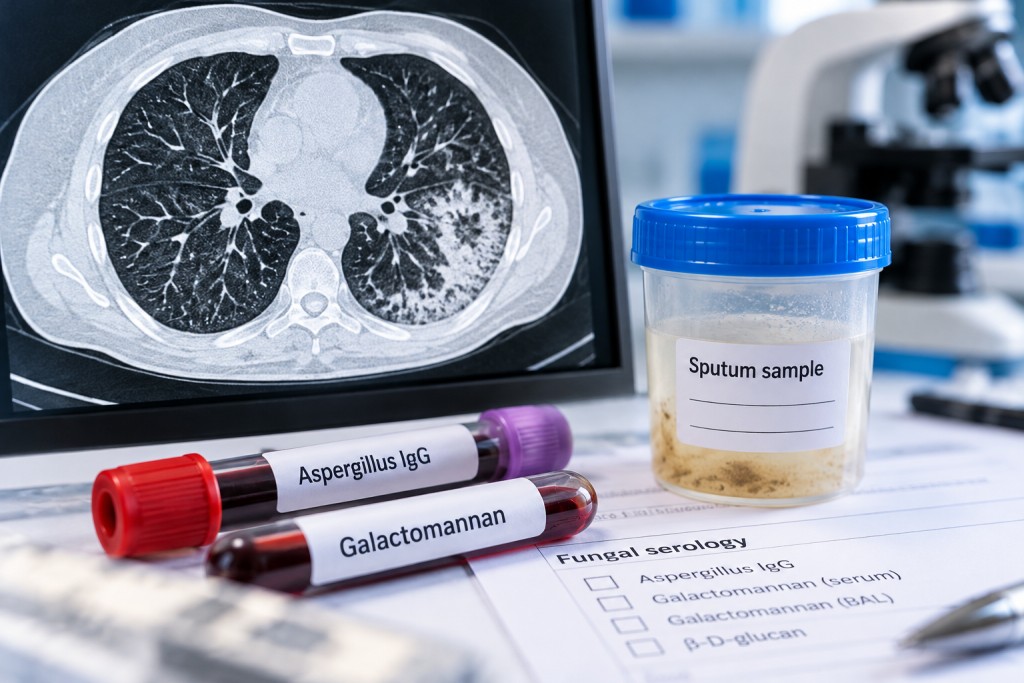
How might doctors investigate Aspergillus-related disease?
Assessment usually combines several types of information:
- symptoms and their pattern over time
- the frequency and severity of exacerbations
- chest X-rays and CT scans
- sputum cultures and other microbiology
- Aspergillus-specific IgE and IgG blood tests
- total IgE and eosinophil counts
- lung-function testing
- occasionally bronchoscopy
Read more about how aspergillosis is diagnosed.
Aspergillus-specific IgG may support a diagnosis of CPA or Aspergillus bronchitis. Aspergillus-specific IgE and total IgE are more relevant when ABPA is suspected.
A positive blood test does not automatically prove active disease. Test results need to be interpreted with symptoms, imaging and sputum findings.
Why CT scans are important
CT scans can show the pattern and extent of bronchiectasis and may identify additional findings such as:
- mucus plugging
- high-attenuation mucus
- nodules
- cavities
- thickening around cavities
- changes suggesting a fungal ball
A CT scan may help distinguish established bronchiectasis from new changes that require further investigation. Read more about CT scans and aspergillosis.
When should someone with bronchiectasis seek further assessment?
Speak to your healthcare team if you have bronchiectasis and develop:
- a clear change in your usual cough or sputum
- repeated exacerbations or chest infections
- symptoms that do not respond as expected to antibiotics
- new or worsening wheeze
- unexplained weight loss or fatigue
- new changes on a chest X-ray or CT scan
- repeated courses of steroids
- coughing up blood
These symptoms do not necessarily mean that you have aspergillosis. They may be caused by bronchiectasis, bacteria, viruses, asthma or other conditions. The purpose of further assessment is to identify the cause accurately.
How is treatment decided?
Treatment depends on which Aspergillus-related condition is present.
- Aspergillus sensitisation may require monitoring and treatment of associated airway disease rather than antifungal medication.
- ABPA may require corticosteroids, antifungal treatment or other specialist therapies.
- Aspergillus bronchitis may be considered for antifungal treatment when symptoms and microbiology support the diagnosis.
- CPA may require prolonged antifungal treatment and careful monitoring.
Airway clearance, vaccination, treatment of bacterial infections and management of the underlying bronchiectasis remain important regardless of whether Aspergillus is detected.
Antifungal medicines can interact with inhalers, corticosteroids and other medicines, so they should only be started under appropriate medical supervision.
Key message: Bronchiectasis makes it harder to clear mucus and inhaled particles, which may increase vulnerability to several Aspergillus-related conditions. Most people with bronchiectasis will not develop active aspergillosis, but persistent or unusually severe symptoms may justify assessment for Aspergillus sensitisation, ABPA, Aspergillus bronchitis or CPA.
Related information
- Understanding chronic pulmonary aspergillosis
- Aspergillus bronchitis
- Allergic bronchopulmonary aspergillosis
- How aspergillosis is diagnosed
- Understanding Aspergillus blood tests
- Mucus clearance techniques
- Diseases associated with aspergillosis
Further reading
Recent review: Agarwal R, Chotirmall SH, Chalmers JD.
Allergic bronchopulmonary aspergillosis and Aspergillus-related airway diseases in bronchiectasis: a narrative review.
Journal of Thoracic Disease. 2025;17:11501–11519.
Read the review on PubMed
Recent research: Tiew PY, Narayana JK, Jaggi TK, et al.
Aspergillus fumigatus sensitization is associated with high-risk bronchiectasis.
Chest. 2026;169:932–946.
Further discussion: Agarwal R, Sehgal IS, Muthu V, Bardin P.
Does ABPA contribute to bronchiectasis? A structured evaluation of competing hypotheses.
Clinical & Experimental Allergy. 2026;56:498–505.
Read the paper
This information is for education and should not replace advice from your own healthcare team.

Did this page help you?
Tell us in one minute