Understanding treatment for coughing up blood in chronic pulmonary aspergillosis (CPA).
Coughing up blood can be one of the most frightening experiences for someone living with chronic pulmonary aspergillosis (CPA). Even a small amount of bright red blood can be alarming, particularly when it happens repeatedly.
If your doctor has recommended a procedure called bronchial artery embolisation (BAE), you may be wondering what it involves, whether it is safe and how likely it is to stop the bleeding.
Bronchial artery embolisation is an established treatment that can stop bleeding without the need for major lung surgery.
This guide explains why the procedure is used, what to expect and what happens afterwards.
Why does aspergillosis cause bleeding?
In CPA, long-term fungal infection and inflammation can damage lung tissue. Some people develop cavities in their lungs, sometimes containing a fungal ball called an aspergilloma.
The body responds to chronic inflammation by developing additional blood vessels around the affected areas. Some of these vessels become enlarged and fragile.
Most significant bleeding in CPA comes from the bronchial arteries, which carry blood under relatively high pressure.
If one of these abnormal vessels bleeds, blood can enter the airways and be coughed up. This is called haemoptysis (coughing up blood).
Bleeding may range from small streaks of blood in mucus to larger amounts of fresh red blood.
Repeated episodes, increasing bleeding or difficulty breathing can indicate a potentially serious problem, even if the amount of blood seems relatively small.
What is bronchial artery embolisation?
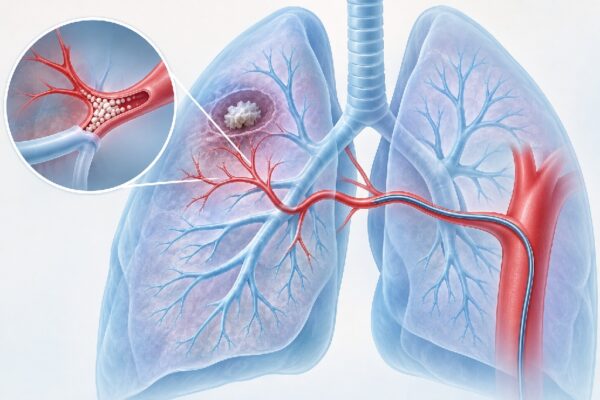
Bronchial artery embolisation is a procedure designed to stop bleeding by blocking the abnormal blood vessels responsible.
It is performed by an interventional radiologist, a specialist doctor who uses imaging equipment to carry out treatments inside the body.
Rather than operating directly on the lung, the radiologist passes a very thin tube called a catheter through an artery, usually in the groin or sometimes the wrist.
Using X-ray imaging, they guide the catheter towards the blood vessels supplying the affected area of the lung.
Once the abnormal vessels have been identified, tiny particles or other specially designed materials are introduced to block the blood flow.
This reduces blood flow through the abnormal vessels and helps stop the bleeding.
The procedure does not remove lung tissue and usually does not require opening the chest.
Although patients sometimes call it a “vein embolisation”, it is usually arteries that are treated.
Why has my doctor recommended it?
Your respiratory specialist may recommend embolisation if:
- You have experienced repeated episodes of coughing up blood.
- The amount of blood is increasing.
- You have had a significant episode of bleeding.
- Scans suggest abnormal blood vessels associated with your lung disease.
- There is concern that further bleeding could become dangerous.
You do not necessarily need to have experienced a massive bleed before embolisation is considered.
Sometimes doctors recommend treatment after several smaller episodes because they are concerned about the risk of a more serious bleed.
In people with CPA, this is a recognised approach.
What happens before the procedure?
The hospital team will usually review your medical history, medication and recent scans.
You may have a CT scan with contrast dye to help identify the abnormal blood vessels.
Blood tests may be performed to check your blood count, kidney function and ability to clot.
Tell the team if you:
- Take blood-thinning medication.
- Have kidney problems.
- Have previously reacted to contrast dye.
- Have difficulty lying flat.
- Have experienced problems with anaesthesia or sedation.
You may be asked not to eat or drink for several hours beforehand, depending on the planned anaesthesia and local hospital instructions.
Do not stop prescribed blood-thinning medication unless your medical team tells you to.
The interventional radiologist will explain the procedure, its benefits and possible complications before asking for your consent.
What happens during embolisation?
The procedure takes place in a specialist radiology department.
You will usually be given local anaesthetic to numb the area where the catheter enters the artery. Sedation may also be offered to help you relax. Occasionally, general anaesthesia is required.
The radiologist then:
- Inserts a fine catheter into an artery, usually through the groin.
- Guides it towards the blood vessels supplying the affected lung area.
- Injects contrast dye to make the vessels visible on X-ray images.
- Identifies the abnormal vessels associated with the bleeding.
- Introduces tiny particles or other materials to block the selected vessels.
- Checks the result before removing the catheter.
You may feel some pressure at the catheter entry site or a warm sensation when the contrast dye is injected. Some people experience temporary chest discomfort.
The procedure often takes around one to two hours, although complex cases may take longer.
Throughout the procedure, the team monitors your breathing, oxygen levels, heart rate and blood pressure.
How successful is it?
Bronchial artery embolisation is generally very effective at controlling bleeding in the short term.
Published studies involving patients with different causes of haemoptysis commonly report initial bleeding control in approximately 80–90% or more of cases, although results depend on the underlying disease and how success is measured.
This makes embolisation an important treatment for significant or recurrent lung bleeding.
However, there is an important distinction:
Embolisation treats the bleeding. It does not cure the underlying aspergillosis.
The inflammation and structural changes associated with CPA may remain, even after the bleeding has stopped.
For more detailed clinical evidence, see the CIRSE Standards of Practice on Bronchial Artery Embolisation.
Can the bleeding come back?
Yes. Some people experience further bleeding months or years after successful embolisation.
This can happen because:
- New abnormal blood vessels develop.
- Previously blocked vessels reopen.
- Other vessels begin supplying the affected lung tissue.
- The underlying aspergillosis or associated lung damage progresses.
People with aspergillomas or longstanding inflammatory lung disease may have a greater risk of recurrent bleeding.
This does not necessarily mean the original procedure failed.
Embolisation can often be repeated if bleeding returns.
Your respiratory team will also consider whether your antifungal treatment or other management needs reviewing.
Is bronchial artery embolisation safe?
Bronchial artery embolisation is generally considered safe when performed by an experienced interventional radiology team. However, like any medical procedure, it carries risks.
More common temporary effects
- Bruising or soreness at the catheter entry site.
- Chest discomfort.
- Temporary difficulty swallowing.
- Tiredness or flu-like symptoms.
- Occasionally, a temporary fever.
Less common or serious complications
- Bleeding or damage to an artery at the catheter entry site.
- Allergic reactions to contrast dye.
- Kidney problems related to contrast dye.
- Unintended blockage of blood vessels supplying other tissues or organs.
- Rarely, damage to the spinal cord, which can cause weakness or paralysis.
The spinal cord complication is particularly important because some bronchial arteries are connected to vessels supplying the spinal cord. Modern imaging and careful catheter placement are used to minimise this risk.
Major complications are uncommon, but they cannot be eliminated entirely.
Your radiologist will discuss the risks relevant to your particular anatomy and medical condition.
For a detailed NHS explanation, see the Cambridge University Hospitals guide to bronchial artery embolisation.
What happens after the procedure?
You will be monitored while the team checks your breathing, blood pressure and catheter entry site.
If the catheter was inserted through the groin, you may need to remain lying down for several hours.
Many patients remain in hospital overnight. Some need a longer stay, particularly if they have experienced substantial bleeding or have significant underlying lung disease.
You may feel tired or experience some chest discomfort for a few days. Flu-like symptoms can sometimes last longer.
The hospital will advise you when to resume normal activities, including driving, exercise and lifting.
It is important to follow the instructions provided by your treating team.
Will I still need antifungal treatment?
Usually, yes, if antifungal treatment remains indicated for your CPA.
Embolisation and antifungal medication have different purposes.
Embolisation aims to control bleeding from abnormal blood vessels.
Antifungal treatment aims to control the underlying fungal disease and limit further damage.
Successful embolisation does not automatically mean that antifungal treatment can be stopped.
Your specialist will review your antifungal treatment and follow-up plan.
When should I seek urgent medical help?
Coughing up blood should always be taken seriously, particularly if you already have damaged lungs.
Call 999 immediately if you cough up more than a few streaks or spots of blood, experience substantial or ongoing bleeding, have difficulty breathing, develop chest pain, feel faint or collapse.
For smaller amounts of fresh blood, seek urgent medical advice rather than waiting for a routine appointment. Contact your respiratory team promptly, or use NHS 111 if you cannot reach them and there are no emergency symptoms.
Do not wait for a planned embolisation appointment if the bleeding is recurring or worsening.
Even relatively modest bleeding can be dangerous if blood interferes with breathing.
If you have previously undergone embolisation, new bleeding should still be assessed.
Questions you may want to ask your radiologist
- Which blood vessels do you think are responsible for my bleeding?
- Will I be awake during the procedure?
- How long am I likely to remain in hospital?
- What are the main risks in my particular case?
- How likely is the bleeding to return?
- What should I do if I cough up blood again?
- Will this change my antifungal treatment or follow-up?
It is reasonable to ask for explanations in everyday language and to discuss any concerns before consenting.
A final word
Being referred for bronchial artery embolisation can be unsettling, especially if you have already experienced frightening episodes of coughing up blood.
However, the recommendation does not necessarily mean that your lung disease has suddenly become much worse.
It often means that your medical team has recognised a potentially serious complication and wants to reduce the risk of further bleeding.
For many people with CPA, embolisation provides effective control of bleeding and can make an important difference to their safety and quality of life.
The most important thing is to remain in contact with your specialist team, continue the treatment recommended for your CPA and seek urgent help if significant bleeding occurs again.
Further information and references
- Lung Bleeding (Haemoptysis) in Aspergillosis – further patient information on coughing up blood.
- Stephen E: Living with Chronic Pulmonary Aspergillosis – a patient’s experience of living with CPA.
- Cambridge University Hospitals: Bronchial Artery Embolisation – A Guide for Patients.
- Kettenbach et al. (2022). CIRSE Standards of Practice on Bronchial Artery Embolisation.
This information is intended to help patients understand bronchial artery embolisation. It does not replace advice from your respiratory specialist or interventional radiologist. Individual risks, recovery and treatment decisions depend on your medical circumstances.

Did this page help you?
Tell us in one minute