
Azithromycin is an antibiotic, but why do some people take it regularly for years, even when they don’t have a chest infection? And how can they tell whether it is helping?
At a recent National Aspergillosis Centre patient meeting, someone asked an interesting question. They had been taking azithromycin for many years and remembered being told that it helped to “smooth” the lungs.
But what does that actually mean? And is long-term azithromycin still considered a useful treatment?
The answer is yes, for appropriately selected patients. However, azithromycin has benefits beyond treating bacterial infections, and these are not always immediately obvious.
Azithromycin does more than treat infections
Azithromycin belongs to a group of antibiotics called macrolides.
Its familiar role is treating infections caused by susceptible bacteria. It does not kill fungi such as Aspergillus.
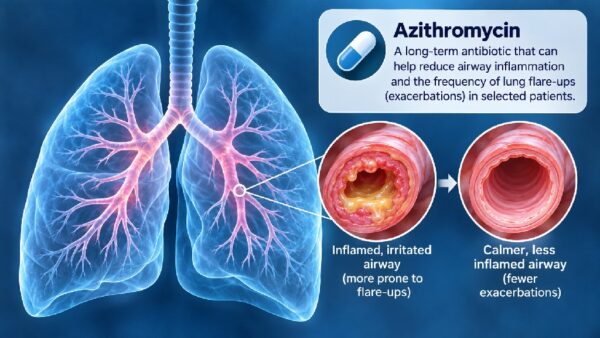
However, azithromycin also has immunomodulatory effects. This means it can influence the way our immune system responds to inflammation.
In certain chronic lung conditions, particularly bronchiectasis, these effects may help reduce repeated flare-ups, known medically as exacerbations.
This is why some patients are prescribed azithromycin regularly for months or years, rather than taking it only when they develop an infection.
For more about why different antibiotics are prescribed, see our Understanding Antibiotics: A Guide for People Living with Aspergillosis and Bronchiectasis.
Does azithromycin really “smooth” the lungs?
Not literally.
Azithromycin does not work like a bronchodilator, such as salbutamol, which relaxes the smooth muscle surrounding the airways and helps them widen.
But the description may reflect a genuine benefit.
In chronically inflamed airways, immune cells release substances intended to fight infection. Unfortunately, these substances can also irritate and damage surrounding lung tissue.
Azithromycin can influence some of these inflammatory processes, including those involving neutrophils.
It may also affect mucus production and the activity of bacteria living in the airways.
Together, these effects can help reduce repeated exacerbations in appropriately selected patients.
Some people may notice less coughing or sputum, or feel that their breathing is more settled. Others notice little immediate difference.
The main benefit may be fewer bad episodes over time, rather than feeling noticeably better after each tablet.
Why can inflammation become a problem?
Inflammation is an essential part of our defence against infection.
When microorganisms enter the airways, immune cells recognise the threat and recruit other cells to help.
Neutrophils are particularly effective at attacking microorganisms. They release powerful substances that help destroy bacteria and fungi.
However, excessive or prolonged neutrophil activity can also damage our own tissues.
In bronchiectasis, damaged airways may struggle to clear mucus effectively. This can contribute to a repeating cycle:
Poor mucus clearance → infection and inflammation → airway damage → further problems clearing mucus.
Azithromycin may help interrupt parts of this cycle.
Its benefits probably reflect a combination of antibacterial and anti-inflammatory effects. Researchers cannot always separate the contribution of each mechanism.
For more information about how bronchiectasis and fungal lung disease can occur together, see Bronchiectasis and Aspergillosis: Understanding the Connection.
Why take an antibiotic when I don’t have an infection?
For some patients, the main purpose of long-term azithromycin is to prevent future exacerbations.
An exacerbation is a significant worsening of respiratory symptoms, often involving increased coughing, sputum, breathlessness or fatigue, sometimes requiring additional treatment.
Repeated exacerbations can be exhausting, disrupt everyday life and contribute to further lung damage.
Clinical trials have shown that long-term macrolide treatment can reduce exacerbations in selected patients with bronchiectasis.
The 2025 European Respiratory Society guideline strongly recommends offering long-term macrolides to people with bronchiectasis who remain at high risk of exacerbations despite standard care.
This does not mean that everyone with bronchiectasis needs azithromycin. Treatment depends on individual circumstances, previous exacerbations and the balance of benefits and risks.
If I don’t feel any different, how do I know it is working?
This is perhaps the most important question.
Some medicines have an obvious effect. A painkiller may reduce pain within an hour. A bronchodilator may make breathing easier relatively quickly.
Azithromycin used to prevent exacerbations is different.
Imagine someone who previously experienced five significant chest flare-ups each year. After starting long-term azithromycin, they experience only two.
They might not feel noticeably different on an ordinary day, but having fewer exacerbations could make a substantial difference to their health and quality of life.
Doctors may assess the benefit by looking at:
- How many exacerbations occur each year.
- How often additional antibiotics or steroids are needed.
- Whether hospital admissions have decreased.
- Changes in symptoms and quality of life.
- Whether treatment is causing unwanted effects.
It is not always easy to establish how much benefit an individual medicine provides, particularly when several treatments have changed over time.
Not noticing an immediate improvement does not necessarily mean the medicine isn’t working.
However, treatment should still be reviewed periodically to establish whether it remains worthwhile.
Who is most likely to benefit?
Long-term azithromycin is particularly well established for selected patients with bronchiectasis who experience repeated exacerbations despite appropriate standard treatment.
It may also be used in selected patients with COPD or certain forms of severe asthma.
However, the reasons for prescribing it, and the strength of the evidence, differ between these conditions.
It is not routinely prescribed simply because someone has a persistent cough or ongoing breathlessness.
What about people with aspergillosis?
Azithromycin does not treat Aspergillus infection.
However, some people with chronic pulmonary aspergillosis (CPA) or allergic bronchopulmonary aspergillosis (ABPA) also have bronchiectasis.
If they experience repeated airway exacerbations, their respiratory specialist may consider whether long-term azithromycin would help.
The decision is based on their underlying airway disease and exacerbation history, not simply on having aspergillosis.
Why isn’t everyone given azithromycin?
Long-term treatment has potential disadvantages.
Antibiotic resistance
Repeated exposure to antibiotics can encourage bacteria to develop resistance, making some future infections harder to treat.
Non-tuberculous mycobacteria (NTM)
NTM are environmental bacteria that can cause chronic lung infections, particularly in people with damaged airways.
Azithromycin is an important component of treatment for certain NTM infections, but it generally needs to be combined with other medicines.
Taking azithromycin alone when an NTM infection is present can encourage macrolide resistance, making the infection much harder to treat.
This is why specialists normally investigate for NTM before starting long-term azithromycin.
For further explanation, see our Common Associated Conditions Hub, which includes information about NTM lung disease and its overlap with aspergillosis.
Heart rhythm
Azithromycin can affect the electrical activity of the heart, potentially prolonging the QT interval measured on an ECG.
This is particularly important for people taking other medicines that can also affect heart rhythm.
Hearing and liver function
Long-term treatment can sometimes cause hearing or balance problems, gastrointestinal symptoms or changes in liver function.
Patients should report new symptoms and attend recommended monitoring appointments.
For broader information about treatment safety, see Managing Side Effects of Aspergillosis Treatments.
Is azithromycin safe alongside antifungal medicines?
This is particularly relevant to people living with aspergillosis.
Some antifungal medicines, including voriconazole and posaconazole, can also affect the QT interval.
Taking them alongside azithromycin may increase the risk of heart-rhythm problems in susceptible patients.
A respiratory specialist or pharmacist should review the complete medication list and consider whether ECG or other monitoring is required.
This does not mean these medicines can never be prescribed together. It means the combined risks need careful assessment.
Should treatment be reviewed after several years?
Yes.
Long-term azithromycin is an established treatment, and some patients continue taking it for many years under specialist supervision.
However, the benefits and risks should be reviewed regularly.
The British Thoracic Society recommends assessing the clinical benefit at approximately six and twelve months after starting treatment.
Longer-term reviews should consider exacerbation frequency, side effects, antibiotic resistance and whether the original reason for prescribing remains relevant.
The 2025 European Respiratory Society guideline also recognises that the optimal duration of treatment is uncertain.
This does not mean that azithromycin must automatically be stopped after a year.
For some patients, continued treatment may provide substantial benefit. In others, the specialist team may consider whether a supervised treatment break or change in approach is appropriate.
Patients should not stop long-term azithromycin without discussing it with their respiratory team.
Questions to ask your respiratory specialist
If you have been taking azithromycin for a long time, these questions may be useful:
- Why was azithromycin originally prescribed for me?
- Is it mainly intended to prevent infections, reduce inflammation, or both?
- Have I experienced fewer exacerbations since starting treatment?
- How do we know whether it is still helping?
- Have my heart rhythm, liver function and other medicines been reviewed?
- Do I need further sputum testing, including for NTM?
- Should I continue the same treatment, or is it time to review whether I still need it?
The important message
Azithromycin remains a useful and evidence-based treatment for selected patients with chronic respiratory disease.
Its benefits can extend beyond treating bacterial infections. In bronchiectasis, long-term treatment can reduce the frequency of exacerbations, potentially through a combination of antibacterial and anti-inflammatory effects.
It does not literally smooth the lungs, directly open the airways or treat Aspergillus infection.
And because its main benefit may be preventing future problems, patients may not notice an obvious day-to-day effect.
The most useful question is not simply “Can I feel it working?” but:
“Am I having fewer flare-ups, and does the benefit still outweigh the risks?”
That is a conversation worth having with your respiratory team.
Further reading
- European Respiratory Society: Clinical Practice Guideline for Adult Bronchiectasis (2025)
- British Thoracic Society: Long-Term Macrolide Use in Adults with Respiratory Disease
- NHS: Bronchiectasis
This article provides general information and does not replace advice from your respiratory specialist. Do not start, stop or change prescribed antibiotic treatment without discussing it with your clinical team.
Prepared following a question raised at a National Aspergillosis Centre patient meeting. The discussion has been anonymised.

Did this page help you?
Tell us in one minute