Most treatments for aspergillosis work by attacking the fungus directly. But researchers are exploring another possibility: helping the immune system recognise and attack the fungus more effectively.
One particularly interesting approach presented at the Fungal Update: Mycology Conference 2026 involves laboratory-made human antibodies designed to recognise proteins in the fungal cell wall.
The work is still at a preclinical stage — it has not yet been tested as a treatment for aspergillosis in people — but it points towards a potentially very different way of treating serious fungal infections.
What are monoclonal antibodies?
Antibodies are proteins made by our immune system. They recognise particular molecular structures, allowing the immune system to identify potential threats.
A monoclonal antibody, or mAb, is an antibody produced specifically to recognise a chosen target.
Monoclonal antibody medicines are already widely used in medicine. Some people with severe asthma, for example, receive biologic treatments based on monoclonal antibodies.
Researchers are now investigating whether the same basic technology could be used against fungi.
Instead of targeting part of the human immune system, these experimental antibodies are designed to recognise structures on the fungus itself.
Are antibodies already used against infections?
Yes. Although using monoclonal antibodies against fungal infections is experimental, the broader idea of using laboratory-made antibodies to prevent or treat infection is already well established.
For example, monoclonal antibodies are used to protect babies and young children against respiratory syncytial virus (RSV). Other antibody treatments have been developed for serious infections including Ebola, HIV and anthrax.
There are also examples of antibodies being used alongside conventional antimicrobial treatment. Bezlotoxumab, for example, targets a toxin produced by Clostridioides difficile and has been used with antibiotics to reduce the risk of recurrent infection.
These treatments work in different ways. Some antibodies block a virus from entering human cells, while others neutralise toxins or interfere with another important part of the infectious process.
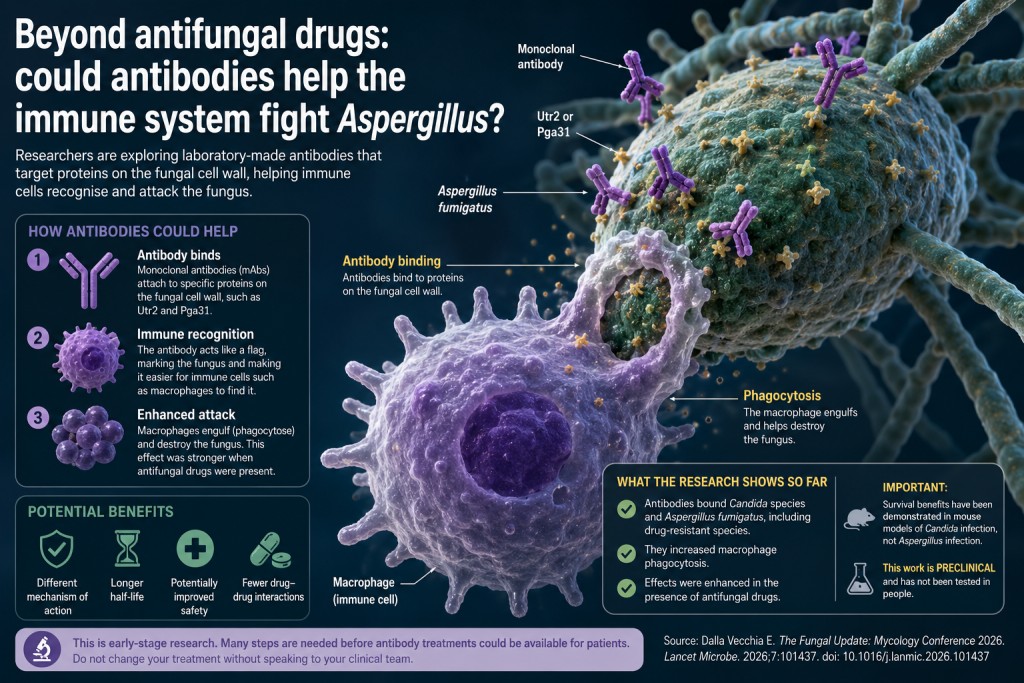
The experimental fungal antibodies described at the Fungal Update conference use another strategy. They bind proteins on the fungal cell wall and appear to make the fungus easier for macrophages to recognise and engulf. The researchers also found that this effect was stronger in the presence of antifungal drugs.
So the new idea is not that antibodies can be used against infectious diseases — we already know that they can. The important question is whether this established medical technology can be successfully extended to infections caused by fungi such as Aspergillus.
Targeting the fungal cell wall
At the Fungal Update conference in London in March 2026, Professor Carol Munro of the University of Aberdeen presented preclinical research into human monoclonal antibodies targeting two fungal cell-wall proteins called Utr2 and Pga31.
The researchers are interested in developing a pan-fungal treatment — one potentially capable of recognising more than one important fungal pathogen.
According to the conference report published in The Lancet Microbe, the antibodies bound to both Candida species and Aspergillus fumigatus, including drug-resistant species.
That is particularly interesting because antifungal resistance is an increasing concern. If an antibody attacks a completely different fungal target from conventional antifungal medicines, existing resistance mechanisms might not necessarily prevent it from working.
However, considerably more research will be needed to establish whether that potential translates into an effective treatment.
Helping immune cells recognise the fungus
Binding to the fungus is only part of the story.
The antibodies also increased phagocytosis by macrophages.
Macrophages are immune cells capable of recognising, engulfing and destroying microorganisms and other foreign material.
One way of thinking about an antibody is therefore as a highly specific biological marker. By attaching to its target on a fungus, it can potentially make that fungus easier for immune cells to recognise and attack.
This is fundamentally different from simply giving another conventional antifungal drug.
Antibodies and antifungal drugs might work together
Perhaps one of the most intriguing observations reported at the conference was that antibody binding and macrophage phagocytosis were enhanced in the presence of antifungal drugs.
That raises an interesting possibility.
Future antibody treatments might not necessarily replace drugs such as azoles or echinocandins. Instead, they could potentially be used alongside antifungal treatment, attacking the infection through complementary mechanisms.
The antifungal drug could interfere directly with fungal growth or survival while the antibody helps the immune system recognise and remove the fungus.
Whether this combination would provide a meaningful clinical advantage in aspergillosis remains to be established.
What has actually been demonstrated so far?
This distinction is important.
The experiments reported for Aspergillus fumigatus showed that the antibodies could bind the fungus and enhance its phagocytosis by immune cells.
The striking survival results presented at the conference came from mouse models of Candida infection, not Aspergillus infection.
In immunocompetent mice with disseminated candidiasis, monoclonal antibody treatment was associated with an 83% improvement in survival, together with reductions in fungal burden and kidney lesions.
Researchers also studied immunosuppressed mice with Candida albicans candidaemia. Survival increased from 40% with caspofungin alone to 80% when monoclonal antibodies were added.
Those are encouraging preclinical results, particularly because serious fungal infections often occur in people whose immune systems are weakened.
But they should not be interpreted as evidence that the antibody treatment has already been shown to cure invasive aspergillosis.
Why might antibodies be useful?
Existing antifungal medicines can be highly effective, but treating serious fungal infections presents several difficulties.
One of the attractions of antibody-based treatment is the possibility of attacking fungi through a completely different biological mechanism.
Professor Munro hopes that these potential treatments could also offer advantages such as improved safety, a longer half-life and fewer drug–drug interactions compared with existing small-molecule antifungal drugs.
These remain hoped-for advantages rather than demonstrated benefits in patients.
Nevertheless, they are particularly interesting in fungal disease because people requiring long courses of antifungal treatment can encounter toxicity, interactions with other medicines and difficulties maintaining appropriate drug concentrations.
Treating the fungus — or helping the host?
The antibody research also fits into a wider shift in thinking about fungal treatment.
At the same conference, Professor Frank van de Veerdonk described a phase 3 trial investigating interferon-gamma immunotherapy for candidaemia. The trial had completed enrolment, with the conference report stating that interim results showed no safety signal.
Interferon-gamma and monoclonal antibodies are very different approaches, but they illustrate the same broader idea: treating a fungal infection might involve not only attacking the fungus directly but also using or modifying the patient’s immune response.
This is known as host-directed therapy or immunotherapy.
For infections such as aspergillosis, where the interaction between the fungus and the patient’s immune system is central to whether disease develops, this is an important area of research.
What happens next?
The monoclonal antibodies described at the conference remain preclinical experimental treatments.
Before a new antibody therapy could become available to patients, researchers would need to establish its safety, determine an appropriate dose, investigate how it behaves in the human body and then test whether it actually improves outcomes in people with fungal infections.
Many treatments that look promising in laboratory and animal experiments do not ultimately succeed in human clinical trials.
Professor Munro nevertheless hopes that these antibodies can progress to clinical testing.
A different direction for antifungal treatment
The antifungal development pipeline is already beginning to expand, including new antifungal drugs designed to attack fungal cells in different ways.
Monoclonal antibodies represent something different again.
Rather than developing another version of an existing antifungal, researchers are exploring whether highly targeted biological treatments could mark fungi for attack by the immune system and work alongside conventional antifungal medicines.
For Aspergillus, the evidence is still at an early stage. The antibodies have been shown to recognise A. fumigatus and enhance its uptake by immune cells in laboratory experiments, but the survival benefits reported so far come from Candida models.
That distinction matters.
But if future studies demonstrate similar effects against Aspergillus in living organisms and eventually in people, monoclonal antibodies could open an entirely new avenue for treating fungal disease.
Research source
Dalla Vecchia E. The Fungal Update: Mycology Conference 2026. The Lancet Microbe. Published online 7 May 2026; 7:101437.
Read The Lancet Microbe conference report
This article discusses early-stage research and does not describe a treatment currently available for aspergillosis. Patients should not change their antifungal treatment without discussing it with their clinical team.

Did this page help you?
Tell us in one minute