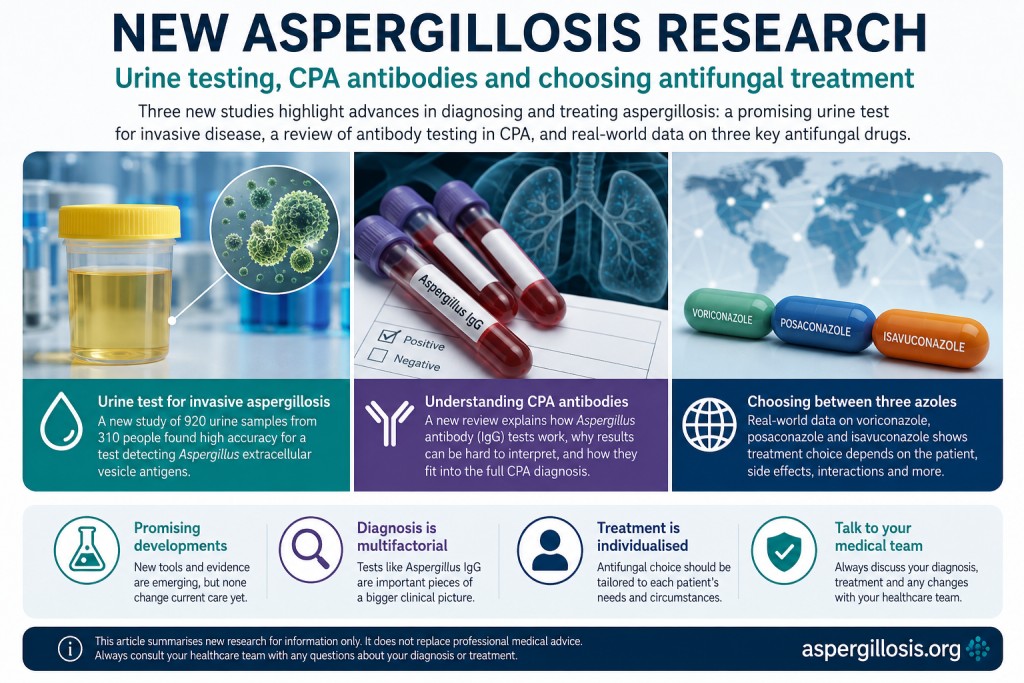
Research published this week highlights three different parts of aspergillosis care: a possible future urine test for invasive aspergillosis, a detailed review of antibody testing in chronic pulmonary aspergillosis (CPA), and new real-world evidence about the use of three important azole antifungal drugs.
These studies do not immediately change how patients should be diagnosed or treated, but they show how researchers are trying to make diagnosis easier and treatment more individualised.
Could invasive aspergillosis eventually be detected using a urine test?
Diagnosing invasive aspergillosis (IA) can be difficult. It usually occurs in people who are seriously ill or whose immune systems are weakened, and obtaining samples directly from the lungs is not always straightforward.
Researchers have been developing a test called MycoMEIA–Aspergillus, which looks in urine for galactofuranose-containing antigens associated with extracellular vesicles released by Aspergillus.
Extracellular vesicles are tiny membrane-bound packages released by cells, including fungi. Material associated with these vesicles can enter the circulation and ultimately appear in urine, potentially providing a much easier sample in which to look for evidence of infection.
In the new study, researchers examined 920 urine samples from 310 people being investigated for invasive fungal disease.
At the patient level, the test achieved approximately:
- 91% sensitivity — the proportion of people with invasive aspergillosis correctly identified by the test.
- 89% specificity — the proportion without invasive aspergillosis correctly identified as negative.
The overall diagnostic performance was also high, with an area under the receiver operating characteristic curve (AUC) of approximately 0.97.
These are encouraging results, particularly because collecting urine is considerably easier and less invasive than obtaining many respiratory samples.
Does this mean a urine test for aspergillosis is now available?
No.
This is still a developing diagnostic test. The researchers themselves emphasise the need for further confirmation and validation of the final assay before it could become part of routine clinical practice.
The idea also has a longer research history. Earlier studies explored detecting Aspergillus antigens in urine, so the important development here is the strengthening and refinement of this approach rather than the first discovery that Aspergillus-associated material can be detected in urine.
If successfully validated, a urine test could eventually complement existing diagnostic methods rather than necessarily replace them.
Research paper:
Datta K, Baburina I, Zhang SX, et al. Detection of Galactofuranose-Containing Antigens Associated With Aspergillus Extracellular Vesicles in Urine: The Biological Basis of a New Diagnostic for Aspergillosis. Journal of Infectious Diseases. 2026.
Read the research paper
Understanding Aspergillus antibody tests in chronic pulmonary aspergillosis
A second new publication examines a test that is already extremely important in clinical practice: Aspergillus antibody testing in chronic pulmonary aspergillosis (CPA).
CPA is a long-term lung infection caused by Aspergillus, usually developing in people who already have structural lung damage or another underlying lung condition.
Blood tests measuring antibodies against Aspergillus — often reported as Aspergillus IgG — form an important part of CPA diagnosis.
However, interpreting these tests is more complicated than simply deciding whether a result is positive or negative.
The new narrative review examines the different methods used to detect anti-Aspergillus antibodies, their diagnostic performance and some of the difficulties involved in interpreting results.
Why can’t an antibody result diagnose CPA on its own?
An antibody response tells doctors that the immune system has recognised Aspergillus. It does not, by itself, prove that the fungus is causing CPA.
Doctors therefore combine several pieces of information, which can include:
- symptoms and how long they have been present;
- CT or other radiological findings;
- Aspergillus IgG or other antibody results;
- fungal culture, PCR or other microbiological evidence where available;
- the patient’s underlying lung disease;
- and whether another condition could better explain the findings.
Similarly, an antibody result that is not raised does not necessarily exclude CPA in every patient.
This is why CPA diagnosis is best thought of as assembling several pieces of evidence, rather than relying on a single blood test.
The review is particularly useful because different laboratories and commercial assays can use different techniques and thresholds. Understanding those differences matters when interpreting results and comparing measurements made at different centres.
Research paper:
Gibert C, Maitre T, Godet C, et al. Ins and outs of anti-Aspergillus serology in chronic pulmonary aspergillosis: a narrative review. Clinical Microbiology and Infection. 2026.
Read the research paper
Voriconazole, posaconazole or isavuconazole for invasive pulmonary aspergillosis?
The third study looks at treatment rather than diagnosis.
Researchers used a large global real-world database to investigate how three important triazole antifungal drugs are being used in invasive pulmonary aspergillosis (IPA):
voriconazole, posaconazole and isavuconazole.
Voriconazole has historically had a particularly important role in the treatment of invasive aspergillosis, but clinicians now have several azole options.
That does not mean there is one universally “best” antifungal.
Choice of treatment can depend upon factors including:
- the type and severity of infection;
- other medicines being taken and possible drug interactions;
- liver function;
- previous antifungal exposure;
- adverse effects;
- the susceptibility of the Aspergillus isolate, where this is known;
- whether adequate drug concentrations can be achieved;
- and the individual patient’s underlying illnesses.
Real-world database studies are valuable because they show how medicines perform and are selected outside the tightly controlled environment of a clinical trial.
However, they also need careful interpretation. Patients receiving different antifungals may differ substantially in their underlying illnesses and previous treatments, so differences in outcomes cannot automatically be attributed to the antifungal drug itself.
The study therefore contributes to the growing evidence supporting a more individualised approach to antifungal treatment, rather than providing a simple league table of the three medicines.
Research paper:
Hashimoto E, Yoshida S, Kitano T. Clinical positioning of Voriconazole, Posaconazole, and Isavuconazole in the treatment of Invasive Pulmonary Aspergillosis: A Global Real-World Database Study. Journal of Global Antimicrobial Resistance. 2026.
Read the research paper
What does this research mean for patients?
None of these studies means that patients should change their treatment or that current diagnostic tests have suddenly become obsolete.
Instead, together they illustrate three areas in which aspergillosis care continues to develop.
Researchers are looking for simpler samples, such as urine, that might help diagnose serious Aspergillus infections. At the same time, they are improving our understanding of established tests such as Aspergillus IgG and investigating how existing antifungal drugs can be selected more effectively for individual patients.
For people living with aspergillosis, this gradual accumulation of evidence is important. Improvements in diagnosis and treatment often come not from a single dramatic breakthrough, but from many studies that progressively make tests more accurate, treatment choices better informed and care more personalised.
This article discusses newly published research and is intended for general information. New research findings do not automatically represent current clinical guidance. Patients should discuss questions about their diagnosis or antifungal treatment with their clinical team.

Did this page help you?
Tell us in one minute