
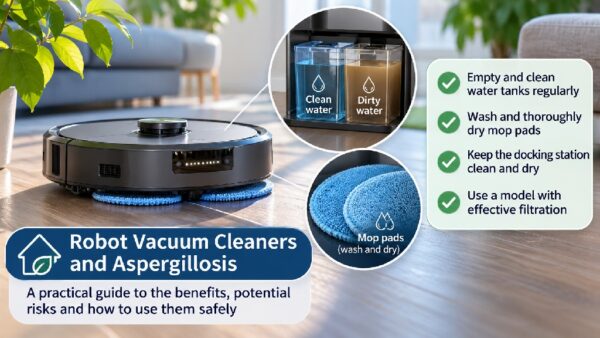
Robot vacuum cleaners can make household cleaning much easier, especially for people living with fatigue or breathlessness. But models that also wash floors use water — could they encourage mould growth and increase exposure to fungal spores?
At a recent National Aspergillosis Centre patient meeting, a discussion about robot vacuum cleaners raised an interesting question.
Modern robot cleaners do much more than vacuum. Some mop floors, wash their own cleaning pads, collect dirty water and dry their equipment automatically.
These features can make cleaning much less physically demanding. However, they also introduce something that fungi need to grow: moisture.
So should people with aspergillosis be concerned?
Robot vacuum cleaners may offer real benefits
For people with chronic respiratory disease, ordinary household cleaning can be tiring.
Vacuuming, bending, moving furniture and mopping floors may provoke coughing or breathlessness. A robot cleaner can reduce some of this physical work.
Regular removal of settled dust may also be useful, since household dust can contain fungal spores, allergens and other particles.
However, vacuum cleaners vary in how effectively they capture fine particles. A well-sealed machine with effective filtration is preferable to one that allows collected dust to escape through its exhaust.
Robot cleaners also cannot reach every area, so they do not eliminate the need for other cleaning.
Why might a robot mop encourage mould growth?
Fungal spores are naturally present in household dust and indoor air.
Most do not begin growing simply because they are present. They need suitable conditions, particularly moisture and a source of nutrients.
Robot cleaners that mop floors may contain several places where these conditions develop:
- Dirty-water tanks: Water collected from floors may contain dust, skin cells, food residues and other organic material.
- Mop pads: Damp fabric can retain dirt and moisture after cleaning.
- Docking stations: Water may accumulate in washing trays, drainage channels and other hidden compartments.
- Dust containers: If dust becomes wet, it may provide a suitable environment for microbial growth.
The problem is not the brief use of water to clean a floor. It is moisture remaining inside the equipment for prolonged periods.
Some manufacturers specifically warn that stagnant water and damp cleaning pads can encourage mould or bacterial growth.
Does this mean the machine will spread Aspergillus spores?
Not necessarily.
There is an important difference between a machine having conditions suitable for mould growth and actually increasing someone’s exposure to airborne Aspergillus spores.
If mould develops inside a dirty-water tank or cleaning pad, disturbing contaminated material could potentially release fungal particles.
However, there is currently insufficient direct evidence to conclude that properly maintained robot mop-vacuums increase airborne Aspergillus exposure or cause aspergillosis.
The type of microorganism growing inside a poorly maintained machine may also vary. Bacteria, yeasts and other fungi can all be involved.
A musty smell suggests that cleaning and maintenance are needed, but does not establish that Aspergillus is present.
The sensible approach is therefore precautionary maintenance, rather than avoiding these machines altogether.
What about the water left on floors?
Most robot mops use relatively small amounts of water, particularly on hard flooring.
If the floor dries promptly, fungal growth is unlikely to be encouraged simply by mopping.
However, problems may arise if water accumulates:
- Under furniture or appliances.
- Along skirting boards.
- In flooring joints or damaged seals.
- Beneath rugs or mats.
- On surfaces unsuitable for wet cleaning.
Repeatedly wetting an area that cannot dry properly may eventually create favourable conditions for mould.
The general principle is to avoid persistent dampness, whether cleaning is done manually or by a robot.
What should I look for when choosing a robot cleaner?
For someone with aspergillosis, useful features may include:
Effective filtration: Look for good fine-particle filtration and a well-sealed dust collection system. A HEPA-labelled filter alone does not guarantee that the complete machine prevents dust leakage.
Automatic mop drying: Some docking stations use warm air to dry pads after washing. This may reduce the time they remain damp.
Removable water tanks: Tanks that are easy to empty, wash and dry are preferable to inaccessible compartments.
Accessible cleaning trays: Hidden areas that collect dirty water should be easy to inspect and clean.
Straightforward maintenance: A complicated machine that is difficult to clean may not be the best choice, regardless of how many automatic features it offers.
Self-cleaning features are helpful, but they do not make a machine maintenance-free.
How can I reduce the risk of mould growing inside my robot cleaner?
A few practical habits can make a substantial difference.
After wet cleaning
- Empty dirty-water tanks promptly, ideally after each cleaning session.
- Rinse tanks and remove visible debris according to the manufacturer’s instructions.
- Wash reusable mop pads and ensure they dry thoroughly.
- Check that automatic drying cycles have completed successfully.
- Wipe away water collecting in docking-station trays or compartments.
Regularly
- Inspect the machine for visible mould, persistent dampness or unpleasant odours.
- Clean filters, brushes and dust containers according to the manufacturer’s instructions.
- Replace worn or persistently contaminated pads.
- Check that cleaned floors are drying properly.
- Follow the manufacturer’s recommendations for cleaning products; unsuitable chemicals can damage the machine or create irritating fumes.
Do not assume that a self-cleaning docking station never needs cleaning.
What if I discover mould inside the machine?
If you notice visible mould or persistent musty odours, stop using the wet-cleaning function until the problem has been addressed.
Where possible, ask someone who does not have significant respiratory vulnerability to clean or replace contaminated components.
Avoid dry brushing or shaking visibly mouldy material indoors, as this may disperse particles.
Wash removable hard surfaces as instructed by the manufacturer, dry them thoroughly and replace porous components that cannot be cleaned adequately.
Do not mix cleaning chemicals or add disinfectants to the machine unless the manufacturer specifically permits them.
If contamination is extensive or repeatedly returns, replacing affected components — or the appliance itself — may be more sensible than repeated cleaning.
Are traditional vacuum cleaners safer?
Not automatically.
Conventional vacuum cleaners can also release dust if their filters are ineffective, seals are poor or containers are emptied carelessly.
Bagless vacuum cleaners may expose users to a cloud of collected dust during emptying.
Robot cleaners may reduce direct exposure during routine cleaning, particularly if they operate while the user is elsewhere.
However, emptying their dust containers and maintaining their filters still require care.
For people who are particularly vulnerable to fungal exposure, having another household member empty and maintain the cleaner may be helpful.
Should people with aspergillosis avoid robot mops?
There is no good evidence supporting a general recommendation to avoid them.
For many patients, the reduction in physical effort may be valuable.
The main considerations are whether the appliance captures dust effectively, dries its wet components and can be maintained without creating unnecessary exposure.
People with severe immune suppression or other particular clinical vulnerabilities may need more individualised advice from their clinical team.
For most households, a well-maintained robot cleaner is likely to be more useful than a poorly maintained one, regardless of whether it has a mopping function.
The important message
Water-based robot cleaning is not inherently dangerous for people with aspergillosis.
The potential problem is allowing dirty water, damp pads and organic debris to remain inside the machine long enough for microorganisms to grow.
Good filtration, regular maintenance and thorough drying can help reduce avoidable exposure.
And importantly, robot cleaners can reduce the physical burden of household cleaning — something that matters to people living with chronic lung disease.
The aim is not to make the home completely free of fungal spores, which is impossible.
It is to reduce unnecessary exposure while making everyday life easier.
Further reading
- US Environmental Protection Agency: A Brief Guide to Mold, Moisture and Your Home
- Xiaomi: Why a Robot Vacuum’s Water Tank May Develop an Odour
- iRobot: Roomba Combo Care and Maintenance
This article provides general household guidance for people living with aspergillosis. Individual precautions may differ for people with significant immune suppression or other respiratory vulnerabilities.
Prepared following a discussion at a National Aspergillosis Centre patient meeting.

Did this page help you?
Tell us in one minute