
Updated October 2026
Have you ever attended a hospital appointment only to discover that the doctor cannot see your latest test results, medication changes or letters from another hospital?
For people living with long-term conditions such as aspergillosis, this can be especially frustrating. You may receive care from your GP, local hospital, specialist centre and community services, but each organisation may hold different parts of your medical history.
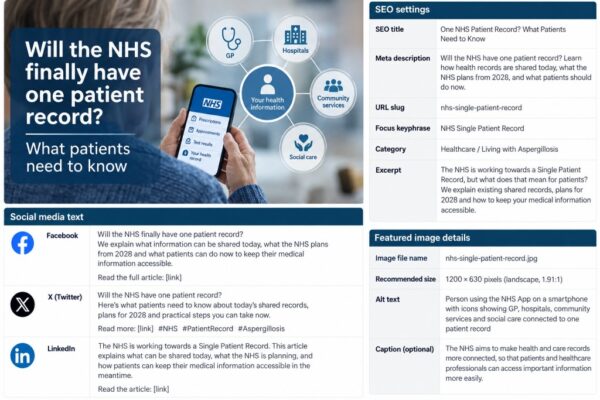
The NHS in England is working towards better-connected health records. Its long-term ambition is a Single Patient Record that helps healthcare professionals and patients access important information more easily.
But how close are we, and what does this mean for patients today?
Why are NHS medical records still separate?
Different NHS organisations have developed their own electronic record systems over many years. GP practices, hospitals, community services, mental health teams and social care providers may therefore record information in different places.
These systems can share some information, but they do not always communicate fully with one another.
This can mean:
- Patients having to explain their medical history repeatedly.
- Clinicians not immediately seeing recent test results or medication changes.
- Hospital letters taking time to reach other services.
- Tests occasionally being repeated because previous results are unavailable.
- Patients having to help coordinate information between different specialists.
For someone receiving long-term antifungal treatment, incomplete medication information can be particularly important because some antifungal medicines interact with other prescribed drugs.
What information can NHS staff already share?
1. Summary Care Record
In England, the Summary Care Record (SCR) provides authorised healthcare professionals with important information drawn from GP records.
This includes current medications, allergies and previous adverse reactions to medicines. Additional medical information may also be available.
It is particularly useful when someone needs care outside their usual GP practice, including urgent or emergency treatment.
However, the Summary Care Record is not a complete medical record. For example, it may not contain every medication prescribed by a hospital specialist or every investigation performed elsewhere.
2. Regional Shared Care Records
Many parts of England now use regional Shared Care Records, which bring together selected information from different health and care organisations.
Depending on the local system, healthcare professionals may be able to see:
- Current medications and allergies.
- Diagnoses and significant medical history.
- Recent blood tests and other investigation results.
- Hospital admissions and discharge information.
- Care plans and relevant community or social care information.
These records are developed locally, so the information available varies between regions and organisations. Some systems can share information across neighbouring areas, while others remain more limited.
Important: Having a Shared Care Record does not mean that every NHS professional can automatically see every part of your medical history.
3. Hospital electronic patient records
Many hospitals use comprehensive electronic patient record systems, including systems such as Epic.
These can make information easier to share within a hospital organisation and, where suitable arrangements exist, with other healthcare providers.
However, using the same software does not automatically guarantee that two hospitals can access one another’s records. Technical connections, organisational agreements, permissions and information governance arrangements are also necessary.
What is the NHS Single Patient Record?
The NHS in England is developing a Single Patient Record (SPR) as part of its long-term plans to improve healthcare.
The intention is to bring relevant information from different healthcare organisations together so that patients and authorised professionals can access it more easily.
This does not necessarily mean replacing every existing hospital and GP computer system with one enormous database. The central aim is to make information held in different systems available in a more connected and consistent way.
If implemented successfully, it could help healthcare professionals make better-informed decisions, reduce unnecessary duplication and improve coordination between services.
When will the Single Patient Record be available?
Under the government’s 10 Year Health Plan for England, the ambition is for people to begin accessing Single Patient Record information through the NHS App from 2028.
That is a planned starting point, not a promise that every patient’s complete medical history will be available nationally in 2028.
Implementation will take time. The information available will depend on how different NHS systems are connected, the progress of national and local programmes, and the safeguards needed to protect patient information.
There is therefore no reliable date on which every NHS organisation can be expected to have immediate access to every patient’s complete record.
Will patients be able to see their own records?
Patients can already use the NHS App for a growing range of services, including viewing certain GP health record information, prescriptions, appointments and test results where available.
What you can see depends on the services you use and how information is made available.
The Single Patient Record is intended to extend this access over time, helping people see more of their information in one place.
Better patient access could make it easier to check medication lists, understand treatment decisions and prepare for appointments.
Will my information be kept secure?
Medical records contain sensitive personal information. Any system that connects records must protect confidentiality and ensure that information is only accessed for legitimate purposes.
Existing Shared Care Records use access controls, information governance arrangements and audit mechanisms. Healthcare staff should only access information relevant to their responsibilities.
The proposed Single Patient Record will also require appropriate privacy and security safeguards.
Patients should be given clear information about how their data is used, who can access it and what choices or rights they have.
What does this mean for people with aspergillosis?
People with chronic pulmonary aspergillosis, allergic bronchopulmonary aspergillosis (ABPA) and other complex respiratory conditions may receive care from several different services.
For example, a patient may have:
- A GP who manages routine prescriptions.
- A local respiratory consultant.
- A specialist aspergillosis service providing treatment advice.
- Hospital pharmacy teams monitoring antifungal interactions.
- Community nurses, physiotherapists or other professionals providing support.
Better-connected records could help these professionals work together more effectively.
It may become easier to share antifungal treatment plans, monitoring results, CT scan reports and information about adverse drug reactions.
However, until these systems are reliably connected, patients may still need to help ensure that important information reaches everyone involved in their care.
What can patients do now?
While the NHS works towards more connected records, there are practical steps you can take to reduce the risk of missing information.
- Keep an up-to-date medication list. Include prescribed medicines, inhalers, antifungal treatments and any relevant non-prescription products.
- Record allergies and serious adverse reactions. Make sure healthcare professionals know about them.
- Keep important clinic letters. These can be useful when attending a different hospital or specialist.
- Use the NHS App where available. Check what information you can access and whether anything important appears incorrect.
- Ask whether your records are shared. Your GP or hospital may be able to explain which regional systems they use.
- Check that medication changes are communicated. This is particularly important when hospital specialists prescribe medicines that interact with other treatments.
- Keep a short health summary. A brief record of your diagnoses, current treatments and specialist contacts can be valuable in an emergency.
Will patients eventually stop repeating their medical history?
That is one of the important ambitions behind better-connected NHS records.
But even with improved technology, clinicians will still need to ask questions, confirm details and listen to patients. Medical records can be incomplete, out of date or interpreted differently.
The goal should not be to remove conversations with patients. It should be to make those conversations more useful by ensuring that important information is already available.
Key points
- The NHS already shares some information through Summary Care Records and regional Shared Care Records.
- These systems are useful but do not yet provide a complete, universally accessible medical history.
- The NHS in England is developing a Single Patient Record to improve access to relevant information.
- The ambition is for patients to begin accessing this through the NHS App from 2028, with further development over time.
- Patients should continue keeping their own medication lists and important medical information while systems become better connected.
Further information
- NHS England: The Single Patient Record
- NHS England: Shared Care Records
- NHS England: Summary Care Record
- NHS App
This article describes developments in NHS England. Record-sharing arrangements and digital health programmes may differ in Scotland, Wales and Northern Ireland.

Did this page help you?
Tell us in one minute